🦶 CRYPTID SIGHTING · EXP. Nº6501
ACTIVE
Kongamato
The kongamato reaches us through one book, one chapter and one afternoon.
Where and when was Kongamato sighted?
- Location
- Zambia
- Date sighted
- Unknown
- Coordinates
- -12.5, 27.8
- Last updated
LOCATION
What is Kongamato?
In 1923 Frank H. Melland, magistrate of the Kasempa District of Northern Rhodesia, published In Witch-Bound Africa, and in chapter XIX he described a charm the Kaonde carried when fording a river and the thing it was meant to keep off: something that dammed the water below the crossing and drowned the traveller. Asked what a kongamato was, his informants said "a bird", then corrected themselves - "more like a lizard with membranous wings like a bat" - four to seven feet across, red, featherless, with teeth in its beak, though nobody, they said, had ever seen one close and lived. Melland then fetched two illustrated books from his house, and a Jiundu headman named Kanyinga picked out the pterodactyl. That picture, shown by a colonial magistrate to a room of people at once, is the foundation of a century of pterosaur talk. Melland put a question mark in front of his own translation of the name, printed the sceptics' answer to the one killing attributed to it, and retracted a second-hand story in a footnote. Almost none of that survived the retelling.
What is the history of Kongamato?
The kongamato does not come to us from a swamp. It comes from one book, one chapter and one afternoon, and all three can be read in full.
The man who wrote it down. Frank Hulme Melland (1879-1939) was Magistrate for the Kasempa District of Northern Rhodesia from 1911 to 1922 — the extreme north-west of the territory, with Katanga on its northern border and Angola on its western one. He was also a Fellow of the Royal Anthropological Institute, of the Royal Geographical Society and of the Zoological Society, and had been awarded the Cuthbert Peek Grant by the R.G.S. in 1922. His book, In Witch-Bound Africa: An Account of the Primitive Kaonde Tribe and Their Beliefs, was published in 1923 by J. B. Lippincott in Philadelphia and by Seeley, Service & Co. in London, with 47 illustrations and three maps. The kongamato has chapter XIX to itself, pages 237 to 242.
Melland understood the problem with his own position and printed it in his preface: "my official position, while bringing me into close touch with some aspects of native life, has also been somewhat of a handicap. There is a natural tendency among the natives to feel that the knowledge they impart to a magistrate may bring someone into trouble, or may even be used against the informant." The dedication speaks of "the natives committed to my charge". Everything that follows was collected by a judge from people who could be judged by him.
It arrived as a charm. The kongamato enters the book on page 236, in the middle of a list of talismans, under the heading "Accidents by River". The muchi wa kongamato is a river-crossing charm: part of the root of the mulendi tree is ground with water into a bark cup, more of the root is cut into strips and tied into a bundle carried in the canoe or when fording on foot, and "when the kongamato comes the bundle is dipped in the medicine and the water is sprinkled therewith, which keeps off the kongamato and his flood." The danger being warded off is a flood. The creature, Melland was told, "lives downstream of the ford, and has the power of stopping the waters from flowing away, thus causing a sudden rise in the water level, and overwhelming the passenger."
The conversation. Melland asked what the thing was. He set the exchange down as dialogue: "'What is the kongamato?' The answer was, 'A bird.' 'What kind of bird?' 'Oh, well it isn't a bird really: it is more like a lizard with membranous wings like a bat.'" He adds at once: "I write this down verbatim because I was not in the least thinking of, nor seeking for, information as to any prehistoric animals or reptiles. It came on me quite unexpectedly."
Further questions produced what he himself put in quotation marks as "facts": a wing-spread of four to seven feet, a general colour of red, no feathers but only skin on the body, and teeth in the beak — with the caveat that "these last two points no one could be sure of, as no one ever saw a kongamato close and lived to tell the tale."
The picture. Then came the step that made the legend: "I sent for two books which I had at my house, containing pictures of pterodactyls, and every native present immediately and unhesitatingly picked it out and identified it as a kongamato." One of the people who did so has a name in the book and almost never anywhere else: Kanyinga, a headman from the Jiundu country. He is the man who made the identification that a century of writing has since attributed to "the natives". Melland's chapter is headed "THE KONGAMATO" with the standing subtitle "The Pterodactyl".
What his informants actually claimed. Melland is precise about the category, and the precision has been lost since: "The natives do not consider it to be an unnatural thing like a mulombe, only a very awful thing, like a man-eating lion or rogue elephant, but infinitely worse." A mulombe, defined elsewhere in the same book, is "a snake with a man's head, made by certain ng'anga's, that kills the people indicated to it by its owner" — a thing manufactured by witchcraft. The kongamato was not that. It was filed with dangerous animals.
The Jiundu. Melland describes some fifty square miles of swamp formed by an inland delta, the river splitting into innumerable channels and reuniting downstream as clear water, much of the inflow vanishing underground through limestone; big trees, matted creepers, moist loam. Until a few years before he wrote, it had sheltered hundreds of outlaws — murderers, thieves and tax defaulters — who shot at any uniform that came in sight; by the time of the book they had moved into villages along its edge and cut a corduroyed road through the swamp, passable "except in the rains". His chapter ends on a question: "Has the winged reptile got this swamp-forest all to himself; or is he, too, but a story that is told?"
How it left Zambia. In 1925 the Prince of Wales toured southern Africa, and the correspondent who travelled with him, G. Ward Price, met "Mr. F. H. Melland, the Magistrate at Broken Hill". Ward Price's Through South Africa with the Prince (Gill, 1926) devotes a page to the kongamato, and the page is where the drift starts.
Timeline: the documented record of Kongamato
- 1897 Chief Kapiji Mpanga Mwandwe later told Melland that when the prospector George Grey passed through, he understood from Grey's followers that Grey had at some earlier date shot a kongamato near Fort Jameson. Melland printed the story and disbelieved it in the same breath — 'I fancy Kapiji got hold of the wrong end of the story' — then added a footnote: he had since asked Charles Grey, 'and he says that he never heard his brother mention this'. It is the only claimed killing of one, and the man who published it also retracted it.
- 1911 The most recent case Melland could collect: two men and two women said to have been killed by a kongamato in the Mutanda River near Lufumatunga village. He printed the objection alongside it — the river was in flood and there were no witnesses to the manner of death — and concluded that it was evidence of the belief 'and no more'. This is also the year he took up the magistracy of the Kasempa District, which he held until 1922.
- 1923 J. B. Lippincott (Philadelphia) and Seeley, Service & Co. (London) publish In Witch-Bound Africa. Chapter XIX, 'The Kongamato', pp. 237-242, gives the wing-spread as four to seven feet, the colour as red, the body as skin without feathers and the beak as toothed, and records the picture test in which a Jiundu headman named Kanyinga and everyone else present picked the pterodactyl out of two illustrated books Melland had sent for from his own house. The name is glossed '? overwhelmer of boats', question mark included. The book has 47 illustrations; not one of them shows the creature.
- 1925 The Prince of Wales tours southern Africa. The correspondent travelling with him meets 'Mr. F. H. Melland, the Magistrate at Broken Hill', by then transferred out of Kasempa.
- 1926 G. Ward Price publishes Through South Africa with the Prince (Gill, London). His page on the kongamato is the first retelling, and it already drifts: Melland's twenty-two years among Bantu peoples become 'twenty-five years' experience'; the two books he 'sent for' from his house become books he 'sent home for'; and Melland's careful 'I admit I have no faith in these powers; but I do believe that some such reptile exists' is quoted with the disclaimer removed. Ward Price does add one thing Melland did not write, that the books were shown 'to many natives at different times'.
- 26 March - 5 April 1957 A pterodactyl flap runs in the Rhodesia Herald (Salisbury) over eleven days, and the institutional rebuttal appears inside the same newspaper: 'Ape-Man in City Office More Likely Than Pterodactyl in S.R. Swamp - Museum Director' on 29 March, 'Pterodactyls Seen Near Northern Rhodesian River' on 2 April, and 'Museum Director Says There are No Flying Reptiles' on 5 April. The sightings of the 1950s that circulate today - an engineer named J. P. F. Brown in 1956, a man with a chest wound who drew his attacker in 1957 - reach us only through later cryptozoological compilations, and Shuker notes that in one version it was the sight of a picture of a pterodactyl that produced the identification.
- 1996 Dick Hobson gives the kongamato a chapter in Tales of Zambia (Zambia Society Trust, London), telling it as Kaonde belief from the North-Western Province and reporting that ornithologists in Zambia identified the likely source of the pterodactyl stories as the whale-headed or shoebill stork. His source note for the chapter lists a single work: Melland's book.
- 1998 The Historical Dictionary of Zambia (Scarecrow Press) files the kongamato as 'a pterodactyl-like creature of Kaonde legend' and attributes it to sightings of 'an out-of-range whale-headed or shoe-billed stork'. The reference literature, unlike the popular literature, gets both the language and the range caveat right.
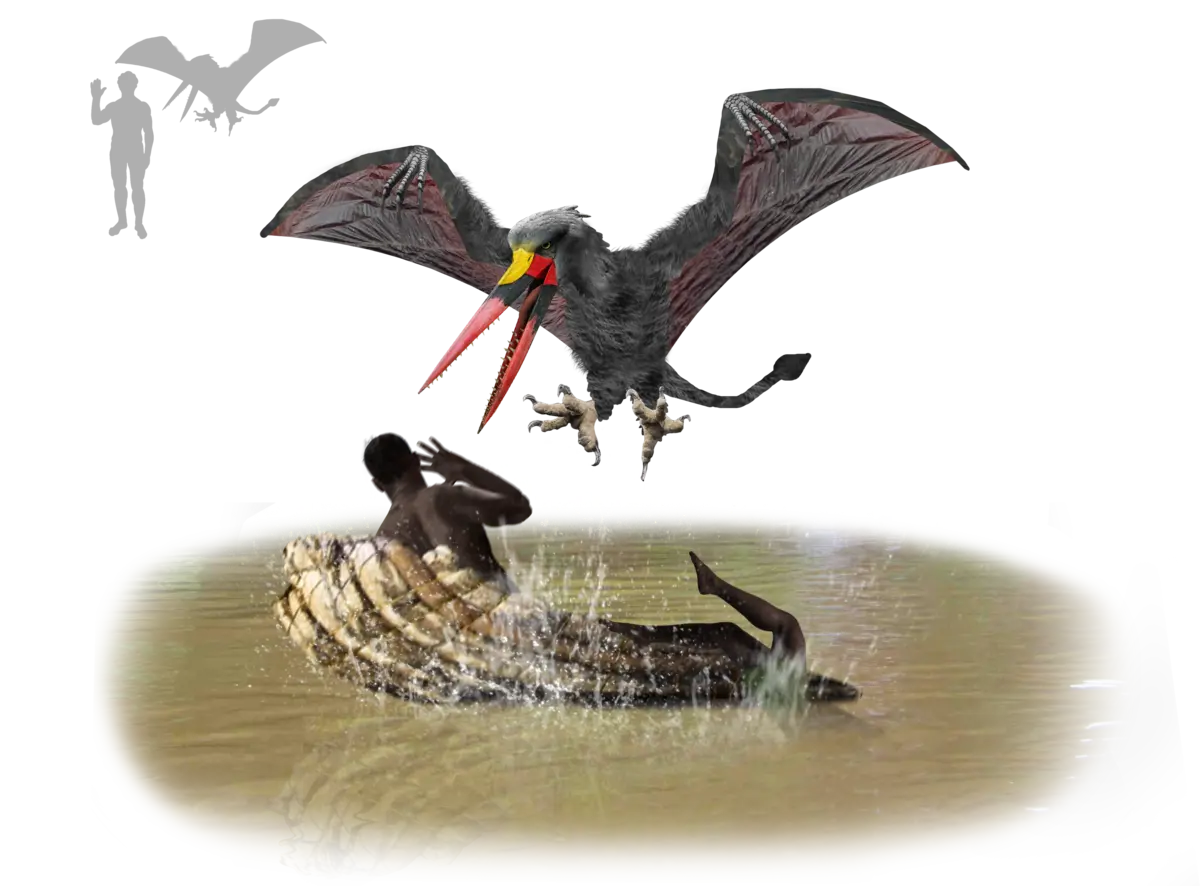
- 6 May 2017 Tim Bertelink uploads a digital painting to Wikimedia Commons under the title File:Kongamato.png, captioned by its author 'Artist's impression of the Kongamato' and licensed CC BY-SA 4.0. It is the image most searches now return for the word, and it is a modern reconstruction, not a document.
- 11 October 2024 Frank Willems records the call of Hypsignathus monstrosus, the hammer-headed fruit bat and the largest bat in Africa, at Kanjimana in Ikelenge District, North-Western Province - 10.9526 South, 24.0834 East, some 94 km from Mwinilunga town. The recording is archived with audio as xeno-canto XC940650 and reaches GBIF through the xeno-canto Chiroptera dataset. It is one of only three georeferenced Zambian records of the species in GBIF, and all three are from this same corner of the country.
Is there a rational explanation for Kongamato?
Every identification in this file was made from a picture. That is the single fact that organises the whole case. In 1923 Melland asked what the kongamato was, got an answer with membranous wings in it, and then fetched two illustrated books "which I had at my house, containing pictures of pterodactyls". His chapter already carried the subtitle "The Pterodactyl". The people in the room answered together, in front of the district magistrate, none of them separately, none of them blind to what he was hoping for. The only control he ran was to note that "they said they could not identify any other of the prehistoric monsters which I showed them" — a control run in the same session, on the same group, by the same interested party. And the pattern repeats: in the 1957 flap, Karl Shuker records that in one telling "the man's terror at seeing the picture of a pterodactyl created the link" and in the Northern Rhodesian version "the man sketched a pterodactyl-like beast". Every identification recorded by Melland or by Shuker went through an image: a picture shown to the witness, or one the witness drew.
Melland was more sceptical than the authors who retold him. He glossed the name as "(? overwhelmer of boats)" — with the question mark. He recorded the only killing ever attributed to the animal, four people in the Mutanda River near Lufumatunga village in 1911, and printed the rebuttal in the same paragraph: "Sceptics point out that when the said people were killed the river was naturally in flood, and that there were no witnesses as to the manner of death. I think this may be taken as evidence in the belief of the powers of the kongamato and no more. I admit I have no faith in these powers." He repeated a second-hand story that George Grey had shot one, said in the text that he suspected the chief had "got hold of the wrong end of the story", and then added a footnote retracting it: he had asked Charles Grey, "and he says that he never heard his brother mention this." Of a list of extra attributes sent to him after he had left the district by his colleague C. H. Hazell, he wrote that they were "probably due to the fertile imagination of some frightened traveller". None of that scepticism survived the retelling.
The question mark has been deleted from the translation, and that is checkable. A full-text sweep of the digitised books that mention the kongamato returns 139 titles; twenty-nine of them contain the phrase "overwhelmer of boats". In only three does the question mark survive: the 1923 and 1967 printings of Melland himself, and Roy Mackal's Searching for Hidden Animals (1980), which reproduces the paragraph verbatim. Everywhere else — popular encyclopaedias, children's cryptid books, paranormal compendia — it is stated flatly as the meaning of the word. Melland was not sure what the name meant. The literature is.
And the language is wrong. In Witch-Bound Africa is a book about the Kaonde of the Kasempa District, and the word "Bemba" does not occur in it once. The reference works follow Melland: the Historical Dictionary of Zambia files the kongamato as "a pterodactyl-like creature of Kaonde legend". Kaonde and Bemba are two different Zambian languages spoken at opposite ends of the country. A search of the same 139-book corpus for the kongamato alongside Bemba returns nine titles, and in every one of them the two words are simply on the same page by accident: national language lists, an index, a novel. There is no source that attributes the name to Bemba.
The standard zoological explanation is in the wrong half of the country. Almost every retelling offers the shoebill, Balaeniceps rex, as the animal behind the stories, and the reference literature places the Zambian population in the Bangweulu swamp of north-eastern Zambia. Queried on 4 October 2026, the Global Biodiversity Information Facility holds 83 georeferenced Zambian records of the shoebill. All of them lie between 29.87° and 31.99° East. The Jiundu is at roughly 24.3° East: the nearest shoebill record is about 600 km away. In the box that contains Mwinilunga and Ikelenge — latitude 10.5° to 13° South, longitude 23.5° to 25.5° East — GBIF holds 40,704 bird records and zero shoebills. That zero is not an artefact of nobody looking: the controls in the same box are the hamerkop, Scopus umbretta, with 80 records, and the saddle-billed stork, Ephippiorhynchus senegalensis, with one. John J. Grotpeter's dictionary was careful enough to call its own suggestion "an out-of-range whale-headed or shoe-billed stork", and it was right to.
The animal that is documented there is the one nobody put in the picture book. The hammer-headed fruit bat, Hypsignathus monstrosus, is the largest bat in Africa: males have a wingspan of 686 to 970 mm, an enlarged rostrum and larynx, and males call at their display grounds with loud honking and croaking; it lives in riverine forest and swamp. Melland's informants gave four to seven feet, 1.2 to 2.1 m, so the bat reaches the bottom of that range and no further. On 11 October 2024 Frank Willems recorded the call of Hypsignathus monstrosus at Kanjimana, in Ikelenge District, North-Western Province — 94 km from Mwinilunga town, in the same corner of Zambia where Melland collected the belief. The recording is archived, with audio, as xeno-canto XC940650. The match stops there. Animal Diversity Web describes a slate-brown coat with dark brown wing membranes, where Melland's informants said red, and the bat has a muzzle where they described a toothed beak. What the record does show is that the candidate with a documented presence, a leathery featherless wing and an unearthly voice was never in the two books Melland fetched from his house.
What the belief was actually about is a flooded ford. The charm is a river-crossing charm; the creature stops the water flowing away and raises the level; the one recorded death was in a river in flood. Drowning at a swollen crossing is a real, recurrent and lethal danger in that country, and Melland himself said the 1911 case was evidence of the belief and nothing else.
Dated negations, as of August 2026. No specimen, bone, photograph, film or sound recording attributable to the kongamato is known. The image that dominates search results is not evidence either: it is a digital painting uploaded to Wikimedia Commons in May 2017 by Tim Bertelink, captioned by its own author "Artist's impression of the Kongamato".
Can you visit Kongamato?
The swamp. The kongamato has no site of its own; what the sources give is a place, the Jiundu swamp. Frank Melland, magistrate of Kasempa District, described it in 1923 as "some fifty square miles of swamp, formed by an inland delta", where the Jiundu River spreads into innumerable channels under "big trees that grow to a great height". He added that the outlaws who had used it as a refuge now lived in villages alongside, and had cut a road through it "by which one can now pass in comfort — except in the rains". Karl Shuker (1995) places the Jiundu in what is now Mwinilunga District, in Zambia's North-Western Province, in the strip of country that runs north between Angola and the Democratic Republic of the Congo. On 24 September 2026 a search of OpenStreetMap's place names for "Jiundu" within Zambia returned nothing, while the same search found Mwinilunga, Ikelenge and Solwezi.
The nearest mapped places. OpenStreetMap puts Mwinilunga town at 11.7315° S, 24.4260° E and Ikelenge at 11.2401° S, 24.2711° E. Measured between those points, Mwinilunga lies 220 km west-north-west of Solwezi, the provincial capital, in a straight line, and Ikelenge lies 57 km north-north-west of Mwinilunga.
The seasons. Melland's calendar of the Kaonde year, compiled, as he says, largely from notes by C.H.H., gives November as the month to start sowing and December as the month of heavy rains. January is still rain, with the old food finished, and in March the rivers are full.
The source of the Zambezi. Melland wrote that "the Zambezi itself rises in a wooded dip, containing several small springs". OpenStreetMap maps the Source of the Zambezi River as a spring at 11.3694° S, 24.3084° E, in Ikelenge District, beside road RD280. West Lunga National Park is mapped further south, in Mwinilunga District, around 12.81° S, 24.80° E.
What the Kaonde told Melland, and what has been recorded there since. His informants did not class the kongamato with the mulombe as an unnatural thing; they spoke of it as "a very awful thing, like a man-eating lion or rogue elephant, but infinitely worse", and said that "no one ever saw a kongamato close and lived to tell the tale". The large flying animal on record from this corner of Zambia is a bat. GBIF holds three Zambian records of the hammer-headed bat, all made by Frank Willems at Kanjimana, in Ikelenge District, on 11 October 2024, two of them with sound recordings archived at xeno-canto (XC940587 and XC940650). The Animal Diversity Web calls it the largest bat found in Africa, with a male wingspan of 686 to 970 mm.
Sources consulted
- Frank H. Melland, «In Witch-Bound Africa: An Account of the Primitive Kaonde Tribe and Their Beliefs - chapter XIX, 'The Kongamato' (pp. 237-242), plus the muchi wa kongamato charm at p. 236 and the author's own statement of the magistrate problem in the preface. The primary source for everything: the four-to-seven-foot wing-spread, the red colour, the toothed beak nobody could confirm, the two illustrated books fetched from his house, the headman Kanyinga, the 1911 Mutanda deaths with the sceptics' reply, the George Grey footnote, and the '? overwhelmer of boats' gloss with the question mark. Read in full» — J. B. Lippincott, Philadelphia / Seeley, Service & Co., London, 1923 book
- G. Ward Price, «Through South Africa with the Prince - the page on the kongamato (chapter XX), written by the correspondent who met Melland in person at Broken Hill during the 1925 royal tour. The earliest retelling and the earliest drift. Read in full: a whole-book search returns 'kongamato' twice, 'Jiundu' once, 'pterodactyl' twice and 'Melland' three times, all in this single passage, against controls of 76 hits for 'Rhodesia' and 15 for 'wounded' - so the story of a man mauled in the Jiundu marshes who fled at the sight of a pterosaur picture, widely attributed to this book, is not in it» — The Gill Publishing Co., London, 1926 book
- Karl P. N. Shuker, «In Search of Prehistoric Survivors - section 'whale-heads with wings: unmasking the kongamato'. Quotes Melland verbatim, locates the Jiundu in Mwinilunga District, argues from habitat that the swamp-forest is wrong for a shoebill, and supplies the contemporary newspaper citations for the 1957 flap: Rhodesia Herald (Salisbury), 26 March, 29 March, 2 April and 5 April 1957, including the headline 'Museum Director Says There are No Flying Reptiles'. Consulted through Internet Archive full-text search in snippet view, not read in full» — Blandford, London (ISBN 0713724692), 1995 book
- John J. Grotpeter, «Historical Dictionary of Zambia, 2nd edition - entry KONGAMATO: 'A pterodactyl-like creature of Kaonde legend', attributed to sightings of 'an out-of-range whale-headed or shoe-billed stork', cross-referenced to CHIPEKWE. The reference work that gets the language and the range caveat right. Entry consulted through Internet Archive full-text search in snippet view» — Scarecrow Press, Lanham, Maryland, 1998 book
- Dick Hobson, «Tales of Zambia - chapter 61, 'The Legend of the Kongamato' (p. 140). A Zambian retelling that names the Kaonde of the North-Western Province, reports the shoebill explanation as coming from ornithologists in Zambia, and lists a single source for the chapter: Melland's book. Consulted through Internet Archive full-text search in snippet view» — Zambia Society Trust, London (ISBN 0952709252), 1996 book
- Global Biodiversity Information Facility, «GBIF occurrence records for Zambia, queried 11 August 2026 and again on 4 October 2026; figures below are from the second query (on 11 August the box held 38,654 Aves and 78 Scopus umbretta). Balaeniceps rex: 83 georeferenced Zambian records, all between 29.87 and 31.99 degrees East, nearest about 600 km from the Jiundu. In the box 10.5-13 South by 23.5-25.5 East, which contains Mwinilunga and Ikelenge: 40,704 Aves records, 0 Balaeniceps rex, 80 Scopus umbretta, 1 Ephippiorhynchus senegalensis. Hypsignathus monstrosus: 3 georeferenced Zambian records, all from Kanjimana, Ikelenge District, October 2024, recorded by Frank Willems, one of them archived with audio as xeno-canto XC940650» — GBIF Secretariat, Copenhagen (occurrence search API), 2026 archive
- University of Michigan Museum of Zoology, «Hypsignathus monstrosus, Animal Diversity Web species account: male wingspan 686-970 mm, males 228-450 g, enlarged rostrum and larynx, lek display of guttural honking and croaking, habitat riverine forest, swamp, mangrove and palm forest below 1,800 m, range from Senegal to northern Angola. Used for the size, colour ("The pelage is slate-brown"; face and wing membranes dark brown) and voice of the hammer-headed bat. Also consulted: the Balaeniceps rex account, which places the Zambian shoebill population in the Bangweulu swamp of north-eastern Zambia» — Animal Diversity Web, 2026 web
- Internet Archive / Open Library, «Full-text search of digitised books mentioning the kongamato, run 11 August 2026 across the Internet Archive book corpus. 139 distinct titles contain the word; 29 contain the phrase 'overwhelmer of boats'; the question mark that Melland put in front of his own translation survives in only three - the 1923 and 1967 printings of Melland and Roy Mackal's Searching for Hidden Animals (1980), p. 330. Searching for the kongamato alongside 'Bemba' returns 9 titles, in none of which the two words are connected» — search-inside index, 2026 archive
- Tim Bertelink (User:Triangulum), «File:Kongamato.png - digital painting uploaded 6 May 2017, described by its author as 'Artist's impression of the Kongamato', categorised as a self-published work under 'Flying cryptids', licensed CC BY-SA 4.0. The image used on this page and the one most searches return; a modern reconstruction, not a historical document» — Wikimedia Commons, 2017 web
Reviewed by V. Serrano on 2026-08-11 · How we verify our content
📎 Source: Enigma Atlas
💬 Field testimonies (0)
No testimonies yet. Add the first.
Add your testimony
🔒 Log in to add a testimony