👻 HAUNTED PLACE · EXP. Nº1189
ACTIVE
Changi Hospital
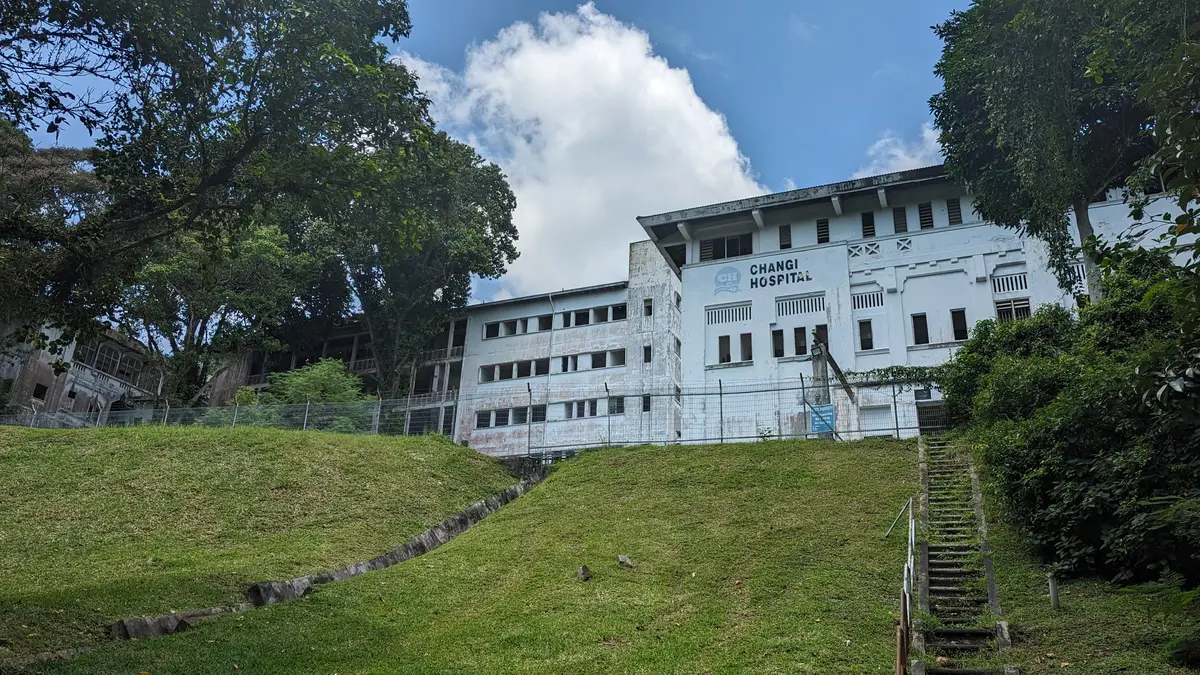
Old Changi Hospital stands empty on a hilltop at 24 Halton Road, above Changi Village in eastern Singapore.
Where is Changi Hospital?
- Location
- Changi, Singapore, Singapore
- Type
- Hospital / asylum
- Coordinates
- 1.391, 103.981
- Last updated
LOCATION
Why is Changi Hospital said to be haunted?
It is routinely called the country's most haunted building, on the strength of a story that the Japanese used it as a torture centre during the occupation of 1942-45. The documents do not support it. The National Heritage Board dates the hilltop building to 1962, seventeen years after the Japanese surrender; the wider Changi cantonment, built between 1927 and 1937, did become a prisoner-of-war camp, but the POW hospital was moved in 1942 to Roberts Barracks, where Stanley Warren painted the Changi Murals, and the Kempeitai's documented premises in Singapore were all in town, none in Changi. The site was a British military hospital run by the Royal Air Force from 1946, renamed ANZUK Hospital in 1971 and UK Military Hospital in 1975, and became the civilian Changi Hospital under the Ministry of Health in 1976. It closed in 1997, when Changi Hospital and Toa Payoh Hospital were merged into the purpose-built Changi General Hospital at Simei. Interviewed by The Straits Times in 2021, heritage author Jerome Lim said the ghost stories were likely unfounded and became popular only after the hospital closed. The buildings are State property, fenced and closed: entry is not permitted and unauthorised acts on State land are an arrestable offence.
What is the history of Changi Hospital?
The legend of Old Changi Hospital is usually told as a single sentence: a British hospital that the Japanese turned into a torture centre. Almost every part of that sentence belongs somewhere else. Changi was never one place. It was a whole military district, and the reason the story works is that the district's separate buildings — and their separate horrors — have been quietly collapsed into the one that photographs best.
The National Heritage Board dates the Changi Cantonment to 1927-1937: a British base built to guard the eastern end of the Johor Strait and the naval base at Sembawang, garrisoned before the war by Royal Artillery and Royal Engineers units. A medical officer was on site from the beginning of construction. The historian Faizah bte Zakaria, writing for the National Library Board, records that a Major Champney arrived in 1928 and worked with the engineers on the drainage of the site against malarial mosquitoes — a piece of work written up in the Journal of the Royal Army Medical Corps in 1937. A Royal Army Medical Corps centre appears on the 1930 and 1937 maps reproduced in Probert's The History of Changi, at what is now Halton Road, and a hospital is referred to at the inquest into a sapper's death in 1930.
Faizah is careful in a way that later retellings are not. Work on the base was halted between 1929 and 1933, and the detailed accounts of the cantonment published in the Royal Engineers Journal in 1937 and 1938 do not mention the construction of any specific hospital facility. "These maps might only have been plans," she writes.
What happened next is the part that matters. Singapore fell on 15 February 1942 and the Changi cantonment became a prisoner-of-war camp. The small hospital on top of Barracks Hill was immediately overwhelmed — dysentery was widespread among the prisoners — and, in Faizah's words, "the hospital quickly moved to the nearby Roberts Barracks and remained there till 1944", when the last POWs were moved into Changi Prison to make way for a Japanese airfield.
So the POW hospital was at Roberts Barracks, not on Barracks Hill. We can be unusually precise about this, because one of the best-known objects in Singapore's war heritage was made there. Bombardier Stanley Warren was admitted to the dysentery wing of Roberts Barracks Hospital, in Block 151, in August 1942; between September 1942 and May 1943 he painted five biblical murals on the wall of St Luke's Chapel on the ground floor of that block. The Changi Murals survive today inside Changi Air Base (West) — a different site, several kilometres from the hospital on the hill.
The other two places routinely folded into the story are also elsewhere. The Selarang Barracks incident — some 15,000 POWs ordered onto a parade square on 1 September 1942 after refusing to sign a no-escape pledge — happened at Selarang. Changi Prison, built for 600 inmates, held civilian internees and then, from 1944, POWs in attap huts raised in its grounds. And the Kempeitai, the Japanese military police whose name is attached to the hospital in every retelling, had documented premises in Singapore: the National Library Board's account by Wong Heng places their headquarters and East District Branch at the Stamford Road YMCA under Lieutenant-Colonel Masayuki Oishi, their main jail at Outram, and branches in Chinatown, Oxley Road, the Central Police Station and a house at Smith Street and New Bridge Road. None of them is in Changi.
The hospital that people actually visit came after the war, not before it. The Royal Air Force took over Changi in 1946 — the Japanese had built the airfield with prisoner labour in 1943 — and RAF Hospital Changi was working by October 1947, when a baby was born there. It became the ANZUK Hospital in 1971, the UK Military Hospital in 1975, and was handed to Singapore in December 1975 as the SAF Hospital. In 1976 it passed to the Ministry of Health and was combined with the nearby Changi Chalet Hospital to make the 180-bed Changi Hospital: an upper block on Halton Road and a lower block on Turnhouse Road, 100 metres apart, ten minutes' walk up a steep flight of steps — a split that made the place hard to run.
The National Heritage Board gives the building on top of the hill, at 24 Halton Road, a completion date of 1962. In 1997 Changi Hospital was merged with Toa Payoh Hospital into the new Changi General Hospital at Simei, officially opened on 28 March 1998, and the Halton Road site was vacated. It has been empty ever since. The Singapore Land Authority rented it out short-term for filming — Growing Up, Incredible Tales, Crime Hunters — put it up for commercial lease in 2006 (won by Premium Pacific, a Bestway Properties subsidiary, for a spa resort that never happened, the site returning to the state in January 2010), tendered it again unsuccessfully in 2012, and in 2021 ran an open ideas competition with the Urban Redevelopment Authority. Nothing has yet been built.
Timeline: the documented record of Changi Hospital
- 1927-1937 The British build the Changi Cantonment to guard the eastern end of the Johor Strait and the naval base at Sembawang. Before the war it houses Royal Artillery and Royal Engineers units.
- 1928 A Major Champney becomes the first medical officer stationed at Changi, working with the engineers on drainage against malarial mosquitoes. Work on the base is then halted between 1929 and 1933.
- February 1942 Singapore falls and the cantonment becomes a POW camp. The small hospital on top of Barracks Hill is overwhelmed by dysentery and moves to Roberts Barracks, where it stays until 1944.
- 1 September 1942 The Selarang Barracks incident: some 15,000 prisoners of war are ordered onto the parade square at Selarang after refusing to sign a pledge not to escape. It happens at Selarang, not at the hospital.
- September 1942 - May 1943 Bombardier Stanley Warren, admitted in August 1942 to the dysentery wing of Roberts Barracks Hospital, paints five murals in St Luke's Chapel on the ground floor of Block 151. They locate the POW hospital precisely — and it is not the building on Barracks Hill.
- 1944 The last POWs are moved into Changi Prison, into attap huts raised in its grounds, to make way for the Japanese airfield built with prisoner labour.
- 1946 The Royal Air Force takes over Changi after the war because of the airfield the Japanese had built there in 1943.
- October 1947 RAF Hospital Changi is documented as working: a baby is born there that month. This is the first evidence of a fully functioning hospital on the site.
- 1962 The National Heritage Board dates the completion of the hilltop hospital building at 24 Halton Road — seventeen years after the Japanese surrender.
- 1976 After spells as ANZUK Hospital (1971), UK Military Hospital (1975) and SAF Hospital, the site passes to the Ministry of Health and merges with Changi Chalet Hospital as the 180-bed civilian Changi Hospital, split between Halton Road and Turnhouse Road.
- 1997 Changi Hospital is merged with Toa Payoh Hospital into the new Changi General Hospital at Simei, officially opened on 28 March 1998. The Halton Road premises are vacated and have been empty ever since.
- 2000 The earliest press coverage of ghost-hunting at the site cited by the National Library Board: a spook-hunting story in The Straits Times, three years after closure.
- January 2010 The spa-resort project awarded in 2006 to Premium Pacific, a Bestway Properties subsidiary, falls through and the site returns to the state. The same year the found-footage horror film Haunted Changi is shot on the premises.
- 15 April 2021 Launching the SLA and URA ideas competition, The Straits Times asks heritage author Jerome Lim about the ghost stories. He says they are likely unfounded and probably became popular only after 1997, that there are no records of hospital tortures, and that the POW hospital was at Roberts Barracks.
- 3 November 2021 "Ascending to the Sky", a proposal to turn the hospital into a stargazing observatory and aviation viewing deck, wins the open category of the Charmingly Changi competition. Nothing has yet been built.
- November 2022 The State Lands Protection Bill is introduced to replace an Act last reviewed in 1974. Unauthorised acts on State land become an arrestable offence punishable by a fine of up to S$50,000 or six months' imprisonment.
Is there a rational explanation for Changi Hospital?
The most useful thing anyone has said about this building was said out loud, in the national newspaper, by a heritage researcher answering a direct question.
When The Straits Times covered the 2021 ideas competition for the site, it asked the heritage author Jerome Lim about the rumours of paranormal sightings. The paper reported that "Mr Lim said that these were likely unfounded, and probably became popular only after the hospital ceased operations in 1997". On the wartime claims he was more specific still. While the eventual hospital building "did serve as a prisoner-of-war (POW) camp, it was only for a short period between February 1942 and May 1943"; "according to accounts, life was relatively more pleasant here for prisoners-of-war than it was elsewhere, and there were no records or accounts of hospital tortures, meaning the rumours are likely untrue"; and "in fact during the days of the POW camp, the POW hospital was at Roberts Barracks, a site which is within the current Changi Air Base (West)". The same article records that the buildings were used as a fully functioning hospital only "after World War II from 1947, when the British Royal Air Force took over the buildings at Changi Point".
The chronology is the hardest objection. The National Heritage Board dates the hilltop building at 24 Halton Road to 1962 — seventeen years after the Japanese surrender. Whatever pre-war fabric survives elsewhere on the site, the corridors that appear in every photograph, video and film of "the torture chambers" were built by a British air force in peacetime, for the families of servicemen.
The Kempeitai attribution fails on the documents. Their Singapore premises are catalogued — headquarters and East District Branch at the Stamford Road YMCA, the main jail at Outram, branches at Chinatown, Oxley Road, the Central Police Station and Smith Street. The National Heritage Board's historic-site marker for the Kempeitai East District Branch stands outside the YMCA at 1 Orchard Road, and it is there that the interrogations for which they were tried are recorded, including the 193 days of Elizabeth Choy's imprisonment. A military police force does not appear in the record in one place and operate secretly in another simply because a later ruin looks the part.
The reputation is younger than the ruin. The National Library Board's account notes that the closed building "quickly became a site for thrill seekers", and the earliest coverage it cites is a spook-hunting story in The Straits Times in 2000 — three years after closure, and fifty-five years after the occupation ended. What followed was a commercial loop: the Singapore Land Authority rented the empty wards to television productions, and in 2010 the found-footage horror film Haunted Changi was shot on the premises. The building was a film set for its own legend before most of the legend existed.
The fabric supplies the rest. The Urban Redevelopment Authority described the architecture as "high headroom, large roof overhangs and open verandas — typical of British military architecture adapted for the tropics". That is a building designed to be permanently open to the wind, standing unlit and unmaintained on an exposed hilltop since 1997, in a monsoon climate. Visitors arrive at night, in the dark, already knowing what they came to find.
One thing should not be softened. The scepticism here is about this building, not about what happened in Changi. Thousands of prisoners of war and civilian internees suffered and died across the district, and the record is real and accessible: the camp's own Annual Medical Report POW Camp Changi 2/42-2/43 survives in the Royal Army Medical Corps Muniments Collection at the Wellcome Collection, and Stanley Warren's murals are still on the wall at Roberts Barracks. Moving that suffering into a hospital block that was finished in 1962, because it makes a better ghost story, is not a harmless error.
Can you visit Changi Hospital?
Old Changi Hospital is closed and has no visitor access. The buildings at 24 Halton Road, Singapore 506997, on the hill above Changi Village, are State property in the care of the Singapore Land Authority. They are unmaintained and shut.
Unauthorised entry onto State land is a criminal matter in Singapore. Under the State Lands Protection Act 2022, section 5 makes it an offence to occupy State land without lawful authority, or to damage, enclose or interfere with it; section 5(2) makes that an arrestable offence. Section 6 sets the penalty at a fine not exceeding S$50,000 or imprisonment for up to 6 months, or both. Section 5(3) removes the obvious defence: the prosecution does not have to prove that the accused knew the land was State land. The Singapore Land Authority, introducing the Bill in November 2022, described it as a modernisation of protections last reviewed in 1974. The urban-exploration videos of the interior are a record of people taking that legal risk.
The exterior is another matter. The building stands on the hilltop off Halton Road and Netheravon Road and is a listed stop on the National Heritage Board's free Changi Heritage Trail, on its "War and Peace" route. That route is about 7.6 km long and takes roughly an hour and a half using public transport between stops; a companion guide and map are downloadable from the Board's Roots portal. The same route takes in Changi Prison, Changi Beach and Changi Village.
The collection is at the Changi Chapel and Museum, 1000 Upper Changi Road North, Singapore 507707. It opens Tuesday to Sunday from 9.30am to 5.30pm with last admission at 5pm, and closes on Mondays except public holidays. Admission is free for Singapore citizens and permanent residents; for tourists and foreign residents it is S$9 for adults, S$7 concession (seniors 60+, students, special access), free for children aged 6 and under, and S$27 for a family package of five with a maximum of three adults. Buses 2 and 29 stop at Changi Chapel Museum; bus 5 stops at Changi Women's Prison, ten minutes' walk away. By MRT the Downtown Line runs to Upper Changi (DT34), then bus 2 for seven stops. Parking is limited and charged at S$1.20 per hour from 6am to 5.59pm and S$3 per entry overnight. The museum covers the prisoners of war and civilian internees held in the Changi Prison camp and displays a replica of the Changi Murals.
The murals themselves remain where Stanley Warren painted them, in Block 151 at Changi Camp on Martlesham Road. That block sits inside an operational air base and is closed to the public. The Board states that the replica at the museum is the way to see them.
The camp's own Annual Medical Report POW Camp Changi 2/42-2/43, Part I (reference RAMC/1016/2, Royal Army Medical Corps Muniments Collection) has been digitised by the Wellcome Collection and can be read online free of charge.
Sources consulted
- Faizah bte Zakaria, «Old Changi Hospital» — Singapore Infopedia, National Library Board, 2026 web
- The Straits Times, «Ideas sought to repurpose Old Changi Hospital, rejuvenate surrounding Changi Point area» — The Straits Times, Singapore, 2021 newspaper archive
- Syarafana Shafeeq, «Spooky or romantic? Proposal to turn Old Changi Hospital into stargazing observatory wins competition» — AsiaOne / The Straits Times, 2021 newspaper archive
- Wong Heng, «Kempeitai» — Singapore Infopedia, National Library Board, 2026 web
- National Heritage Board, «Kempeitai East District Branch (historic site marker, 1 Orchard Road)» — Roots, roots.gov.sg, 2026 web
- National Heritage Board, «Former Changi Hospital, 24 Halton Road — Changi Heritage Trail landmark» — Roots, roots.gov.sg, 2026 web
- National Heritage Board, «Former Changi Cantonment and RAF Changi — Changi Heritage Trail landmark» — Roots, roots.gov.sg, 2026 web
- National Heritage Board, «Changi Murals, Block 151, Changi Camp (Martlesham Road)» — Roots, roots.gov.sg, 2026 web
- Royal Army Medical Corps, «Annual Medical Report POW Camp Changi 2/42-2/43, Part I (RAMC/1016/2, Royal Army Medical Corps Muniments Collection)» — Wellcome Collection, London, 1943 archive
- Parliament of Singapore, «State Lands Protection Act 2022, Part 2 (Improper use of State land), sections 5 and 6» — Singapore Statutes Online, Attorney-General's Chambers, 2022 report
- Singapore Land Authority, «New State Lands Protection Bill to replace the State Lands Encroachments Act (press release, 7 November 2022)» — sla.gov.sg, 2022 report
- Nor-Afidah Rahman and Phyllis Wee, «Changi General Hospital» — Singapore Infopedia, National Library Board, 2026 web
- National Heritage Board, «Changi Heritage Trail — War and Peace (route, companion guide and map)» — Roots, roots.gov.sg, 2026 web
- Changi Chapel and Museum, National Heritage Board, «Visitor Information — opening hours, admission and transport» — heritage.sg, 2026 web
- Vernon Cornelius-Takahama and Janice Loo, «Stanley Warren and the Changi Murals» — Singapore Infopedia, National Library Board, 2026 web
Reviewed by V. Serrano on 2026-08-01 · How we verify our content
💬 Field testimonies (0)
No testimonies yet. Add the first.
Add your testimony
🔒 Log in to add a testimony