👻 HAUNTED PLACE · EXP. Nº9475
ACTIVE
Grandmaster's Palace, Valletta
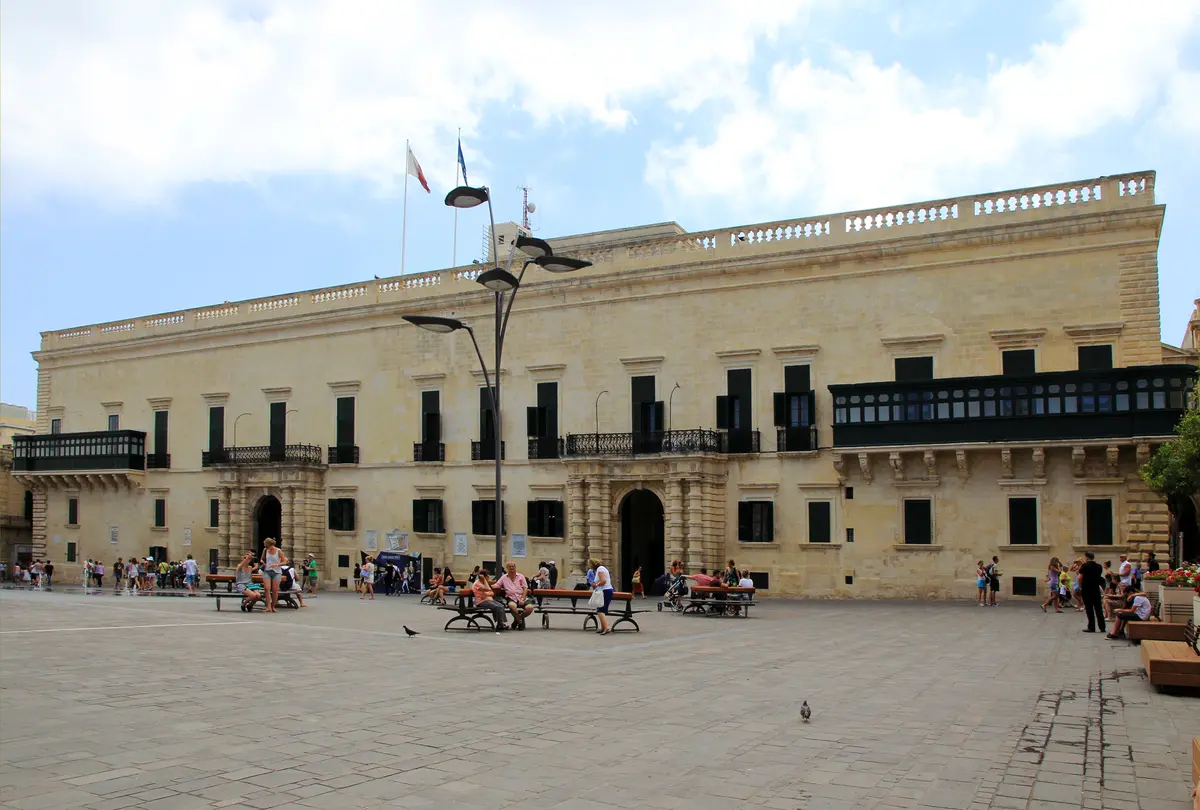
Begun in 1574 around the town house of the knight Eustachio del Monte and enlarged by the architect Girolamo Cassar, the Grandmaster's Palace has been the centre of Maltese power for four and a half centuries: seat of the Grand Masters of the Order of St John, then of the British governors, of Malta's parliament from 1921 to 2015, and of the Office of the President since 1974.
Where is Grandmaster's Palace, Valletta?
- Location
- Valletta, Malta
- Type
- Public building
- Coordinates
- 35.899, 14.514
- Last updated
LOCATION
Why is Grandmaster's Palace, Valletta said to be haunted?
Its one recorded ghost story is late and surprisingly modest. In The Ghosts of Malta (1983), Joseph Attard tells of an English lady, living in the palace in the governors' era, who repeatedly heard cats and dogs fighting in an empty room and once watched a large cat jump out of a window — while the workmen in the yard below insisted they had seen no animal at all. The witness has no name, the episode no date, and no earlier version of the tale has been traced. The palace itself needs no legend: restored for forty million euros and reopened in 2024, with Matteo Perez d'Aleccio's frescoes of the Great Siege and one of Europe's great armouries, it is Malta's most visited heritage site.
What is the history of Grandmaster's Palace, Valletta?
When the Order of St John began building its new capital on the Sciberras peninsula in 1566, the Grand Master's residence was meant to rise in the south of the city, near the site later occupied by the Auberge de Castille — present-day South Street was first known as Strada del Palazzo for that reason. Events decided otherwise. In 1571 Grand Master Pierre de Monte moved the Order's headquarters from Birgu to Valletta and lodged in the town house that his nephew, the knight Eustachio del Monte, had built in 1569 on what is now St George's Square. The Council of the Order bought the house, and from 1574 the Maltese architect Girolamo Cassar — designer of much of early Valletta — began enlarging it into a magisterial palace, absorbing the neighbouring auberge of the Italian langue when the Italian knights moved to new quarters in 1579. Cassar's austere Mannerist façade survives; the ornate portals and the long closed timber balconies that wrap the corners were added in the eighteenth century.
Successive Grand Masters embellished the building. Nicolau Nasoni frescoed the ceilings of the main corridors in 1724 under António Manoel de Vilhena, and in the 1740s Manuel Pinto da Fonseca gave the palace its present configuration, embellishing the façade, opening a second main entrance and raising a clock tower whose Moors Clock, built by Gaetano Vella, was inaugurated on 11 June 1745 — local tradition insists, without documentation, that the mechanism came from Rhodes with the Order in 1530. The Scottish traveller Patrick Brydone, writing from Valletta in June 1770, judged the Grand Master "more comfortably and commodiously lodged than any prince in Europe, the king of Sardinia perhaps only excepted", and pronounced the great stair the easiest he had ever climbed.
The Order's expulsion by Napoleonic France in 1798 turned the building into the Palais National; with British rule from 1800 it became the Governor's Palace, gaining an Anglican chapel in the former kitchens and, in the 1840s, a semaphore station on the belvedere. Governor John Gaspard Le Marchant set up the statue of Neptune in one of the two courtyards between 1858 and 1864, and in 1897 Governor Arthur Fremantle had the surviving escutcheons of the Grand Masters affixed in Neptune's Courtyard "for their better preservation". Malta's first constitutional parliament met in the palace's Tapestry Hall in 1921, and the legislature sat in the building — from 1976 in the former Armoury hall — until 4 May 2015, when the House of Representatives walked out of the palace in procession to Renzo Piano's new Parliament House down the street. The palace has housed the Office of the President of Malta since that office was created in 1974. Included on Malta's Antiquities List of 1925 and today a Grade 1 national monument, it underwent a forty-million-euro restoration — eighteen million co-financed by the European Regional Development Fund — that returned the Armoury to its original hall and reopened the building to the public on 12 January 2024.
Timeline: the documented record of Grandmaster's Palace, Valletta
- 1569 The knight Eustachio del Monte builds his town house on the site, by the architect Girolamo Cassar; two years later his uncle, Grand Master Pierre de Monte, moves the Order's headquarters to Valletta and lodges there.
- 1574 The Council of the Order, under Grand Master Jean de la Cassière, has bought the house and begins enlarging it into the magisterial palace, to Cassar's austere Mannerist design.
- 1724 Nicolau Nasoni frescoes the ceilings of the palace's three main corridors during the magistracy of António Manoel de Vilhena.
- 6 June 1770 The Scottish traveller Patrick Brydone, writing from Valletta, describes the Grand Master as "more comfortably and commodiously lodged than any prince in Europe, the king of Sardinia perhaps only excepted".
- 1800 After the Order's expulsion by Napoleonic France in 1798 and two years as the Palais National, the building becomes the residence of the British governors of Malta: the Governor's Palace.
- 1921 Malta's first constitutional parliament meets in the palace's Tapestry Hall, which will host the chamber until 1976, when it moves into the former Armoury hall.
- 1974 On the creation of the Republic, the palace becomes the seat of the Office of the President of Malta, which it remains today.
- 1983 Joseph Attard publishes The Ghosts of Malta, the popular collection that records the palace's only documented ghost story: an unnamed English lady of the governors' era, phantom cat-and-dog fights in an empty room, and a large cat that leaps out of a window unseen by the workmen below.
- 16 March 2009 A Times of Malta feature, "Malta's most haunted", retells Attard's story: the lady follows the cat to the window and sees it jump into the yard, where the workmen have seen no animal. It is the earliest accessible dated version of the tale.
- 4 May 2015 The House of Representatives leaves the palace: MPs pose for a final photograph in the old chamber and walk in procession across St George's Square to Renzo Piano's new Parliament House.
- 12 January 2024 After a 40-million-euro restoration (18 million co-financed by the EU), the palace reopens to the public, with the Armoury reinstated in its original hall and around 85 per cent of the building's footprint accessible.
Is there a rational explanation for Grandmaster's Palace, Valletta?
The palace's entire paranormal file rests on one book. The story of the English lady who, while living in the palace in the era of the British governors, kept hearing cats and dogs fighting in an empty room and once saw a large cat leap out of a window, appears in The Ghosts of Malta (1983), a popular collection by the Maltese author Joseph Attard. The witness has no name, the episode has no date, and no earlier printed version has been traced — though the search could not be closed cleanly: the three full-text book corpora consulted were unavailable on the day of research, so the question of an older source remains open rather than answered.
What can be measured is how the story grows more supernatural the further it travels from its source. In the earliest accessible account of Attard's version — a Times of Malta feature of 16 March 2009 — the lady follows the cat to the window and sees it "jump outside in the yard where some men were working"; the only anomaly is that the workmen had seen no cat. When the episode entered Wikipedia (the haunted-places category in June 2015, the Attard-sourced paragraph on 11 August 2016), the yard and the workmen disappeared and the cat now "jumped through a window before vanishing". Later retellings — including the previous version of this very page — went further still, adding a closed window and a vanishing "before her eyes" that no source records. A cat jumping into a courtyard needs no ghost; each supernatural upgrade entered the story at a traceable date, decades after the era it evokes.
The institutional silence is also worth weighing. Heritage Malta, which runs the palace as Malta's most visited heritage site, and the Office of the President describe the building at length without a single reference to hauntings — and since the owner is the state, with no ghost-themed ticket to sell, that silence is clean. The ghost survives where the incentive is: in Halloween features and commercial walking tours of Valletta.
Can you visit Grandmaster's Palace, Valletta?
The palace occupies a city block in the centre of Valletta. Heritage Malta, which runs the visit, gives its address as St George's Square, and the national inventory entry (NICPMI 01134, 2012) as Triq ir-Repubblika, Republic Street. The building remains the seat of the Office of the President of Malta. According to Heritage Malta's page, read on 24 September 2026, the visit now covers more than 85 per cent of the building's footprint: the Piano Nobile corridors, the rediscovered Uccelliera, the State Rooms with Matteo Perez d'Aleccio's cycle of the Great Siege of 1565, and the Armoury, reinstated in its original hall, the former Parliament Chamber, where the armour of Grand Masters Alof de Wignacourt and Jean de Valette is shown. The Throne Room is closed "until further notice".
Tickets on that date cost 12 euros for adults (18 and over), 10 euros for youths (12 to 17) and senior citizens (60 and over), and 8 euros for children (6 to 11); infants (1 to 5), Heritage Malta members and Heritage Malta Passport holders enter free. Heritage Malta closes all its sites on 1 January, Good Friday and 24, 25 and 31 December, with last admission 30 minutes before closing time. The palace page adds that it may close "on rare occasions" for state functions. It lists the State Rooms as shut until 1.30pm on 25 September, 28 October, 18 November and 2 December 2026, and all day on 26 October 2026, Budget Day, with the Armoury open on each of those days; six further dates are listed for January to June 2027. Heritage Malta states that some areas cannot be fully reached by visitors with mobility impairments and that the nearest bus stop is five minutes away on foot. Its telephone number for the palace is +356 21249349.
Sources consulted
- Patrick Brydone, «A Tour through Sicily and Malta, in a Series of Letters to William Beckford» — W. Strahan and T. Cadell, London (scan of a 1775 printing), 1773 book
- Joseph Attard, «The Ghosts of Malta» — Progress Press / Publishers Enterprises Group, San Ġwann (first ed. 1983; 5th ed. 1997, ISBN 9990900302), 1983 book
- Times of Malta, «Malta's most haunted» — Times of Malta, 2009 newspaper archive
- Times of Malta, «Parliament House inaugurated, holds first sitting: 'A milestone in Malta's parliamentary history'» — Times of Malta, 2015 newspaper archive
- Superintendence of Cultural Heritage, Malta, «Grandmaster Palace — NICPMI Inv. No. 01134» — National Inventory of the Cultural Property of the Maltese Islands, 2012 report
- Heritage Malta, «Grand Master's Palace» — heritagemalta.mt, 2026 web
- Times of Malta, «Grand Master's Palace reopens to visitors after years of extensive restoration» — Times of Malta, 2024 newspaper archive
- Juliana Zammit, «The Blue Lady, a headless bride and the vanishing cat: Maltese ghostly folklore for Halloween night» — MaltaToday, 2024 newspaper archive
Reviewed by V. Serrano on 2026-08-17 · How we verify our content
💬 Field testimonies (0)
No testimonies yet. Add the first.
Add your testimony
🔒 Log in to add a testimony