👻 HAUNTED PLACE · EXP. Nº9475
ACTIVE
Mohatta Palace
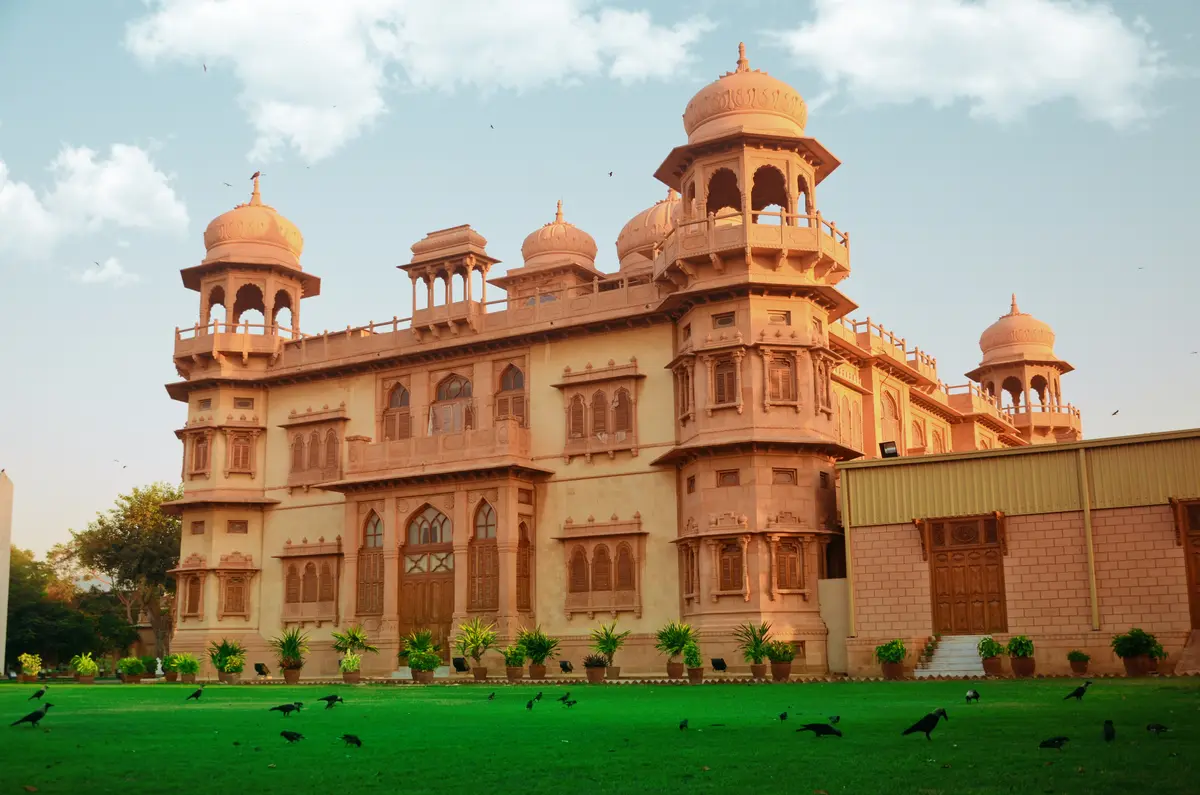
Mohatta Palace was built in 1927 as a seaside summer house in Karachi's Clifton district for Shivratan Mohatta, a Marwari ship chandler from Rajasthan, in pink Jodhpur stone and local yellow Gizri stone.
Where is Mohatta Palace?
- Location
- Sindh, Pakistan
- Type
- Museum
- Coordinates
- 24.815, 67.033
- Last updated
LOCATION
Why is Mohatta Palace said to be haunted?
He kept it for twenty years. At Partition the new state took the house for its Foreign Ministry; a member of the Sindh Assembly told the House in 2013 that it had been "forcibly vacated" and the owner's belongings thrown out. In 1964 it passed to Fatima Jinnah, sister of Pakistan's founder, who ran her 1965 presidential campaign against Ayub Khan from it and was found dead in an upstairs bedroom on 9 July 1967, with no post-mortem and no inquiry then or since. Her sister Shireen Bai lived there until 1980; the house was then sealed in litigation for fifteen years and opened as a museum on 15 September 1999. The haunting talk goes back at least to a dinner-party remark made while Fatima Jinnah lived there; the museum's websites never mention it, although one of its trustees told a newspaper in 2012 that it was "a fact".
What is the history of Mohatta Palace?
Mohatta Palace is a house that four different Pakistans have used in turn, and each handover was less voluntary than the one before.
In 1927 Rai Bahadur Seth Shivratan Chandraratan Mohatta, a Marwari trader from Rajasthan who had made his fortune in Karachi as a ship chandler, commissioned a summer house on the seafront at Clifton. His architect was Ahmed Hussein Agha, who had come from Jaipur as chief surveyor to the Karachi Municipality and was, in the museum's own words, "one of the first Muslim architects of India". Agha worked in a Mughal revival idiom, combining pink Jodhpur stone with the local yellow Gizri stone quarried a few kilometres away, to recreate the Anglo-Mughal palaces of the Rajput princes. The News described the result in 2015 as a building of about 18,500 square feet with nine domes, a basement pool chamber fed by a hot and cold water system, and a family temple to Shiva on the barsati, the roof terrace.
At Partition the house was taken. The two accounts on the record differ only in temperature. Dawn's Jaleel Bin Hamid Zubairi wrote in 2013 that the new government requisitioned property from owners who held several houses, that Mohatta Palace was picked for the Ministry of Foreign Affairs, and that when Mohatta appealed to Muhammad Ali Jinnah — whom he knew — the Quaid declined to intervene against his own government's policy. In February 2013, on the floor of the Sindh Assembly, the MQM parliamentary leader Sardar Ahmed put it more bluntly: the palace was "forcibly vacated" from its Hindu owner, the owner's belongings were thrown out, and he left for India disheartened. (In the same sitting the Culture Minister, Sassui Palijo, told the House the palace was built in 1886 — six decades adrift, and now in the assembly record.)
For the next seventeen years the house was a ministry. The diplomat Sultan Muhammad Khan, who worked there, remembered it without romance in his 2006 memoir: commuting to the Foreign Office at Mohatta Palace "when no regular bus service existed and taxis were rare and expensive, was a daily ordeal"; the all-pervasive sand got into everything; the summer heat was oppressive and "only the Foreign Secretary was allowed a window air-conditioner". Bhopal House, across an open space, had been taken over for the same ministry.
When the Foreign Office moved to Islamabad in 1964 the palace passed to Mohtarma Fatima Jinnah, the founder's sister, and became Qasr-e-Fatima. How it passed is disputed: Zubairi says it was transferred in exchange for her late brother's properties in India; the historian Sana Fatima writes that she bought it. From here she ran her 1965 presidential campaign against Field Marshal Ayub Khan, lost an election the opposition considered rigged, and withdrew. Rafia Zakaria, writing about the Karachi of her own family, described a city that "seemed to know or care when or why she moved to Mohatta Palace and shut herself up alone in its twenty-four rooms".
On the morning of 9 July 1967 the dhobi came to deliver the laundry and rang repeatedly with no answer — which, her neighbour Begum Ghulam Hussain Hidayatullah said, had never happened before. Fatima Jinnah was found dead in her upstairs bedroom. K. H. Khursheed and her niece Sheher Bano were told; the Commissioner of Karachi, Syed Darbar Ali Shah, the DIG of police and M. H. Isphahani arrived; doctors told the press she had died of heart failure in her sleep. There was no post-mortem and no judicial inquiry, and there has never been one since. Her sister Shireen Bai then lived on the ground floor until her own death in 1980. The house went into litigation and was sealed for fifteen years, until in 1995 the Government of Sindh, with the federal government, bought it for six million rupees for a public trust. Two phases of restoration were finished in August 1999 and the Mohatta Palace Museum opened on 15 September 1999, growing from three galleries that year to forty-four by 2005. It is listed as protected heritage in Sindh under number SD-P-74.
Timeline: the documented record of Mohatta Palace
- 1927 Rai Bahadur Seth Shivratan Chandraratan Mohatta, a Marwari ship chandler from Rajasthan, commissions a seaside summer house at Clifton from Ahmed Hussein Agha, chief surveyor to the Karachi Municipality, in pink Jodhpur and yellow Gizri stone.
- 1947 The new Government of Pakistan takes the house for its first Ministry of Foreign Affairs. Dawn reports that Mohatta appealed to Muhammad Ali Jinnah and was refused; the Sindh Assembly was later told the palace had been "forcibly vacated" and the owner's belongings thrown out.
- 1964 The Foreign Office moves to Islamabad and the palace passes to Mohtarma Fatima Jinnah, who renames it Qasr-e-Fatima. Sources disagree on whether it was exchanged for her brother's Indian properties or purchased.
- 1965 Fatima Jinnah runs her presidential campaign against Field Marshal Ayub Khan from the palace. She loses an election the opposition considers rigged and then withdraws from public life.
- 9 July 1967 The dhobi rings repeatedly with the laundry and gets no answer. Fatima Jinnah is found dead in her upstairs bedroom; the Commissioner of Karachi, Syed Darbar Ali Shah, the DIG of police and M. H. Isphahani attend, and doctors tell the press she died of heart failure in her sleep. There is no post-mortem.
- July 1967 Her nephew Akbar Pirbhai protests against her burial without a post-mortem. Akhtar Balouch, writing in 2015, puts the funeral crowd in Karachi at more than 600,000 and notes that there has never been an inquiry.
- January 1972 A citizen, Ghulam Sarwar, petitions a court for an inquiry, arguing that Fatima Jinnah "was a hurdle in the way of the group that wanted to remain in power". No inquiry follows.
- 1980 Shireen Bai, Fatima Jinnah's sister, who had lived on the ground floor since 1967, dies. The property goes into litigation and the palace is sealed.
- 1995 After fifteen years locked and empty, the palace is bought by the Government of Sindh with the federal government for six million rupees and vested in the Mohatta Palace Gallery Trust.
- 15 September 1999 The Mohatta Palace Museum opens to the public after two phases of restoration completed in August. It grows from three galleries in 1999 to forty-four by 2005.
- 2006 The earliest datable printed claim that the palace is haunted appears in a memoir, not the press: Yasmeen Sherazee, a guest of Fatima Jinnah, recalls returning "after dinner at my Uncle Hassan's house just after he made the announcement that Mohatta Palace was haunted".
- 26 June 2015 The News publishes the fullest account of the lore: a legend of a blocked tunnel to a subterranean Hindu temple, guides citing objects that move, rumours of British Raj ghosts and guards who claim to have "felt" a presence at night — with the note that the claims remain unverified and no harm has been done.
- 4 March 2016 A Daily Times listicle puts Mohatta Palace first among five haunted sites in Karachi while conceding in its opening line that "there are no specific legends associated with the alleged supernatural occurrences".
- 16 July 2026 The Sindh High Court orders status quo on a petition against a multi-storey building next door at Kazi House (Dawat-e-Hadiya), a protected property; the heritage department tells the court any structure must stay below the height of Mohatta Palace.
Is there a rational explanation for Mohatta Palace?
What is remarkable about Mohatta Palace's reputation is how little there is inside it.
The newspapers that describe it admit as much: Saher Baloch, writing about the palace's supposed secret tunnel in The News on Sunday of 22 July 2012, mentioned "tales of the palace being haunted" in passing. The News, on 26 June 2015, reported that "some museum guides acknowledge that the building may be haunted, citing various incidents where objects have been observed to have moved from their original place", that there were "rumours that the palace is haunted by ghosts of the British Raj era", and that guards "claim having 'felt' the presence of these spirits during the night" — before adding, in the same paragraph, that "these claims, however, remain unverified and the guards themselves claim that no serious harm has been done". The Daily Times listicle of 4 March 2016, which put the palace first among five Karachi sites, opened its entry by conceding that "there are no specific legends associated with the alleged supernatural occurrences in Mohatta palace", then offered guards hearing "the sounds of huge parties", wine glasses floating and exhibits rearranged overnight. A haunted-places article that begins by admitting there is no legend is a fair summary of the evidence.
The museum's websites say nothing on the subject: a crawl of both official sites on 8 October 2026 — the current mohattapalacemuseum.org and the older mohattapalacemuseum.com, which is still online — returned 109 distinct pages and about 216 KB of text, in which the words ghost, haunted, paranormal and supernatural appear zero times; as controls in the same crawl, "Mohatta" appears 361 times, "exhibition" 408, "1999" 25 and "Fatima Jinnah" four. The year 1967 also appears zero times: the older site states that Fatima Jinnah's "demise" came "in 1964", the year she moved in, and the current one gives no date of death at all. One trustee has spoken on the record, though: in the 2012 article Hameed Akhund, a member of the museum's board of trustees, called the haunting the one story about the palace that he took "somewhat seriously". "It is a fact," he said, and in the reporter's summary people working late at night during the renovation, or while preparing exhibitions, had "spoken of some mysterious things happening". Visitors cannot add photographs from inside: the museum's visitor policy requires phones to be deposited at the entrance and allows photography only outside the building and in the gardens.
The mundane explanations come from the same articles and from the building's own timetable. The house stood locked, empty and in litigation from 1980 to 1995 — fifteen years of a sealed palace on a Clifton seafront that people walked past daily. The News supplied the folk mechanism itself in 2015: "It is said that if you leave a house vacant for a long period of time, it becomes haunted." In the 2012 article the architect Yasmeen Lari blamed the long years in which the building was sealed and disused for much of the damage, and Akhund, who had gone into the famous tunnel towards the Shiva temple, described it as too small to stand up in and, in his view, a conduit for water running to the sea. The talk is older than the empty years, however. Yasmeen Sherazee, recalling a stay at the palace as Fatima Jinnah's guest, wrote in her 2006 book that "we got back to the palace after dinner at my Uncle Hassan's house just after he made the announcement that Mohatta Palace was haunted": the earliest version in print is an uncle's remark at a dinner party, made while Fatima Jinnah still lived in the house.
The genuinely unresolved thing here is documentary. Fatima Jinnah was buried without a post-mortem, and her nephew Akbar Pirbhai protested against it; Akhtar Balouch noted in Dawn in 2015 that there has never been an inquiry. According to the historian Sana Fatima, three women who washed her body, and the man known as Haji Kallu who prepared it, were asked to keep silent, and one of the women said she had seen "four inches wound on her neck". Nothing about that requires a ghost, and the record around it is careless in ways that are easy to check: the peer-reviewed Pakistan Journal of History and Culture printed her date of death as "July 31st, 1967", which is her birthday. She was born on 31 July 1893 and died on 9 July 1967, three weeks short of seventy-four.
Can you visit Mohatta Palace?
Mohatta Palace is an open, working museum, and no special access or ghost tour exists.
The address is 7 Hatim Alvi Road, Block 5, Old Clifton, Karachi 75600 (telephone 021-35837669 and 021-35374879). According to the museum's own visitor policy, it opens Tuesday to Sunday from 11:00 to 18:00 and closes on Mondays; adult admission is 100 rupees and children under twelve enter free. Because the building shuts at six and runs no after-dark programme, anyone selling a night visit or a paranormal tour of the palace is not the museum.
One practical warning that costs visitors real money and time: there are two official-looking museum websites, and only one is current. Plan from mohattapalacemuseum.org. The older mohattapalacemuseum.com is still online with a 2019 exhibition on its front page, still advertises admission at 30 rupees, still lists opening hours that were changed years ago, and now carries outbound links to unrelated commercial sites. Its history page is still worth reading — it is more detailed than the current one, and it is the only official text that mentions Shireen Bai — but do not use it to plan a visit.
Phones are not allowed inside the building and must be left at the entrance; photography and video are permitted outside and in the gardens only. Tripods, lighting rigs and drones need prior approval, students photographing for coursework need a letter from their institution, and commercial or fashion shoots are not permitted without written consent. Private celebrations such as weddings and birthdays are not allowed; the gardens can be booked for corporate events by arrangement. Escorted tours with commentary, for individuals and groups, are arranged in advance through the museum.
The palace is protected heritage in Sindh under number SD-P-74, and its surroundings are contested. On 16 July 2026 the Sindh High Court ordered status quo on a petition against a multi-storey construction next door, at the adjoining protected property known as Kazi House or Dawat-e-Hadiya (SD-P-73); the heritage department told the court that any approved structure must stay below the height of Mohatta Palace. Expect building work and possible disruption on the approach.
Two features that draw questions are not on the visitor route: the family shrine to Shiva on the roof terrace, and the tunnel of local legend said to run from the grounds to a subterranean Hindu temple less than a kilometre away, which The News reported in 2015 as long since caved in and blocked at both ends. Transport details on the archived official site — bus 20, minibuses N and W30, and a ten-minute walk from the Abdullah Shah Ghazi shrine or the Do Talwar monument — are more than a decade old; check current routes locally.
Sources consulted
- Jaleel Bin Hamid Zubairi, «Mohatta Palace: some facts» — Dawn, 2013 newspaper archive
- Sana Fatima, «Fatima Jinnah's Political Journey and her Controversial Death» — Pakistan Journal of History and Culture, Vol. XXXV, No. 2 (NIHCR), 2014 academic
- Akhtar Balouch, «How Fatima Jinnah died - an unsolved criminal case» — Dawn, 2015 newspaper archive
- Sultan Muhammad Khan, «Memories & Reflections of a Pakistani Diplomat» — Paramount Publishing Enterprise, Karachi, 2006 book
- Yasmeen Sherazee, «Cry of a Muslim Woman: A True Pakistani Story» — AA Publishers, 2006 book
- Magazine Desk, «Insight Mohatta Palace» — The News International (US magazine), 2015 newspaper archive
- Web Desk, «5 haunted place in Karachi you should never go» — Daily Times, 2016 newspaper archive
- Ramzan Chandio, «'Mohatta palace was forcibly vacated'» — The Nation, 2013 newspaper archive
- Mohatta Palace Museum, «About the Museum (archived official site, admission and history)» — mohattapalacemuseum.com, Internet Archive, 2011 archive
- Mohatta Palace Museum, «History of the Museum / About the Museum (visitor policy, tickets, hours)» — Official site, 2026 web
- Jamal Khurshid, «SHC orders status quo on plea against construction near Mohatta Palace» — The News International, 2026 newspaper archive
- Rafia Zakaria, «The Upstairs Wife: An Intimate History of Pakistan» — Beacon Press, 2015 book
- Saher Baloch, «The mystery of Mohatta's secret tunnel (mentions 'tales of the palace being haunted'; trustee Hameed Akhund: 'It is a fact')» — The News on Sunday (Kolachi), The News International, 22 July 2012, 2012 newspaper archive
Reviewed by V. Serrano on 2026-08-13 · How we verify our content
💬 Field testimonies (0)
No testimonies yet. Add the first.
Add your testimony
🔒 Log in to add a testimony