👻 HAUNTED PLACE · EXP. Nº9474
ACTIVE
Sanzhi UFO houses
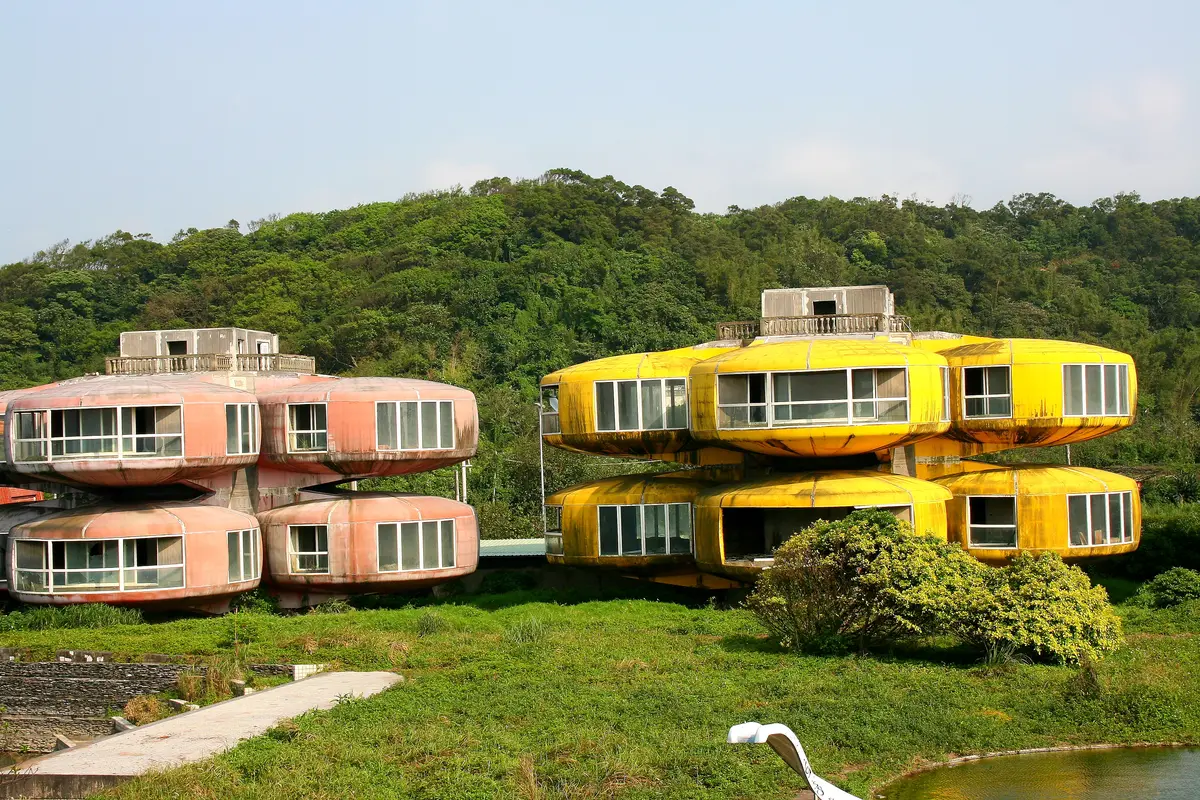
For nearly thirty years a cluster of two-storey pods in pink, yellow and blue stood beside the coast road north of Tamsui, in Sanzhi.
Where is Sanzhi UFO houses?
- Location
- New Taipei, Taiwan
- Type
- Ruin / ancient site
- Coordinates
- 25.261, 121.478
- Last updated
LOCATION
Why is Sanzhi UFO houses said to be haunted?
The internet knows them as the cursed resort where workers died and a severed stone dragon took its revenge. The Taiwanese record says something duller and stranger. A plastics manufacturer from Sanzhi itself bet on the holiday trade of the years when US forces were stationed in Taiwan; it got its first construction licence in 1978, the year Washington announced it was switching recognition to Beijing, and went bankrupt in 1980. A second developer, Hung Kuo, put NT$800 million into finishing the pods in 1989 and walked away the same year after a row about what the place should be. One of the designers told the Taipei Times that the site was "definitely not haunted" and that the ritual held before construction was ordinary building practice. The ghost story is not part of that record: the earliest datable printed mentions are two Taiwanese newspaper pieces of January 2008 written to debunk an internet rumour, twenty-eight years later. All 23 pods and two gate archways came down from 29 December 2008. Nothing is left on the plot.
What is the history of Sanzhi UFO houses?
The complex had a formal name that almost nobody used: the Sanzhi Longgang International Leisure Club (三芝龍港國際休閒俱樂部). It stood on the seaward side of the Tamsui–Jinshan road, Provincial Highway 2, at around its 17-kilometre marker, beside a Formosa Plastics petrol station in Xiban, then in Sanzhi Township, Taipei County, and today in the Sanzhi District of New Taipei. Everybody called it 飛碟屋 — the flying-saucer houses — or 太空屋, 玲瓏屋, 彩虹屋: space houses, jewel houses, rainbow houses.
The idea came from Yu-chou Co. (宇洲纖維), a plastics and fibre manufacturer based in Sanzhi itself. The commercial reasoning was reported plainly by the Taiwanese press: the developer was betting on the holiday trade of the years when US forces were stationed in Taiwan, when the north-coast beaches were popular with foreign visitors, and expected to bring holidaymakers and visiting businesspeople straight from Chiang Kai-shek International Airport — today Taoyuan — to a beach resort of their own.
That is the part worth doing the arithmetic on. One of the designers, who gave the Taipei Times only his family name, Lin, said the first construction licence was issued in 1978. In December of that same year Washington announced that it would recognise the People's Republic of China from 1 January 1979, withdraw recognition from Taipei and abrogate the 1954 Mutual Defense Treaty; the US State Department's own account of the normalisation notes that American military personnel had already been leaving Taiwan gradually in the run-up. The US Taiwan Defense Command was disbanded in 1979. So the resort's declared clientele was not a rumour invented by bloggers — it is what the developer's plan was reported to be — but that clientele was packing its bags while the moulds were being cut. Chinese-language chronologies of the same project put the building permit and the groundbreaking three years later, in 1981, which only widens the gap.
The design is the other thing that is repeated wrongly everywhere. These were not Futuro houses. Lin told the Taipei Times that "the idea for the design came from Matti Suuronen, an architect from Finland" — the idea, not the product. A Futuro is a single ellipsoidal fibreglass shell built from licensed moulds and set on legs; what went up at Sanzhi was, in Lin's own description, "a reinforced concrete construction covered by fiber reinforced plastic", cast locally and bolted into clusters of round pods stacked two storeys high around a concrete core, with a rooftop terrace on top. Further east along the same coast, at Feicui Bay in Wanli, a separate developer named Su Ming had built his own saucer-shaped holiday units; whether those have anything to do with Suuronen or are simply copies is still argued over, and several of them are still standing — which is why so many photographs captioned "Sanzhi" today are not of Sanzhi at all.
Yu-chou went bankrupt in 1980 and work stopped with much of the complex unfinished. It resumed once, in 1989. Hung Kuo Group had just taken over the running of the Taipei Hilton and wanted to extend into tourism; when Tsai Chin-hsien (蔡錦賢), president of a Tamsui beer house called Haichungtien, proposed finishing the pods, Hung Kuo backed him with NT$800 million (about US$24 million) and became the project's manager. King Interior Design Co came in as subcontractor, with Lin heading its design department. The plan was a very large beer house and resort. Lin found that the concrete-and-fibreglass shells were vulnerable to earthquake damage and leaks with no practical way to fix them: "We just wanted to finish the construction as soon as possible so we did not redesign or reconstruct the remaining half-completed houses." Work stopped again at the end of 1989 over a disagreement about what the place should be — Haichungtien wanted a local business, Hung Kuo an international resort. In 1995 Hung Kuo mortgaged the land to three banks and the pods were left exactly as they were.
They stayed that way for another thirteen years, becoming a fixture of the coast road and, as the Taipei Times put it, a site "often used as a location for photographers because of its unusual atmosphere and beautiful coastal setting". The end came on 29 December 2008, when the Taipei County Public Works Bureau sent in the machines. Its director, Lee Shu-chuan (李四川), counted 23 pods and two gate archways and justified the demolition on public safety: the concrete was spalling badly and the reinforcing bars were exposed, corroded and in places fractured. Online petitions asked the county to spare a single pod as a museum. It did not. A site supervisor, speaking anonymously, told the Taipei Times a month later: "We received an order to tear them down and we plan to finish the job within a month. I have no idea what will happen to the site afterwards."
Timeline: the documented record of Sanzhi UFO houses
- 1978 The first construction licence is issued for the resort promoted by Yu-chou Co., a plastics manufacturer from Sanzhi itself. The designer known only as Lin gave the date to the Taipei Times in 2009; Chinese-language chronologies of the same project put the permit in 1981.
- 1 January 1979 The United States, having announced the decision the previous December, recognises the People's Republic of China, withdraws recognition from Taipei and moves to abrogate the 1954 Mutual Defense Treaty; American military personnel had already been leaving Taiwan gradually, and the US Taiwan Defense Command is disbanded that year. The holidaymakers the resort was aimed at are gone before it is finished.
- 1980 Yu-chou Co. goes bankrupt and construction stops with much of the complex unfinished. Lin gives this, and not any accident, as the reason the work halted.
- 1989 Hung Kuo Group, fresh from taking over the running of the Taipei Hilton, backs Tsai Chin-hsien of the Tamsui beer house Haichungtien with NT$800 million to finish the pods as a beer hall and resort. Work stops again at the end of the year: Haichungtien wanted a local business, Hung Kuo an international resort.
- 1995 In financial trouble, Hung Kuo mortgages the land to three banks. The complex is left in the state in which it would be photographed for the next thirteen years.
- 16 January 2008 The Apple Daily leads on the international false rumour that has turned the site into a "ghost city", including the claim that ten thousand bodies were buried there. It is the earliest printed mention of the ghost story that can be fixed to a date — and it is a debunking. The paper closed in 2022 and its archive is offline; the headline and date survive in the citation record.
- 20–21 January 2008 A detailed Taiwanese reconstruction of the project is published, reporting roughly a hundred truckloads of earth excavated and no bones, and two tilers injured in a fall from third-floor scaffolding with no fatalities. The next day the Liberty Times runs "Netizens' rumour-mongering turns the Sanzhi UFO houses into a haunted house", tracing the story to ruin photographs posted on a blog by a Taiwanese photographer.
- 3 April 2008 Carrie Kellenberger photographs the pink and yellow pod clusters at 15:20; the geotagged image, later released under a free licence, is the photograph on this file and one of the last dated records of the complex standing.
- 29 December 2008 The Taipei County Public Works Bureau begins the demolition. Its director, Lee Shu-chuan, counts 23 pods and two gate archways and cites spalling concrete and exposed, corroded and fractured reinforcement. Online petitions to keep one pod as a museum are refused.
- 29 January 2009 The Taipei Times publishes the only interview with one of the designers. Lin says: "First of all, the site is definitely not haunted." The county's tourism bureau director, Chin Hui-chu, announces plans for hotels and beach facilities on the site.
- 13 January 2015 Six years after the last pod came down, Taiwanese media report that the British press has rediscovered the site, and repeat the unsourced Dutch soldiers' burial ground and old execution ground stories. The legend now outlives the buildings.
- 11 September 2021 The rebuilt 57-metre Zhilan Park offshore viewing platform opens at Qianshui Bay, a kilometre and a half south of the empty plot. It is what the coast got instead of the resort.
Is there a rational explanation for Sanzhi UFO houses?
The most useful witness against the ghost story is one of the men who designed the place.
Interviewed by the Taipei Times in January 2009, the designer identified only as Lin said there were a lot of rumours about the site and that most of them were false. "First of all, the site is definitely not haunted," he said, in reference to reports of ghosts near the complex and to the high number of unexplained traffic accidents on the road outside. He also dealt with the detail that gets quoted most: the ritual performed before construction began. "It is traditional in the construction business to pay your respects to any spirits at the site of a new project before you start work. It had nothing to do with the ghost stories."
The specific claims are checkable and they do not hold. The story that more than 20,000 skeletons were dug up at the site is contradicted by the only detailed account of the excavation, published in Taiwan in January 2008, which puts it at roughly a hundred truckloads of earth and no bones at all. The same account traces the construction "deaths": two tilers fell from third-floor scaffolding and were injured. Nobody was killed building the pods.
The fatal accidents that did happen were on the road. When it was widened, a stone dragon by the resort gates was cut and moved, and after a run of deadly crashes local talk attributed them to the dragon's resentment — talk that the Liberty Times reported in 2008 as exactly that, neighbourhood lore, alongside the road blessings it prompted. Somewhere between Taiwan and the English-speaking internet, those road deaths migrated into the building site and became dead construction workers who walked off the job.
Dating the story is the decisive move here. The earliest printed mentions of the Sanzhi "ghost city" that can be fixed to a date are two Taiwanese newspaper pieces of January 2008 — and both were written to knock the story down. The Apple Daily led on 16 January 2008 with a headline about an international false rumour and the wild claim that ten thousand bodies were buried there; the Liberty Times followed on 21 January under the headline "Netizens' rumour-mongering turns the Sanzhi UFO houses into a haunted house". The Liberty Times traced the whole thing to photographs of the ruin posted on a blog by a Taiwanese photographer and then amplified by Japanese and English-language sites into tourist deaths during construction, lingering spirits, unearthed bones and a "Taiwan ghost city". That is twenty-eight years after the site fell silent, and the first thing the record contains is a denial.
The claim that the land had been a Dutch soldiers' burial ground appears in foreign coverage from September 2008 and was still being repeated by Taiwanese outlets in 2015, alongside a supposed old execution ground, always without a source. Nothing in the county's demolition file, the designers' accounts or the excavation description supports it.
One last note, about our own text. Until this rewrite this file described visitors feeling cold spots inside the fibreglass shells despite the tropical heat outside. That sentence appears in none of the Taiwanese or English-language sources listed below; it was ours, and it is gone.
Can you visit Sanzhi UFO houses?
Nothing of the complex survives. Demolition of the 23 pods and the two gate archways began on 29 December 2008 and no part of the site was preserved, so pages and videos that offer a walk among the saucers are showing either old footage or another place altogether.
The coordinates on this file — 25.2610 N, 121.4777 E — fall on the seaward side of the Tanjin Road (Provincial Highway 2), around its 17-kilometre marker, in Xiban, Sanzhi District, New Taipei. OpenStreetMap node 2321727881 sits about twenty metres from that point, named Sanzhi UFO houses / 三芝飛碟屋 and tagged razed:building=yes with the note "demolished UFO Houses"; its second and last version is dated 28 January 2020. The hotels and beach facilities announced by the county tourism bureau in January 2009 were never built on that plot, and no map data or report traced for this file records anything standing on it today.
A kilometre and a half south lies Qianshui Bay (淺水灣), along kilometres 14.5 to 16.5 of the same road: a crescent of sand and algal reef, open all year, free of charge. The North Coast and Guanyinshan National Scenic Area Administration lists cold showers at NT$30 for three minutes and foot-rinse machines at NT$10 for ninety seconds. Parking runs NT$100 on weekdays and NT$50 an hour at weekends with a NT$500 daily cap, NT$20 for motorcycles; there are two accessible bays and an accessible toilet. Taiwan Tourist Shuttle route 716, the Crown Northern Coast Line, stops at 大崛(淺水灣), and Tamsui Bus and Keelung Bus services reach 大堀 from Tamsui MRT station and Keelung railway station. The 57-metre Zhilan Park offshore viewing platform, rebuilt on the base of a 1992 structure that coastal erosion forced out in 2015, opened on 11 September 2021.
The saucer houses that survive on this coast are the Feicui Bay units at Wanli, a separate development further east. Several of them are private property and some remain in use as dwellings, and what can be seen of them is visible from the road.
Sources consulted
- Jimmy Chuang, «FEATURE: Taipei County looks to rebuild site of weird UFO houses» — Taipei Times, 2009 newspaper archive
- 黃其豪 (Huang Chi-hao), «網友以訛傳訛 三芝飛碟屋變鬼屋 (Netizens' rumour-mongering turns the Sanzhi UFO houses into a haunted house)» — 自由時報 / Liberty Times, 2008 newspaper archive
- 香腸, «[獨家] 三芝飛碟屋-完整事件還原 (Exclusive: the Sanzhi UFO houses, the full story reconstructed)» — 香腸炒魷魚, 2008 web
- ETtoday 旅遊雲, «三芝廢棄飛碟屋登上國際媒體 每日郵報:未來感十足» — ETtoday, 2015 newspaper archive
- Office of the Historian, «Milestones 1977–1980: China Policy» — U.S. Department of State, 1979 report
- Noah Reed, «Visualization: U.S. Taiwan Defense Command Force Distribution, 1973» — Taiwan Security Monitor, Schar School, George Mason University, 2023 academic
- Carrie Kellenberger, «三芝飛碟屋 (photograph, 3 April 2008, geotagged 25°15′39.12″N 121°28′39.81″E)» — Wikimedia Commons / Flickr, 2008 archive
- Josh Ellis, «Wanli UFO Village (萬里飛碟屋)» — goteamjosh.com, 2018 web
- 北海岸及觀音山國家風景區管理處, «淺水灣 / Qianshui Bay — official visitor information» — North Coast & Guanyinshan National Scenic Area Administration, 2025 web
- OpenStreetMap contributors, «Node 2321727881 — Sanzhi UFO houses / 三芝飛碟屋, tagged demolished» — OpenStreetMap, 2026 web
Reviewed by V. Serrano on 2026-08-13 · How we verify our content
💬 Field testimonies (0)
No testimonies yet. Add the first.
Add your testimony
🔒 Log in to add a testimony