👻 HAUNTED PLACE · EXP. Nº9474
ACTIVE
Wadi al-Salam
Wadi al-Salam, the Valley of Peace, spreads north-west from the Shrine of Imam Ali in Najaf and is usually called the largest cemetery on earth.
Where is Wadi al-Salam?
- Location
- Najaf, Iraq
- Type
- Cemetery
- Coordinates
- 32.017, 44.298
- Last updated
LOCATION
Why is Wadi al-Salam said to be haunted?
It exists because of one grave: Ali ibn Abi Talib was buried here in 661, the city grew around him, and Shia tradition holds that a believer buried at his side lies in a part of Heaven. For fourteen centuries the dead have been carried to Najaf from Iran, India and the whole of Iraq, in a corpse traffic that once became an Ottoman-Iranian border dispute. About 50,000 people are interred every year. The famous ghost of the gravediggers, an entity they call Tantal, comes from a single Al Jazeera report published in September 2019 — and that report contains what the retellings leave out: the physiological explanation, and the fact that the worst-affected man recovered after psychiatric treatment in Beirut. The superlatives are shakier than they look, too: Iraq's own UNESCO file calls it only one of the largest cemeteries in the world.
What is the history of Wadi al-Salam?
Wadi al-Salam exists because of one grave.
ʿAli ibn Abi Talib — cousin and son-in-law of the Prophet Muhammad, first imam of Shia Islam and fourth caliph in the Sunni sequence — was assassinated in Kufa in 40 AH / 661 CE. Shia accounts hold that he was buried in secret out in the desert so that his enemies could not exhume and desecrate the body, and that the site was only made public generations later. The town that grew around it is Najaf. Rose Aslan's entry on the city for the Encyclopædia Iranica (2015) sets out both that tradition and the medieval Sunni scholars who disputed the location. Seminary, pilgrimage economy and cemetery all descend from that single burial: the graveyard is not beside the city by accident — the city is beside the grave.
For Shia Muslims, burial here is doctrine rather than sentiment. The Shia reference encyclopaedia WikiShia collects the hadiths the practice rests on, among them a saying attributed to Imam ʿAli himself: that no believer dies anywhere on earth without his spirit being summoned to Wadi al-Salam, which is "a part of Heaven". The name — وادي السلام, Valley of Peace — is glossed in the same tradition as a promise of exemption from the torments of the intermediate state between death and resurrection.
That belief produced one of the longest-running movements of the dead in history. Devout Shia from as far away as India were carried to Najaf for burial "just outside the old city walls", and the income from burials and pilgrims, as Aslan notes citing the historian Meir Litvak, helped keep Najaf's clergy financially independent of Ottoman patronage. In the nineteenth century the traffic became a diplomatic problem in its own right: Sabri Ateş's study Bones of Contention: Corpse Traffic and Ottoman-Iranian Rivalry in Nineteenth-Century Iraq (2010) examines the Ottoman response to Iranians bringing corpses across the frontier for burial in the Shia shrine cities, as a tangle of sovereignty, border control, commerce and — once cholera became a global threat — quarantine. Caravans of coffins travelled for weeks.
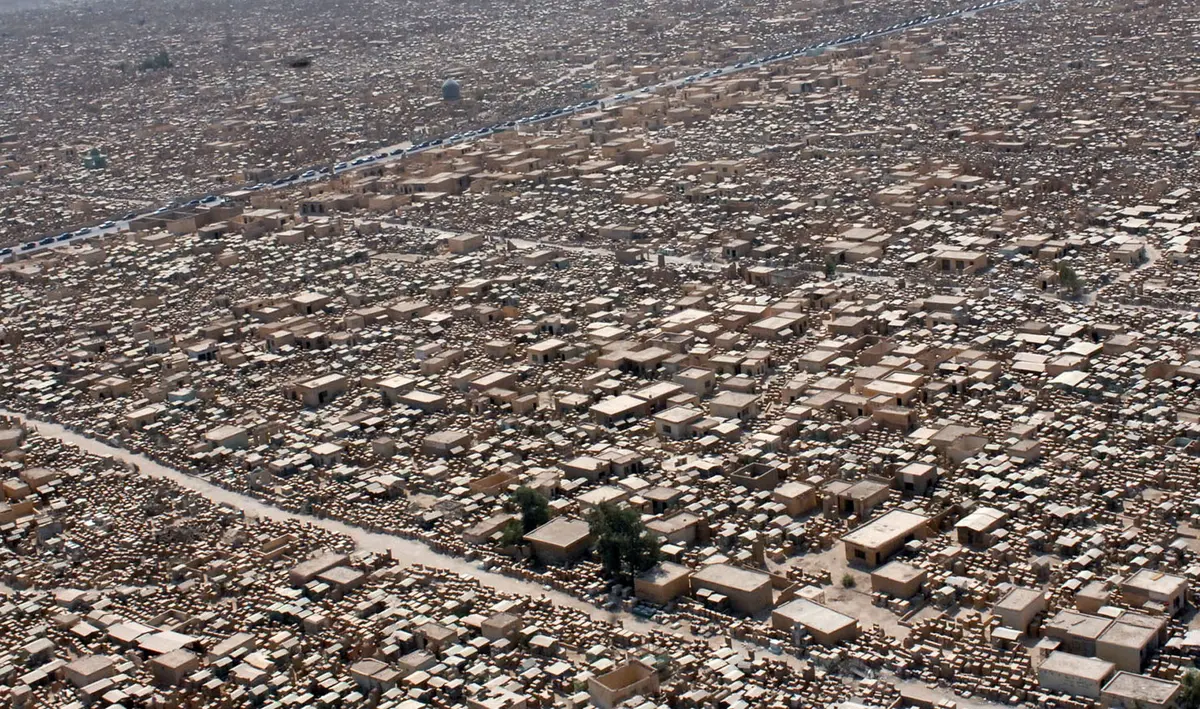
Under the Islamic cemetery are older ones. The nomination file Iraq lodged with UNESCO in 2011 claims for the site the kings of al-Hira and rulers of the Sassanid era alongside Companions of the Prophet, and burials sponsored by the Hamdanid, Fatimid, Buyid, Safavid, Qajar and Jalayirid states. The same document describes the four burial forms that give the place its skyline: sunken graves, tower graves, rooms allotted to a single family, and vaults cut underground and entered by ladder, each holding many bodies. It is why aerial photographs look like a city. They are of a city — with streets, doorways and roofs — built for the dead.
The site is protected under Iraqi law by the General Endowment Act No. 64 of 1966, as amended, and Law No. 40 of 1999. Iraq placed it on UNESCO's Tentative List on 24 January 2011 (Ref. 5578, cultural criteria iii, v and vi). Fifteen years later it is still on the Tentative List and has never been inscribed on the World Heritage List — worth keeping straight, because a great deal of writing about the cemetery calls it a World Heritage Site.
Modern Iraqi history is legible in the ground. In August 2004 the cemetery was a battlefield: fighters of Muqtada al-Sadr's Mahdi Army used its tombs, catacombs and tunnels as cover against US and Iraqi forces during the Battle of Najaf, and tombs were wrecked by gunfire and mortars. A decade later the war against ISIL filled new ground. After Grand Ayatollah Ali al-Sistani's 2014 call to arms, an Associated Press report from September 2018 recorded that Najaf authorities had offered six parcels of cemetery land to the militias raised in response; a graveyard guard, Jabir al-Bugharban, said his section alone was receiving about six bodies a day during the heaviest fighting in Salahuddin and Anbar.
Ground inside Wadi al-Salam is therefore valuable, and it is traded. Al Jazeera reported in 2019 that a prime plot near the shrine could cost up to $4,000. Families resell plots. In April 2025 the Iraqi outlet The New Region documented a fraud in which fake graves were built at night across the cemetery's access roads and sold to mourners from other provinces through Facebook adverts — one plot advertised at two million dinars — with Najaf municipality's media director, Bashar al-Sudani, saying dozens of fake graves had been removed. That is the world in which this cemetery's ghost stories are told.
Timeline: the documented record of Wadi al-Salam
- 40 AH / 661 CE ʿAli ibn Abi Talib is assassinated in Kufa. Shia accounts hold that he was buried secretly in the desert nearby so his enemies could not desecrate the body; the town of Najaf grows around the grave, and the cemetery grows around the town. Medieval Sunni scholars disputed the location.
- 19th century The corpse traffic (naql al-janaʾiz) to the Shia shrine cities becomes an Ottoman-Iranian dispute over sovereignty, borders, commerce and — as cholera spreads — quarantine, studied by Sabri Ateş. Income from burials and pilgrims underwrote the financial independence of Najaf's clergy.
- 1966 The General Endowment Act No. 64 gives the cemetery its legal protection; it is reinforced by Law No. 40 of 1999. Both are cited by Iraq as the guarantee of the site's integrity.
- August 2004 The cemetery becomes a battlefield. Fighters of Muqtada al-Sadr's Mahdi Army use its tombs, catacombs and tunnels as cover against US and Iraqi forces during the Battle of Najaf; graves are wrecked by gunfire and mortars. Burials and pilgrimage resume afterwards.
- 10 September 2007 Sgt. Johnnie French photographs the cemetery from the air for the US military. The official caption calls Wadi al-Salam "the second largest in the world", covering "more than four and a half square miles", with "more than one million" buried — figures nothing like the ones now in circulation.
- 24 January 2011 The Permanent Delegation of Iraq submits the cemetery to UNESCO's Tentative List (Ref. 5578, criteria iii, v, vi), giving 917 hectares and calling it "one of the largest cemeteries in the world". Fifteen years on it has still not been inscribed on the World Heritage List.
- 2013 Gravedigger Murtaza Jwad Abo Sebi says that while lowering a woman's shrouded body into her tomb at night, "her hand slapped my face so fiercely that I was left petrified". He would spend five years self-harming before psychiatric treatment in Beirut; he told the story publicly only in 2019.
- 2014 After Grand Ayatollah Ali al-Sistani's call to arms against ISIL, whole new sections fill with militia dead. An Associated Press report in September 2018 records that Najaf authorities had offered six parcels of cemetery land to the militias.
- December 2016 Haider al-Hatemi, then a gravedigger, dates to this month the blow to the head he attributes to a shadow. His family later sold their house to spend about $30,000 on shamanic healing; he did not recover and stopped working.
- 10 September 2019 Al Jazeera publishes Sebastian Castelier and Quentin Muller's report on the gravediggers, the single origin of everything written since about a creature called Tantal at Wadi al-Salam. The article itself supplies the physiological explanation and the psychiatric outcome that later retellings drop.
- 16 November 2023 NASA's Earth Observatory compares Landsat images of Najaf from 2003 and 2023 and states that about 50,000 people are interred in the cemetery each year — the only measured, sourced figure in the whole dossier.
- 5 April 2025 The New Region reports a fraud in which fake graves are built overnight across the cemetery's access roads and sold to mourners from other provinces through Facebook adverts. Najaf municipality says dozens have been demolished to reopen the roads.
Is there a rational explanation for Wadi al-Salam?
Almost everything published in English about a ghost at Wadi al-Salam traces back to a single piece of reporting.
On 10 September 2019 Al Jazeera published Gravediggers claim ghosts haunt world's largest cemetery in Iraq, by Sebastian Castelier and Quentin Muller; Al Jazeera's Arabic service ran its own version on 24 October 2019 under Muller's byline. Five men are named in it: the gravediggers Haider al-Hatemi (26), Murtaza Jwad Abo Sebi (23), Hani Abu Ghnaim (61) and Hussein Hamoudi Haboudi (47), plus Ameer Al Juboury (23), who manages a gravediggers' unit. Two incidents are described. Every later version — including this site's own previous entry — is a copy of that article, usually with the parts that undercut the ghost taken out. It is not an AFP or Reuters wire story, as is often assumed; it is one freelance reportage.
Those missing parts matter. Castelier and Muller print the physiological explanation in the body of the piece: slight post-mortem movement can occur as muscles relax and then stiffen in rigor mortis. That bears directly on the only physical claim in the article, made by Abo Sebi, who said that in 2013, lowering a woman's shrouded body into her tomb at night, "her hand slapped my face so fiercely that I was left petrified". Our earlier text turned that into "a hand seemed to slap his face", which loses both whose hand it was and the explanation the reporters had already supplied.
It also loses the ending. Abo Sebi spent five years replaying the moment, burning his arms with cigarettes and attempting suicide more than once, and was treated at the American University Hospital in Beirut at a cost of $7,000. The article describes him as cured, married, and back at work earning up to $300 a month. That is not a haunting. It is a documented case of untreated occupational trauma in a man who was seventeen or eighteen when it happened, and it ended with psychiatry.
Haider al-Hatemi's case did not end. He dates his experience — a shadow behind him, a violent blow to the head — to December 2016, not to 2019, which is only when he told it; and he is a former gravedigger, no longer able to work. He says he no longer walks straight and feels the ghost still in his body. His family sold their house to pay some $30,000 for shamanic healing, his wife filed for divorce, and the article closes with him in tears: "I've lost everything." What circulates online as a spooky anecdote is, in the source, an account of a disabled young man ruined by paying for the wrong kind of treatment.
The black-market theory has exactly one author. It is Ameer Al Juboury, aged 23, who suggests the entity "takes possession" of plots illegally resold by families after easy money. Our earlier text attributed this to "supervisors" in the plural; nobody said it but him. Read plainly it is a moral claim rather than an observation — graves obtained wrongly are dangerous — and given the plot fraud documented in the same cemetery six years later, it is a belief doing precisely the work beliefs do.
The creature's name is borrowed. Al-Ṭanṭal (الطنطل) is a well-attested figure of Iraqi popular tradition, at home not in Najaf but in the southern marshes: a shape-shifting night giant, guardian of buried treasure, a trickster who rewards those who flatter his appearance and drives the rest mad — and, above all, the thing parents invoke to stop children going out after dark. Individual tantals are named after individual marshes: Tantal Abu Ghraib, Tantal Umm al-Ubaid, Tantal Hafiz. Al Jazeera itself ran a feature on them by Abdulrahman Zeyad on 31 October 2023 that never once mentions Najaf or any cemetery. The gravediggers are not reporting an entity peculiar to Wadi al-Salam; they are reaching for the bogeyman they grew up with. The two other names the 2019 article gives, "Bzebza" and "Ghreria", appear there only in Latin transliteration, and I could not tie either to an Arabic spelling or to any folklore source.
Finally, the superlatives, which nobody has measured. Iraq's own UNESCO submission calls the site "one of the largest cemeteries in the world" — not the largest — and gives 917 hectares. Guinness World Records lists it as the largest burial ground at 9.17 km², which is Iraq's figure to the decimal, and says only that it holds "millions of sets of human remains". English Wikipedia gives 1,485.5 acres (6.01 km²). The US Army caption on the photograph at the head of this page, written in 2007, calls Wadi al-Salam "the second largest in the world", covering "more than four and a half square miles" (about 11.6 km²), with "more than one million" buried. Press coverage later settled on roughly 10 km² and six million graves, and NASA's Earth Observatory repeated those in 2023. Between 6 and 11.6 km², then, and between one and six million dead, depending which source you trust. The only measured and sourced figure in the whole file is the rate: about 50,000 people are interred here every year.
Can you visit Wadi al-Salam?
Wadi al-Salam is a working cemetery in Najaf, in Najaf governorate, some 150 km south of Baghdad; burials take place in it every day. The ground begins immediately north-west of the old city and runs outward from the Shrine of Imam ʿAli, which is the reason it is there; Iraq's own submission to UNESCO puts the cemetery at about 13 per cent of the surface of the city. The nearest airport is Najaf International (NJF), built in large part to serve pilgrims to the shrine.
Entry to the country changed in 2025: the British Foreign, Commonwealth and Development Office page on Iraqi entry requirements — the version updated on 22 July 2026, consulted on 9 September 2026 — states that a visit visa is no longer obtainable on arrival in Iraq. The application goes through the Iraqi government's e-visa portal at least 24 hours ahead of departure, and the same page gives the price as $160 for a visa valid 60 days. That advice places "the remainder of Najaf province" under a warning against all but essential travel. Pilgrimage travel to the shrine cities is generally arranged through organised groups.
The cemetery is a religious site as well as a burial ground. Arms and legs are covered; women cover their hair, and an abaya is expected inside the precinct of the shrine. Funerals in progress are not photographed; neither are mourners or open graves. Many of the tombs are the roof of a family vault with a ladder shaft beneath them and were not built to be stood on. Thursday and Friday are the busiest days; during Arbaʿeen millions of pilgrims converge on Najaf and Karbala.
The older sections lie closest to the shrine, and the expansion to the north-west is organised around what people in Najaf call the seven entrances. Its ground is uneven brick and plaster with unmarked shafts and no shade, and Al Jazeera's 2019 report from among the gravediggers describes visitors losing their way inside it.
Plots offered for private sale are a known fraud here. In April 2025 The New Region reported that gravediggers were building fake graves overnight on the access roads at the third and fourth entrances and selling them through Facebook adverts to families from Baghdad, Basra, Nasiriyah, Diwaniyah, Samawah and Kut. The Najaf municipality had been demolishing those graves to reopen the roads. Legitimate burial is arranged through the cemetery administration and the municipality.
Wadi al-Salam entered UNESCO's Tentative List on 24 January 2011 under reference 5578 and has remained there since. It holds no World Heritage inscription; guides and travel pages describe it as one all the same.
Sources consulted
- Sebastian Castelier and Quentin Muller, «Gravediggers claim ghosts haunt world's largest cemetery in Iraq» — Al Jazeera, 2019 newspaper archive
- Permanent Delegation of Iraq to UNESCO, «Wadi Al-Salam Cemetery in Najaf — Tentative List submission, Ref. 5578» — UNESCO World Heritage Centre, 2011 report
- Rose Aslan, «NAJAF» — Encyclopædia Iranica, online edition, 2015 academic
- Sabri Ateş, «Bones of Contention: Corpse Traffic and Ottoman-Iranian Rivalry in Nineteenth-Century Iraq» — Comparative Studies of South Asia, Africa and the Middle East 30(3), pp. 512-532, 2010 academic
- Sgt. Johnnie French, «Pilgrimage converges on An Najaf (photo ID 60956)» — DVIDS, U.S. Department of Defense, 2007 archive
- Adam Voiland, images by Wanmei Liang, «Changing Najaf» — NASA Earth Observatory, 2023 report
- Guinness World Records, «Largest cemetery» — Guinness World Records, 2024 report
- Associated Press, «Daesh battle swells vast Iraqi cemetery» — Gulf News, 2018 newspaper archive
- The New Region, «Fake graves block roads in Najaf's Wadi al-Salam cemetery» — The New Region, 2025 newspaper archive
- Abdulrahman Zeyad, «Spooky Arab tales for Halloween: Iraq's shape-shifting Tantals» — Al Jazeera, 2023 newspaper archive
- WikiShia, «Wadi l-Salam Cemetery (Najaf)» — WikiShia (Shia reference encyclopaedia), 2024 web
Reviewed by V. Serrano on 2026-08-14 · How we verify our content
💬 Field testimonies (0)
No testimonies yet. Add the first.
Add your testimony
🔒 Log in to add a testimony