📜 LEGEND · EXP. Nº0270
ACTIVE
William Tell and the Apple
The story is dated 1307. The oldest text that tells it was written around 1470, in the chancery of a small alpine canton: the Weisses Buch von Sarnen, a copybook of charters compiled by the Obwalden land-scribe Hans Schriber.
Where does the legend of William Tell and the Apple come from?
- Location
- Altdorf, Canton of Uri, Switzerland
- Kind of legend
- Myth
- Coordinates
- 46.88, 8.644
- Last updated
LOCATION
What is the legend of William Tell and the Apple?
His Tell has no first name, no village, no date and no shooting distance. The bailiff Gessler is named there, but Swiss print called him Grissler for the next two centuries. Wilhelm, Bürglen, the son Walter and the date of Monday 19 November 1307 are all the work of one sixteenth-century chronicler, Aegidius Tschudi; Schiller took them almost whole in 1804. Even the spare arrow is older than Switzerland's claim on it: Saxo Grammaticus tells the same scene around 1200, with a Danish archer named Toko, an apple, a king called Harald and three arrows drawn instead of one. Uri had the man who first printed that comparison, in 1760, burned by the executioner in the market square of Altdorf. The record of the argument is better documented than the shot.
What is the history of William Tell and the Apple?
The apple shot is dated to 1307. The oldest text that tells it was written around 1470.
That gap of some hundred and sixty years is the first fact about William Tell, and most of the others follow from it. What survives from the years around 1300 is a small pile of very unromantic parchment. The Federal Charter agreed by the men of Uri, Schwyz and Unterwalden at the beginning of August 1291 is a working document: it binds the three valleys to mutual defence, forbids the buying of judicial office, sets death for murderers and exile for arsonists, regulates the recovery of debts and orders everyone to obey the judges they have. Nothing in it concerns a marksman, a bailiff, a hat on a pole or an oath sworn at night in a meadow. Werner Stauffacher and Walter Fürst, two of the men the legend later placed at the Rütli, do appear in genuine documents of the period. Tell does not, and neither does any murdered Habsburg bailiff.
The story surfaces in the chancery of a small alpine canton. Hans Schriber, land-scribe of Obwalden, compiled between about 1470 and 1474 the manuscript now catalogued as Staatsarchiv Obwalden A.02.CHR.0003 and known since the seventeenth century, from its white leather binding, as the Weisses Buch von Sarnen. It is a copybook: five hundred pages of treaties, charters and settlements. Inside it, on some twenty-five pages, Schriber set down the earliest known narrative of the founding of the Confederacy, and inside that narrative a man called Thäll. Schriber gives his Tell neither a first name nor a birthplace, and the episode carries no date. His child is a Kind — the word does not specify son or daughter; the Tellenlied later makes it a son. The prose is flat and administrative: 'du der Tall kam untz an die ze Tellen blatten … du swang er den Nawen zu hinn und namm sin schieszüg und sprang üs dem Nawen üf die blatten und stiess den Nawen von jmm' — Tell reaches the slab, swings the boat in, takes his shooting gear, jumps, and shoves the boat back into the storm. Then he runs overland to the hollow way at Küssnacht, waits behind a bush, and shoots an arrow into 'dem lantvogt gesler'.
Everything the modern story is made of arrives afterwards, and it can be watched arriving. The Tellenlied, a ballad first written down in 1501 inside Ludwig Sterner's chronicle of the Burgundian wars and printed at Zurich around 1540, supplies the shooting distance and the punchline: 'Zwentzig vnd hundert schritt, die must er stän' — a hundred and twenty paces — and one spare bolt kept in his göller, with which, he tells the bailiff, 'ich wölt' euch auch hin troffen'. The ballad also supplies the political claim that made the story worth telling: 'davon entsprung der erste Eydgnoss', from this sprang the first Confederate. Melchior Russ of Lucerne, writing between 1482 and 1488, leaves the bailiff without any name at all and has Tell shoot him from the slab itself, out on the lake, with no hollow way in sight. Petermann Etterlin put the tale into print at Basel in 1507 and turned Schriber's gesler into Grissler. Around 1512 Altdorf staged it as a play, the Urner Tellenspiel, which has a claim to be the earliest surviving political drama in German.
The version everyone knows is the work of one man, Aegidius Tschudi of Glarus, who finished his Chronicon Helveticum around 1570 and had it printed only in 1734-36. Tschudi gave the hero the first name Wilhelm, the village of Bürglen, a son called Walter and a bailiff called Hermann Gessler, and he pinned the shot to a weekday and a date: Monday, 19 November 1307. Friedrich Schiller took Tschudi almost whole for the play he finished in 1804; Rossini's opera followed in 1829; and the hero of a fifteenth-century chancery note became the founding figure of a nation-state.
Timeline: the documented record of William Tell and the Apple
- c. 1200 Saxo Grammaticus writes the Toko episode in Book X of the Gesta Danorum: the apple set on a stick, the son stood in the stick's place, three arrows drawn from the quiver, and the answer to King Harald that the others were meant for him. Two further chapters give Toko a second forced ordeal and the killing of the king by an arrow from ambush.
- Beginning of August 1291 Uri, Schwyz and Unterwalden seal the Federal Charter. It regulates mutual defence, the buying of judicial office, penalties for murder and arson, debt recovery and obedience to judges. It names no Tell, no bailiff and no oath at the Rütli.
- c. 1470-1474 Hans Schriber, land-scribe of Obwalden, compiles the Weisses Buch von Sarnen. Inside a five-hundred-page copybook of charters, some twenty-five pages carry the earliest known narrative of the Confederacy's origin — and with it a man called Thäll, with no first name, no birthplace and no date.
- 1482-1488 Melchior Russ of Lucerne writes his chronicle. His bailiff has no name at all, and his Tell shoots the man from the slab itself, out on Lake Uri — not in the hollow way at Küssnacht.
- 1501 The Tellenlied is written down in Ludwig Sterner's chronicle of the Burgundian wars. Stanza nine gives the distance for the first time — 'Zwentzig vnd hundert schritt', a hundred and twenty paces — and stanza twelve the political point: from this sprang the first Confederate.
- 1507 Petermann Etterlin's Kronika is printed at Basel, the first printed telling. He copies the White Book but turns its 'gesler' into Grissler — the form Swiss print will use for the next two centuries.
- c. 1570 Aegidius Tschudi completes the Chronicon Helveticum, printed only in 1734-36. He supplies the first name Wilhelm, the village of Bürglen, the son Walter, the bailiff Hermann Gessler and the date: Monday, 19 November 1307. He is also the first writer to mention a chapel on the Tellsplatte.
- 1607 François Guillimann, who had repeated the story in his Swiss antiquities of 1598, writes to Melchior Goldast that on examination 'tout ce récit me paraît une pure fable'. It is the earliest recorded doubt.
- 1675 Bartholomäus Anhorn the Younger devotes a passage of his Magiologia to the shot, still reckoning the distance at a hundred and twenty paces and arguing that Tell managed it by skill and not, like the magic marksmen of the witch trials, by forbidden arts.
- 1722 The 1722 Zurich edition of Josias Simler's Regiment der Eydgnossenschaft states the reason for the name change in print: of a family called Grisler nothing further can be found, but of the Gesslers plenty can — they held Brunegg castle and sold the lordship of Grüningen to Zurich in 1409.
- 30 May and 4 June 1759 After seven years, the Uri parish vicar Johannes Imhoff finally sends the documents demanded of him to prove Tell's existence. Rochholz, reading them in 1877, calls them adventurous and fruitless trifles.
- 1760 Uriel Freudenberger publishes anonymously Der Wilhelm Tell, ein dänisches Mährgen — Guillaume Tell, fable danoise — setting out the Toko parallel. The government of Uri has it burned publicly at Altdorf by the executioner and on 4 June writes to the other cantons urging condemnation. Felix von Balthasar's official rebuttal earns him a letter of thanks and two gold medals.
- 1804 Schiller's Wilhelm Tell is premiered at Weimar on 17 March. Working from Tschudi, Schiller shortens the shot to eighty paces and has Gessler add that Tell had boasted of hitting a man at a hundred.
- 28 August 1895 Richard Kissling's Tell Monument is unveiled on the Rathausplatz at Altdorf, its plinth cut with Tschudi's date of 1307 in protest at the federal decision to celebrate 1291 instead. Hans Sandreuter paints the background on the tower behind it.
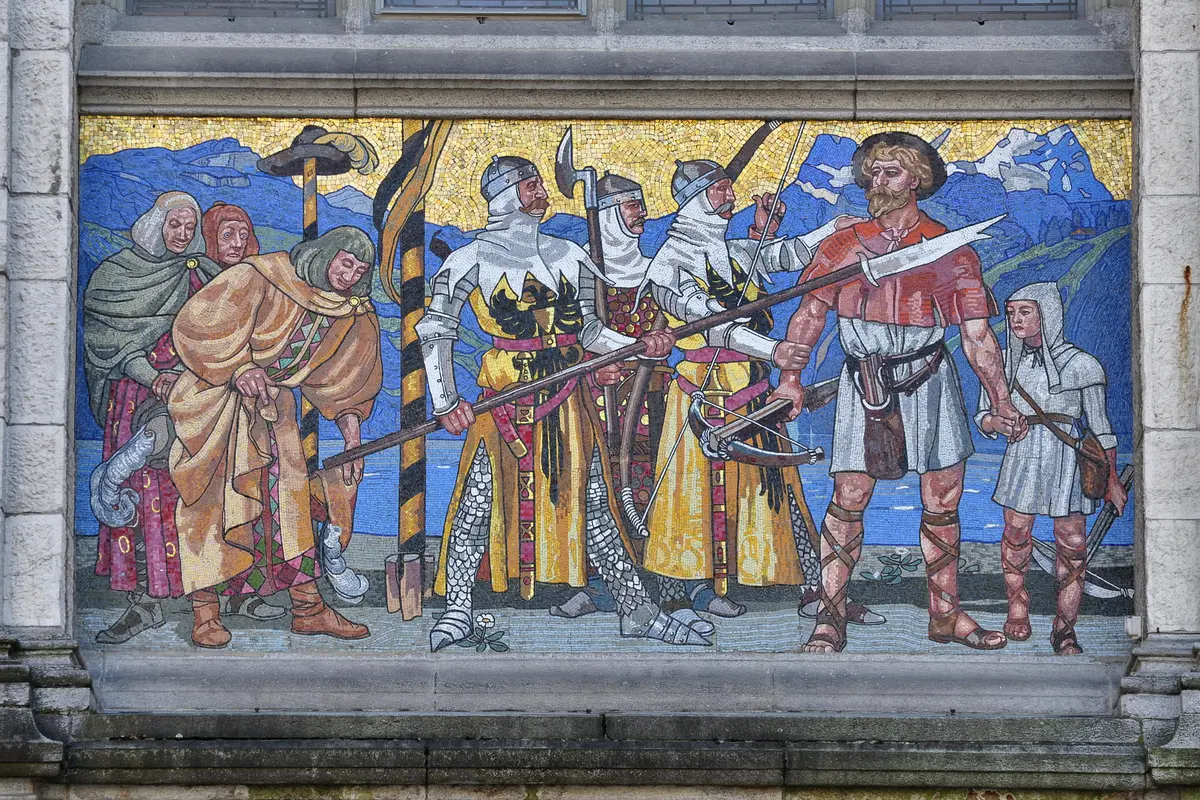
- 1901 Hans Sandreuter completes the mosaic 'Tell's arrest' (244.5 by 474 cm, inv. LM 59002) for the armoury facade of the Swiss National Museum in Zurich, one of fourteen he had won the commission for in 1897. He dies on 1 June of that year with the series unfinished. It is the image that illustrates this entry: the hat on its pole held out by cowed villagers, three men-at-arms in Habsburg surcoats, and Tell with his crossbow beside his son. Like Kissling's monument, it contains no apple.
Is there a rational explanation for William Tell and the Apple?
The spare arrow, and what it was for, is the oldest detail of the episode, and its oldest source is Danish.
Saxo Grammaticus finished the Gesta Danorum around 1200, some two hundred and seventy years before Hans Schriber picked up his pen. In Book X, chapter 7, a warrior named Toko boasts in his cups that he could hit an apple set at a distance on a stick, 'pomum quantumcumque exiguum baculo e distantia superpositum prima spiculi directione feriret'. King Harald Bluetooth has the man's son stood 'baculi loco', in the place of the stick, with the apple on his head. Toko turns the boy's face away so the sight of the missile will not frighten him, then draws not one spare shaft but two: 'Tribus deinde sagittis pharetra expeditis', three arrows out of the quiver, and the first hits. Asked why he took three when he only had one attempt, he answers: 'Ut in te primi errorem reliquorum acumine vindicarem, ne mea forte innocentia poenam, tua impunitatem experiretur violentia' — in Oliver Elton's translation of 1894, "That I might avenge on thyself the miss of the first with the point of the others, lest perchance my innocence might suffer and thy violence escape." Saxo then has Harald force Toko into a second ordeal, a headlong descent of the Kullen rock on boards strapped to his feet, which Toko survives; and in the following chapter Toko finally kills Harald with an arrow, from ambush, while the king has stepped into the bushes. Apple, spare arrows, defiant answer, a second forced ordeal survived, and a tyrant shot from cover: five elements, all in one Danish text, all more than two centuries before the Swiss one.
The standard free English Saxo serves the parallel short. Elton's translation stops at Book IX; Toko survives in it only as the first item of an appendix of 'Passages from Later Books', printed with an editorial ellipsis where Saxo's praise of father and son stood. The Kullen descent and Harald's death are left out, so Elton's English carries three of the five elements — the apple, the spare arrows and the answer — and drops the two that come after.
The Swiss knew this early and reacted badly. François Guillimann, who had reported the Tell story in his Swiss antiquities of 1598, wrote to Melchior Goldast in 1607 that on closer examination 'tout ce récit me paraît une pure fable'. In 1752 the Bernese pastor Uriel Freudenberger, through intermediaries, had a sceptical essay placed in the hands of the Uri parish vicar Johannes Imhoff at Schattdorf, with the mock-courteous suggestion that Uri refute him from the Tell documents it surely possessed. It took Imhoff seven years to answer: his papers went off on 30 May and 4 June 1759, and Ernst Ludwig Rochholz, who read them, called them adventurous trifles. On the strength of that emptiness Freudenberger published anonymously in 1760 the pamphlet known in German as Der Wilhelm Tell, ein dänisches Mährgen and in French as Guillaume Tell, fable danoise, which laid the Toko parallel out in print for the first time. The government of Uri had it burned publicly at Altdorf by the executioner and, on 4 June 1760, wrote to the other cantons pressing them to condemn it. Felix von Balthasar answered it officially with a Schutzschrift für Wilhelm Tell (Zurich, 1760), whose central argument was that nobody builds chapels over a fairy tale; Uri sent him a gracious letter and two gold medals. Rochholz's verdict in 1877 was that the counter-evidence hurriedly gathered in Uri to refute the pamphlet was 'nicht weniger Träume und Fälschungen' than the papers Imhoff had sent — no less dreams and forgeries.
One smaller thing can be checked with arithmetic, and it fails. Tschudi dates the shot to Monday, 19 November 1307; in the Julian calendar then in use, 19 November 1307 was a Sunday. This is not a general incapacity of his: his other date, the Rütli oath on 'the Wednesday before Martinmas' 1307, converts exactly to 8 November 1307, which was indeed a Wednesday. The distance changes with the teller. The Tellenlied says a hundred and twenty paces; Bartholomäus Anhorn, discussing the shot in his Magiologia of 1675, still says a hundred and twenty and worries whether it could be done without witchcraft; Schiller cut it to eighty.
The name is the neatest case of all. Schriber's manuscript has 'gesler', but the printed tradition that Switzerland actually read had Grissler for two centuries: Etterlin in 1507, Sebastian Franck in 1538, Stettler in 1627, Cysat in 1659, Steiner in 1684, Fäsi as late as 1765, and the inscription put up in the Küssnacht chapel in 1768. The switch back to Gessler comes with the eighteenth-century demand for documents, and the 1722 Zurich edition of Josias Simler's Regiment der Eydgnossenschaft states the reason out loud: of a family called Grisler nothing further can be found, but of the Gesslers plenty can — they held Brunegg castle and sold the lordship of Grüningen to Zurich in 1409. Rochholz put it bluntly: the chroniclers made of that name an instrument of continued historical fraud. None of this proves that nothing happened in Uri around 1300. It dates the telling, which is a different and more answerable question.
Can you visit William Tell and the Apple?
The pin for this entry is on the Rathausplatz in Altdorf, the capital of Uri, about 160 m south of the Tell Monument. Most of what can be visited here was built or dated long after the chronicles that tell the story.
The Tell Monument stands in the open on the Rathausplatz, at the foot of an old tower, and costs nothing to see. According to the canton of Uri, thirty artists entered the public competition of 1891, and in 1892 the Uri monument committee chose, unanimously, the model by the Solothurn sculptor Richard Kissling. The bronze was inaugurated at the festivities of 27 and 28 August 1895. It shows Tell with his crossbow on his shoulder, accompanied by his son Walter. The plinth carries the year 1307, Tschudi's date for the Rütli oath. The canton's own account presents that year as a reply to a federal decision: in 1891 the Federal Council decided to celebrate the alliance of 1291 with a festival in Schwyz, and Uri protested to it in vain. The canton writes that the Uri men then had 1307 cut into the plinth rather than 1291, to make clear who had led the founding of the Confederation. The painted background on the tower behind the statue is by Hans Sandreuter, the Basel artist who also made the mosaic that illustrates this entry.
About 110 m east of the monument, the Tellspielhaus on Schützengasse is where the Tellspielgesellschaft stages Schiller's play. The society's chronicle records the first Altdorf performance on 25 June 1899 in a temporary theatre on the Schützenmatte; the foundation stone of the present building was laid on 21 April 1924, and the first season in it followed in 1925. The building has belonged to the municipality of Altdorf since 1 January 1999, and the society performs there as a guest. Its productions come in seasons: the chronicle's latest is 2024, and the society announces the next, directed by Annette Windlin, for 2028.
Bürglen, where Tschudi placed Tell's home, lies about 1.6 km east-south-east of the monument in a straight line, and the Tell-Museum says a public bus stops at its door every half hour. The museum occupies the Wattigwiler tower at Klausenstrasse 139a, 6463 Bürglen, telephone +41 41 870 41 55, and the Tell-Museumsgesellschaft Uri, founded in 1956, has run it there since 1966. It says it holds more than five hundred documents and objects in which Tell is the subject. The 2026 season runs from 16 May to 18 October, Tuesday to Sunday, with Whit Monday also open. In May and June, and again in September and October, the hours are 10:00 to 11:30 and 13:30 to 17:00. In July and August the museum opens from 10:00 to 17:00 without a break. Adult admission is CHF 9; students pay CHF 7 and children CHF 5, while a family ticket costs CHF 16. In the winter half of the year it opens on request for groups of ten or more. The Tell chapel in the village was founded in 1582 by Hans Scherer and Peter Gisler on the spot where Tell's house is said to have stood. The museum grew out of an exhibition on that chapel's restoration of 1949–50, and it calls the chapel's paintings of 1588 the oldest pictorial cycle of the Tell story in the oldest surviving Tell chapel.
The Tellsplatte, the ledge onto which Tell is said to have leapt from Gessler's boat, is on the Uri arm of the lake in the municipality of Sisikon, about 6.2 km north-north-west of the monument in a straight line. Uri Tourismus says the chapel there can be reached by boat or by car as far as the Hotel Restaurant Tellsplatte, and that it lies directly on the Weg der Schweiz footpath. The present chapel was built in 1879–80. Its four wall paintings by the Basel painter Ernst Stückelberg run from the Rütli oath to the death of Gessler; Stückelberg had a studio in Bürglen, and the Tell-Museum holds a large collection of his work. According to the museum, Uri makes its annual pilgrimage to the chapel by boat on the Friday after Ascension. Both the museum and Uri Tourismus give 1388 as the date of a first chapel on the site. Rochholz, in 1877, traced that date to a testimony attributed to the Uri Landammann Hans Zumbrunnen, which the parish vicar Johann Imhoff brought to light only in 1759; he wrote that the document had "längst als eine Abenteuerlichkeit verurtheilt" — long since been condemned as an extravagance. He also quoted the three oldest chroniclers of the story word for word to show that none of them knows of any chapel on the slab. The first to mention a "Heilig-Hüsslin" there is Tschudi, who died in 1572.
Sources consulted
- Saxo Grammaticus, «Gesta Danorum, Liber X, cap. 7-8 (the Toko episode, Latin text)» — Latin text after the Holder edition, Latin Wikisource (consulted 2026); the episode is cited by Elton as Bk. x, p. 329, ed. Holder, 1200 book
- Hans Schriber, land-scribe of Obwalden, «Weisses Buch von Sarnen» — Sarnen, Staatsarchiv Obwalden, Sig. A.02.CHR.0003; 508 pages, the founding narrative on pp. 441-465; digitised by e-codices in 2012. The Middle High German passages quoted here are taken from G. von Wyss's 1856 separate printing as reproduced by Rochholz, 1470 archive
- Ernst Ludwig Rochholz, «Tell und Gessler in Sage und Geschichte. Nach urkundlichen Quellen» — Heilbronn, 1877 (full text, Internet Archive). Source of the White Book and Tellenlied quotations, of the Grisler/Gessler series from Etterlin to Fäsi, of Simler's 1722 remark, and of the Imhoff correspondence of 1759, 1877 book
- Oliver Elton (translator) and Frederick York Powell, «The First Nine Books of the Danish History of Saxo Grammaticus, Appendix I: Passages from Later Books of Saxo» — David Nutt, London, 1894 (full text, Internet Archive). The Toko episode appears only here, abridged, with the Kullen descent and the killing of Harald omitted, 1894 book
- Jean-Joseph Hisely, «Recherches critiques sur l'histoire de Guillaume Tell» — Mémoires et documents publiés par la Société d'histoire de la Suisse romande, vol. II, third issue, pp. 431-486, Lausanne, 1843 academic
- Friedrich Schiller, translated by Sir Theodore Martin, «Wilhelm Tell (English verse translation)» — Project Gutenberg ebook no. 6788; the eighty paces are spoken by Gessler in Act III, scene 3, 1804 book
- Wikimedia Commons; photograph by Roland zh, 20 September 2010, CC BY-SA 3.0, «Landesmuseum Zürich: mosaic 'Tells Verhaftung' by Hans Sandreuter, 1901 (file description page)» — commons.wikimedia.org, giving artist, date, medium, dimensions and inventory number LM 59002 (consulted 2026), 1901 web
- Tellspielgesellschaft Altdorf, «Chronik der Tellspiele Altdorf» — tellspiele-altdorf.ch, official site of the company (dates of 1512, 1899, 1924-25 and the announced TELL 2028 season; consulted 2026), 2026 web
- Bundesbrief Society, «The Federal Charter of 1291: history and provisions» — bundesbrief.org, English summary of the charter's clauses and of the surviving original kept at Schwyz (consulted 2026), 2026 web
- Tell-Museum Uri, Bürglen, «Tell-Museum Bürglen: visit, season and prices» — tellmuseum.ch, official museum site (2026 season, hours and admission; museum in the Wattigwiler tower since 1966), 2026 web
- Kanton Uri, «Telldenkmal – ein politisches Manifest: the 1891 federal decision to celebrate 1291 in Schwyz, Uri's unsuccessful protest, and the year 1307 cut into the plinth of the 1895 monument» — ur.ch, publications of the cantonal administration, 28 December 2018, 2018 web
- Kanton Uri, «Das Telldenkmal von Richard Kissling: the 1891 competition (thirty entrants), the committee's unanimous choice of 1892, and the inauguration of 27-28 August 1895» — ur.ch, publications of the cantonal administration, 28 December 2018, 2018 web
- Uri Tourismus AG, «Tellskapelle Sisikon: the present chapel of 1879/80, Stückelberg's four frescoes, and access by boat or by car to the Hotel Restaurant Tellsplatte» — uri.swiss, official tourist board of Uri (consulted 24 September 2026), 2026 web
Reviewed by V. Serrano on 2026-08-15 · How we verify our content
📎 Source: Enigma Atlas
💬 Field testimonies (0)
No testimonies yet. Add the first.
Add your testimony
🔒 Log in to add a testimony