🦶 CRYPTID SIGHTING · EXP. Nº8141
ACTIVE
Chupacabra
The chupacabra, literally "goat-sucker," is a legendary predator blamed for killing livestock and draining their blood through small puncture wounds, leaving carcasses oddly bloodless with no other visible trauma.
Where and when was Chupacabra sighted?
- Location
- Canóvanas, Puerto Rico
- Date sighted
- 1995-08-01
- Coordinates
- 18.379, -65.902
- Last updated
LOCATION
What is Chupacabra?
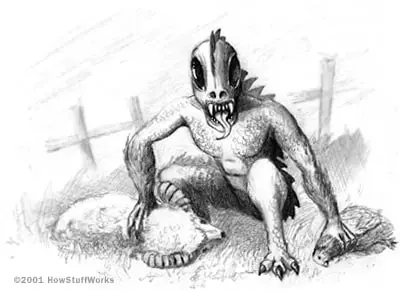
Descriptions of the creature differ sharply: early witnesses described a spiny, kangaroo-like reptilian biped with glowing red eyes, while later, especially in the continental United States, the name got attached to hairless, coyote-like animals suffering from mange. The panic began in Puerto Rico in 1995, when a wave of mysteriously mutilated farm animals swept the island, particularly around the town of Canóvanas, and quickly spread through Latin America and the American Southwest amid heavy media coverage. Veterinarians and biologists have generally attributed the killings to known predators such as dogs, coyotes and wild cats, with autopsies of suspected victims finding plenty of blood, and mangy canids photographed as "chupacabras" turning out to be ordinary animals with severe skin disease. It remains one of the most recognizable modern legends across Latin America.
What is the history of Chupacabra?
The chupacabra is probably the only cryptid of worldwide fame whose date of birth can be pinned down almost to the day. It is not a creature of old folklore: it dates from August 1995, and it came out of Puerto Rico.
That summer, farmers in Canóvanas, a municipality east of San Juan, found dead animals — goats, chickens, rabbits — with puncture wounds to the neck and, it was said, drained of blood. The phrase coined for whoever was responsible, chupacabras, "goat-sucker", was descriptive and it stuck immediately.
What turned that into a creature with a face was one specific account. During the week of 7 August 1995, a Canóvanas resident named Madelyne Tolentino said she had seen something outside her house. Her description is the one that founded the iconography: a figure between three and five feet tall, bipedal, with spines or a ridge running down its back and large eyes, black or red, alien-looking.
That description is the one that spread. From it the chupacabra stopped being an anonymous predator and became a recognisable character, and within a few years it had jumped from Puerto Rico to Mexico, Central America, the southern United States and from there to much of the world. It mutated on the way: across the American mainland, most of the supposed specimens described and photographed stopped being spined bipeds and became hairless, dog-like quadrupeds.
In thirty years the name has been applied to two physically incompatible creatures, and that inconsistency is one of the keys to understanding the case.
Timeline: the documented record of Chupacabra
- Summer 1995 Farmers in Canóvanas, Puerto Rico, find dead animals with puncture wounds to the neck. The name "chupacabras" is coined for the unknown culprit.
- Week of 7 August 1995 Madelyne Tolentino says she saw outside her house a bipedal figure three to five feet tall, with spines down its back and large dark eyes. Her description founds the chupacabra's iconography.
- July 1995 The film Species, whose creature Sil shares the key features of the description, had opened in US cinemas on 7 July 1995, about a month before the sighting. Tolentino herself later mentions the film and the resemblance.
- 2011 Benjamin Radford publishes Tracking the Chupacabra, arguing that Tolentino's description was shaped by the film: memory contamination rather than deliberate fabrication.
- 2025 Radford revisits the case and documents substantial inconsistencies between Tolentino's 1996 and 2010 accounts, but concludes that "we don't know, and can't conclusively prove, what (if anything) she saw".
Is there a rational explanation for Chupacabra?
The reference work on the chupacabra was done by the investigator Benjamin Radford, and his most-quoted conclusion is usually stated more forcefully than he states it himself.
Radford pointed out an uncomfortable resemblance: the creature Tolentino described — bipedal, thin, with spines or a ridge along the back and large dark eyes — looks remarkably like Sil, the creature from the film Species, which opened in US cinemas on 7 July 1995, about a month before her sighting in the second week of August. Tolentino herself made the connection in an interview of March 1996: "a movie called Species. It would be a very good idea if you saw it… It was a creature that looked like the chupacabra, with spines on its back and all."
Radford does not accuse Tolentino of lying; when he interviewed her in 2010 he found her "open, helpful, and sincere". His explanation is memory contamination: a frightening and unexplained experience unconsciously interpreted through a recently seen visual template, an explanation that requires bad faith from nobody.
In a review of the case published in Skeptical Inquirer in 2025, Radford added a further problem: substantial differences between the account Tolentino gave in 1996 and the one she gave him in 2010. In the first there were several potential witnesses — her mother, a local boy who worked for her husband, neighbours; in the second, only she and her mother. Physical details shifted too: three fingers in 1996, five human-looking fingers in 2010; "about four feet" tall in 1996, about three feet in 2010.
Radford does not close the case by claiming to know what happened. His conclusion is that "we don't know, and at this remove can't conclusively prove, what (if anything) she saw that day".
That leaves the second, mainland wave, and there the answer is physical. Radford dates the first dead, dog-like "chupacabra" to 2000, on a ranch outside Managua, Nicaragua; from about 2004 the carcasses came mostly from Texas and the American Southwest. His fact sheet counts about six recovered bodies, with "DNA results" showing "normal animals (mostly dogs and coyotes)". Writing in Live Science in 2012, he adds that the bodies were usually animals "stricken with a parasitic infection that caused the animal to lose its fur and take on a gaunt, monstrous appearance" — a caption to the article names mange — and that "when suspected chupacabra victims have been professionally autopsied, invariably they are revealed to contain plenty of blood".
Can you visit Chupacabra?
Canóvanas is a municipality in north-eastern Puerto Rico, and the pin on this file sits on its town centre, 25.5 km (15.9 miles) east-south-east of El Morro in Old San Juan in a straight line. Benjamin Radford, reviewing the case in the Skeptical Inquirer in 2025, calls it "a suburb of the capital, San Juan" and "a semi-rural area a few kilometers from the El Yunque rainforest". The sighting that fixed the creature's image happened at a private house: Radford interviewed Madelyne Tolentino in June 2010 at the home she then lived in and at the earlier residence where she had the sighting.
The nickname "El Pueblo del Chupacabras" owes much to the mayor of the time, José "Chemo" Soto Rivera, who in Radford's words "courted local press (and voters) by promising to protect the public from the terrifying menace". On 2 May 2011 El Nuevo Día reported Soto's proposal to put up a statue of the creature to draw shoppers to the town's outlet centre. The monuments that a Listín Diario travel piece described in May 2026 are to the cacique Canovanax, one of them in the Plaza de Recreo Juan Francisco Arroyo Salamán; the town's other name is "La Ciudad de los Indios".
El Yunque National Forest, the only tropical rainforest in the United States National Forest System, lies to the south-east. On 23 August 2023 the Forest Service stopped requiring an online reservation for the PR-191 recreation corridor: entry became first-come, first-served from 8:00, under an agreement with Puerto Rico's Department of Public Safety to police traffic on the road, as News is my Business reported at the time. A notice in the Federal Register of 8 September 2026 proposes charging $4 per person per day at La Mina and $10 for a three-day pass at the El Portal visitor centre, to take effect no earlier than six months after publication.
Sources consulted
- Mystery Wire, «Chupacabra! The real story behind the legendary creature» — Mystery Wire, 2020 newspaper archive
- Benjamin Radford, «Tracking the Chupacabra: The Vampire Beast in Fact, Fiction, and Folklore» — University of New Mexico Press, 2011 book
- Benjamin Radford, «Chupacabra revisited: dueling origin stories of the Hispanic vampire» — Skeptical Inquirer, 2025 academic
- Benjamin Radford, «Chupacabra fact sheet — resumen de la investigación» — benjaminradford.com, 2011 report
- Benjamin Radford, «Chupacabra: Facts about the Mysterious Vampire Beast — DNA of the carcasses, mange, blood found in autopsied victims» — Live Science, 2012 web
- The Numbers, «Species (1995) — Box Office and Financial Information: domestic release 7 July 1995» — Nash Information Services, 2026 web
Reviewed by V. Serrano on 2026-07-28 · How we verify our content
📎 Source: Enigma Atlas
💬 Field testimonies (0)
No testimonies yet. Add the first.
Add your testimony
🔒 Log in to add a testimony