🦶 CRYPTID SIGHTING · EXP. Nº6501
ACTIVE
Emela-ntouka
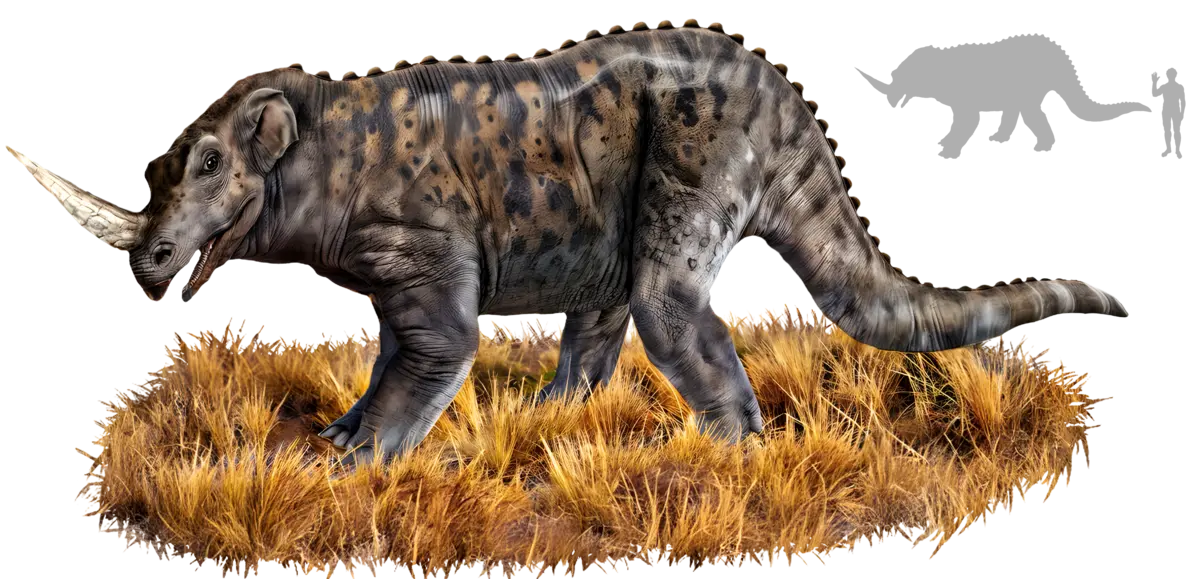
The emela-ntouka is an animal said to live in the swamp forests north of the Equator in the Republic of the Congo: elephant-sized, semi-aquatic, with a heavy tail and a single horn on its snout, and a reputation for goring elephants without eating them.
Where and when was Emela-ntouka sighted?
- Location
- Congo
- Date sighted
- Unknown
- Coordinates
- -0.5, 15.8
- Last updated
LOCATION
What is Emela-ntouka?
Its documentary trail is short and easy to check. In December 1954 the French colonial hunting inspector Lucien Blancou published in the journal Mammalia an article titled "A forest rhinoceros?", reporting hearsay gathered between October 1949 and October 1953 in the districts of Kellé, Ouesso, Epéna, Impfondo and Dongou: an animal larger than a buffalo which his informants did not give a horn to, a horned animal elsewhere, and a beast that sometimes disembowels elephants. He named no candidate but a rhinoceros, printed the verdict of the region's leading zoologists that it was "the survival of a myth", and admitted in 1963 that he had never even recorded a local name for it. The name emela-ntouka reaches print thirty years later, collected by the American biochemist Roy Mackal on his 1980-81 expeditions. It was Mackal, in 1987, who floated a surviving ceratopsian dinosaur — and Mackal who set the idea aside again in the same book.
What is the history of Emela-ntouka?
The animal that kills elephants has a paper trail, and it is short enough to read in an afternoon. It begins with a French colonial game inspector who spent fourteen years chasing the story and admitted, in print, that he never even managed to write down what the animal was called.
Lucien Blancou arrived in Brazzaville in October 1949 to take up the post of hunting inspector for the Moyen-Congo. He was not a naturalist by training but an administrator of the French colonial hunting service, and he ended his career as inspecteur en chef des Chasses d'Outre-Mer. His notes are taken seriously by professional mammalogists — Jonathan Kingdon cites him in East African Mammals, and the Rhino Resource Center, the standing bibliography of everything published about rhinoceroses, returns nineteen records for his name, among them at least eight papers of his own.
The article everyone cites is real, and its title is a question about a rhinoceros. "Notes sur les mammifères de l'Equateur africain français. Un Rhinocéros de Forêt?" ran in Mammalia volume 18, issue 4, December 1954, pages 358-363, between George Gaylord Simpson on mammal systematics and R. Verheyen on the black buffalo. I have read all six pages. What is in them is this.
Blancou opens with a hunting writer, Georges Trial, who published in Les Cahiers de chasse et de nature in 1952 an account of meeting a rhinoceros in the savannas of the Lower Ogooué, in Gabon, around 1930 — a claim the Gabonese specialists Blancou consulted greeted "with the greatest scepticism". He then works through the distribution maps of the late forester Louis Lavauden, which placed a rhinoceros population in the forest angle between Cameroon and French Equatorial Africa, and demonstrates that Lavauden never set foot there.
Then come the four years of hearsay that everything else is built on. "From October 1949 to October 1953," Blancou writes, "I obtained various corroborations, above all from Messrs Millet, Rolland and Rozan, administrators of Overseas France, concerning the existence of rhinoceroses in the great equatorial forest, in the districts of Kellé, Ouesso and Dongou, in the Moyen-Congo, always north of the Equator. This based on the reports of indigenous Africans." Three districts, three different animals:
- Kellé. "The Africans of the north of the Kellé district, and notably the Pygmies, know in the forest an animal larger than a buffalo, almost as large as an elephant, but which is not a hippopotamus, and whose tracks they see only at long intervals, but which they fear above all other dangerous animals. The track they drew, for the instruction of M. Millet, was that of a rhinoceros. On the other hand, they do not seem to attribute a horn to it. But they have not told us that the beast does not have one." During Claude Millet's posting at Kellé, in 1950, one of the best-known African chiefs of the district walked for several days to the post to report that "the beast had reappeared". Millet's offers of payment in kind for tangible proof produced nothing.
- Ouesso. "Around Ouesso, the local people do speak of a large animal with a horn on its nose (one or several, I do not know). They fear it as much as those of Kellé do."
- Epéna, Impfondo, Dongou. "The presence of a beast which sometimes disembowels elephants is also known, but would appear perhaps less current than in the preceding districts. A specimen is said to have been killed 20 years ago at Dongou, but on the left (Belgian) bank of the Ubangi river."
That is the whole of the testimony. Blancou's own summary: "All that is, admittedly, rather thin."
His article contains its own named sceptics, and he prints them. "I must say that my friends Maclatchy and Malbrant, co-authors of the excellent Faune de l'Equateur africain français, and who, to assemble the documentation of their work, investigated for 20 years, in every direction, in Gabon and the Moyen-Congo, cannot for the moment believe in this existence, and regard all information on the subject only as the survival of a myth: a unicorn, as is spoken of elsewhere." André Maclatchy and René Malbrant were the standing authorities on the fauna of the region. Blancou answers them with a question rather than a rebuttal — where would a forest unicorn have come from? — and closes with four hypotheses, of which the first is an unknown forest rhinoceros "very certainly different from the two African species of wooded savanna and steppe (Diceros bicornis and Ceratotherium simum)", and the second a relict related to the Asian forest rhinos, Rhinoceros sondaicus and sumatrensis. His last word on it is four syllables: "All that remains, obviously, to be proved."
Nine years later he came back to it, and gave the case away. In September 1963 Blancou published "Un rhinocéros africain forestier?" in the popular magazine La Vie des Bêtes (no. 62, pp. 24-27), noting that in the meantime only one person had bothered to take the material up: Bernard Heuvelmans, "the eminent specialist in 'Cryptozoology'", who summarised it in the English edition of On the Track of Unknown Animals. Blancou sketches what he thinks the animal would be — a small rhinoceros, 1 to 1.20 m at the shoulder and 2.40 to 2.70 m long, relatively smooth-skinned — wonders aloud whether to name it Didermocerus africanus and withdraws the idea himself as "a nomen nudum". And then, in a parenthesis, he writes the sentence that decides this page:
> "(I did not even have the opportunity to have its name or names in local dialects made precise: people spoke of 'the beast', that is all, and that is an unforgivable gap as far as I am concerned.)"
Blancou never recorded a name. Not emela-ntouka, not any other. The word does not appear in the 1954 article — I read every page of it looking — and in 1963 its author says so himself.
The name arrives thirty years later, with an American biochemist. Roy P. Mackal, of the University of Chicago, went to the Likouala in 1980 and 1981 looking for Mokele-mbembe and came back with a second animal. In A Living Dinosaur? In Search of Mokele-Mbembe (E. J. Brill, 1987) he gives it chapter 17 and writes: "The Bomitabas refer to the creature as Emela-ntouka, but it has various other names. The name Aseka-moke is also encountered here and there, and Ngamba-namae is yet another (but less often heard) name. Around Lake Tele the term used is Emia-ntouka." It is Mackal, not Blancou, who joins the two: after quoting Heuvelmans's translation of the 1954 article he adds, "The latter part of this report clearly refers to the Emela-ntouka" — the latter part being Epéna, Impfondo and Dongou. Karl Shuker, in In Search of Prehistoric Survivors (1995), is equally careful with his verb: "It must also be the creature noted in a Mammalia article (December 1954) by Lucien Blancou." Must be. An inference by two later authors, not a datum from 1954.
The dinosaur is Mackal's, it is 1987, and it is a hypothesis he then drops. Chapter 17 works through the rhinoceros idea, stumbles on the reported heavy tail and on the claim that the horn looks like ivory, and turns to the ceratopsians, settling on Monoclonius and Centrosaurus — the single-horned, short-frilled line — because a nasal horn of fused bone cannot be torn off, as a rhinoceros horn can. He then finds the difficulty he cannot solve: ceratopsians laid eggs, and no informant ever mentioned eggs. His verdict on page 246 is "the Ceratopsian hypothesis remains viable, if improbable", and his final summary on page 295 is not a dinosaur at all: the emela-ntouka is "most probably a variety of a semi-aquatic rhinoceros". The Congolese Triceratops of a thousand websites is Mackal misread.
Who did keep the dinosaur is on the record. In November 2000 the creationist authors William J. Gibbons and Dave Woetzel interviewed Baka informants in southern Cameroon with animal picture cards. Gibbons's own report, published by the Institute for Creation Research, states the outcome plainly: "Our witnesses immediately picked out a picture of the triceratops as being a dead ringer for this animal which is reputed to kill and disembowel elephants." Woetzel's ministry, Genesis Park, files the emela-ntouka in an exhibit called "The Ceratopsian Enclave".
One last thing about the source, said in his own words. Blancou closes the 1954 article by arguing that whoever solves the puzzle will have to work with the forest peoples rather than around them: "It is no longer a matter of quickly earning one's stripes as an 'explorer' by filming 'tamed' Pygmies." The scare quotes are his. He is describing his contemporaries' habits; he is also describing an enquiry conducted entirely through French administrators, in which the Bomitaba, the Aka and their neighbours appear as informants relayed at second hand, and never as authors. That is the shape of the record we have, and it is worth saying out loud before anyone treats it as folklore collected in the field.
Timeline: the documented record of Emela-ntouka
- c. 1930 The hunting writer Georges Trial says he met a rhinoceros in the savannas of the Lower Ogooué, in Gabon. He publishes it only in 1952; Blancou reports that the Gabonese specialists he consulted received it "with the greatest scepticism".
- January 1931 Géraud de Galassus, colonial administrator, tells Blancou that rhinoceroses exist in the forest in the south of the Batouri subdivision, eastern Cameroon, around 4°N. Blancou records it without attaching importance to it.
- October 1949 Blancou reaches Brazzaville as hunting inspector for the Moyen-Congo. The administrator Claude Millet, then head of the Kellé district, tells him vehemently of an unclassified large animal in his territory. Blancou's four years of enquiry begin here.
- 1950 One of the best-known African chiefs of the Kellé district walks several days to the post to tell Millet that "the beast had reappeared". Millet offers the Kellé forest peoples payment in kind for tangible proof of the animal. Nothing is produced.
- December 1954 Lucien Blancou publishes "Un Rhinocéros de Forêt?" in Mammalia 18(4): 358-363. He reports an animal "larger than a buffalo" at Kellé to which informants give no horn, a horned animal at Ouesso, and a beast that "sometimes disembowels elephants" at Epéna, Impfondo and Dongou. He names no local word for any of them, and prints the verdict of the region's leading zoologists, Maclatchy and Malbrant: "the survival of a myth: a unicorn".
- September 1963 Blancou returns to the case in La Vie des Bêtes no. 62. He notes that only Heuvelmans has picked the material up, imagines a small rhinoceros 1-1.20 m at the shoulder, floats and withdraws the name Didermocerus africanus as a nomen nudum — and concedes in a parenthesis that he never obtained a local name: "people spoke of 'the beast', that is all, and that is an unforgivable gap as far as I am concerned".
- 1980-1981 Roy P. Mackal, of the University of Chicago, mounts two expeditions to the Likouala in search of Mokele-mbembe and collects, from Bomitaba informants, the name Emela-ntouka — together with Aseka-moke, Ngamba-namae and, around Lake Tele, Emia-ntouka.
- March 1984 The French wildlife photographer Yvan Ridel sends Heuvelmans and Mackal photographs of a footprint trail. Heuvelmans replies that it looks "superficially like a rhino footprint" but with too sharp a middle toe, that no rhinos are known within 1,000 miles of the Congo, and that the trail appears to have been made by a biped.
- 1987 Mackal publishes A Living Dinosaur? Chapter 17 is the first appearance of the name in a book. He proposes a single-horned ceratopsian, Monoclonius or Centrosaurus, calls the idea "viable, if improbable" because ceratopsians laid eggs and no informant mentioned eggs, and concludes on page 295 that the animal is "most probably a variety of a semi-aquatic rhinoceros".
- 1999 Loren Coleman and Jerome Clark's Cryptozoology A to Z states that "Emela-ntouka is Lingala for 'Killer of Elephants'" — a different language from the Bomitaba to whom Mackal, who collected the word, attributed it.
- November 2000 In southern Cameroon, the creationist authors William J. Gibbons and Dave Woetzel interview Baka informants with animal picture cards. Gibbons reports that "our witnesses immediately picked out a picture of the triceratops as being a dead ringer for this animal which is reputed to kill and disembowel elephants".
- 24 August 2001 Alfred Roca, Nicholas Georgiadis, Jill Pecon-Slattery and Stephen O'Brien publish in Science the nuclear DNA evidence from 195 wild elephants that splits the African elephant into two species, recognising Loxodonta cyclotis, the forest elephant of the Congo Basin, as distinct from Loxodonta africana.
- 2018 John Poulsen and colleagues review the position of the forest elephant in Conservation Biology: "Poaching is rapidly extirpating African forest elephants (Loxodonta cyclotis) from most of their historical range, leaving vast areas of elephant-free tropical forest."
- August 2020 Mahmoud Haddara and colleagues publish from a Médecins Sans Frontières trauma centre in Burundi the largest clinical series of hippopotamus bite injuries on record — eleven patients — and state that the true magnitude and burden of hippopotamus attacks "are still unknown".
Is there a rational explanation for Emela-ntouka?
Our own page used to open with a provenance clause: that the name "entered print in 1954, when former colonial wildlife administrator Lucien Blancou described the animal in the journal Mammalia as 'larger than a buffalo' and capable of killing elephants, buffalo or hippopotamuses when startled, drawing on earlier local reports from the 1930s". Every element of that sentence can be checked, and it fails in four places.
The article exists. Mammalia 18(4), December 1954, pages 358-363: "Notes sur les mammifères de l'Equateur africain français. Un Rhinocéros de Forêt?" It is indexed by the publisher and the scan is free at the Rhino Resource Center. So far so good.
The phrase exists, and it is attached to the wrong animal. "Plus gros qu'un buffle, presque aussi gros qu'un éléphant" is Blancou's, and Heuvelmans translated it accurately. But it belongs to the Kellé paragraph, and the Kellé animal is the one Blancou says the informants do not give a horn to. Our sentence welded the size of the hornless animal to the horn of the animal reported two paragraphs later at Ouesso, and to the elephant-disembowelling of a third animal at Epéna, Impfondo and Dongou — the only one Mackal himself identified as the emela-ntouka. The fact was not invented. It was assembled backwards.
The buffalo and the hippopotamuses are not in Blancou at all. He wrote that the beast "sometimes disembowels elephants". Buffalo and hippopotamus come from Mackal's informants in the 1980s. And "drawing on earlier local reports from the 1930s" reverses the chronology: Blancou dates his corroborations precisely, October 1949 to October 1953. The only 1930s item in the article is a specimen said to have been killed "20 years ago" at Dongou, and Blancou is careful to say it happened on the Belgian bank of the Ubangi, in another country.
And the central claim is contradicted by its own source. The name did not enter print in 1954, because Blancou did not have it. He says so himself in 1963, in a parenthesis in La Vie des Bêtes: he never had the chance to get the animal's name or names in local languages recorded — "people spoke of 'the beast', that is all, and that is an unforgivable gap as far as I am concerned". The word emela-ntouka first appears in print, as far as I can date it, in Roy Mackal's book of 1987, collected on his expeditions of 1980-81.
On the etymology, this page now says nothing, and that is the honest position. The gloss "killer of elephants" is repeated everywhere, but it does not survive contact with the sources. Mackal offers two incompatible translations in the same paragraph — the animal "is sometimes referred to as the 'water-elephant' or 'killer of elephants'" — and gives no linguistic authority for either. He attributes the word to the Bomitaba, a Bantu people of the Likouala; Loren Coleman and Jerome Clark's Cryptozoology A to Z (1999) states flatly that "Emela-ntouka is Lingala for 'Killer of Elephants'". Those are different languages. I could not consult a Bomitaba lexicon; the closest documented relative I could read in full is John Whitehead's Grammar and Dictionary of the Bobangi Language (1899), on the same river system. That dictionary has an entry for "elephant" — nsoku, headword nzoku — and an entry for "kill" — bôma — and it also has ntoka/ntuka, which means "pawn, pledge, security". In Lingala, elephant is likewise nzoku. In other words: the lexicon works, the words I needed are in it, and nothing in it supports the gloss. That is not proof that no speaker has ever used the phrase; it is a reason not to print a translation we cannot source. Until someone points to the word inside a Bomitaba or Lingala dictionary, this page carries no etymology.
The zoology, with names. Blancou's own candidate was a rhinoceros, and he understood the problem better than his successors. The two African species, Diceros bicornis and Ceratotherium simum, are animals of wooded savanna and steppe; he says so in 1954. In 1963 he does the arithmetic that settles it: for Trial's Gabon rhinoceros to be a stray, it would have had to cross the forest from the north (Oubangui-Chari, Chad, Cameroon) or come from the south, from southern Angola, "across at least 1,800 kilometres of savanna, some of it heavily peopled, and from which rhinos disappeared several hundred years ago". Heuvelmans, writing privately to Mackal about photographed footprints in 1984, put the same point in a sentence: "no rhinos were known to be found less than 1000 miles away from the Congo".
What does live in those swamps is Loxodonta cyclotis, the African forest elephant, recognised as a species distinct from Loxodonta africana by Alfred Roca and colleagues in Science in 2001 on the strength of nuclear DNA from 195 wild elephants. Jonathan Poulsen and co-authors summarised its position in Conservation Biology in 2018 in eight words: "Poaching is rapidly extirpating African forest elephants from most of their historical range." Nothing in the Likouala disembowels elephants at scale except people with rifles.
The hippopotamus, Hippopotamus amphibius, does kill humans, and here the honest report is that nobody knows how many. The widely circulated annual death tolls have no traceable source. The largest published clinical series I can find is eleven patients, reported by Mahmoud Haddara and colleagues from a Médecins Sans Frontières trauma centre in Burundi in 2020, whose opening line is that hippopotamus attacks "have long been recognized to cause serious injuries, but its magnitude and burden are still unknown". A dangerous animal that is genuinely under-documented sits a few metres away from a legendary one that is over-documented, and only the legendary one gets written about.
The fights, incidentally, go the other way. The examples are in Mackal's own book: in Kruger National Park a rhinoceros bull was left dead in pools of blood after a fight with an elephant, and C. A. W. Guggisberg watched a hippopotamus in Tsavo pull a drinking rhinoceros down by the right foreleg and tear it apart. A one-horned animal that habitually kills elephants and hippopotamuses is not a gap in African zoology; it is a reversal of it.
What is on the table as of August 2026. No specimen, no bone, no horn, no photograph of the animal. The nearest thing to physical evidence is a set of footprint photographs taken by the French wildlife photographer Yvan Ridel and sent to Heuvelmans and Mackal in 1984; Heuvelmans's own reading was that they looked "superficially like a rhino footprint" but with too sharp a middle toe, and that the trail appeared to have been made by a biped — which is not what anyone is arguing for. There is no article on the emela-ntouka in the English or Spanish Wikipedia, while a search for "mokele-mbembe" returns 68 English articles. And the interviewing method that produced the modern record is the one its own users have described: picture cards, shown by expedition members who already knew which answer they wanted. Gibbons printed the result in 2002 without noticing what it demonstrates — that the same informants, shown the same deck, will identify a triceratops as a local animal.
Can you visit Emela-ntouka?
Nothing on the ground is marked, and what this page can give instead is the box Blancou drew: he was precise about it and everything since has been vaguer.
In the 1954 article he confines the whole question to "the great dense humid forest, between the Equator and the 3rd degree North and from the 12th to the 18th degree of longitude East", an area he sizes as "a third of the extent of France" [1]. His informants were in five named places, and the modern administrative geography of the Republic of the Congo follows them without difficulty: Kellé, today in the Cuvette-Ouest department; Ouesso, capital of the Sangha; and Epéna, Impfondo and Dongou in the Likouala, the last two on or near the Ubangi. Impfondo is the departmental capital and the practical air gateway to the region from Brazzaville. Blancou repeats one constraint twice and never relaxes it: always north of the Equator.
The map pin on this file sits at 0.5 S and 15.8 E. That is some 55 km south of the Equator, outside the rectangle Blancou drew. English Wikipedia places Kellé itself at 0°3′39″S 14°29′16″E, about 7 km south of the Equator, so the westernmost district he named also falls outside his own northern limit.
Part of the region carries a British travel warning. The FCDO, the British foreign ministry, advises against all travel to within 50 km of the Republic of Congo-Central African Republic border in the Likouala region. That strip takes in Dongou and the upper Ubangi, two of the places Blancou named. The page carries an update date of 2 June 2026 and was consulted on 10 September 2026 [12]. A visa must be obtained in advance, a yellow fever certificate is required to clear the border and malaria is present year-round.
The Lake Tele route is a different trip. The Mokele-mbembe expedition itinerary runs from Brazzaville to Impfondo by air; from Impfondo to Epéna by road; from Epéna to Boha by river; and from Boha 50 km on foot. It crosses the same department, and the two animals are routinely sold as one package although their paper trails have nothing in common. The Lac Télé Community Reserve is a co-managed protected area; entry needs permits and community fees.
Both of Blancou's articles are free scans on the Rhino Resource Center, the rhinoceros bibliography maintained by Kees Rookmaaker. The 1954 paper in Mammalia runs to six pages [1] and the 1963 piece in La Vie des Bêtes to four [2]; both are in French. Between them they hold everything that genuinely dates from 1949 to 1953. A Living Dinosaur? (1987) by Roy Mackal [3] and In Search of Prehistoric Survivors (1995) by Karl Shuker [4] can be read in full on the Internet Archive; chapter 17 of the first is where the name enters the literature. John Whitehead's Grammar and Dictionary of the Bobangi Language (1899) is on the Internet Archive too, with the elephant entry at the headword Nzoku [5]. The Institute for Creation Research still publishes Gibbons's expedition report [6] and Genesis Park still runs its "Ceratopsian Enclave" exhibit [11], both first-party documents about who has been doing the asking.
The Likouala and Sangha forests hold western lowland gorillas and forest elephants, over one of the largest peatland complexes on earth.
Sources consulted
- Lucien Blancou, «Notes sur les mammifères de l'Equateur africain français: Un Rhinocéros de Forêt? — the primary source. Six pages read in full: the Kellé animal "plus gros qu'un buffle" to which informants give no horn, the horned animal at Ouesso, the beast that "éventre quelquefois les éléphants" at Epéna, Impfondo and Dongou, the corroborations dated October 1949 to October 1953, and the verdict of Maclatchy and Malbrant that it is "la survivance d'un mythe: une licorne". The words emela-ntouka do not occur.» — Mammalia, vol. 18, no. 4, pp. 358-363; scan hosted by the Rhino Resource Center, 1954 academic
- Lucien Blancou, «Un rhinocéros africain forestier? — Blancou returns to the case nine years later and concedes, in a parenthesis, that he never recorded a local name: "Je n'ai même pas eu l'occasion de faire préciser son ou ses noms en dialectes locaux: on a parlé de « la bête », c'est tout, et c'est une lacune impardonnable en ce qui me concerne." Also his arrival in Brazzaville in October 1949, the administrator Claude Millet, the small rhinoceros he imagines, and the 1,800 km of savanna a stray would have had to cross.» — La Vie des Bêtes, no. 62 (September), pp. 24-27; scan hosted by the Rhino Resource Center, 1963 newspaper archive
- Roy P. Mackal, «A Living Dinosaur? In Search of Mokele-Mbembe — chapter 17 "Emela-ntouka: Killer of Elephants", the first book appearance of the name; the attribution to the Bomitaba and the variants Aseka-moke, Ngamba-namae and Emia-ntouka; Heuvelmans's translation of Blancou 1954 at p. 237 and Mackal's own claim that "the latter part of this report clearly refers to the Emela-ntouka"; the ceratopsian hypothesis and its retraction at p. 295 in favour of "a variety of a semi-aquatic rhinoceros"; the Kruger and Tsavo fights; Ridel's footprints and Heuvelmans's letter at p. 316.» — E. J. Brill, Leiden; full text on the Internet Archive, 1987 book
- Karl P. N. Shuker, «In Search of Prehistoric Survivors: Do Giant "Extinct" Creatures Still Exist? — pp. 28-30, the emela-ntouka and the chipekwe. Shuker quotes the Epéna/Impfondo/Dongou passage of Blancou 1954 and writes "It must also be the creature noted in a Mammalia article", attributing the ceratopsian idea explicitly to Mackal's own investigations. His bibliography carries the full Mammalia citation.» — Blandford, London; full text on the Internet Archive, 1995 book
- John Whitehead, «Grammar and Dictionary of the Bobangi Language — the lexicographic control. In the closest well-documented relative of Bomitaba on the same river system: "Elephant, n., nsoku" (headword Nzoku); "Kill, vt., bôma"; and "Ntoka, n., pawn, pledge, security". Nothing in it supports the gloss "killer of elephants".» — Baptist Missionary Society / Kegan Paul, London; full text on the Internet Archive, 1899 book
- William J. Gibbons, «In Search of the Congo Dinosaur — first-party report of four creationist expeditions (1985-2002), including the November 2000 Cameroon interviews in which "our witnesses immediately picked out a picture of the triceratops as being a dead ringer for this animal which is reputed to kill and disembowel elephants".» — Institute for Creation Research, 2002 report
- Alfred L. Roca, Nicholas Georgiadis, Jill Pecon-Slattery and Stephen J. O'Brien, «Genetic evidence for two species of elephant in Africa — nuclear DNA from 195 free-ranging elephants in 21 populations supports recognition of Loxodonta cyclotis, the forest elephant, as a species distinct from Loxodonta africana.» — Science, vol. 293, no. 5534, pp. 1473-1477, 2001 academic
- John R. Poulsen, Cooper Rosin, Amelia Meier and colleagues, «Ecological consequences of forest elephant declines for Afrotropical forests — "Poaching is rapidly extirpating African forest elephants (Loxodonta cyclotis) from most of their historical range, leaving vast areas of elephant-free tropical forest."» — Conservation Biology, vol. 32, no. 3, pp. 559-567, 2018 academic
- Mahmoud M. Haddara, Jean-Baptiste Haberisoni, Miguel Trelles and colleagues, «Hippopotamus bite morbidity: a report of 11 cases from Burundi — the largest published clinical series of hippopotamus attacks, from a Médecins Sans Frontières trauma centre; states that although such attacks are known to cause serious injuries, "its magnitude and burden are still unknown".» — Oxford Medical Case Reports, 2020(8), omaa061, 2020 academic
- Loren Coleman and Jerome Clark, «Cryptozoology A to Z: The Encyclopedia of Loch Monsters, Sasquatch, Chupacabras and Other Authentic Mysteries of Nature, entry "Emela-ntouka" (p. 83): "Emela-ntouka is Lingala for 'Killer of Elephants'" — the competing language attribution.» — Fireside / Simon & Schuster, New York, 1999 book
- Genesis Park (Dave Woetzel), «The Emela-ntouka of the Congo — creationist exhibit filed under "The Ceratopsian Enclave": the name given as "literally 'killer of elephants'", Mackal's Centrosaurus/Monoclonius identification presented without his retraction, and further neck-frill reports gathered by "Genesis Park staff during a recent expedition to Cameroon".» — genesispark.com, 2026 web
- Foreign, Commonwealth and Development Office, «Republic of Congo travel advice — regional risks and entry requirements (consulted 11 August 2026): "FCDO advises against all travel to within 50km of the Republic of Congo-Central African Republic border in Likouala Region"; visa required in advance; yellow fever certificate required to clear border control. Page last updated 2 June 2026.» — gov.uk, 2026 web
Reviewed by V. Serrano on 2026-08-11 · How we verify our content
📎 Source: Enigma Atlas (folclore)
💬 Field testimonies (0)
No testimonies yet. Add the first.
Add your testimony
🔒 Log in to add a testimony