🦶 CRYPTID SIGHTING · EXP. Nº6501
ACTIVE
Lindworm
A lindworm is the serpent-dragon of Northern European tradition: wingless, or with a single pair of clawed forelimbs, coiled around a hoard, and known in Sweden as lindorm or drake.
Where and when was Lindworm sighted?
- Location
- Escandinavia, Sweden
- Date sighted
- Unknown
- Coordinates
- 60.0, 15.0
- Last updated
LOCATION
What is Lindworm?
It has never been a candidate species. In the ballads and wonder tales it is usually a benevolent enchanted prince; in the folk belief of Värend, written down by Gunnar Olof Hyltén-Cavallius between 1863 and 1868, it is a dead man, someone who buried treasure in secret and turned into a serpent when he died, while a woman who did the same became a large black hen. And it is a picture: the dragon-loop of the runestones, of which the eleventh-century Ramsund carving near Eskilstuna is the best known. One man did try to move it into zoology, and left the paperwork behind. In a memorandum to the Royal Swedish Academy of Sciences signed on 29 October 1883 and printed at his own expense in 1884, the same Hyltén-Cavallius asked for the lindorm to be restored to the Swedish fauna, and offered from one hundred up to one thousand kronor for a dead specimen delivered at his farm. Nobody ever collected it.
What is the history of Lindworm?
A lindworm is not an animal that someone once claimed to have discovered. It is a figure of Northern European tradition with three distinct lives — a tale, a belief and a heraldic device — and each of them can be read in printed sources with an author and a date.
The first life is the tale. The Swedish encyclopaedia Nordisk familjebok (Uggleupplagan, vol. 16, 1912, cols. 645-646) opens its entry Lindorm with the creature of medieval heroic poetry, ballads and chivalric romance, and adds a detail that later monster books drop: "Den skildras oftast som ett godt, mot människan välsinnadt väsen" — it is most often described as a good being, well disposed towards people. Those lindworms are usually enchanted princes who recover their human shape through love, as in the ballad Lindormen printed by Geijer and Afzelius, and in the wonder tale Kong Lindorm studied by Axel Olrik in Danske Studier in 1904. The same entry disposes of the commonest piece of folk etymology attached to the name: the idea that lindworms live under lime trees (Swedish lind) arose from a false reading of the word, whose first element is the old term for a snake (Old High German lint, Old Norse linnr).
The second life is the belief, and it was written down by the man who would later try to turn it into zoology. In Wärend och Wirdarne (Stockholm, 1863-1868), Gunnar Olof Hyltén-Cavallius placed the drake — the Värend name for the lindorm — not among the animals but in his chapter on heathen belief, under the heading of what becomes of a human being after death. His § 114, on page 461 of the first volume, is unambiguous: "Var skattgömmaren en man, så förvandlade han sig efter döden till en stor Orm eller Drake" — if the person who buried treasure in secret was a man, after death he turned into a great serpent or dragon, and lies brooding over his money in an old cairn. By day he is a serpent as thick as a man's thigh, with a cloven tail and a mane running down his back like a horse's; on calm autumn nights he flies between the burial mounds as a great fiery besom, at treetop height, throwing sparks. And § 115 completes the system: if the treasure-hoarder was a woman, she took the shape of a large black hen. The dragon and the black hen are the same belief, told about the same dead people, in the same paragraphs of the same book.
The third life is the image, and it is the oldest thing here. Hyltén-Cavallius himself listed it in 1884: the dragon of the north survives "afbildad i vikingens drak-skepp och i runstenarnes drak-slingor" — carved on Viking ships and in the dragon-loops of the runestones. The best known of those loops in Sweden is the Ramsund carving, Sö 101, cut into a rock face at Ramsundsberget by Sundbyholm, in Jäder parish, about ten kilometres north-east of the centre of Eskilstuna. The runic corpus dates it by carving style (Pr1) to roughly 1010-1040 and reads its picture field as episodes from the story of Sigurd Fafnesbane: Sigurd, from below, drives his sword through the beast whose coiled body is the band that carries the inscription — and the inscription itself is about a bridge, made by a woman named Sigrid, daughter of Orm and mother of Alrik, for the soul of Holmger. It is worth being exact about this: the animal on the rock is Fáfnir, named as such in the Norse texts, and no carver labelled him a lindworm. What Sö 101 documents is the serpent-dragon as a visual convention of eleventh-century Sweden, which is precisely what the word describes.
The Central European branch of the same figure, the Lindwurm, has its own monument and its own fossil. Klagenfurt, in Carinthia, used a dragon on a tower as its city seal from 1287, and a verse beneath the arms in the town's Schützenbuch of 1608 states plainly where the city was thought to have got its name: "Ein Lindwurm gantz ungeheuer … Im Zollfelt sollicher da lag … Davon sie iren namen hatt". Between 1590 and 1593 a sculptor carved a seven-and-a-half-metre dragon from a single block of chlorite schist from the Kreuzberg quarry and three hundred boys hauled it into the new square on rollers; the Hercules who threatens it with a club was added only in 1636. And in the town hall there hung on a chain, for centuries, a colossal skull said to be the dragon's own.
Timeline: the documented record of Lindworm
- c. 1010-1040 The Ramsund carving (Sö 101) is cut into a rock face at Ramsundsberget by Sundbyholm, in Jäder parish near Eskilstuna. Dated by carving style (Pr1) to the first half of the eleventh century, it shows Sigurd killing the dragon Fafnir, whose coiled body forms the band carrying an inscription about a bridge made by a woman named Sigrid, daughter of Orm and mother of Alrik, for the soul of Holmger.
- 1287 The oldest known form of the seal of the city of Klagenfurt, showing a dragon on a tower, appears on documents. Puschnig treats it as documentary proof that the Lindwurm legend existed in Carinthia in the thirteenth century, well before any recorded fossil find.
- 24 September 1414 A deed records Margareth die Verberin, abbess of the convent of St Clare at St Veit, exchanging a field "bei der Lindgrube am Zollfelde". The place name of the gravel pit later called the Lindwurmgrube is therefore documented before any dated account of the skull.
- 1590-1593 According to an old manuscript reported by Heinrich Hermann in 1824, work on the Klagenfurt Lindwurm begins in the Kreuzberg quarry in 1590 and the seven-and-a-half-metre dragon is finished three years later and hauled into the Neuer Platz on rollers by three hundred boys. The Hercules is set up only in 1636, its sculptor Michael Hönel documented by an account of 1633.
- 1608 The Klagenfurt Schützenbuch carries, beneath the city arms, the verse "Ein Lindwurm gantz ungeheuer … Im Zollfelt sollicher da lag … Davon sie iren namen hatt". Puschnig identifies it as the oldest written record of the Klagenfurt Lindwurm legend then known.
- 1840 Franz Unger, having been shown the colossal skull hanging on a chain in the Klagenfurt town hall archive, identifies it as Rhinoceros tichorhinus Cuvier and publishes his note in the Steiermärkische Zeitschrift; he adds that the fossil evidently lay before the maker of the monument, and asks whether the hollow on the Zollfeld locally called the Drachengrube might be where it was dug up.
- 8 February 1849 The Klagenfurt city council agrees to hand the "Lindwurmkopf" over to the newly founded Naturhistorisches Landesmuseum on condition that it always remain in Carinthia. The transfer is completed later that year; the skull is today in the kärnten.museum.
- 1863-1868 Gunnar Olof Hyltén-Cavallius publishes Wärend och Wirdarne. In § 114, within his chapter on heathen belief and what becomes of a human being after death, the drake or lindorm is a man who buried treasure in secret and turned into a serpent when he died; in § 115 a woman who did the same becomes a large black hen.
- 29 October 1883 At Sunnanvik, Hyltén-Cavallius signs his memorandum to the Royal Swedish Academy of Sciences. Not being a zoologist, he declines to judge the accounts himself, asks that the witnesses be re-examined by one, and proposes a reward for the delivery of a specimen so that "the most feared and most famous reptile of the Nordic ancient world" might be restored to the Swedish fauna.
- 5 May 1884 At Jäthsberg, M. Bergström swears before the witnesses A. W. Rappe and Arthur Hofstedt that he killed a glossy black snake some ten feet long, thick as a man's thigh and maned at the neck, with an oar; he dragged the stinking carcass to the water's edge and never found it again. His statement is one of the accounts printed in the memoir.
- 20 May 1884 The reward notice is dated at Torne, Sunnanvik, and printed on the last leaf of the pamphlet: from one hundred up to one thousand kronor for a dead specimen delivered at Sunnanvik farm, according to its size and condition, freshly killed or in a tight cooper's vessel filled with spirits. It was never claimed.
- 1885 A second, enlarged edition of the memoir appears with forty-eight sworn accounts attached. No specimen is ever produced, and Swedish zoology takes no position beyond silence.
- 1912 The entry Lindorm in the Uggleupplagan of Nordisk familjebok records the memoir, allows that its detailed descriptions have a certain interest, and calls its subject "detta fantasidjur" — this fantasy animal. The same entry separates the ballad and wonder-tale lindworm, usually a benevolent enchanted prince, from the heraldic figure.
- 5 November 1935 With permission from the Klagenfurt building office, Roman Puschnig measures the stone head of the monument early in the morning, having already measured the fossil in the museum. His study confirms that the skull served as the model, but records that the find date and find spot are unproven, that the attribution to Ulrich Vogelsang is a guess he himself started in 1917, and that Othenio Abel had withdrawn, after Puschnig's communications of 1924, his assumption that the fossil gave rise to the legend.
Is there a rational explanation for Lindworm?
Somebody did try, once, to make the lindworm into a species — and because he did it in print, on paper, with his name and the date at the bottom, the attempt can be read instead of guessed at.
On 29 October 1883, from his farm at Sunnanvik, Gunnar Olof Hyltén-Cavallius signed a memorandum addressed to the Royal Swedish Academy of Sciences. He printed it at his own expense the following year in Växjö, at the press of the local newspaper Smålandsposten: Om draken eller lindormen. Mémoire till Kongl. Vetenskaps-Akademien (Wexiö, 1884). The method is on page 5 and is stated as a method: strip away from the whole complex of ideas its mythical and foreign components, and what remains as the kernel of the legends is "folkets hågkomst af en stor forntida djur-art, tillhörande reptiliernas klass" — the people's memory of a great ancient animal species belonging to the class of reptiles. He then formulates the objection himself, in quotation marks: "Hvar existerar då detta blott af arkeologerna kända forntida djur? Är det en längesedan utdöd och försvunnen djur-art? — Den svenska zoologien vet ingenting derom och den moderna vetenskapen erkänner inga lösa hypotheser, utan kräfver bevisade fakta. Gif oss dessa fakta!" Where does this ancient animal, known only to archaeologists, exist? Swedish zoology knows nothing of it, and modern science demands proven facts. Give us these facts.
His answer to that demand closes the pamphlet on page 8: since he was not a zoologist he did not consider himself entitled to judge the objective validity of the peasants' accounts, but he thought it a duty to lay them before the highest scientific authority in the country, proposed that the witnesses be re-examined by a zoologist, and asked that a suitable reward be offered for the killing and delivery of "frågans corpus delicti". If in this way the most feared and most famous reptile of the Nordic ancient world were restored to the Swedish fauna, he wrote, it would be a gain for natural history and cultural history at once. The reward followed on the last leaf, dated Torne, Sunnanvik, 20 May 1884: anyone delivering a dead specimen at Sunnanvik farm would receive from one hundred up to one thousand kronor, according to its size and condition, provided it arrived freshly killed or in a tight cooper's vessel topped up with spirits. A second, enlarged edition appeared in 1885 with forty-eight sworn statements attached. The specimen never came, and the reward was never claimed.
The accounts themselves are not vague. On 5 May 1884, at Jäthsberg, a man signing M. Bergström swore before two witnesses, A. W. Rappe and Arthur Hofstedt, that he had beaten a snake to death with an oar after more than a hundred blows; that it was glossy black, about ten feet long as measured with his outstretched arms, thick as a man's thigh, with a mane of finger-length scales on its neck ending like black horsehair, white fangs the size of a little finger and a paler belly; that the carcass stank and that he dragged it to a rock at the water's edge, where he searched for it in vain afterwards. A closing postscript adds that the fright made him bedridden for three weeks until three holes opened on his right ankle. That is a real document about a real fright. It is not a specimen.
Swedish reference literature settled the matter without ceremony a generation later. The 1912 Nordisk familjebok records the memoir, notes the detailed descriptions it contains, and calls the subject of them "detta fantasidjur" — this fantasy animal. And the strongest argument against the zoological reading is the collector's own earlier work: in 1863-1868 the same author had filed the same creature under the transmigration of souls, in a pair with the black hen into which a dead woman turned. Nobody has ever proposed the black hen as an undescribed species.
The fossil belongs to a different story and deserves its own precision, because it is regularly told wrong. The colossal skull kept on a chain in Klagenfurt town hall is a woolly rhinoceros, Coelodonta antiquitatis, identified as Rhinoceros tichorhinus Cuvier by the Graz naturalist Franz Unger, who saw it around 1840 and published his note the same year in the Steiermärkische Zeitschrift (new series, vol. 6, part 1, pp. 75-81), reprinted unchanged in Carinthia in 1841. Unger also launched the claim that the sculptor of the monument had worked from it: the proportions and even the size, he wrote, agree strikingly with the stone skull, "and one recognises clearly that this fossil skull lay before the maker of the monument". Roman Puschnig tested that claim in the fullest study the object has ever had (Carinthia II, 125./45. Jg., 1935, pp. 65-85). He measured the fossil, obtained permission to measure the stone head on 5 November 1935, compared both against the dragon imagery available to a sixteenth-century carver — Gessner, Münster, Kircher, the city seals — found that the stone head resembles none of them and does resemble the rhinoceros in its upper contour and jaw line, and concluded that Unger and Othenio Abel were right.
What Puschnig also did was correct the direction of the story. Abel had assumed that the discovery of a supposed dragon skull gave rise to the legend; after Puschnig's communications in 1924 he withdrew that, because the dragon on the city seal of 1287 documents the legend well before any recorded skull. Three further cautions come straight out of the same study, and each of them contradicts something that circulates freely today. The date of the find is not documented: the museum label of 1935 says the skull was found "probably around 1335 on the Goritschitzen", Fritz Pichler's list of Carinthian rhinoceros sites (1886) gives "Goritschitzen um 1353", Puschnig's own footnote writes 1334, and he states that the Goritschitzen tradition and the alternative — the gravel pit on the Zollfeld known as the Lindwurmgrube, a place name already in a deed of 24 September 1414 — are "about equally credible and both about equally unproven". The identification of the sculptor as Ulrich Vogelsang is likewise unproven, and Puschnig says he is himself partly to blame for it: he formed the guess in 1917 from the fact that Vogelsang was the provincial sculptor at the time, mentioned it to local historians and in museum lectures, and saw it printed by Paul Grueber in 1921. Only the Hercules has a document behind it — Michael Hönel, from an account of 1633.
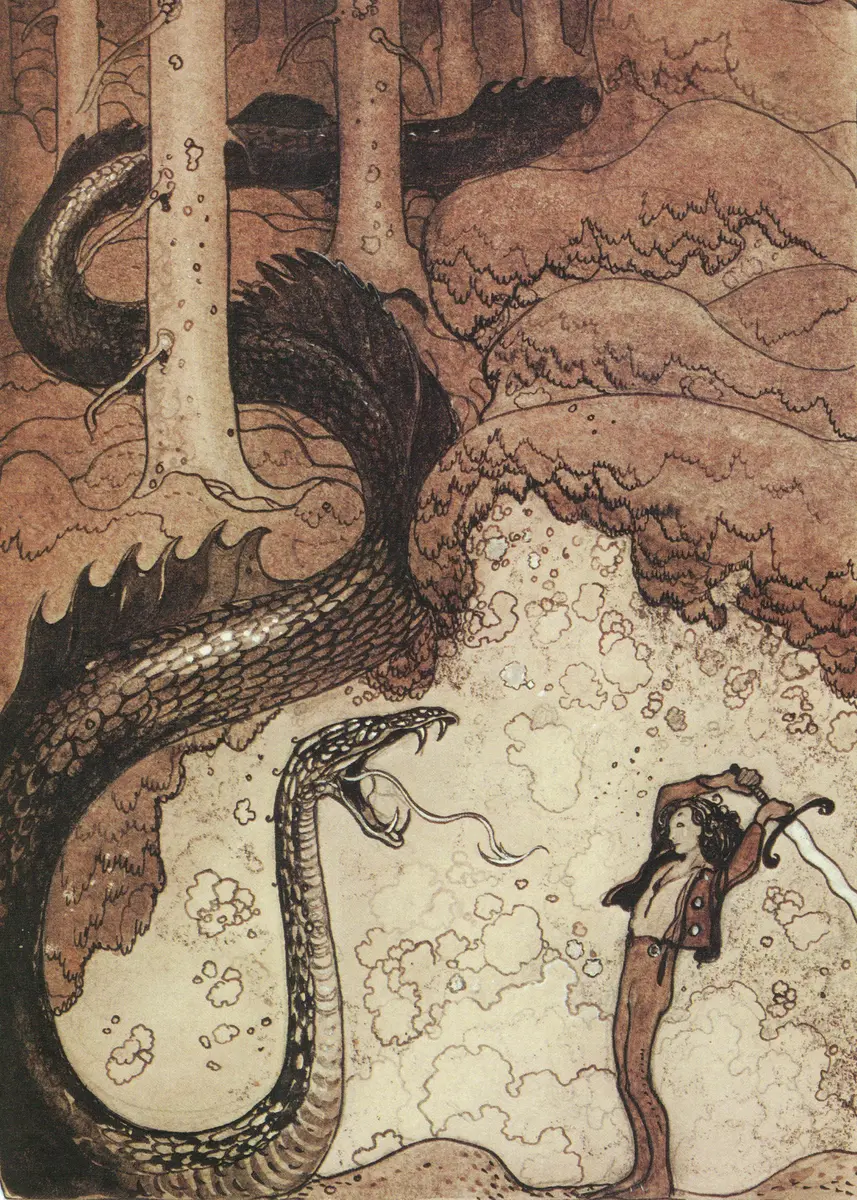
One last note on the picture attached to this file. It is a public-domain illustration by John Bauer, published in 1911 in the Swedish children's annual Guldslottet, Barnens julbok no. 13 for a story by Harald Östenson; it shows a young man with a sword fighting a snake. Its filing under "lindworms" is a category added by the person who uploaded it to Wikimedia Commons in June 2022, not a title given by Bauer.
Can you visit Lindworm?
No lindworm has a habitat to visit. Three places hold the documents this file is built on.
Ramsundsberget (Sö 101), Södermanland, Sweden. The Sigurd carving is cut into a rock face at Ramsundsberget, Mora, in Jäder parish in the municipality of Eskilstuna. The runic database runinskrifter.net gives its position as 59°26′28.6″N 16°38′4.0″E, about 10.5 km (6.5 miles) north-east of central Eskilstuna, and cross-refers it to entry Jäder 39 in the Swedish National Heritage Board's register of cultural remains. The carving is on open rock, and the database records it as standing in its original place.
Klagenfurt am Wörthersee, Carinthia, Austria. The Lindwurm fountain stands in the open on the Neuer Platz. The skull that Franz Unger identified in 1840 as a woolly rhinoceros is about 500 metres to the south-east, at the kärnten.museum, Museumgasse 2, which names the "Lindwurmschädel" among the pieces on show. The museum's own page for the site, read on 24 September 2026, gives opening hours of Tuesday to Saturday from 10:00 to 17:00, Thursday until 19:00 and Sunday from 11:00 to 16:00, closed on Mondays. Admission is €12 for adults and €10 reduced, free up to the age of 18, and €20 for a family.
Sunnanvik, Småland. The reward notice of 1884 was dated at Torne, Sunnanvik, and offered payment for a dead specimen delivered to Sunnanvik farm. The printed memoir can be read without going there: the Swedish National Library has digitised the 1884 first edition of Om draken eller lindormen, whose last leaf carries the notice. The enlarged 1885 text was reissued in 2017 as Drakormens gåta, with an introduction, notes and a postscript by the herpetologist Thomas Malm, published in Växjö by Kronobergs läns hembygdsförbund (ISBN 978-91-86870-23-2).
Sources consulted
- Gunnar Olof Hyltén-Cavallius, «Wärend och Wirdarne: ett försök i svensk ethnologi, första delen — § 114 «Draken» y § 115, pp. 461-463: el enterrador de tesoros que al morir se vuelve serpiente, y la mujer que se vuelve gallina negra» — P. A. Norstedt & Söner, Estocolmo (digitalización de Google Books en Projekt Runeberg), 1863 book
- Roman Puschnig, «Der „Lindwurmschädel" von Klagenfurt — Carinthia II, 125./45. Jahrgang, pp. 65-85: descripción y medidas del fósil, medición de la cabeza de piedra el 5-XI-1935, las dos tradiciones sobre el hallazgo (Goritschitzen 1335 / Lindwurmgrube), el documento de 1414, la atribución a Vogelsang y la rectificación de Abel» — Naturwissenschaftlicher Verein für Kärnten, Klagenfurt (digitalizado en zobodat.at), 1935 academic
- Gunnar Olof Hyltén-Cavallius, «Om draken eller lindormen. Mémoire till Kongl. Vetenskaps-Akademien — primera edición: el método en p. 5, la petición firmada en Sunnanvik el 29-X-1883 en p. 8, el testimonio jurado de M. Bergström (Jäthsberg, 5-V-1884) en p. 42 y el anuncio de recompensa de 100 a 1.000 coronas fechado el 20-V-1884 en la última hoja» — Smålandspostens Boktryckeri, Wexiö (ejemplar digitalizado por la Kungliga biblioteket, dominio público), 1884 book
- N. E. H. (firmante de la entrada), ««Lindorm», en Nordisk familjebok, Uggleupplagan, tomo 16, cols. 645-646 — el lindorm benévolo de la balada y el cuento, la falsa etimología del tilo, la serpiente-rueda, la figura heráldica y el veredicto sobre la memoria de 1884» — Nordisk familjeboks förlag, Estocolmo (Projekt Runeberg), 1912 book
- Samnordisk runtextdatabas / Sveriges runinskrifter, «Sö 101 (Sigurdsristningen / Ramsundsristningen), Ramsundsberget, Jäders socken — datación por estilo Pr1 (c. 1010-1040), coordenadas, soporte y lectura del campo figurado como episodios de Sigurd Fafnesbane» — runinskrifter.net, 2024 report
- Thomas Malm, «A Footnote to Scandinavian Herpetology: Gunnar Olof Hyltén-Cavallius and his Quest for the Dragon or Lindworm — Bibliotheca Herpetologica 14(1)» — International Society for the History and Bibliography of Herpetology (registro en Lund University Publications), 2020 academic
- Wikipedia en alemán, «Lindwurmbrunnen (Klagenfurt) — encargo de 1583, chloritschiefer del Kreuzbergl, atribución dudosa a Ulrich y Andreas Vogelsang, adición del Hércules de Michael Hönel en 1636, estudio de Unger de 1840 y traslado del cráneo al museo en 1849, con la bibliografía de Unger y Puschnig» — de.wikipedia.org, 2026 web
- Institutet för språk och folkminnen (Isof), «Drake — ficha del galería de seres de la creencia popular sueca: el dragón como serpiente gigante sin alas que incuba tesoros, su consideración antigua como animal real a partir de huesos de animales extintos, y la recompensa que ofreció Hyltén-Cavallius por un ejemplar entregado en su finca» — isof.se, 2024 report
- Sagobygden (Sagomuseet, Ljungby), «Om draken eller lindormen — Drakens gåta: la memoria enviada a la Academia en 1883 e impresa a costa del autor en 1884, la segunda edición ampliada de 1885 con 48 memorat, la recompensa de hasta mil coronas y el debate que provocó en la prensa y entre los investigadores» — sagobygden.blog, 2018 web
- Wikimedia Commons (subida por el usuario Blockhaj), «File:John Bauer, 1911 (cropped, no signature).jpg — metadatos de la ilustración usada en esta ficha: joven con espada peleando con una serpiente, publicada en «Guldslottet, Barnens julbok» n.º 13 (1911) para un relato de Harald Östenson, subida el 19 de junio de 2022 y categorizada entonces como «Lindworms»» — commons.wikimedia.org, 2022 web
- Landesmuseum Kärnten, «kärnten.museum Klagenfurt — opening hours (Tue-Sat 10-17, Thu 10-19, Sun 11-16, closed Mondays), admission (€12, reduced €10, 0-18 free, family €20) and the Lindwurmschädel on display» — landesmuseum.ktn.gv.at (consulted 24 September 2026), 2026 web
- Thomas Malm (ed.), «Drakormens gåta: Om Draken eller Lindormen av Gunnar Olof Hyltén-Cavallius (1885), med inledning, noter, bildurval och efterskrift av Thomas Malm» — Kronobergs läns hembygdsförbund, Växjö (Årsbok), 200 pp., ISBN 978-91-86870-23-2; record in Lund University Publications, 2017 book
Reviewed by V. Serrano on 2026-08-14 · How we verify our content
📎 Source: Enigma Atlas
💬 Field testimonies (0)
No testimonies yet. Add the first.
Add your testimony
🔒 Log in to add a testimony