🦶 CRYPTID SIGHTING · EXP. Nº0555
ACTIVE
Yacumama
Yacumama, "mother of the waters" in Quechua, is the immense serpent said to guard the oxbow lakes and slow rivers of the Peruvian Amazon.
Where and when was Yacumama sighted?
- Location
- Bajo Huallaga, Loreto, Peru
- Date sighted
- Unknown
- Coordinates
- -5.9, -76.1
- Last updated
LOCATION
What is Yacumama?
Both halves of the name are printed in a Lima vocabulary of 1586, and the oldest detailed record of the belief is not cryptozoological: on 29 August 1851, on the lower Huallaga below Yurimaguas, the United States Navy officer William Lewis Herndon wrote that the lakes there were held to be guarded by a serpent able to raise a tempest that swamped canoes, and that boatmen entering an unfamiliar lake blew horns until it answered. Herndon then spliced in an Italian missionary's 1845 account of a snake shot on a different river, the Pastaza — and that seam is where a spirit began turning into a specimen. The people who actually hold the belief keep the two apart: the 2015 Kukama-Kukamiria dictionary files the yacumama under spirit beings and the anaconda, Eunectes murinus, under reptiles. In 1862 the naturalist Antonio Raimondi already used the name for the anaconda, Boa murina, and wrote that the Indians greatly exaggerated its size; the largest of 780 anacondas measured by the zoologist Jesús A. Rivas in Venezuela between 1992 and 1998 was a female of 5.21 m. The 40-metre giant arrived in 2009.
What is the history of Yacumama?
The name is a Quechua compound, and it is far older than anything ever sighted under it. Both halves are printed in the Arte, y vocabulario en la lengua general del Perú llamada Quichua, y en la lengua española, issued at Lima by Antonio Ricardo in 1586: mama, glossed there as "madre generalmente, que parió", and yacu, water, which the Spanish-to-Quechua half of the same book gives under aguar alguna cosa (yacuchani) and anegar (yacun). The etymology can therefore be checked, morpheme by morpheme, in a dictionary with a date on it, printed 267 years before Herndon's report.
The oldest detailed record of the belief in English comes from a United States Navy survey of the Amazon.
On 29 August 1851, Lieutenant William Lewis Herndon of the United States Navy was working his way down the lower Huallaga, below Yurimaguas. He had entered what he called the lake country, where oxbow lakes fringe the river and drain to it by channels that go dry in the dry season, and he wrote this:
"Many of these lakes are, according to the traditions of the Indians, guarded by an immense serpent, which is able to raise such a tempest in the lake as to swamp their canoes, when it immediately swallows the people. It is called in the 'Lengua Inga' 'Yacu Mama,' or mother of the waters; and the Indians never enter a lake with which they are not familiar that they do not set up an obstreperous clamor with their horns, which the snake is said to answer; thus giving them warning of its presence."
That is page 169 of Exploration of the Valley of the Amazon, Part I, printed at Washington in 1853 by Robert Armstrong, Public Printer, and the running head at the top of the page is literally THE YACU MAMA. Herndon names no nation. The "Lengua Inga" is simply the nineteenth-century name for Quechua — the same language the 1586 vocabulary calls "la lengua general del Perú llamada Quichua".
Then Herndon does the thing that shaped everything after him. "I never saw the animal myself," he writes, "but will give a description of it written by Father Manuel Castrucci de Vernazza, in an account of his mission to the Givaros and Zaparos of the river Pastaza, made in 1845." What follows never uses the word yacumama. It is an Italian Franciscan's account of a snake he shot from his own canoe on a different river, offered as a piece of natural theology: the animal "confounds, intimidates, and infuses respect into the heart of the boldest man", and "so great is the force of his inspiration, that he draws in with his breath whatever quadruped or bird may pass him, within from twenty to fifty yards of distance". Herndon glued a belief and a specimen together in a single paragraph, and every later account inherited the join without seeing it.
He also mistranslated it, and left the evidence on the page. Castrucci wrote in Spanish and measured in varas; Herndon rendered vara as "yard" one for one. A Castilian vara is 0.8359 m, a yard 0.9144. Castrucci's snake was fifteen varas, about 12.5 m, where Herndon's "fifteen yards" would make 13.7 m, and "two yards of thickness" is dos varas de grosor, about 1.67 m. Herndon knew something was wrong. He wrote that "two yards of thickness is scarcely credible" and went back to argue with the priest's Spanish about grosor and diámetro; he even copied the words dos varas de grosor, and still left the measurement in yards. The same volume also dates Castrucci's mission twice: 1845 beside the serpent, and 1846 a hundred pages earlier, where Herndon quotes the same friar on cattle parasites near Moyobamba.
What the belief actually is, the people who hold it have had in print since 2015. The Diccionario kukama-kukamiria / castellano compiled by Rosa Vallejos Yopán and Rosa Amías Murayari for FORMABIAP and AIDESEP gives parana mama — "yacumama o purawa, madre de las boas, madre del agua" — and uni mama, "madre del agua, también conocido como purawa, o en castellano amazónico como yacumama". The phrasing files yacumama as regional Spanish. The Kukama-Kukamiria are not Quechua speakers; theirs is a Tupí-Guaraní language, and their own words are parana mama, uni mama and purawa. The dictionary adds that shamans call her at midnight, that her body is black, and that she lives in the deep and rises to breathe.
And it files her under "Seres espirituales" — spirit beings — alongside the yacuruna and the muiwatsu, mother of the boa. The anaconda has its own separate entry, iwirati tsukuri, "la serpiente más grande de la amazonía, Eunectes murinus", filed under "Reptiles". Different word, different category, same book, same speakers. Roxani Rivas Ruiz, who has done fieldwork among the Kukama-Kukamiria since 1991, built her 547-page La serpiente, madre del agua (PUCP and CAAAP, Lima, 2022) on exactly that reading: the serpent as the central figure of aquatic shamanism, in an identity triad with the river and the shaman.
Timeline: the documented record of Yacumama
- 1586 The Arte, y vocabulario en la lengua general del Perú llamada Quichua is printed at Lima by Antonio Ricardo. It glosses mama as "madre generalmente, que parió" and gives yacu for water. Both halves of the name are attested in print 267 years before the serpent reaches an English page.
- 1845 (dated 1846 elsewhere in the same book) Father Manuel Castrucci de Vernazza, an Italian Franciscan, writes an account of his mission to the Jívaro and Zápara of the Pastaza in which he describes shooting a snake of two varas thick and fifteen long from his canoe, crediting it with drawing prey in by its breath. The account is about the Pastaza and never uses the word yacumama.
- 29 August 1851 Lieutenant William Lewis Herndon, descending the lower Huallaga below Yurimaguas, records that the lakes there are held to be guarded by an immense serpent called Yacu Mama in the "Lengua Inga", and that boatmen entering an unfamiliar lake blow horns until it answers. He names no nation and never mentions the Ucayali in connection with it.
- 1853 Exploration of the Valley of the Amazon, Part I, is printed at Washington by Robert Armstrong, Public Printer. On pages 168-169, under the running head THE YACU MAMA, Herndon splices his own note on the belief to Castrucci's 1845 description of a killed snake, converting varas to yards one for one, and adds his own verdict: "Doubtless the padre met with, and killed the boa-constrictor; but two yards of thickness is scarcely credible."
- January 1907 Percy Fawcett says he shot a 62-foot anaconda on the Rio Abunã. The account only reaches print in 1953, assembled from his journals by his son Brian, and critics have since suggested the editor added colour and possibly length.
- 1907 The Nuttall Encyclopaedia, edited in London by James Wood, compresses Herndon into forty-five words. It drops Herndon, Castrucci, the Pastaza and the etymology; calls the creature "marine"; transfers Castrucci's suction-breath to the lake serpent and stretches it to "a hundred yards"; and turns canoe-borne entry into a lone Indian about to bathe. This is the version most later writers have actually read.
- 2 May 2009 Mike Warner and his son Greg, of Hillhall near Lisburn, announce that aerial imagery taken during a twelve-day expedition in March has captured a snake 40 m long and 2 m wide, "known by the locals as the 'black boa' or 'Yacumama'". In November they propose that Sachamama, Yacumama and Minhocão are one burrowing animal.
- 12 June 2009 Jon Downes and Richard Freeman, of the Centre for Fortean Zoology, publish their assessment of the Warner photographs: "we disagree completely with their conclusions and believe that these pictures show nothing more than a natural formation of mud or sand". The rejection comes from within cryptozoology, and is explicit that the Warners' sincerity is not in question.
- 2015 Rosa Vallejos Yopán and Rosa Amías Murayari publish the Diccionario kukama-kukamiria / castellano for FORMABIAP and AIDESEP. It files parana mama and uni mama — "yacumama o purawa" — under "Seres espirituales", and the anaconda, iwirati tsukuri, Eunectes murinus, under "Reptiles": different words, different categories, and yacumama recorded as regional Spanish rather than as a Kukama word.
- 2022 Roxani Rivas Ruiz publishes La serpiente, madre del agua (PUCP and CAAAP, Lima, 547 pp.), built on fieldwork among the Kukama-Kukamiria since 1991. It treats the serpent as the central figure of aquatic shamanism, in an identity triad with the river and the shaman — a religious institution, not a species awaiting description.
- February 2024 A paper in Diversity co-authored by Jesús A. Rivas splits the green anaconda in two and names Eunectes akayima of the Orinoco. In his 2000 doctoral thesis Rivas had given the largest of the 780 anacondas he caught in the Venezuelan llanos from 1992 to 1998 as a female of 521 cm and 97.5 kg.
Is there a rational explanation for Yacumama?
The yacumama was a being of the lakes before anybody wanted it measured, and the route from one to the other has names and dates.
The river first. Herndon's passage names no nation and no other river: it says "the traditions of the Indians", and it is dated 29 August 1851 on the lower Huallaga below Yurimaguas. The only people from the Ucayali in that day's entry are three Conibos in a canoe, "from the Ucayali, going up for salt", met a paragraph before the serpent. Castrucci's snake was killed on the Pastaza.
1862, a naturalist. Antonio Raimondi put a Linnaean name beside the word in his Apuntes sobre la provincia litoral de Loreto (Lima, Tipografía Nacional, 1862). Among the province's snakes he lists "el gigantesco Yacumama (Boa murina, Lin.)", the anaconda, and adds: "Los indios exajeran mucho la talla de este animal, la que casi nunca pasa de cinco varas de longitud y el grosor de un muslo." Five varas is about 4.2 m. He also records that the Indians believed "el Yacumama ó serpiente Boa" could draw a man in with its breath. So the regional name was already attached to a real animal in 1862, by a naturalist who thought the reported sizes exaggerated.
1907, the first compression. The Nuttall Encyclopædia, edited by James Wood in London, boiled Herndon down to forty-five words: "Yacu-mama, a fabulous marine monster, said to haunt the lagoons of the Amazon, and to suck into its mouth and swallow whatever comes within a hundred yards of it; before bathing in a lagoon, where he apprehends its presence, the Indian sounds a horn, the effect of which is to make it reveal itself if it is there." Set beside Herndon, it subtracts Herndon, Castrucci, the Pastaza, the Lengua Inga, the etymology and Herndon's own doubt. It invents the word marine, turning a being of lakes and rivers into a sea monster. It gives the lake serpent a suction-breath that in Herndon's pages belongs to Castrucci's Pastaza snake, and stretches its reach from "twenty to fifty yards" to a hundred; Raimondi had heard of the same breath in Loreto. And it inverts the practice: Herndon's people sound horns entering an unfamiliar lake by canoe, while Nuttall's single Indian sounds one before going for a bathe.
The link is still working. The English Wikipedia article, a four-sentence stub, cites that 1907 entry and reports it as "suck up any living thing that passed within 100 steps" and a "conch horn". Neither steps nor conch is in the source it cites.
2 May 2009, the giant. Mike Warner, of Hillhall near Lisburn in Northern Ireland, and his son Greg announced after a twelve-day expedition in March 2009 that aerial imagery had caught a snake reported at 40 m long and 2 m wide, dark brown, "known by the locals as the 'black boa' or 'Yacumama'". They reported over 700 photographs and five hours of video, and shared the findings with the Peruvian government, the National Geographic Society and Queen's University Belfast. In November 2009 they presented what they called the first photographed Minhocão "trench", from a newspaper report of a track 20 m long and 5 wide, and restated their belief that Sachamama, Yacumama and Minhocão are one burrowing animal.
The rejection came from inside cryptozoology. On 12 June 2009 Jon Downes and Richard Freeman of the Centre for Fortean Zoology wrote that "we disagree completely with their conclusions and believe that these pictures show nothing more than a natural formation of mud or sand", Freeman adding that the supposed head "looks to me like a sandbank or lump of mud". They were explicit that they did not doubt the Warners' sincerity.
The measured animal. In his doctoral thesis for the University of Tennessee (2000), Jesús A. Rivas summarised the measurements of 780 green anacondas caught in the Venezuelan llanos from 1992 onwards: the largest female was 521 cm long and weighed 97.5 kg, and "the largest snake that I have caught, out of 780 animals, is only a little more than 5 m". Rivas co-authored the paper in Diversity that on 16 February 2024 split the green anaconda in two, adding Eunectes akayima of the north. Guinness World Records, read on 4 October 2026, describes the 8.45 m female shot in Brazil around 1960 as "reports".
Percy Fawcett's 62-foot anaconda of the Rio Abunã, January 1907, is the usual anchor for the giant, and it reaches print through Exploration Fawcett, which his surviving son Brian assembled from the Colonel's journals in the early 1950s; the book appeared in 1953, after Fawcett had disappeared in 1925. In David Levell's 2015 review, "some critics have suggested his son Brian may have found vested interest in adding colour – and a few feet to the gigantic 62-foot anaconda his father described shooting".
Can you visit Yacumama?
There is no site to visit, and saying so is the useful information. This page's coordinates — 4.2° S, 73.3° W — are round numbers dropped in the middle of Loreto; they are a region, not a place. The lakes Herndon was writing about are a stretch of the lower Huallaga below Yurimaguas, and they look today exactly like every other oxbow lake on that river.
What does exist is the country, and it is worth the trip on its own terms.
Iquitos, the capital of Loreto and the largest city on earth with no road to it, is reached only by air or by river. Flights run daily from Lima, about two hours; the river boat from Yurimaguas down the Huallaga and the Marañón takes two to three days and is the same water Herndon travelled. Pucallpa, in the neighbouring department of Ucayali, is the opposite case: it is the end of the Carretera Federico Basadre from Lima, about 780 km, roughly 18 to 20 hours by bus, or an hour by air. Ten kilometres from Pucallpa is the Yarinacocha lagoon, the oxbow that the modern popular literature — not Herndon — names as the yacumama's home.
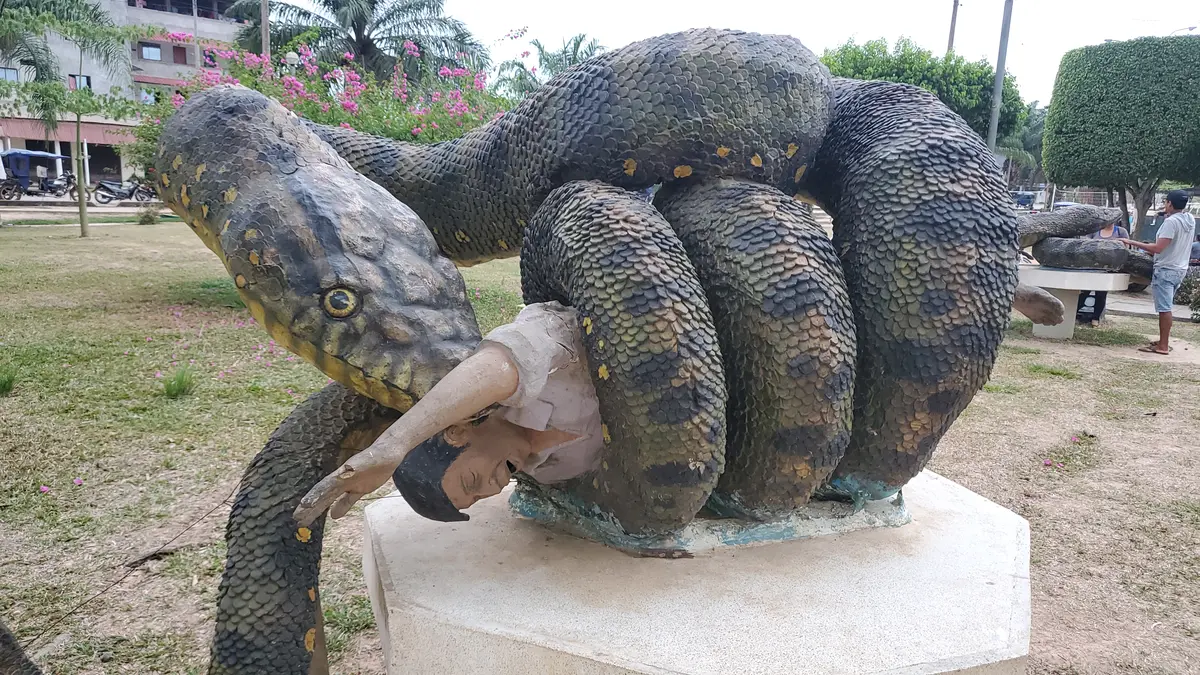
The photograph on this page is not of a snake. It is a sculpture, uploaded to Wikimedia Commons by Layza Gonzales under CC BY-SA 4.0, photographed on 23 September 2022 at 8°22′38″ S, 74°33′44″ W — that is, in Pucallpa, department of Ucayali, some 480 km from the coordinates of this entry. It shows the yacumama coiling around a mean-spirited fisherman to teach him a lesson, a story about a lake mother withholding her fish that is told across Loreto and Ucayali. It is a good photograph of contemporary Amazonian public art. It is not a photograph of a place where anything happened.
Where to read the sources instead. All the primary material here is free. Herndon's Exploration of the Valley of the Amazon, Part I, is on the Internet Archive and Project Gutenberg; the yacumama is on pages 168-169. The 1586 Lima vocabulary and the 1614 reprint are both on the Internet Archive from the John Carter Brown Library. The Vallejos and Amías Diccionario kukama-kukamiria / castellano (2015, 312 pp.) is a free download. The one thing that is not free is the book that matters most: Roxani Rivas Ruiz, La serpiente, madre del agua (PUCP and CAAAP, Lima, 2022, 547 pp., ISBN 978-612-317-819-2), sold in print and as an e-book.
One warning. Tour operators in Iquitos and Pucallpa sell yacumama-themed excursions. Buy them as folklore and as river travel, which is what they are worth, and not as a chance of seeing the animal. Green anacondas are real, common in these waters, genuinely dangerous to handle and best left alone — and the largest one anyone has ever measured would not fill a third of the sculpture in Pucallpa.
Sources consulted
- William Lewis Herndon, «Exploration of the Valley of the Amazon, made under direction of the Navy Department, Part I. The Yacu Mama passage is on pp. 168-169, under that running head, dated 29 August 1851 on the lower Huallaga below Yurimaguas; it reproduces the description written by Father Manuel Castrucci de Vernazza in his account of his 1845 mission to the Jivaro and Zapara of the river Pastaza (dated 1846 by Herndon on p. 89), and closes with Herndon's own doubt about 'two yards of thickness'. Read in full in two independent copies: the Internet Archive scan of the 1853 Armstrong printing and the Project Gutenberg transcription (ebook 57756); they agree word for word.» — Washington: Robert Armstrong, Public Printer (U.S. Navy Department), 1853 report
- Anónimo (atribuido al Tercer Concilio Limense), «Arte, y vocabulario en la lengua general del Peru llamada Quichua, y en la lengua española. El control positivo de la etimologia: 'Mama, madre generalmente, que parió' en la seccion quechua-castellano, y yacu como agua en la castellano-quechua ('Aguar alguna cosa. yacuchani, unuchani'; 'Anegar. yacun, unum, aparin'). Ejemplar de la John Carter Brown Library.» — En Los Reyes [Lima]: Por Antonio Ricardo, 1586 book
- Anónimo, «Arte, y vocabulario en la lengua general del Peru llamada Quichua, y en la lengua Española, reimpresión limeña de 1614. Cotejada con la de 1586 para fechar el léxico: la entrada 'Madre del rio' se resuelve aquí como 'mayup rin' (el cauce), no como yacumama — es decir, el compuesto no aparece lexicalizado en ninguna de las dos ediciones, y solo se documenta como nombre de la criatura a partir de Herndon.» — En los Reyes [Lima]: Por Francisco del Canto, 1614 book
- Rosa Vallejos Yopán y Rosa Amías Murayari, «Diccionario kukama-kukamiria / castellano, 312 pp. Entradas 'parana mama' ('yacumama o purawa, madre de las boas, madre del agua'), 'uni mama' ('madre del agua, también conocido como purawa, o en castellano amazónico como yacumama'; 'Uni mama piruara tsuni', la madre del agua es de cuerpo negro), 'muiwatsu' (madre de la boa; los kukama la llaman tsukuri mama) y 'karuara' (yacuruna) — todas en la categoría 'Seres espirituales'. La anaconda tiene entrada aparte, 'iwirati tsukuri', Eunectes murinus, en la categoría 'Reptiles'.» — FORMABIAP y AIDESEP, Iquitos / Lima, 2015 book
- Roxani Rivas Ruiz, «La serpiente, madre del agua: chamanismo acuático entre los kukama-kukamiria de la Amazonía peruana, 547 pp., ISBN 978-612-317-819-2. Trabajo de campo desde 1991. Analiza la serpiente, madre del agua, como institución central del chamanismo acuático, en tríada identitaria entre la serpiente, el río y el chamán.» — Pontificia Universidad Católica del Perú, Fondo Editorial, y Centro Amazónico de Antropología y Aplicación Práctica (CAAAP), Lima (Colección Estudios Amazónicos 4), 2022 book
- James Wood (ed.), «The Nuttall Encyclopaedia, entry 'Yacu-mama'. El eslabón intermedio, en cuarenta y cinco palabras: 'a fabulous marine monster, said to haunt the lagoons of the Amazon, and to suck into its mouth and swallow whatever comes within a hundred yards of it; before bathing in a lagoon, where he apprehends its presence, the Indian sounds a horn, the effect of which is to make it reveal itself if it is there.' Es la fuente que cita hoy la Wikipedia inglesa.» — Frederick Warne & Co., London, 1907 book
- Wikipedia contributors, «Yacumama, artículo de la Wikipedia en inglés (wikitexto consultado el 14 de agosto de 2026). Esbozo de cuatro frases que cita la entrada de Nuttall de 1907 pero le añade dos datos que no están en ella: '100 steps' donde la fuente dice 'a hundred yards', y 'conch horn' donde dice solo 'a horn'. No menciona a Herndon, ni el Ucayali, ni a Castrucci.» — English Wikipedia, 2026 web
- Jon Downes y Richard Freeman, Centre for Fortean Zoology, «Peruvian 'giant snake' pictures released through the CFZ bloggo, 12 de junio de 2009. Veredicto de la propia criptozoología sobre las imágenes de los Warner: 'we disagree completely with their conclusions and believe that these pictures show nothing more than a natural formation of mud or sand'; Freeman añade que la supuesta cabeza 'looks to me like a sandbank or lump of mud'. Del mismo blog, una entrada de noviembre de 2009 recoge la 'zanja' de 20 por 5 metros y la propuesta de que sachamama, yacumama y minhocão son un mismo animal.» — CFZ — Still on the Track, 2009 report
- Ghost Theory, «Lisburn men find giant snake in the Amazon, 10 de junio de 2009. Detalle del anuncio de Mike Warner (73) y su hijo Greg (44): expedición de doce días en marzo de 2009, anuncio el 2 de mayo, unas 700 fotografías y cinco horas de vídeo desde dos cámaras aéreas, serpiente estimada en 40 metros de largo por 2 de ancho, parda oscura, 'known locally as the black boa or Yacumama'. Material entregado al Gobierno peruano, a la National Geographic Society y a la Queen's University de Belfast.» — ghosttheory.com, 2009 web
- David Levell, «Book Review: Exploration Fawcett, 26 de julio de 2015. Sobre la cadena editorial del relato de la anaconda de 62 pies: 'In the early 1950s Fawcett's surviving son Brian assembled Exploration Fawcett from the Colonel's journals'; 'Some critics have suggested his son Brian may have found vested interest in adding colour — and a few feet to the gigantic 62-foot anaconda his father described shooting (this is two to three times longer than various recorded maximums for the largest anaconda species).' No he podido leer el texto de 1953 directamente: se cita aquí a través de esta reseña, no como si lo hubiera consultado.» — davidlevell.wordpress.com, 2015 web
- Guinness World Records, «Heaviest species of snake. Ficha de récord consultada el 4 de octubre de 2026: la anaconda verde, dividida en dos especies desde el artículo publicado en la revista Diversity el 16 de febrero de 2024 y firmado por el especialista Jesús A. Rivas, de la New Mexico Highlands University. De la hembra de 8,45 m abatida en Brasil hacia 1960 dice que hay 'reports'.» — guinnessworldrecords.com, 2024 web
- Layza Gonzales, «File:LA YACUMAMA Y EL PESCADOR MEZQUINO.jpg. Página del fichero: obra propia de Layza Gonzales, CC BY-SA 4.0, fecha 23 de septiembre de 2022, tomada con un Samsung Galaxy Z Flip. Descripción original: 'Se observa la representación de un mito de la selva amazónica de como la Yacumama envuelve al pescador mezquino para darle una lección'. Coordenadas del fichero: -8,377186 / -74,562193, es decir Pucallpa, departamento de Ucayali. Categorizada en 'Arte y cultura en Ucayali 2022'. Es una escultura, no un animal, y no está en Loreto.» — Wikimedia Commons, 2022 web
- Antonio Raimondi, «Apuntes sobre la provincia litoral de Loreto. Entre las serpientes de la provincia: 'el gigantesco Yacumama (Boa murina, Lin.)', con la observación de que 'los indios exajeran mucho la talla de este animal, la que casi nunca pasa de cinco varas de longitud y el grosor de un muslo', y la creencia de que 'el Yacumama ó serpiente Boa' puede atraer a un hombre con su resuello.» — Lima: Tipografía Nacional, por M. D. Cortés, 1862 book
- Jesús Antonio Rivas, «The life history of the green anaconda (Eunectes murinus), with emphasis on its reproductive biology. Tabla 3-1: 780 anacondas capturadas en los llanos de Venezuela entre 1992 y 1998; la hembra mayor, 521 cm de longitud total y 97,5 kg. 'The largest snake that I have caught, out of 780 animals, is only a little more than 5 m.'» — Ph.D. dissertation, University of Tennessee, Knoxville, 2000 academic
Reviewed by V. Serrano on 2026-08-14 · How we verify our content
📎 Source: Enigma Atlas
💬 Field testimonies (0)
No testimonies yet. Add the first.
Add your testimony
🔒 Log in to add a testimony