🦶 CRYPTID SIGHTING · EXP. Nº0555
ACTIVE
Chullachaqui
The Chullachaqui is a shape-shifting forest being of the Peruvian Amazon, told above all in San Martín and Loreto.
Where and when was Chullachaqui sighted?
- Location
- Loreto y San Martín, Peru
- Date sighted
- Unknown
- Coordinates
- -3.744, -73.252
- Last updated
LOCATION
What is Chullachaqui?
Its name is Quechua: González Holguín's 1608 vocabulary glosses chaqui as "pie o la pierna" and chhulla as a thing "sin compañera entre cosas pareadas", the same dictionary that records chulla ñaui for the one-eyed and chhulla maqui for the one-handed. The being borrows any shape it likes, a friend, a relative, a bird, a piglet, a tree, a stream, and leads whoever follows it deep into the forest; only its mismatched feet give it away. Which foot, though, is not settled: Francisco Izquierdo Ríos printed the defect in the right foot in 1939 and in the left in 1952 and 1975, and it is his last version that everyone now repeats. The name reached print in 1939, in his Ande y Selva and in the American pulp magazine Short Stories of 10 September. The Chullachaqui is also a set of trees, chullachaqui caspi, blanco and colorado, used in Amazonian plant medicine. None of the lists that include it among cryptids proposes an animal behind it; Debra S. Marshall's A Silent Invasion printed it in such a list in 2014, and Spanish Wikipedia classified it as a cryptid in March 2018.
What is the history of Chullachaqui?
The Chullachaqui is a forest being of the Peruvian Amazon, told above all in San Martín and Loreto. It is not a hidden animal and it has never been proposed as one. It is a shape-shifter, and what the tales are really about is a recognition test: whatever it borrows — a friend, a relative, a bird, a pig, a tree, a stream — its feet give it away, because they do not match.
The name is Quechua and, unusually for this catalogue, the etymology can be checked in a primary source rather than repeated. In Diego González Holguín's Vocabulario de la lengua general de todo el Perú llamada lengua Qquichua o del Inca (Lima, 1608) the two pieces are there, separately. "Chaqui" is glossed "Pie o la pierna". "Chhulla" gets two entries: "Vna cosa sin compañera entre cosas pareadas" — a thing with no partner among paired things — and "Candelero, vinagera cossa desigual que no viene con otra o no corresponde en tamaño, o en proporcion", which is, word for word, the Chullachaqui's defect. A third entry, "Chulla chulla, o chacu chacu", is glossed simply "Lo desigual". The 1608 vocabulary also has the same pattern with other body parts: "Chulla ñaui. El de vn ojo no mas, o el tuerto", "Chhulla rinri. El de vna oreja", "Chhulla maqui. El manco de vna mano", "Chhulla çapato. El vn çapato de dos". Chulla + body part = the one who has an odd one. What is NOT in the 1608 vocabulary is the compound itself: a search of the full digitised text returns zero hits for "chulla chaqui" while returning the four control entries above and "Chaqui. Pie o la pierna". The morphemes and the pattern are colonial Cuzco Quechua; the lexicalised creature-name is not recorded there.
That matters because Loreto and San Martín are not Cuzco-Quechua country: the local varieties are lowland Quechua (Lamas, Napo). Nécker Salazar Mejía, of the Universidad Nacional Federico Villarreal, addresses the point directly in his 2019 study of the Arguedas–Izquierdo Ríos compilation: several Amazonian place and creature names are Quechua because of historical contact between Andean and Amazonian peoples. He glosses the name exactly as our file did — "del quechua «chulla», 'desigual', y «chaki», 'pie'" — so the gloss is not ours and not invented; it is a named scholar's, and it is consistent with 1608.
The tales themselves have an author trail, and it flips. Francisco Izquierdo Ríos, born in Saposoa (San Martín), printed the Chullachaqui at least three times, and his own successive versions contradict each other on the single detail everyone repeats. In Ande y Selva (Lima, 1939), tale 32, he closes: "cuando el chullachaqui se transforma en gente siempre tiene una imperfección: la de su pie derecho, que es mucho más pequeño que el izquierdo" — the RIGHT foot is the small one. In the novel En la tierra de los árboles (1952) it has moved: "su pie izquierdo es chiquito, como de criatura recién nacida, como un bola de cerdas o bien como pata de jaguar". And in Pueblo y bosque. Folklore amazónico (1975), the version everybody now quotes, it is fixed: "el izquierdo puede ser chiquito como pie de criatura recién nacida, como bola de caucho o cerdoza, como pata de tigre o como una raíz de árbol, mientras el derecho es de tamaño normal". Nobody falsified anything. The author simply reprinted himself, and the last printing won. Everything downstream — including the earlier version of this file — inherited the 1975 foot without knowing there had been another.
The 1939 text is also where the named informants are, and they are the people that later retellings delete: an aunt, "Una viejecita eximia relatadora de cuentos de Selva"; a grandfather, Nico, to whom it appeared in the plot disguised as his compadre and who advised threatening it with a machete and speaking loudly, and who added that when it vanishes it leaves "un denso olor a chivo"; and a don Pascual, who distinguished it from the Christian devil and said it appears in "sitios pesados" and speaks "siempre palabras incomprensibles i gangosas".
The widest Peruvian printing is Mitos, leyendas y cuentos peruanos, the compilation José María Arguedas and Izquierdo Ríos assembled from texts sent in by rural schoolteachers and published in 1947. It carries four Chullachaqui narratives, and — this is the part that our file had erased — each one is credited to the teacher who collected it: "El cazador y el Chullachaqui" (San Martín), collected by the preceptor Teófilo Peña; "El Chullachaqui" (San Martín), collected by the preceptora Angélica Reá; a second "El Chullachaqui" from Loreto; and "Los chanchitos", also from Loreto. In the hunter's tale the tracks read "la derecha, de pie humano; y la izquierda, de pata de tigre". In the San Martín tale a young woman fishing on the Cumbaza stream is invited onward by "un caballero cojo, pero bien vestido" and held in a cave for eight days. In the Loreto tale two brothers go out shooting and one of them is joined by a double of the other, whom he unmasks because "los pies de su acompañante eran desiguales: el pie izquierdo más pequeño y con uñas a manera de garras de tigre".
And there is a whole second Chullachaqui that had fallen out of this file entirely: it is also a set of trees. In the Amazonian Ethnobotanical Dictionary of James A. Duke and Rodolfo Vásquez (1994), page 230, "Chullachaqui caspi" is Remijia peruviana Standl. (Rubiaceae) — "Iquitos children drink it during the new moon to become strong" — while "Chullachaqui blanco" is Pourouma ovata Trecul and "Chullachaqui colorado" a Tovomita sp. In the vegetalismo of the Iquitos region these are plantas maestras: Robert Tindall's The Jaguar that Roams the Mind (2008) calls chullachaqui caspi "a curative and teacher plant", and the ethnobotanical collection Plants, Health and Healing (2010) records a palero who had "studied" the medicine of the female Chullachaki caspi tree. In the Iquitos region, then, the name also belongs to a plant medicine.
Timeline: the documented record of Chullachaqui
- 1608 Diego González Holguín's Quechua vocabulary is printed in Lima. It glosses "Chaqui" as "Pie o la pierna" and "Chhulla" as "Vna cosa sin compañera entre cosas pareadas" and as a "cossa desigual que no viene con otra o no corresponde en tamaño, o en proporcion", and records the productive pattern chulla ñaui (one-eyed), chhulla rinri (one-eared), chhulla maqui (one-handed), chhulla çapato (one shoe of two). The compound chulla chaqui is not among its entries: zero hits in the full digitised text, against those four controls.
- 1930 Paul C. Standley describes Remijia peruviana as a new species in Studies of American Plants (Field Museum of Natural History, Botany 8: 156), listing the vernacular names "cascarilla" and "collar lisa". "Chullachaqui" does not appear in the volume.
- 1936 Llewelyn Williams's Woods of Northeastern Peru catalogues Amazonian timbers with their Iquitos-region vernacular names, Remijia peruviana among them. A full-text search of the volume returns zero matches for "chullachaqui"; controls in the same volume the same day return 7 for "Remijia", 177 for "caspi" and 141 for "Iquitos".
- 1939 Francisco Izquierdo Ríos publishes Ande y Selva (Lima). Tale 32, pages 104-112, is the oldest printed appearance of the Chullachaqui we have been able to date. It names its informants — an aunt described as "una viejecita eximia relatadora de cuentos de Selva", a grandfather Nico, a don Pascual — and ends: "cuando el chullachaqui se transforma en gente siempre tiene una imperfección: la de su pie derecho, que es mucho más pequeño que el izquierdo". The small foot is the RIGHT one.
- 1941 Ciro Alegría's novel El mundo es ancho y ajeno includes a Chullachaqui episode built around Nara and the cacique Coranke, which explains the mournful song of a jungle bird: "Y ello se debe al maleficio de Chullachaqui". Alegría's creature is "el genio malo de la selva"; it drowns rubber tappers in lakes and rivers and leads them astray. Nothing is said about unequal feet.
- 1947 José María Arguedas and Izquierdo Ríos publish Mitos, leyendas y cuentos peruanos, assembled from texts sent in by rural schoolteachers. It carries four Chullachaqui narratives, each credited to its collector: "El cazador y el Chullachaqui" (San Martín), by the preceptor Teófilo Peña; "El Chullachaqui" (San Martín), by the preceptora Angélica Reá; a second "El Chullachaqui" from Loreto; and "Los chanchitos" from Loreto. These named teachers are the source our earlier file had erased.
- 1948 Harriet de Onís includes the Chullachaqui episode in The Golden Land, her anthology of Latin American folklore in literature, under a footnote reading "Reprinted from Broad and Alien Is the World". The passage keeps its author but changes shelf: a chapter of a 1941 novel is now filed as folklore.
- 1949 Milton Rugoff reprints the same translated passage in A Harvest of World Folk Tales, which is reissued in 1968 and, as The Penguin Book of World Folk Tales, in 1977. Through this chain — novel, translation, anthology, mass-market paperback — most English-language readers meet the Chullachaqui as an anonymous folk tale rather than as a page by Ciro Alegría.
- 1952 In the novel En la tierra de los árboles, page 79, Izquierdo Ríos prints the flaw the other way round: "su pie izquierdo es chiquito, como de criatura recién nacida, como un bola de cerdas o bien como pata de jaguar". Between his own 1939 and 1952 books the small foot has changed sides, without comment.
- 1975 Pueblo y bosque. Folklore amazónico, pages 50-51, fixes the canonical version: "Chullachaqui, en quechua, significa 'pies desiguales'", the left foot small "como pie de criatura recién nacida, como bola de caucho o cerdoza, como pata de tigre o como una raíz de árbol, mientras el derecho es de tamaño normal", and "las gentes creen ver las huellas de sus pies en el barro de los caminos". This is the version every later retelling, ours included, has copied.
- 1994 The Amazonian Ethnobotanical Dictionary of James A. Duke and Rodolfo Vásquez, page 230, records the botanical Chullachaqui: "Remijia peruviana Standl. Rubiaceae. 'Chullachaqui caspi'. Iquitos children drink it during the new moon to become strong", plus "Chullachaqui blanco" (Pourouma ovata Trecul) and "Chullachaqui colorado" (Tovomita sp.). This whole dimension was missing from our previous file.
- 30 December 2009 The Spanish Wikipedia article "Chullachaqui" is created by the user Stuard202020, whose edit summary cites a page on the student-essay site monografias.com. That first version gives a different etymology — "chulla = falso; chaqui = pie", rendered "Falso pie" — and describes one human foot and one animal foot (deer, peccary, tortoise). It contains no cryptid classification.
- 18-21 March 2018 The conversion, dated to the minute. On 18 March the Wikimedia user LLs photographs a Chullachaqui statuette at Los Paucares Inn, Iquitos; on 21 March at 05:27 UTC the same user rewrites the Spanish Wikipedia article, uploads the photograph and adds a creature infobox whose "grupo" field reads "Críptido" and whose "subgrupo" reads "Criatura terrestre", sourcing the etymology to an Ecuadorian Ministry of Education Kichwa dictionary of 2009. That edit is where Spanish Wikipedia classified the Chullachaqui as a cryptid; an English-language book on UFOs, Debra S. Marshall's A Silent Invasion (2014), had already listed it among cryptozoology's creatures. That photograph is the one this file carries.
- 2019 Nécker Salazar Mejía, of the Universidad Nacional Federico Villarreal, publishes "Seres imaginarios y motivos de la literatura oral en Mitos, leyendas y cuentos peruanos" in Boletín de Literatura Oral 9, pages 223-248, analysing the four Chullachaqui tales of the 1947 compilation and glossing the name "del quechua «chulla», 'desigual', y «chaki», 'pie'". It is the named scholarship our previous text had dissolved into "studies of Amazonian oral literature".
Is there a rational explanation for Chullachaqui?
The Chullachaqui turns up in lists of cryptids, and none of those lists proposes an animal behind it.
That can be measured. A full-text search of the Internet Archive's texts on 25 September 2026 finds "chullachaqui" in the same volume as "cryptid" three times: Debra S. Marshall's A Silent Invasion (Schiffer, 2014), a book about aliens and UFOs whose section on cryptozoology names it in a run of others — "Champ, Ebu Gogo, Batutu, Aswang, Barmanou, Chullachaqui, Batsquatch, Dover Demon, Jersey Devil, Mothman"; the twentieth-anniversary rulebook of the role-playing game Changeling: The Dreaming (2017); and a paranormal compilation uploaded in 2023. The same search for "mapinguari" and "cryptid", run the same day, returns 25 volumes. On Cryptid Wiki, the largest amateur cryptid catalogue, a search for "chullachaqui" returns no article, while "mapinguari" returns a full entry that argues Megatherium and "Slothfoot". English Wikipedia calls the Chullachaqui "a mythical forest creature".
In Spanish Wikipedia the label arrives with one edit. On 21 March 2018 the article was rewritten by the user LLs, who added a creature infobox whose "grupo" parameter reads "Críptido" and whose "subgrupo" reads "Criatura terrestre". Before that edit the article, created on 30 December 2009 by the user Stuard202020 from a page on the student-essay site monografias.com, contained no such classification — and gave a different etymology altogether: "chulla = falso; chaqui = pie", "Falso pie". The same 2018 edit attached the photograph of a statuette, taken three days earlier, that this very file uses. In Spanish the classification was a taxonomy field in a template, entered in two saves nine seconds apart; in English, Marshall's list had printed the name among cryptids four years earlier.
There is also nothing stable to classify. The one physical trait a zoologist could work with, the mismatched foot, is the one datum the sources contradict each other on, and the contradiction is internal to a single author: right foot smaller in Izquierdo Ríos 1939, left foot smaller in the same man's 1952 and 1975 books.
What the tales do contain is a recognisable and unremarkable core: dense, visually uniform rainforest disorients people who leave known trails, and children and lone hunters are exactly who is at risk. The 1947 texts also show how a victim gets out. In the San Martín tale a priest blesses the paths and hills, and in the Loreto tale the young man makes the sign of the cross and calls on God. No curandero, no ayahuasca, no tobacco smoke. The claim, repeated across travel blogs and present in the earlier version of this file's source data, that escaping a Chullachaqui requires an ayahuasca ritual is absent from the compilation those blogs ultimately depend on. And the 1939 text records a real cost that the charming versions drop: a young man in the Selva Alta killed his own father, believing him to be the Chullachaqui.
The dating of the name in print has a lower bound. The oldest Peruvian printing located is Izquierdo Ríos, Ande y Selva, 1939, read through Gonzalo Espino Relucé's transcription; Ciro Alegría's novel follows in 1941. In the Internet Archive's full-text corpus, searched on 25 September 2026 for chullachaqui, chulla chaqui and chullachaki, the earliest item that is what its date says is the American pulp magazine Short Stories of 10 September 1939, whose text has "Chulla Chaqui-cuna's cries". Three items the catalogue dates earlier are misdated: a copy of Alegría's novel entered as 1900, a book titled El caballo rojo (1980) entered as 1908, and a Québec children's book of 2008 entered under a butterfly portfolio of 1926. The Field Museum's Amazonian botany of the period has no chullachaqui: the word returns zero matches in Llewelyn Williams's Woods of Northeastern Peru (1936) and in Standley's Studies of American Plants (1930), where Remijia peruviana was first described — the tree that would later carry the name in Duke (1994) is there under other vernaculars. Controls in those same volumes on the same day: "Remijia" 7 and 3 matches, "caspi" 177, "Iquitos" 141. Those printings of 1939 date the name on paper, and a spoken belief can be older than its first printing.
Finally, merging the Chullachaqui with the Curupira is a real and traceable error. The Brazilian Curupira, printed as early as 1560, has feet turned backwards, so that its tracks lead the hunter the wrong way. The Chullachaqui's feet are unequal, so that its tracks reveal that it is not human. Derivative English-language pages describing a "backward-facing foot" on the Chullachaqui — the phrase appeared in the source record this file was built from — have fused the two.
Can you visit Chullachaqui?
The Chullachaqui has no fixed location: the tales collected in San Martín and Loreto put it on forest trails, in chacras and by streams. The pin on this file, at -3.7437, -73.2516, is on Jirón Putumayo in central Iquitos, about a kilometre north-west of the Plaza de Armas, and stands for Loreto, the second of the two departments in the file's region field.
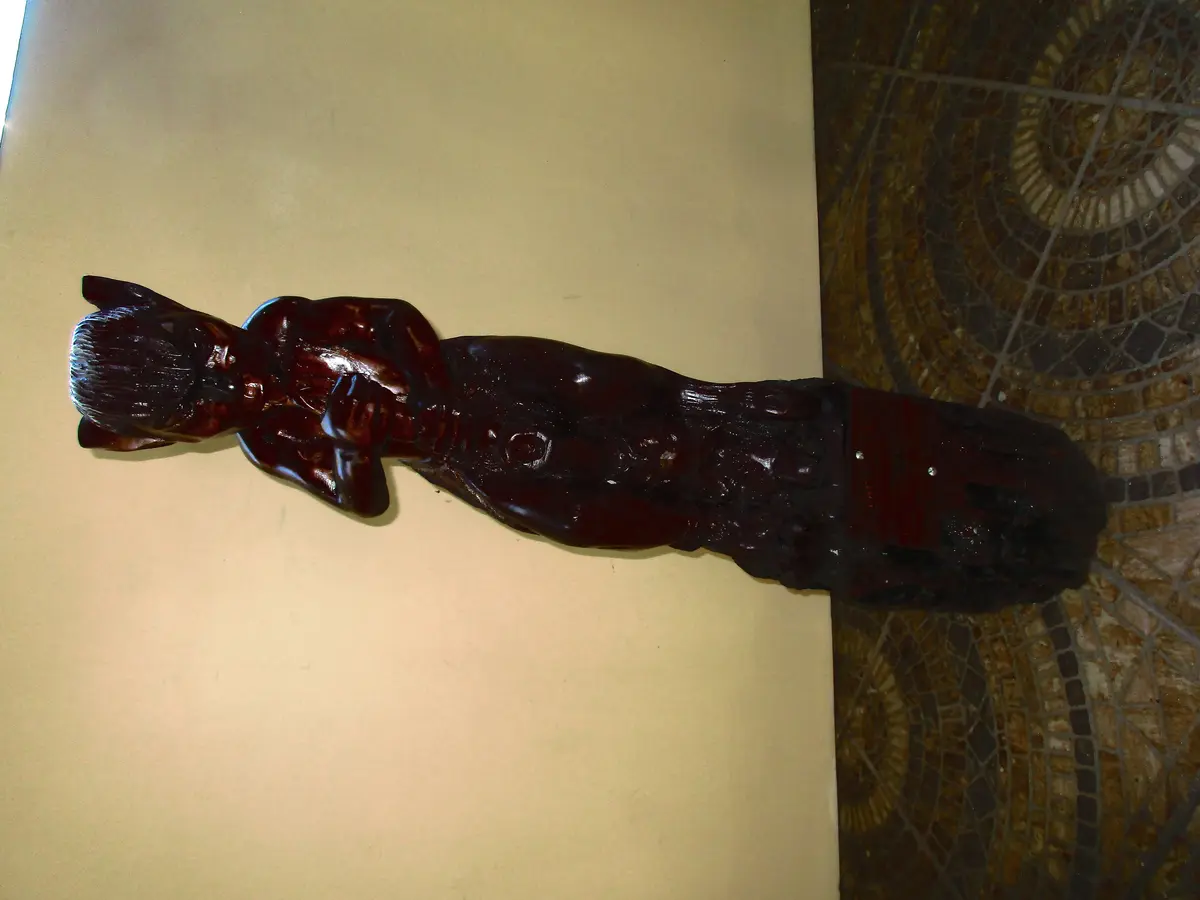
The photograph attached to this file shows a carved statuette at Los Paucares Inn, a lodge that OpenStreetMap places on the Iquitos–Nauta road about 29 km south-west of the Plaza de Armas. Wikimedia Commons records it as taken on 18 March 2018 and uploaded by the user LLs on 21 March 2018 under CC BY-SA 4.0. It is a decorative carving in a tourist lodge; the hat, the face and the proportions are the carver's.
The Complejo Turístico de Quistococha surrounds the lake of that name about 12 km south-west of the Plaza de Armas in a straight line. The Spanish Wikipedia article on it gives 369 hectares of forest, a museum of Amazonian taxidermy, a zoo, a nursery and an artificial white-sand beach called Tunchi Playa. A mural of "El Chullachaqui" at its zoo was photographed in March 2006 by Jorge G. Mori, and the photograph has been on Wikimedia Commons in the public domain since January 2008.
The San Martín tales have real geography. The Cumbaza, the stream where the young woman of the 1947 collection was fishing, runs past Tarapoto and Lamas, and Saposoa, Izquierdo Ríos's home town, is in the same department.
The name also belongs to a plant. Robert Tindall's The Jaguar that Roams the Mind (2008) describes chullachaqui caspi as "a curative and teacher plant", and Duke and Vásquez's Amazonian Ethnobotanical Dictionary (1994) has an entry for it on page 230. Neither book is a clinical source, and this file cites them for the name only.
For reading rather than travelling: González Holguín's 1608 vocabulary is public domain and freely downloadable; Salazar Mejía's 2019 study is open access on Dialnet; Arguedas and Izquierdo Ríos's 1947 compilation can be searched in full text through Open Library; Izquierdo Ríos's Ande y Selva (1939) and Pueblo y bosque (1975) are read here through Gonzalo Espino Relucé's transcription, which gives book and page for each quotation.
Sources consulted
- Diego González Holguín, «Vocabvlario de la lengva general de todo el Perv llamada lengua Qquichua o del Inca» — Lima, Francisco del Canto; digitisation by Runasimipi Qespisqa Software, 2007 (public domain), 1608 book
- Francisco Izquierdo Ríos, «Ande y Selva (Tierra Peruana), tale 32, pp. 104-112» — Lima, Taller Gráfico P. Barrantes C. (quotations read through Gonzalo Espino Relucé's transcription), 1939 book
- Francisco Izquierdo Ríos, «En la tierra de los árboles, p. 79» — Lima, Ediciones Selva (novel; quotation read through Gonzalo Espino Relucé's transcription), 1952 book
- Francisco Izquierdo Ríos, «Pueblo y bosque. Folklore amazónico, pp. 50-51» — Lima, P. L. Villanueva Editor, 1975 book
- José María Arguedas y Francisco Izquierdo Ríos (comps.), «Mitos, leyendas y cuentos peruanos» — Lima (1947); edition consulted via Internet Archive full-text search, with tales credited to the preceptores Teófilo Peña and Angélica Reá, 1947 book
- Nécker Salazar Mejía, «Seres imaginarios y motivos de la literatura oral en Mitos, leyendas y cuentos peruanos de José María Arguedas y Francisco Izquierdo Ríos» — Boletín de Literatura Oral, 9, pp. 223-248 (DOI 10.17561/blo.v9.11), 2019 academic
- Gonzalo Espino Relucé (Universidad Nacional Mayor de San Marcos), «El Chullachaqui en los apuntes de Francisco Izquierdo Ríos» — La alforja de Chuque (blog), November 2010 — transcribes the 1939, 1952 and 1975 passages with book and page, 2010 web
- Ciro Alegría, «El mundo es ancho y ajeno» — Santiago de Chile, Ercilla (Chullachaqui episode; verified by full-text search), 1941 book
- Harriet de Onís (ed. and trans.), «The Golden Land: An Anthology of Latin American Folklore in Literature» — New York, Alfred A. Knopf — Chullachaqui passage footnoted "Reprinted from Broad and Alien Is the World", 1948 book
- Milton Rugoff (ed.), «A Harvest of World Folk Tales» — New York, Viking; reissued 1968 and as The Penguin Book of World Folk Tales, 1977, 1949 book
- Llewelyn Williams, «Woods of Northeastern Peru» — Field Museum of Natural History, Botanical Series XV, Chicago — negative control: zero matches for "chullachaqui", 1936 book
- James A. Duke y Rodolfo Vásquez, «Amazonian Ethnobotanical Dictionary, p. 230» — Boca Raton, CRC Press, 1994 book
- Wikipedia en español (usuarios Stuard202020 y LLs), «Chullachaqui — historial de ediciones (revisiones de 2009-12-30 y 2018-03-21)» — MediaWiki revision history, consulted via the API on 14 August 2026, 2018 archive
- LLs, «File:Estatuilla de Chullachaqui.jpg» — Wikimedia Commons — statuette at Los Paucares Inn, Iquitos; taken 18 March 2018, uploaded 21 March 2018, CC BY-SA 4.0, 2018 web
- Robert Tindall, «The Jaguar that Roams the Mind: An Amazonian Plant Spirit Odyssey» — Rochester, Park Street Press — chullachaqui caspi as "a curative and teacher plant" (pp. 145, 159-160, 204), 2008 book
- Paul C. Standley, «Studies of American Plants (Botany 8: 156) — Remijia peruviana Standl., sp. nov.» — Field Museum of Natural History, Chicago — negative control: zero matches for "chullachaqui", 1930 book
- Debra S. Marshall, «A Silent Invasion: The Truth about Aliens, Alien Abductions, and UFOs (cryptozoology section listing the Chullachaqui)» — Schiffer Publishing, Atglen, PA, 2014 book
- Short Stories, «Short Stories, vol. 168, no. 5 (pulp magazine; “Chulla Chaqui-cuna’s cries”)» — Short Stories (New York), 1939 archive
Reviewed by V. Serrano on 2026-08-14 · How we verify our content
📎 Source: Enigma Atlas
💬 Field testimonies (0)
No testimonies yet. Add the first.
Add your testimony
🔒 Log in to add a testimony