🦶 CRYPTID SIGHTING · EXP. Nº8141
ACTIVE
Mothman
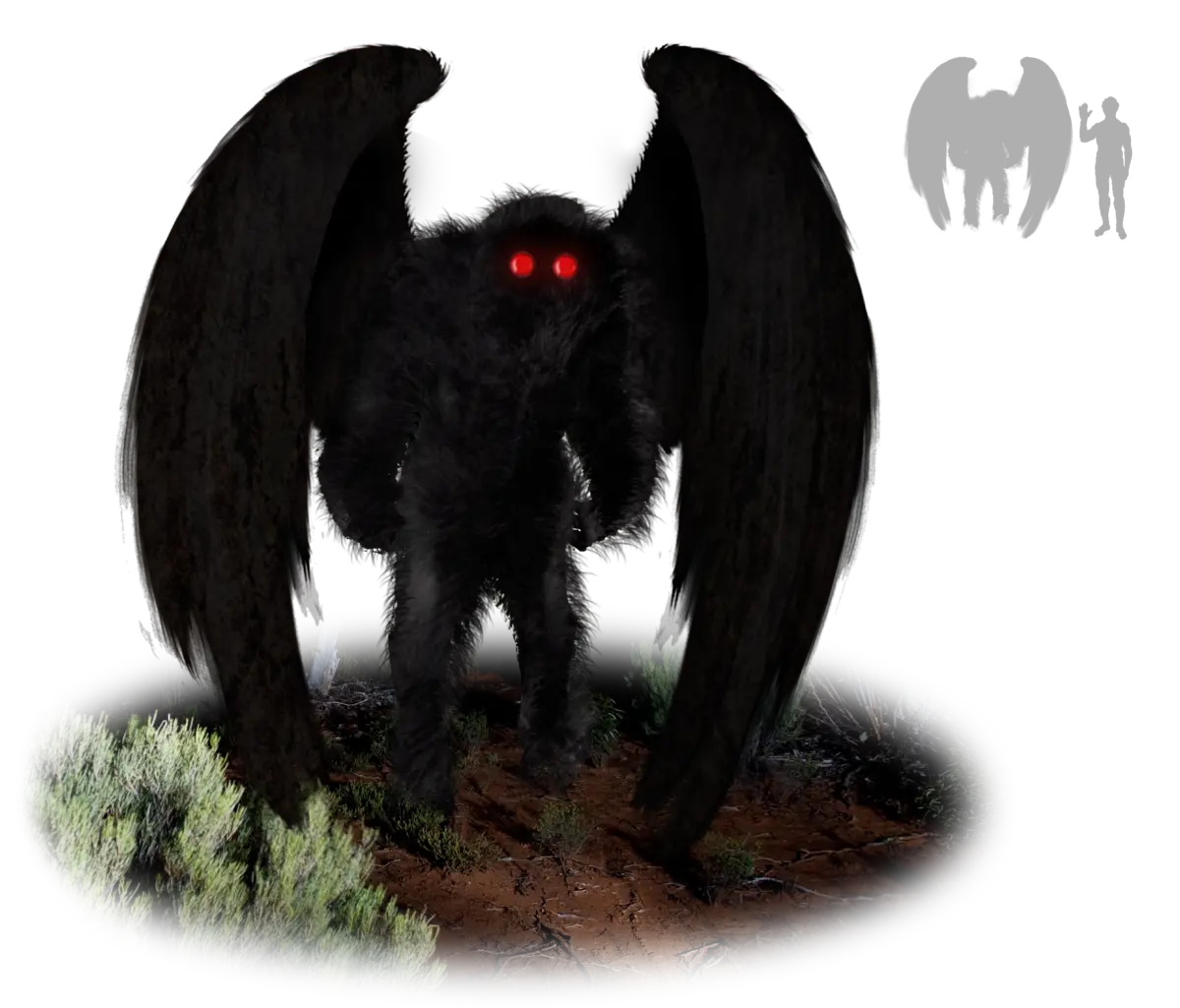
Mothman is a winged, humanoid creature said to have haunted the small town of Point Pleasant, West Virginia, described by witnesses as roughly man-sized with large folded wings and two enormous, glowing red eyes rather than a visible head or face.
Where and when was Mothman sighted?
- Location
- West Virginia, United States
- Date sighted
- 1966-11-15
- Coordinates
- 38.845, -82.137
- Last updated
LOCATION
What is Mothman?
Reports clustered tightly between November 1966 and December 1967, when locals described a gray, moth-like or bird-like figure chasing cars along back roads at night and lurking near an abandoned munitions plant known as the "TNT area." The sightings ended abruptly after the catastrophic collapse of the Silver Bridge over the Ohio River in December 1967, which killed dozens of people, and folklore later linked Mothman's appearances to that disaster as an omen, a connection popularized by journalist John Keel's book "The Mothman Prophecies." Skeptics have proposed that witnesses saw a large owl, such as a barred owl, whose eyes reflect light with an eerie red glow, compounded by fear, darkness and the collective anxiety of a small town. Point Pleasant now embraces the legend with an annual festival and a dedicated Mothman statue and museum.
What is the history of Mothman?
The Mothman case has an unusually precise beginning: the night of 15 November 1966, on a road outside Point Pleasant, West Virginia.
Two young married couples — Roger and Linda Scarberry, and Steve and Mary Mallette — drove into what locals call the TNT area, the grounds of an abandoned Second World War munitions plant north of town, a landscape of overgrown concrete igloos and unlit access roads. They told police they had seen a large dark figure standing at the side of the road, roughly seven feet tall, with eyes that glowed red. Linda Scarberry described a "slender, muscular man" with white wings.
They drove to the sheriff's office and reported it. The story ran in the local paper, and over the following thirteen months dozens of further sightings were reported around Point Pleasant, most of them in or near the same TNT area.
Then came the event that turned a local flap into an enduring legend. On 15 December 1967, at rush hour, the Silver Bridge carrying US Route 35 over the Ohio River collapsed. The suspension span folded in under twenty seconds. Thirty-two vehicles went into the river and forty-six people died.
The sightings stopped. And in the aftermath, the connection was made that has defined the case ever since: that the creature had not been a monster but a warning — an omen that had been circling the town for a year before the disaster. The journalist John Keel built that reading into a book, and the book built the Mothman into an American myth far larger than the events that produced it.
Timeline: the documented record of Mothman
- 15 November 1966 Roger and Linda Scarberry and Steve and Mary Mallette tell police they saw a figure some seven feet tall with red glowing eyes and white wings in the TNT area, the grounds of an abandoned WWII munitions plant.
- Days later, November 1966 Mason County Sheriff George Johnson publicly attributes the sightings to an unusually large heron. Wildlife biologist Robert L. Smith of West Virginia University identifies a likely sandhill crane: near-human height, seven-foot wingspan, red skin around the eyes.
- 15 December 1967 The Silver Bridge collapses at rush hour. Thirty-two vehicles fall into the Ohio River and forty-six people die. The sightings stop, and the retrospective link to an omen is made.
- 4 October 1968 The NTSB's interim report identifies the cause: a stress corrosion crack in eyebar 330, grown over thirty-nine years to about three millimetres, which fractured brittly in near-freezing temperatures under rush-hour load.
- 27 April 1971 The Federal Highway Administration adopts the National Bridge Inspection Standards, a direct consequence of the collapse. The real lesson of Point Pleasant turns out to be about maintenance.
Is there a rational explanation for Mothman?
Two separate things get bundled together in the Mothman story, and both have answers.
What the couples saw. The natural candidate was proposed within days, by people with local standing. Mason County Sheriff George Johnson stated publicly that he believed the sightings involved an unusually large heron. The wildlife biologist Robert L. Smith, of West Virginia University, went further and identified the likely species: a sandhill crane. The fit is uncomfortably good. Sandhill cranes stand close to human height, have a wingspan approaching seven feet, migrate south through the region at exactly that time of year, and — the detail that does the most work — carry a distinctive patch of bare reddish skin around the eyes. A large crane, disturbed at night by headlights on an unlit road, is not a poor match for "a tall grey figure with red eyes and huge wings".
The bridge. This is where the case really ends, because the Silver Bridge collapse is one of the most thoroughly investigated structural failures in American history, and its cause is known in forensic detail.
The NTSB traced it to a single component: eyebar 330, in the north chain on the Ohio side. The eyebar assembly let water pool in the eye-hole; the combination of residual tensile stress and that corrosive environment produced a stress corrosion crack, which grew over thirty-nine years to a length of about three millimetres. On a night near freezing, the steel's toughness dropped, and under heavy rush-hour loading that tiny crack caused a brittle fracture. The chain failed and the bridge went with it. The NTSB's interim report is dated 4 October 1968, and the collapse led directly to the National Bridge Inspection Standards adopted in 1971.
So the "prophecy" links a migratory bird to a three-millimetre crack that had been growing since 1928. What the disaster actually revealed was a country that was not inspecting its bridges — which is a more useful warning than the one the legend offers, and a good deal harder to sell.
Can you visit Mothman?
Point Pleasant has made its peace with the story and turned it into a small, well-run local economy — and, to its credit, without hiding the disaster underneath it.
The Mothman Museum is at 400 Main Street. Admission is $4.99 for ages 11 and over and $1.99 for children under 10 — genuinely cheap for what it holds. Opening is 10:00–17:00 Monday to Thursday, 10:00–18:00 Friday and Saturday, and 12:00–17:00 on Sunday, closed at Easter, Thanksgiving, Christmas and New Year. The reason to go is not the film props: it is the handwritten eyewitness statements from 15 November 1966 and the original press clippings, alongside the newspaper coverage of the Silver Bridge collapse. Seeing both bodies of material in one room is the clearest way to understand how the two stories fused.
Outside, in Gunn Park on Main Street, stands the 12-foot stainless-steel Mothman statue, which is the town's photograph. There is also a historical marker for the legend.
The Silver Memorial Bridge replaced the collapsed span, and there is a memorial near the site listing the forty-six dead. It deserves the visit more than the statue does.
The TNT area — where the first sighting happened — is five miles north of town and is now part of the McClintic Wildlife Management Area, open for fishing, hunting and hiking. The concrete munitions igloos are still there among the trees. It is a working wildlife area with hunting seasons, so check what is in season before wandering off the trails, and go in daylight.
Sources consulted
- Daniel A. Reed, «The Mothman and the Crane: A Contemporary Perspective — el avistamiento de 1966 y las explicaciones de la garza y la grulla canadiense» — Skeptical Inquirer, Committee for Skeptical Inquiry, 2022 academic
- The Open University, «The Silver Bridge Disaster: the collapse — análisis de ingeniería forense» — OpenLearn, 2019 academic
- STRUCTURE Magazine, «Silver Bridge failure 1967 (aka Point Pleasant Bridge)» — National Council of Structural Engineers Associations, 2021 academic
- Mothman Museum, «Mothman Museum — horarios, precios y fondos documentales» — Información oficial de visita, 2026 archive
- West Virginia DNR, «McClintic Wildlife Management Area — ficha oficial del área (ubicación, caza y pesca), zona TNT» — West Virginia Division of Natural Resources, Distrito 5, 2026 web
Reviewed by V. Serrano on 2026-07-28 · How we verify our content
📎 Source: Enigma Atlas
💬 Field testimonies (0)
No testimonies yet. Add the first.
Add your testimony
🔒 Log in to add a testimony