📜 LEGEND · EXP. Nº0270
ACTIVE
The Bell Witch
The Bell Witch is the best-known haunting in the United States and one of the few with a named family, a dated span and a place on the map: the farm of John Bell at Adams, Robertson County, Tennessee, between 1817 and 1821.
Where does the legend of The Bell Witch come from?
- Location
- Adams, Tennessee, United States
- Kind of legend
- Ghost story
- Coordinates
- 36.588, -87.062
- Last updated
LOCATION
What is the legend of The Bell Witch?
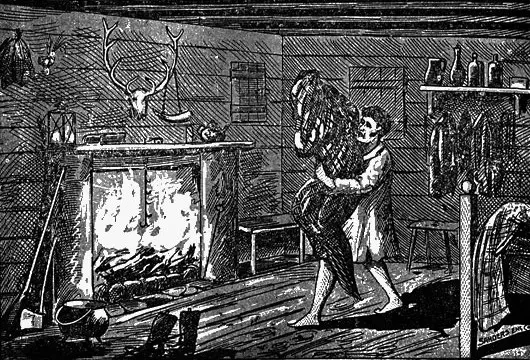
It is also a case that can be read as a paper trail. The oldest printed account we have been able to read is not the famous book but a single paragraph of about 250 words in Goodspeed's History of Tennessee of 1886: an invisible being with a woman's voice that held conversations, shook hands, spilled the milk and pinched the children. There is no death of John Bell in it, no poisoned vial, no General Andrew Jackson, no thwarted courtship and no cave. All of those reach print in 1894, in An Authenticated History of the Famous Bell Witch, written by a newspaper editor from a manuscript released to him in 1891, after every witness was dead, and from letters written for the book itself. The word authenticated on that cover is the author's claim, not anyone's finding.
What is the history of The Bell Witch?
John Bell and his wife Lucy Williams Bell moved from North Carolina to the Red River country of Robertson County, Tennessee, and settled about 1804 on land near what would much later become the village of Adams — a place that did not yet exist, and only came into being in 1859–60 when the Edgefield and Kentucky Railroad was built through it. The disturbances attributed to the household are traditionally dated 1817–1821, and John Bell died on the morning of 20 December 1820.
Everything else about the Bell Witch is a question of who wrote what down, and when. So this file is built as a chain of documents rather than as a ghost story, because the chain is the part that can be checked.
1886 — the earliest printed account I have been able to read is not the famous book. It is a single paragraph, roughly 250 words, in the Robertson County section of the Goodspeed Publishing Company's History of Tennessee, at page 833. It reports that "so great was the excitement that people came from hundreds of miles around to witness the manifestations of what was popularly known as the 'Bell Witch'"; that the thing "was supposed to be some spiritual being having the voice and attributes of a woman"; that it was invisible to the eye "yet it would hold conversation and even shake hands with certain individuals"; and that it "would take the sugar from the bowls, spill the milk, take the quilts from the beds, slap and pinch the children, and then laugh at the discomfiture of its victims". Goodspeed's compiler then refuses the job: "That all this actually occurred will not be disputed, nor will a rational explanation be attempted. It is merely introduced as an example of superstition."
What that paragraph does not contain is almost everything a reader comes here for. There is no death of John Bell in it. No poisoning, no vial. No General Andrew Jackson. No Betsy Bell, no broken courtship. No promise to return. No cave.
1894 — those arrive with the book. An Authenticated History of the Famous Bell Witch was written by Martin Van Buren Ingram, a newspaper editor who had run papers at Springfield and Clarksville, Tennessee; it was printed at Clarksville by W. P. Titus and copyrighted in Ingram's own name. Its centrepiece is a first-person narrative headed "Our Family Troubles", presented as the manuscript of Richard Williams Bell, a son of the house.
Ingram is unusually frank about that manuscript's history, and his own dates are the most interesting thing in the book. Williams Bell, he writes, "put it in shape in 1846, twenty-six years after the culmination of the tragical events in the death of John Bell, Sr."; the text itself says it "was written by father during the Fall and Winter of 1846". Ingram also records that Williams Bell died on 24 October 1857 "at the age of forty-six years" — which makes him a boy of about six to ten during the events he narrates as a witness, and a man of thirty-five when he wrote them down. He asked that nothing be published while any of John Bell Sr.'s immediate family lived, and the paper passed to his eldest son, James Allen Bell.
Ingram prints the correspondence, and it is the load-bearing document of the whole case. James Allen Bell had refused him once already, when Joel Bell asked on Ingram's behalf: "I declined". He gave way only "since the death of all of the family who were victims of the frightful disturbance", in a letter Ingram reproduces, dated at Adairville, Kentucky, 1 July 1891.
The rest of the book was assembled in the same campaign of letter-writing. The Andrew Jackson chapter — chapter XI, "Remarkable and Amusing Incidents Attending the Great Soldier and Statesman's Visit to the Witch" — rests on a sketch supplied by Col. Thomas L. Yancey, a Clarksville lawyer, in a letter dated 1 January 1894: written for the book. It is there that the wagon sticks fast on the lane, and Jackson throws up his hands and says, "By the eternal, boys, it is the witch." The other set pieces belong to the same 1894 gathering: Betsy Bell and her suitor Joshua Gardner, and the voice pleading "Please Betsy Bell, don't marry Joshua Gardner"; the smoky-looking vial one-third full of dark liquid found in the cupboard as John Bell lay dying, and Kate's boast, "I put it there, and gave Old Jack a big dose out of it last night while he was fast asleep, which fixed him"; the entity lining hymns and repeating the sermons of the Rev. James Gunn word for word; and Mrs. Kate Batts, the neighbour whose name the thing was given.
On the identity, Ingram is deliberately unresolved — "First, it was a disturbed spirit hunting a lost tooth. Next, a spirit that…" — and he goes out of his way to clear the Batts family. Betsy Bell, he records through the testimony of Mrs. Mahala Darden, never married Gardner: "she finally married Richard Powell, her school teacher, who was a very prominent man".
Timeline: the documented record of The Bell Witch
- c. 1804 John Bell and Lucy Williams Bell settle on the Red River in Robertson County, Tennessee, near what will later be Adams. The village itself does not exist yet: it grew up in 1859-60 around the Edgefield and Kentucky Railroad.
- 1817 Traditional start of the disturbances at the Bell farm. The Tennessee Encyclopedia entry by the Robertson County historian William T. Turner places the family's first awareness of them 'sometime around 1816'.
- 20 December 1820 John Bell dies. The narrative Ingram attributes to Richard Williams Bell gives the morning of 20 December 1820, and the same date appears in the Tennessee Encyclopedia. The vial found in the cupboard and the entity's boast of having poisoned him are told in that narrative, published in 1894.
- 1821 The entity is said to take its leave, promising to be 'absent seven years' and to return. Not a hundred: seven. It is recorded as returning in 1828, and a section of Ingram's book is devoted to that return.
- Autumn-winter 1846 Richard Williams Bell writes 'Our Family Troubles', 26 years after his father's death. Ingram records that Bell died on 24 October 1857 aged 46, which makes him a child of six to ten during the events he narrates as a witness. He asks that it not be published while any of John Bell Sr.'s immediate family lives.
- c. 1849 Ingram twice reports a long Saturday Evening Post sketch of the case, 'published either at Philadelphia or New York', which blamed Betsy Bell. He quotes nothing from it and his informant's copy was lost. In 2014 Joe Nickell reported that a search of the complete 1849 run, and of 1840-1860 entire, turned up no such article.
- 1886 The earliest printed account I have been able to read: some 250 words on page 833 of Goodspeed's History of Tennessee, Robertson County section. It has the invisible woman's voice, the handshakes, the sugar, the milk, the quilts, the pinched children and the cursing. It has no death of John Bell, no vial, no Andrew Jackson, no Betsy, no courtship, no promise to return and no cave.
- 1 July 1891 James Allen Bell writes to Ingram from Adairville, Kentucky, releasing his father's manuscript at last, having refused an earlier request. Ingram prints the letter. Joe Nickell notes that the manuscript 'has no proven existence before about 1891' and has never been available for examination.
- 1 January 1894 Col. Thomas L. Yancey, a Clarksville lawyer, writes to Ingram with the sketch on which the Andrew Jackson chapter is built. This letter, written for the book, is the earliest datable source for the most famous scene in the legend.
- 1894 M. V. Ingram, a newspaper editor of Springfield and Clarksville, publishes An Authenticated History of the Famous Bell Witch, printed at Clarksville by W. P. Titus. The poisoned vial, Andrew Jackson, Joshua Gardner's courtship of Betsy, the hymn-singing and Kate Batts all reach print here.
- 1934 Dr. Charles Bailey Bell, a Nashville physician descended from the family, publishes The Bell Witch: A Mysterious Spirit, built on conferences his grandfather John Bell Jr. was said to have held with the entity in 1828. This is where the spirit promises to return 107 years later, in 1935 - the source of the 'hundred years' our own page used to report.
- 1937 The predicted year becomes a media season. The Tennessean columnist T. H. Alexander raises the prophecy on 3 January; WSM radio airs a forty-minute dramatisation with more than forty voice actors in June; Coronet magazine bills the case as 'America's No. 1 Ghost Story' in July; and the film The Return of the Bell Witch premieres at Nashville's Princess Theatre at Halloween. By December, with nothing to show, coverage stops.
- 2014 Joe Nickell publishes his analysis in Skeptical Inquirer, arguing on stylistic grounds that Ingram wrote the narrative he attributed to Richard Williams Bell, and reporting the failed search for the 1849 Saturday Evening Post article.
Is there a rational explanation for The Bell Witch?
The word doing the heaviest lifting in this case is printed on the cover of the 1894 book. "Authenticated" is an assertion by its author, not a finding by anybody else.
Joe Nickell examined the case for Skeptical Inquirer in 2014 and argued that Ingram did not merely edit the Williams Bell narrative but wrote it, citing shared vocabulary, sentence construction and literary allusion across the two supposed voices. His documentary point is the harder one to argue with: the manuscript "has no proven existence before about 1891" — which is the date of James Allen Bell's letter of release, printed in the book — and is "today nowhere available to be examined as to its paper, ink, and handwriting". Nobody has ever weighed the object. It exists as text, inside the volume it authenticates.
The one earlier source Ingram appeals to fares no better. Twice he tells readers that "about 1849 the Saturday Evening Post, published either at Philadelphia or New York, printed a long sketch of the Bell Witch phenomenon", written by a reporter who tried to pin the disturbances on Betsy Bell herself. Ingram does not quote a line of it, does not know which city it came from, and his informant remembered owning a copy that had since been lost. Nickell reports that Tim Binga, the Center for Inquiry's director of libraries, searched the 1849 run — which survives complete — and the whole 1840–1860 period, and found no such article.
Jackson is the same shape of problem. He is the detail that lends the story its authority, a future president as eyewitness, and outside Ingram's chapter he lacks support from any known historical source — and that chapter was itself built from a letter written in January 1894, seventy-odd years after the visit it describes.
Then there is the growth, which can be measured. In Ingram the entity leaves in 1821 saying "it would be absent seven years, but would surely return", and returns in 1828; that is also how William T. Turner tells it in the Tennessee Encyclopedia. The century-long promise belongs to a different book: Dr. Charles Bailey Bell, a Nashville physician descended from the family, published The Bell Witch: A Mysterious Spirit in 1934, built around conferences his grandfather John Bell Jr. was said to have held with the entity during that 1828 return — and there the spirit undertakes to come back 107 years later, in 1935. The Nashville Tennessean columnist T. H. Alexander then printed a version due in 1937, and 1937 became a media season: a WSM radio dramatisation of forty minutes with more than forty voice actors in June, a Coronet magazine piece billing the case as "America's No. 1 Ghost Story" in July, and a film, The Return of the Bell Witch, premiering at Nashville's Princess Theatre at Halloween. Coverage stopped by December, nothing having happened.
The cave has no place in any of this. I searched the full text of Ingram's 1894 book — 131,212 words — for the root cav*: it occurs once, in the word "cavorted", in a poem. There is no cave in the founding book at all, while "witch" occurs 804 times, "Kate" 204 and "Betsy" 137 in the same file. Goodspeed's 1886 volume does describe a haunted cave in Robertson County, but it belongs to somebody else: Cheek's cavern near the Sumner County line, where the ghost of a murdered trader was said to walk. The motive the cave's operators advertise today — that the witch was the spirit of Kate Batts, cheated by John Bell over a land deal — is not Ingram's either. He gives her chapter VI and defends her: the Battses were "respectable people", and "nothing of a disreputable nature attached to the family character".
What survives all this is worth stating plainly, because it is not nothing. Something in Adams predates Ingram. Goodspeed's compiler printed it in 1886 from what "contemporaries and their descendants" were still saying, eight years before the book, and the local story was strong enough to be worth a book at all. But between "neighbours in Robertson County told a story about the Bells" and a talking spirit that poisoned a man, argued theology with ministers, entertained Andrew Jackson and promised to return in a century, there stands one nineteenth-century newspaper editor and a manuscript nobody has seen.
Can you visit The Bell Witch?
Adams is in Robertson County, Tennessee, close to the Kentucky state line, about 53 km (33 miles) north-north-west of downtown Nashville in a straight line; the cave's operators call it "a 40-minute drive". Of the Bell farm, the Tennessee Encyclopedia lists the family cemeteries, "the old farm well now abandoned" and traces of the lane down which Jackson is said to have ridden, and records that a log dwelling, "allegedly once a slave or tenant house on the Bell property", has been moved to the grounds of the old public school at Adams. The cave's operators say they keep a chimney stone and an iron kettle from the original Bell cabin, shown inside a reconstructed one.
The Historic Bell Witch Cave is at 430 Keysburg Road, Adams, TN 37010 (tel. +1 615 696 3055), about 300 m from the pin on this file. Its website, consulted on 23 September 2026, advertises guided cave tours, tours of the reconstructed John Bell cabin, guided lantern tours after dark, paranormal investigations with Todd and Leanne Escue of Black Wolf Paranormal, the "Witch's Dell" haunted hayride, "Forgotten History" hayride tours and tubing. The banner on its home page says the site is open Friday to Sunday each week in September, 10:00–17:00; a separate programme runs from 2 October to 1 November, November is weekends only, and the season closes from December to April 2027. A single admission ticket covers the cave tour (about 40 minutes) and the cabin tour (30 to 40). Tickets are sold only on site and no reservations are taken; the prices are published as an image on the "Pricing & Tours" page.
The operators' own notes describe the cave. They give its temperature as 58 °F (14 °C) all year and warn that "your feet may get wet"; rubber boots are for rent. The cave and cabin close during heavy rain, and sometimes after it, "due to flooding in the cave". The site is not ADA accessible, children aged three and under are not allowed into the cave, and every visitor signs a waiver. The operators also say that the cave has been on the National Register since April 2008 and that it holds a Native American burial site.
The book that made the Bell Witch famous does not mention the cave. Ingram's An Authenticated History of the Famous Bell Witch (1894) has been scanned in full and can be read or downloaded free from the Internet Archive, and the Andrew Jackson chapter in it rests on a letter written in January 1894.
Sources consulted
- Goodspeed Publishing Company, «History of Tennessee... together with an historical and a biographical sketch of Montgomery, Robertson, Humphreys, Stewart, Dickson, Cheatham and Houston counties (Robertson County, p. 833)» — Goodspeed Publishing Co., Nashville, 1886 book
- Martin Van Buren Ingram, «An Authenticated History of the Famous Bell Witch (full text, scanned)» — W. P. Titus, Clarksville, Tennessee, 1894 book
- Joe Nickell, «The 'Bell Witch' Poltergeist» — Skeptical Inquirer, vol. 38 no. 1, 2014 academic
- William T. Turner, «Bell Witch» — Tennessee Encyclopedia (Tennessee Historical Society), 2017 academic
- Skyler Gordon, «'Year of the Witch': 1937 and the Return of the Bell Witch» — Tennessee Historical Society, 2017 academic
- Historic Bell Witch Cave, «Historic Bell Witch Cave - official site (tours, season and contact, consulted August 2026)» — bellwitchcave.com, 2026 web
Reviewed by V. Serrano on 2026-08-16 · How we verify our content
📎 Source: Enigma Atlas
💬 Field testimonies (0)
No testimonies yet. Add the first.
Add your testimony
🔒 Log in to add a testimony