📜 LEGEND · EXP. Nº0270
ACTIVE
Paul Bunyan and Babe the Blue Ox
Paul Bunyan is the giant lumberjack of North American tall tales, and the striking thing about him is that his story can be dated layer by layer.
Where does the legend of Paul Bunyan and Babe the Blue Ox come from?
- Location
- Bemidji, Minnesota, United States
- Kind of legend
- Folk tale
- Coordinates
- 47.474, -94.88
- Last updated
LOCATION
What is the legend of Paul Bunyan and Babe the Blue Ox?
In the oldest record made from the lumberjacks themselves -- a field collection published in 1916 by K. Bernice Stewart and Homer A. Watt -- Paul is seven feet tall, not a mountain; his blue ox has no name at all; and the ox is blue because it was white until a winter when it snowed blue snow for seven days. The great exploit is the Round River drive, down a river that turns out to have no outlet. The name Babe, the forty-two axe handles and the Great Lakes dug as a drinking hole all arrive later, in a book written for the Red River Lumber Company by its advertising man, W. B. Laughead, who stated in print that the animals' names were his own inventions. The beard combed with an uprooted pine, the ten thousand Minnesota lakes and the Grand Canyon come later still, from a children's book of 1926 -- and in that book the canyon is a comparison, not something Paul dug. None of which makes him fake: the camp tales were real, and were collected from named informants before any of the advertising was written.
What is the history of Paul Bunyan and Babe the Blue Ox?
Paul Bunyan was a big man before he was a giant, and the difference is documented.
The oldest attempt to write the tales down as they were actually told is a field study: "Legends of Paul Bunyan, Lumberjack", by K. Bernice Stewart and Homer A. Watt, printed in 1916 in the Transactions of the Wisconsin Academy of Sciences, Arts and Letters. Stewart had been hearing the stories from the lumberjacks of Wisconsin and Michigan for years; she and Watt then wrote to and interviewed lumbermen and gathered versions from as far as Oregon, Washington and British Columbia. They printed an address at New York University and asked readers to send more. Some of what they collected, they noted drily, was "too coarse for publication".
The Paul Bunyan of that 1916 record is "a powerful giant, seven feet tall and with a stride of seven feet". Seven feet. He keeps his men's time by cutting notches in a stick and orders supplies by drawing pictures of what he wants; on the one occasion his ingenuity fails he orders grindstones and receives cheeses. His ox is never given a name. It is simply "his blue ox", with the strength of nine horses, "seven feet -- or seven ax-handles -- between his eyes, and fourteen feet between his horns". And it explains its own colour: the ox "was pure white" until "one winter in the woods it snowed blue snow for seven days (that was the winter of the snow-snakes)", and it never lost the colour. The great exploit is not a canyon or a lake system. It is a single forty-acre parcel shaped like a pyramid, cleared of a hundred million feet of pine, floated down a river that turns out to be circular and to have no outlet at all: the Round River drive. The pancake griddle is real too, greased every morning by cooks with hams strapped to their feet -- and an Oregon variant has two hundred cooks doing it with bacon-rinds.
The tales reached print before that. The earliest printing that scholars have brought to light keeps moving backwards: the Forest History Society, reprinting the story in 1986, identified an unsigned anecdote titled "Round River" on an inside page of the Oscoda Press for Friday 10 August 1906, in Michigan, and its introduction by Mary Jane Hennigar was careful to add that Bunyan tales "may have been printed before 1906 in other local newspapers in the timber regions". They had been. Michael Edmonds, in 2009, put the first known appearance in print at a Duluth newspaper item of 4 August 1904, and traced the telling itself back to timber cruisers around Rhinelander, Wisconsin, in the winter of 1885-86. The 1906 anecdote was written up again by James MacGillivray and published as "The Round River Drive" in the Detroit News-Tribune of 24 July 1910; Douglas Malloch turned it into rhyming verse in the American Lumberman of 25 April 1914, unsigned and uncredited. Stewart and Watt thanked Malloch by name for a copy of that poem, and cited its date, in 1916.
Then the advertising department arrived, and this is the part the older versions of this story tend to soften.
The Red River Lumber Company -- a Minnesota firm that cut its last Minnesota log at Akeley in 1915 and moved its operation to Westwood, California -- put Paul Bunyan on its promotional literature. Its copywriter and illustrator was W. B. Laughead, who produced small booklets in 1914 and 1916 and then the book that did the work: the first edition of Paul Bunyan and His Big Blue Ox appeared in 1922 in ten thousand copies, followed the same year by a printing of five thousand, with further editions in 1924, 1927 and 1931 and a revised printing in January 1934. The company gave the copies away on request and never copyrighted the stories.
What Laughead added is not a matter of inference, because he wrote it down. In the editorial note to his own book he states that "the names of the supporting characters, including the animals, are inventions by the writer of this version", and that "the oral chroniclers did not, in his hearing, which goes back to 1900, call any of the characters by name except Paul Bunyan himself". Babe is Laughead's. So is Johnny Inkslinger, so is Brimstone Bill, so is Benny the little blue ox. So is the ox's famous size: "Babe was seven axehandles wide between the eyes according to some authorities; others equally dependable say forty-two axehandles and a plug of tobacco." That is Laughead reconciling his own new figure with the seven ax-handles the lumberjacks really said, and he even supplies the joke that squares them -- "seven of Paul's axehandles were equal to a little more than forty-two of the ordinary kind". And so are the Great Lakes: "The Great Lakes were first constructed to provide a water hole for Babe the Big Blue Ox."
The same editorial note also claims, of the 1914 and 1916 booklets, "so far as we know, this was the first appearance of the Paul Bunyan stories in print." That was already untrue when it was written, and by the company's own reckoning: Malloch's verse had run in a lumber trade journal in April 1914, MacGillivray's story in a Detroit paper in 1910, the Oscoda anecdote in 1906.
The rest of the modern portrait comes from the children's books of the 1920s. Wallace Wadsworth's Paul Bunyan and His Great Blue Ox (George H. Doran Company, 1926) is where Paul acquires the beard he grooms by pulling "up a young pine tree by the roots" to use "its stiff branches in combing and brushing it smooth"; where "the ten thousand lakes that to-day lie in northern Minnesota" are made not by footprints but by the leaking bucket of the Little Chore Boy; where Babe's footprints, sunk knee-deep in solid rock under a winter's supplies, "later filled with water and became the countless lakes which are to be found to-day scattered throughout the state of Maine"; and where Paul is born on the northern coast of Maine before the Revolutionary War. The Grand Canyon is there too, and it is worth reading exactly: Paul lets his peavy -- a logging hook, not an axe -- drag behind him and gouges "a tremendous gash many miles long and hundreds of feet deep", and Wadsworth then says that "any one who has seen the Grand Canyon can have no doubts about the size of the great logger". The canyon is the comparison, not the result.
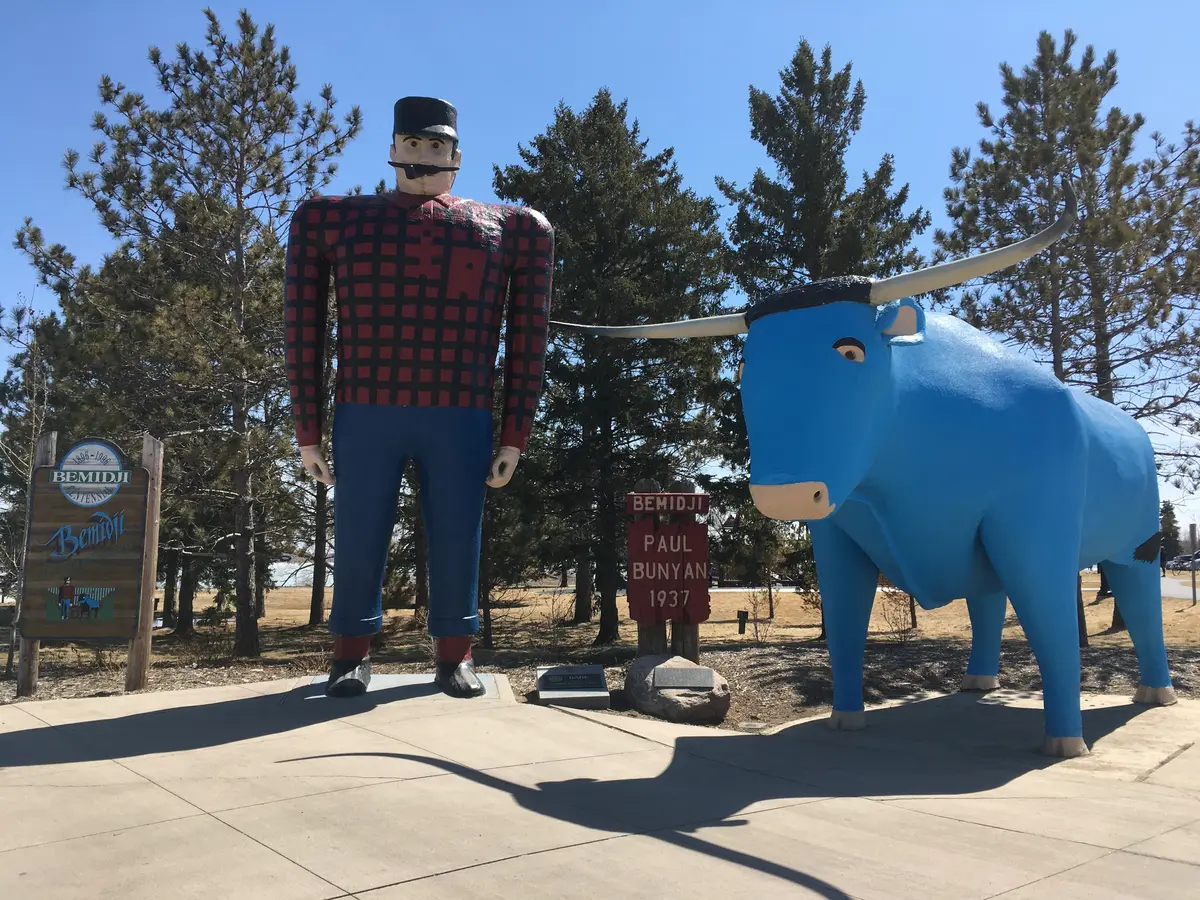
Bemidji, Minnesota, built the figures that fixed all of this in the eye. For the town's Winter Carnival, unveiled on 15 January 1937, Cyril Dickinson's lumber company oversaw an eighteen-foot Paul of concrete and plaster, modelled at three-to-one scale on the sitting mayor, Earl Bucklen; Jim Payton of the Bemidji Electric Company built Babe from a wooden frame wrapped in wire netting and covered with wool and canvas, mounted on a vehicle so it could be driven in parades, with tin horns fourteen feet across. Fourteen feet is the figure Stewart and Watt had recorded from the lumberjacks in 1916 -- not Laughead's forty-two axe handles. The pair were listed on the National Register of Historic Places on 10 March 1988, reference number 88000204, as Minnesota's first and best-known "roadside colossus".
Timeline: the documented record of Paul Bunyan and Babe the Blue Ox
- Winter of 1885-86 Michael Edmonds traces the oldest tellings he could document to timber cruisers working near Rhinelander, Wisconsin -- the earliest point at which the stories can be placed in a specific place and season rather than in an unnamed past.
- 4 August 1904 The first appearance of Paul Bunyan by name in print identified by later research: a short item in a Duluth newspaper, on the decline of the American lumberjack, referring to his doings in North Dakota in a year of blue snow.
- 10 August 1906 An unsigned anecdote titled "Round River" runs on an inside page of the Oscoda Press in Michigan, in a homecoming issue. Reprinting it in 1986, Mary Jane Hennigar called it the earliest printing then known and warned that earlier ones might exist in other timber-country papers.
- 24 July 1910 James MacGillivray rewrites the Oscoda anecdote and publishes it as "The Round River Drive" in the Detroit News-Tribune, where he was then employed -- the story's first appearance in a metropolitan daily.
- 25 April 1914 Douglas Malloch's rhymed version of the same story appears, unsigned and uncredited, in the American Lumberman. Stewart and Watt cite this issue by date in 1916 and thank Malloch for sending them a copy.
- 1916 Stewart and Watt publish the first field collection. Paul is seven feet tall, the blue ox has no name and is seven ax-handles between the eyes and fourteen feet between the horns, and it turned blue in a winter when it snowed blue snow for seven days.
- 1922 W. B. Laughead's Paul Bunyan and His Big Blue Ox is published for the Red River Lumber Company in ten thousand copies, with a further five thousand the same year and editions in 1924, 1927 and 1931. The ox is named Babe here, and here it acquires the forty-two axe handles and a plug of tobacco.
- 1926 Wallace Wadsworth's children's book adds the beard combed with an uprooted pine, the ten thousand Minnesota lakes made by a leaking bucket, Babe's footprints filling to become the lakes of Maine, and the Grand Canyon offered as a comparison for a gash cut by Paul's dragging peavy.
- January 1934 In the editorial note to the revised printing, Laughead states that the names of the supporting characters and the animals are his own inventions, and that the oral tellers he heard from 1900 onwards named nobody but Paul Bunyan himself.
- 15 January 1937 Bemidji unveils the statues at its Winter Carnival: an eighteen-foot Paul modelled on mayor Earl Bucklen, and a Babe built on a vehicle frame with tin horns fourteen feet across -- the measurement recorded from lumberjacks in 1916, not Laughead's.
- March 1950 Richard M. Dorson publishes "Folklore and Fake Lore" in The American Mercury, coining the term fakelore and making Paul Bunyan its standing example -- the start of a dispute among folklorists that has never fully closed.
- 10 March 1988 The Bemidji statues are listed on the National Register of Historic Places, reference 88000204, as Minnesota's first and best-known example of the roadside colossus and for their part in promoting northern Minnesota tourism.
- 2009 Michael Edmonds publishes Out of the Northwoods, arguing against the fakelore verdict by documenting the camp tradition that preceded the advertising -- the position the 1916 field study supports.
Is there a rational explanation for Paul Bunyan and Babe the Blue Ox?
Nobody disputes that Paul Bunyan is a real folk hero. What has been disputed, loudly and for seventy-five years, is how much of what we now repeat about him came out of a bunkhouse and how much came out of an advertising department.
The quarrel has a name and a date. In March 1950 the folklorist Richard M. Dorson published "Folklore and Fake Lore" in The American Mercury and coined the word fakelore for material tailored for mass consumption while claiming to be authentic oral tradition; Paul Bunyan was his standing example. The Forest History Society, reprinting MacGillivray's 1906 story in 1986, described the same argument in a photo caption about the roadside statues: they were an example of camp stories becoming tourist attractions, "starting a debate among folklorists over whether Paul Bunyan was authentic 'folklore' or really commercialized 'fakelore'". I have not been able to read Dorson's 1950 article itself, and report its title, journal and date as they are given in the reference literature rather than as something I verified in the original.
Michael Edmonds argued the other way in Out of the Northwoods (2009), and the 1916 field study settles the core of it in his favour: the oral tradition existed, it was collected from named informants in several states before Laughead's book, and it was already old enough that some lumberjacks claimed to have known Bunyan and pointed out a supposed grave in northern Minnesota.
What can be checked, trait by trait, is which details belong to which layer -- and that is where this page has been wrong. Searching the 1916 field study for the things this entry used to assert gives zero hits for "Babe", zero for storks, zero for the Grand Canyon, zero for the Great Lakes, zero for footprints, zero for ten thousand lakes and zero for a beard, against ten hits for "blue ox", seven for "Round River", six for "pea-soup", four for "pyramid forty" and three for "Big Onion" in the same pass. The single apparent hit for "forty-two" is the page number 642 in a running footer, which is why the body of the article has to be separated from its editorial apparatus before any count is trusted. Laughead's book gives thirty-seven hits for "Babe" and three for the Great Lakes, but zero for storks, zero for a beard and zero for the Grand Canyon. James Stevens's Paul Bunyan (1925) gives zero for storks and zero for the Grand Canyon. Wadsworth (1926) supplies the beard, the pine tree, the Grand Canyon comparison, the ten thousand lakes and the footprints.
Two honest gaps remain. The five storks that are said to have delivered the infant Paul appear in none of the four dated texts searched here, and I could not fix their first printing to any source I was able to read; they are left out of this entry rather than dated by guess. And the Forest History Society facsimile of the 1906 and 1910 stories is a scan whose text layer covers only the five pages of the introduction, so the wording of those two earliest printings could not be searched by term -- what is reported about them above comes from Hennigar's introduction, which is machine-readable, not from the facsimile. Chronicling America, HathiTrust and the Internet Archive's full-text search API were not available for this work.
There is one last thing worth saying plainly, because it is the honest version of the "spirit of the frontier" line this entry used to end on. Stewart and Watt did explain what the exaggeration was for, and their explanation is more specific and less flattering: the tales were "designed to be swallowed by camp-followers and tenderfeet for the entertainment of hardened dwellers in the woods", told in "a contest in yarning", and the style, they wrote, "is really only a natural development of the attempt to 'boom' new sections of the country by representing conditions as superior to what they actually are." A boasting hero grew in an industry whose business was boasting about the country it was cutting down.
Can you visit Paul Bunyan and Babe the Blue Ox?
Paul Bunyan and Babe the Blue Ox stand on the south shore of Lake Bemidji at the corner of Third Street and Bemidji Avenue, in Bemidji, Beltrami County, Minnesota. The pair was entered on the National Register of Historic Places on 10 March 1988 under reference number 88000204. They are outdoors on a paved lakefront apron beside the visitor centre, with no gate and no ticket, and the geotagged Wikimedia Commons photograph in the references below puts them at 47.470456 north and 94.878894 west, roughly 370 metres south-south-east of the map pin.
Paul is about eighteen feet tall and was built in concrete and plaster at a scale of three to one, with Mayor Earl Bucklen as the model. Babe was lighter work: a wooden frame wrapped in wire netting and covered with wool and canvas, fourteen feet across at the horns, mounted on a car for the 1937 winter carnival parade; tail lights shone from his eyes and the exhaust came out of his nostrils. He stopped travelling to fairs in 1939 after the damage and the expense, and what stands by the lake now is the product of repeated repair. Welders put new ribs and a new frame into Babe in 2007 and poured a new foundation, and in 2022 he was lifted fifteen inches to undo hoof damage, at a cost of about $250,000.
The nearest rival statue is at Akeley, some 54 km (33 miles) south-south-west, where a fibreglass Paul kneels with an outstretched hand outside the town's Paul Bunyan History Museum. Akeley declared itself the birthplace in 1949 on the strength of having been the headquarters of the Red River Lumber Company, whose advertising made Bunyan national.
Sources consulted
- K. Bernice Stewart and Homer A. Watt, «Legends of Paul Bunyan, Lumberjack» — Transactions of the Wisconsin Academy of Sciences, Arts and Letters, vol. 18, pp. 639-651, 1916 academic
- W. B. Laughead, «The Marvelous Exploits of Paul Bunyan (Paul Bunyan and His Big Blue Ox), printing of January 1934» — The Red River Lumber Company, Minneapolis and Westwood, California, 1934 book
- Wallace Wadsworth, «Paul Bunyan and His Great Blue Ox» — George H. Doran Company, New York, 1926 book
- James Stevens, «Paul Bunyan» — Alfred A. Knopf, New York, 1925 book
- Mary Jane Hennigar, «Paul Bunyan Story in Print (introduction to a facsimile of the 1906 Oscoda Press tale)» — Journal of Forest History, October 1986, 1986 academic
- MNopedia, Minnesota Historical Society, «Paul Bunyan (folklore character)» — MNopedia, 2016 report
- MNopedia, Minnesota Historical Society, «Paul Bunyan and Babe the Blue Ox statues, Bemidji» — MNopedia, 2016 report
- Kubber333, «File:Paul Bunyan and Babe the Blue Ox.jpg (photograph taken 22 April 2018, geotagged 47.470456 N, 94.878894 W)» — Wikimedia Commons, 2018 archive
Reviewed by V. Serrano on 2026-08-16 · How we verify our content
📎 Source: Enigma Atlas
💬 Field testimonies (0)
No testimonies yet. Add the first.
Add your testimony
🔒 Log in to add a testimony