👻 HAUNTED PLACE · EXP. Nº9046
ACTIVE
The Stanley Hotel
Built in 1909 by inventor F.O. Stanley, who moved to Estes Park seeking relief from tuberculosis, the Stanley Hotel earned its reputation for the paranormal largely thanks to a single night in 1974, when novelist Stephen King and his wife checked into room 217 — nearly the only guests in the hotel before it closed for the season — and King reportedly dreamed the outline of what became "The Shining."
Where is The Stanley Hotel?
- Location
- Estes Park, Colorado, United States
- Type
- Hotel / inn
- Coordinates
- 40.383, -105.519
- Last updated
LOCATION
Why is The Stanley Hotel said to be haunted?
Staff have long told their own stories independent of King's fiction: F.O. Stanley himself is said to still appear in the billiard room and lobby, while his wife Flora is heard playing the ballroom's piano late at night. Room 217 carries its own history — a chambermaid was injured there in a gas explosion in 1911 and reportedly still tidies rooms and turns down beds for guests who never asked. The hotel now runs its own nightly ghost tours through the property.
What is the history of The Stanley Hotel?
The Stanley Hotel exists because a man was sent west to die.
In 1903 doctors told Freelan Oscar Stanley he had consumption and roughly three months left. He was fifty-four, a Maine engineer who with his twin brother Francis had already built two fortunes: a photographic dry-plate process sold to George Eastman, and the Stanley Steamer, among the best-engineered of the pioneer automobiles. The prescription was Colorado's thin, dry air. Stanley lived another thirty-seven years.
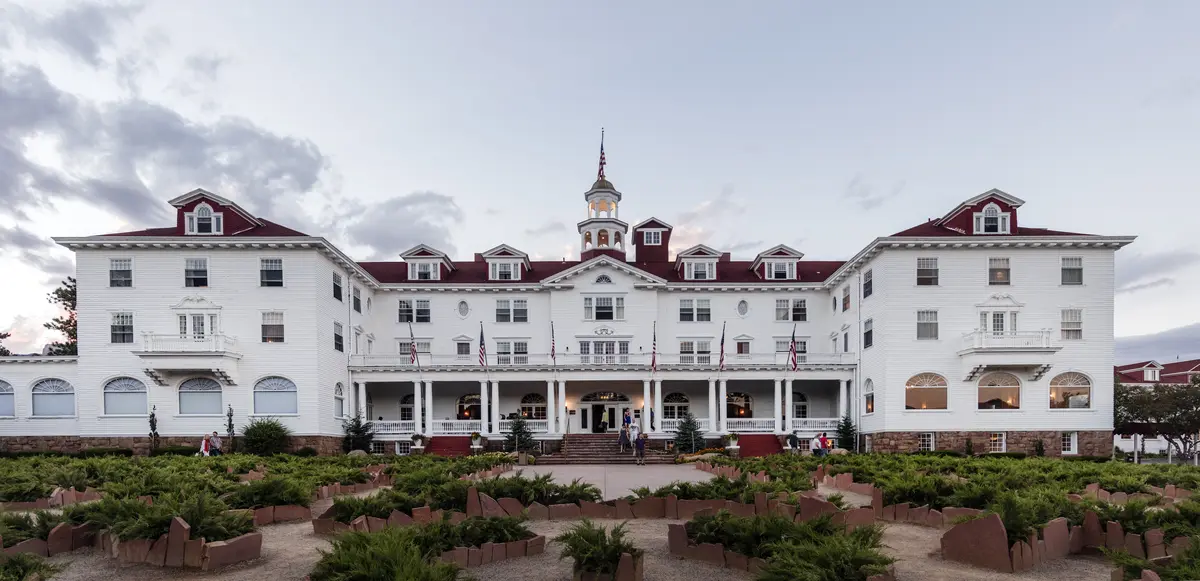
In the summer of 1904 he drove a Steamer up from Lyons into Estes Park. He built a summer house, then decided the valley needed a first-class resort. Land was bought from the McGregor Ranch, building began in 1907, and Stanley acted as his own architect: a four-storey timber H-plan in Colonial Revival, deliberately formal against the granite behind it. He nearly named it the Dunraven, after the Irish earl who had once tried to buy up the valley. It opened on 23 June 1909, and the Rocky Mountain News called it "simply palatial equaling anything of its size in the world", noting that the cooking was done entirely by electricity.
The electricity was his too. Stanley built a hydroelectric plant and a water system, gave the village land for its sewage works, high school and park, and paid to bring elk from Montana to restock the herds. Until 1926 guests came by train to Lyons or Loveland and finished the journey in modified Steamers along roads he had widened himself — today's US 34 and US 36. His wife Flora, who in 1899 rode with him to the summit of Mount Washington in the first car to get there, helped organise the women's club that campaigned for Rocky Mountain National Park.
Stanley sold the hotel in 1929 for a rumoured half million dollars. Decline followed, until John Cullen bought it in 1995.
What rebuilt its reputation was one night in 1974, and King's own account is unglamorous. "In late September of 1974," he writes on his website, "Tabby and I spent a night at a grand old hotel in Estes Park, the Stanley." They were almost its only guests before the winter closure. "Wandering through its corridors, I thought that it seemed the perfect — maybe the archetypical — setting for a ghost story." That night he dreamed of his three-year-old son "running through the corridors, looking back over his shoulder, eyes wide, screaming", chased by a fire hose. He got up, smoked a cigarette at the window, "and by the time the cigarette was done, I had the bones of the book firmly set in my mind." The hotel has been trading on that cigarette ever since.
Timeline: the documented record of The Stanley Hotel
- 1903 Doctors tell Freelan Oscar Stanley he is dying of consumption and has three months to live. On their advice he goes west to Colorado for the high, dry climate. He lives another thirty-seven years.
- Summer 1904 Stanley drives a Stanley Steamer from Lyons up to Estes Park, is taken with the valley and builds a summer home there — the decision that leads to the hotel.
- 23 June 1909 The hotel opens, after Stanley hesitates over calling it the Dunraven. The Rocky Mountain News describes it as "simply palatial equaling anything of its size in the world" and notes that the cooking is done entirely by electricity.
- 25 June 1911 A gas explosion wrecks part of the hotel around room 217 while staff are lighting acetylene lamps during a power failure. A head chambermaid is badly hurt and survives; accounts differ on her name (Wilson or Lambert), on how far she fell and on when she returned to work. This is the incident on which room 217's reputation rests.
- 1929 Stanley sells the hotel for a price rumoured to exceed half a million dollars, but goes on living on the property until his death in 1940.
- Late September 1974 Stephen King and his wife Tabitha spend one night at the hotel, almost its only guests before the winter closure. King writes that he dreamed of his three-year-old son being chased through the corridors by a fire hose, and had "the bones of the book firmly set" in his mind before the cigarette he lit afterwards burned down. His own dating is late September; many retellings place the night at Halloween.
- 1995 John Cullen buys the decayed hotel and begins three decades of restoration, leaning hard on the Stephen King association as a marketing asset.
- 2009 Karen Stollznow publishes in Skeptical Inquirer the results of a Rocky Mountain Paranormal Research Society investigation at the hotel: no anomalous phenomena, and mundane causes reproduced for the best-known incidents, from the moving table to the phantom smell of bacon.
- 15 May 2025 The hotel is sold for $400 million to the Stanley Partnership for Art Culture and Education, a public-private vehicle chaired by Cullen, with over $100 million of works announced including a performance and film centre and a horror film museum with Blumhouse.
Is there a rational explanation for The Stanley Hotel?
The strongest argument against the Stanley's ghosts is that people have gone looking for them with instruments.
In 2009 the researcher Karen Stollznow described in Skeptical Inquirer an investigation by the Rocky Mountain Paranormal Research Society, a group whose speciality is hunting the ghost hunters. They found no anomalous phenomena — "a leak in the ceiling but no ghosts". One by one they reproduced the famous incidents: the table that jumped on television in room 1302 was light enough to lift with two thumbs and could be moved by a foot kept out of shot; the closet that opened by itself in room 401 was traced with seismographs to the lift shaft; the glass that cracked in a guest's hand had been filled with iced water while hot from the kitchen; and the phantom smell of bacon was guests frying bacon on a hotplate.
Stollznow noticed something bigger than any single debunking: the Overlook's invented ghosts have migrated into the hotel's repertoire, and some anecdotes appear borrowed from another lodge nearby. The folklore is not an inheritance but a collection, and it grows.
Even the anchor story is unstable. Retellings of the 1911 explosion disagree on the chambermaid's name — Wilson or Lambert — on whether she fell one floor or two, and on when she returned to work. The hotel's own page for room 217 names nobody: it says only that guests find their shoes lined up by the bed. What is claimed of room 428, footsteps above a room with nothing above it, ignores a timber roof space, a century of settled joints and constant mountain wind.
The incentives are not neutral. Stollznow counted some 500 people a day on ghost tours; the property changed hands in 2025 for $400 million, with a horror museum planned alongside Blumhouse.
Can you visit The Stanley Hotel?
The hotel's website gives its address as 333 E Wonderview Ave, Estes Park, CO 80517; the National Register nomination of 1985 writes it as 333 Wonder View Avenue. Denver's city centre lies about 85 km (53 miles) to the south-east in a straight line. Since 15 May 2025 the hotel has belonged to the Stanley Partnership for Art Culture and Education, a public-private partnership chaired by John Cullen, and the website footer names Sage Hospitality Group as its manager. The hotel's FAQ says that people who are not staying may come for the restaurants, tours, concerts and shops.
On 24 September 2026 the tours page listed five guided walks. The Historic Day Tour lasts 60 minutes and costs $30, or $20 for ages 8 to 17 and $28 for hotel guests and AAA members. The Stanley Ghost Tour, "after dark", also lasts 60 minutes and costs $35; its page says it is wheelchair-accessible, that tours "will never go into guest rooms" and that the night tour "will never go onto guest floors". Both are limited to 20 people. The other three are The Shining Tour and The Vault Whiskey Tour, each of 60 minutes, and the 40-minute Frozen Dead Guy Tour. The tour office is on the lower level of the hotel, on (970) 577-4110.
The tour policies page bars children under 8, "including infants being carried or riding in strollers", along with pets and alcohol. Photography is allowed, audio and visual recording is not. The walk "can be about one and a quarter mile and may feature stairs", and the page mentions the altitude and suggests bringing a water bottle. Tickets cannot be transferred, cancelled or refunded less than 24 hours before the tour. Day visitors pay $10 to park from May to October and receive a Stanley token that can be spent on the property.
Room 217 has been turned over to other use. The FAQ describes Flora Jane, a wine bar "located in the historic Room 217 space", and in another answer says that guests may view the exterior of Room 217 "during select tours, but access is not guaranteed". The Estes Valley Voice interviewed Cullen on the day of the sale "in front of the fireplace in the 217 Wine Bar".
Sources consulted
- Kathleen Hoeft, Long Hoeft Architects, «The Stanley Hotel District, Expanded — National Register of Historic Places Inventory–Nomination Form» — United States National Park Service, 1985 report
- Stephen King, «The Shining — the author on the origin of the novel» — StephenKing.com, official site, 2026 archive
- Karen Stollznow, «The Stanley Hotel: An Investigation» — Skeptical Inquirer, 2009 academic
- Patrick McGuire, «The Stanley Hotel's (Supposedly) Haunted History» — Uncover Colorado, 2025 web
- Patti Brown, «Stanley Hotel sold today for $400 million» — Estes Valley Voice, 2025 newspaper archive
- The Stanley Hotel, «The Stanley Hotel tours — official tours page (the /activities/hotel-tours address now redirects to /tours/)» — Official visitor information, 2026 archive
- The Stanley Hotel, «Stanley Hotel Tour Policies (age limit, recording, walking distance, altitude, 24-hour cancellation, day parking)» — stanleyhotel.com, 2026 web
- The Stanley Hotel, «FAQs & Policies (non-guest visitors, Room 217 and the Flora Jane wine bar, parking)» — stanleyhotel.com, 2026 web
- The Stanley Hotel, «Historic Tours — 60-minute Historic Day Tour, ticket prices» — stanleyhotel.com, 2026 web
- The Stanley Hotel, «The Stanley Ghost Tours — 60-minute night tour, ticket price and route rules» — stanleyhotel.com, 2026 web
Reviewed by V. Serrano on 2026-07-29 · How we verify our content
💬 Field testimonies (0)
No testimonies yet. Add the first.
Add your testimony
🔒 Log in to add a testimony