👻 HAUNTED PLACE · EXP. Nº8141
ACTIVE
Eastern State Penitentiary
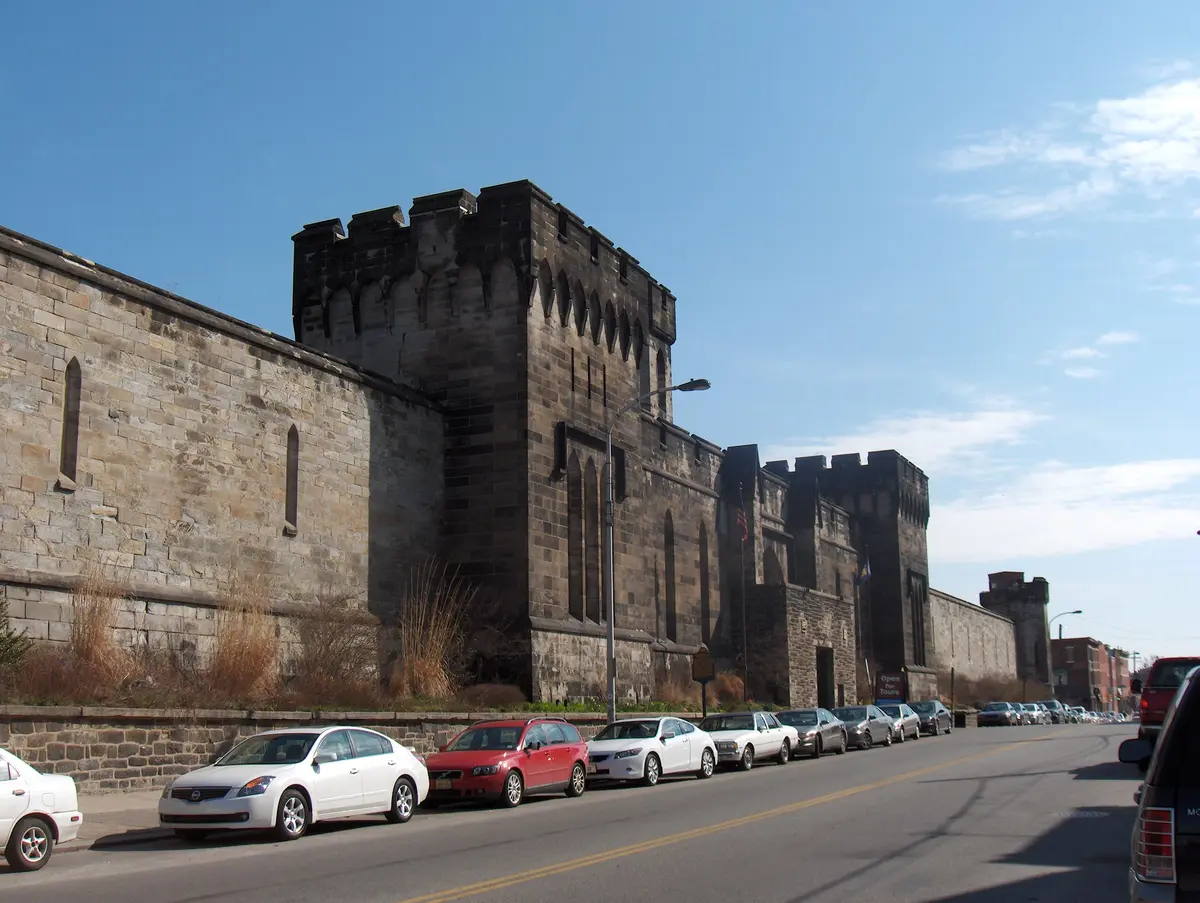
Eastern State Penitentiary, on Fairmount Avenue in Philadelphia, is the most influential prison ever built.
Where is Eastern State Penitentiary?
- Location
- Philadelphia, United States
- Type
- Prison
- Coordinates
- 39.968, -75.173
- Last updated
LOCATION
Why is Eastern State Penitentiary said to be haunted?
Its radial plan — seven cellblocks fanning from a central hub — was copied by hundreds of prisons worldwide. The theory was the Pennsylvania System: total, unbroken solitude. Every inmate had a private cell with a skylight staff called the "Eye of God", a tiny exercise yard, and zero human contact. Prisoners were hooded when moved so they could neither see the building nor be recognised by others. The reformers believed a person left alone with his conscience would arrive, inevitably, at penitence. The word penitentiary comes from precisely that idea. The first prisoner entered in autumn 1829, a young man from Harrisburg, into a building still under construction. Over eight decades the theory failed. Charles Dickens visited in 1842 and left appalled, calling it "rigid, strict and hopeless solitary confinement" and "cruel and wrong" in its effects. The institution formally abandoned the Pennsylvania System in 1913 and ran as a conventional congregate prison until operations ceased in 1970. Roughly 75,000 people passed through across 142 years. The state locked the gates and walked away; for two decades the building rotted, trees growing through cellblock floors. In 1988 Mayor Wilson Goode halted the sale of the empty site, then at risk of demolition. The first Halloween fundraiser was held in 1991, three years before daily tours began in 1994. The haunted reputation and the visitor economy grew up together. Today the site is a museum, stabilised and kept as a ruin. One of the most legendary tales, in NPR's words, comes from Gary Johnson, who helps maintain the prison's old locks: in the early 1990s he reported being gripped by an unseen force after opening an old lock in Cellblock 4, and seeing tormented faces on the cell walls. The museum says it does not claim the prison is haunted; it runs a Halloween haunted attraction and does not permit paranormal investigations at the historic site.
What is the history of Eastern State Penitentiary?
Eastern State Penitentiary was not built to punish. It was built to redeem — and that distinction is what makes its history so uncomfortable to read today.
Pennsylvania approved the project in 1821 and handed the design to John Haviland, a British-born architect who arranged seven cellblocks radiating from a central hub like spokes on a wheel, so that a single guard at the centre could survey every corridor. The layout was copied by hundreds of prisons worldwide, and it is the reason Eastern State is often described as the most influential prison ever built.
The theory behind it was the Pennsylvania System: total, unbroken solitude. Every inmate had a private cell with a skylight the staff called the "Eye of God", a small exercise yard, and no human contact whatsoever. Prisoners were hooded when moved so they could neither see the building nor be recognised by other men. The reformers who backed the system believed that a person left alone with his conscience would arrive, inevitably, at penitence. The word penitentiary comes from precisely that idea.
The first prisoner arrived in the autumn of 1829: Charles Williams, a young Black man from Harrisburg, who entered a building still under construction. What followed over the next eight decades was a slow admission that the theory did not work. Charles Dickens, who visited in 1842 and left appalled, called the system "rigid, strict, and hopeless solitary confinement" and wrote that he believed it "in its effects, to be cruel and wrong", while granting that "in its intention" it was "kind, humane, and meant for reformation".
The institution formally abandoned the Pennsylvania System in 1913 and ran as a conventional congregate prison until operations ceased in 1970. Roughly 75,000 people passed through its cellblocks across 142 years. After brief use as a city jail in 1971 the building stood empty, and for two decades it was left to rot, with trees growing through the cellblock floors and roofs collapsing into the corridors. In 1988, with the site at risk of demolition, Mayor Wilson Goode halted the process of selling it, and in 1994 the ruin opened for hard-hat tours, which drew 10,000 visitors in their first year. The building was stabilised and kept as a ruin.
Timeline: the documented record of Eastern State Penitentiary
- 1821 Pennsylvania's legislature approves funding for the penitentiary and selects the design of the British architect John Haviland: a radial plan of seven cellblocks connected by a central hub like the spokes of a wheel.
- Autumn 1829 The first prisoner, a young man from Harrisburg, enters a building still under construction and begins a sentence of total solitary confinement.
- 1842 Charles Dickens visits and publishes a devastating account, calling the regime "rigid, strict and hopeless solitary confinement" and "cruel and wrong" in its effects.
- 1913 Eastern State formally abandons the Pennsylvania System after eighty years of evidence that enforced solitude broke inmates rather than reforming them.
- 1966 Eastern State is listed on the National Register of Historic Places (reference 66000680), a year after being designated a National Historic Landmark.
- 1970 Operations cease after 142 years and roughly 75,000 inmates. The state locks the gates; the building is left to decay for two decades.
- 1988 With the empty prison at risk of demolition, Mayor Wilson Goode halts the process of selling the site. The Eastern State Penitentiary Task Force sets out to preserve the landmark and stabilise it to make it safe and accessible to the public.
- 1991 The site holds its first Halloween fundraiser — three years before daily tours begin. The haunted reputation and the visitor economy grow up together.
- Early 1990s In the early 1990s, according to NPR, Gary Johnson, who helps maintain the prison's crumbling old locks, had just opened an old lock in Cellblock 4 when, he says, a force gripped him so tightly that he could not move; he said tormented faces appeared on the cell walls. NPR calls it one of the most legendary tales of the site.
- 1994 The ruin opens to the public for daily tours, preserved deliberately in its collapsed state rather than rebuilt.
Is there a rational explanation for Eastern State Penitentiary?
Eastern State does not claim to be haunted, and it does run a haunted attraction. In 2013 the tour guide Ben Bookman told NPR: "It's a lot harder to find a believer than it is to find a skeptic here. We at Eastern State do not claim that the prison is haunted. We run a haunted attraction." He said television crews "come in looking for ghosts" and that this is not the story the site tells: "Inmates were real people. These were people's lives." The site's visitor page, read on 10 October 2026, says paranormal investigations, including the use of EVP recorders and other investigation equipment, are not permitted at the historic site.
The haunted attraction is older than the museum: according to WHYY's 2019 history of the site, the first Halloween fundraiser was held in 1991, the year stabilisation began, and the money it raised went to a daytime tour programme; daily tours started in 1994. That fundraiser was the forerunner of Terror Behind the Walls, which WHYY says was once called America's number one haunted house.
The NPR piece lists what is reported: echoing voices and cackling in Cellblock 12, shadowy figures in Cellblock 6, ghostly faces in Cellblock 4 and the silhouette of a guard in one of the towers. One of the most legendary tales, in NPR's words, comes from Gary Johnson, who helps maintain the prison's crumbling old locks: in the early 1990s, having just opened an old lock in Cellblock 4, he said a force gripped him so tightly that he could not move, and that tormented faces appeared on the cell walls. Against the reports NPR sets the thousands of visitors "who say they've experienced no odd feelings, no sudden chills, no strange sounds, no apparitions", and offers expectation as an explanation: "if you want to have a haunted experience, your imagination just might make sure you do". Faces on walls of peeling paint and damp are what pareidolia, the tendency to see faces in random patterns, would produce.
Can you visit Eastern State Penitentiary?
Eastern State Penitentiary Historic Site is at 2027 Fairmount Avenue, Philadelphia, PA 19130. The nonprofit that runs it describes the building as a National Historic Landmark. Its hours page, consulted on 24 September 2026, gives the current hours as daily from 10:00 a.m. to 5:00 p.m. In January and February, and from 1 to 22 December, the site closes on Tuesdays. It is also closed on New Year's Day, Thanksgiving Day, Christmas Eve and Christmas Day.
Daytime admission comes in two forms: a self-guided audio tour or a 45-minute guide-led tour and discussion. According to the visitor page, tickets bought online cost $21 for adults, $19 for seniors and $17 for college students and young people aged 7 to 17, against $23, $21 and $19 at the door; the museum does not recommend the visit for children under seven. Holders of Museums for All, ACCESS and SEPTA Key Reduced Fare cards pay $2 each for up to four guests, visitors with a disability pay $2 on request, and paid personal care assistants enter free. Philadelphia high-school students enter free with their student ID through the STAMP scheme. None of these discounts applies to Halloween Nights, which in 2026 runs on select nights from 2 October to 7 November under separate admission.
The main audio tour covers stops 1 to 10 and lasts about 40 minutes, and the museum says that most visitors spend about two hours on site. The site is served by Philadelphia Trolley Works, Big Bus, the Phlash, Philadelphia Bike Tours and several SEPTA bus routes. The museum has no car park of its own; there is a lot at 22nd Street and Fairmount Avenue. Parallel parking is free and unlimited on the penitentiary side of 22nd Street and of Brown Street. The accessibility page adds a drop-off zone in front of the entrance on the north side of Fairmount Avenue at 21st Street and two accessible parking spaces on Fairmount Avenue.
The same page describes the conditions inside. Most of the site has no climate control and limited running water. The museum is open rain or shine. Outdoor areas are mostly poured concrete with some gravel. Inside the cellblocks the floors are stone, and the ground is occasionally uneven. The toilets are a trailer with flush toilets near the entrance and two portable toilets at the end of the main audio route, with one accessible stall in each place. Flashlights, lighters, pocketknives and alcohol are among the items the museum does not allow inside.
Sources consulted
- Laurel Dalrymple, «Is Eastern State Penitentiary Really Haunted?» — NPR, 2013 newspaper archive
- Eastern State Penitentiary Historic Site, «History of Eastern State Penitentiary» — Institutional archive, 2026 archive
- Chai Woodham, «Eastern State Penitentiary: A Prison With a Past» — Smithsonian Magazine, 2008 newspaper archive
- Hannah Chinn, «History behind the walls: how Philadelphia's most famous haunted house began» — WHYY, 2019 newspaper archive
- Charles Dickens, «American Notes for General Circulation» — Chapman & Hall, 1842 book
- Eastern State Penitentiary Historic Site, «Plan your visit» — Official visitor information, 2026 archive
Reviewed by V. Serrano on 2026-07-28 · How we verify our content
💬 Field testimonies (0)
No testimonies yet. Add the first.
Add your testimony
🔒 Log in to add a testimony