👻 HAUNTED PLACE · EXP. Nº9046
ACTIVE
Ohio State Reformatory
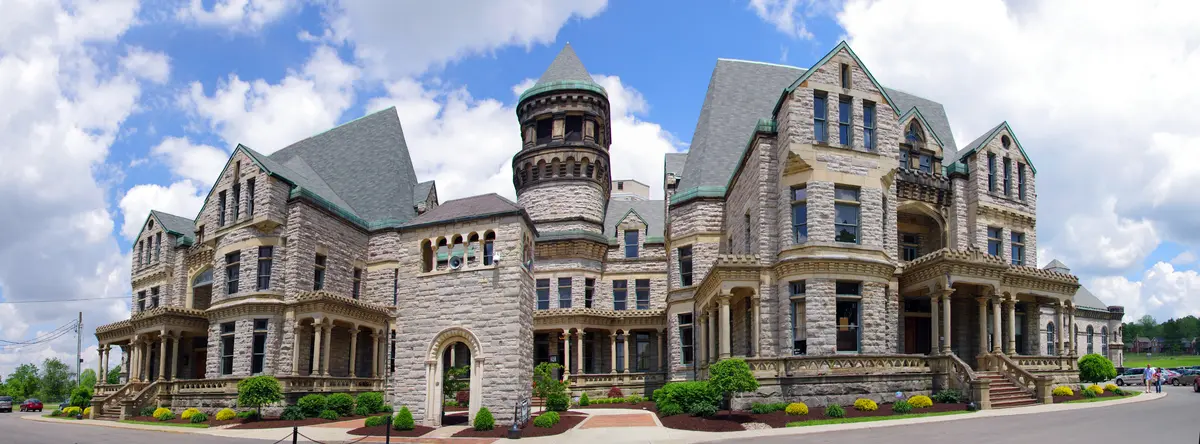
The Ohio State Reformatory in Mansfield, Ohio, designed by the Cleveland architect Levi Scofield, received its first inmates in 1896 as an Intermediate Penitentiary meant to reform young men through religion, education and a trade.
Where is Ohio State Reformatory?
- Location
- Mansfield, Ohio, United States
- Type
- Prison
- Coordinates
- 40.785, -82.505
- Last updated
LOCATION
Why is Ohio State Reformatory said to be haunted?
Overcrowding and decay led four prisoners to sue in 1978, and the consent decree in Boyd v. Denton, approved in 1983, ordered the state to stop operating it after 1987; after extensions it closed in 1990. The building appeared in the 1994 film The Shawshank Redemption and is now a museum run by the Mansfield Reformatory Preservation Society, which also sells ghost walks and ghost hunts. Its best-known ghost story concerns Helen Glattke, wife of the superintendent Arthur Glattke, who died in November 1950 after a pistol discharged accidentally in the family quarters, according to her death certificate; ghost hunters report the scent of roses, said to have been her perfume.
What is the history of Ohio State Reformatory?
The Ohio State Reformatory was designed by the Cleveland architect Levi Scofield, who, in the words of the Mansfield Reformatory Preservation Society (MRPS), meant it "to be an uplifting, inspiring, and intimidating structure". It was first called the Intermediate Penitentiary, because it took inmates too old for juvenile corrections whose offences were more minor than those that sent others to the Ohio State Penitentiary. The first inmates arrived in 1896 after ten years of construction. According to Ohio Memory, the digital collection of the Ohio History Connection and the State Library of Ohio, there were 150 of them, aged between 16 and 30, and they were put to work at once finishing the sewer system and building the 25-foot stone wall around the complex.
The regime offered religion, education and a trade. Inmates were admitted for 18 months and could be released at the end of that time if they showed progress; if not, they served another 18. Superintendent Thomas C. Jenkins wrote in 1934 that the institution "must not only penalize but it must furnish the incentive for the individual to direct his activities in a new and worth-while line". By then the cell blocks, five and six storeys high and designed for nearly 2,000 inmates at one to a cell, held two and sometimes three men to a cell. In the early 1960s, MRPS says, the state withdrew its financial support from the reform model and began converting the reformatory into a maximum security prison.
On 21 August 1978 four prisoners filed a class action in the Northern District of Ohio, Boyd v. Denton. According to the Civil Rights Litigation Clearinghouse, the complaint said that about 2,140 people were held in a facility designed for 1,200, and it alleged antiquated plumbing that frequently leaked and flooded, infestations of roaches and rats, and racial segregation. On 1 February 1983 Chief Judge Frank Battisti approved a consent decree that permanently enjoined the state from operating the reformatory as of 31 December 1987. It also barred assigning prisoners to cells or jobs by race and required at least forty hours of recreation outside the cells for prisoners not in solitary confinement. Extensions were allowed while two new prisons were built, and the reformatory closed in 1990.
The wall and the outbuildings were then demolished, while the cell blocks and the administration building were left standing "because of the high cost of their destruction", as MRPS puts it. The building appeared in the 1994 film The Shawshank Redemption. MRPS was formed in 1995, and in 2000 the State of Ohio gave the building to the City of Mansfield, which sold it to the society for $1.
Timeline: the documented record of Ohio State Reformatory
- 1886 Construction begins on the design of the Cleveland architect Levi Scofield. It will last ten years: the Reformatory admits its first inmates in 1896.
- 1896 The first 150 inmates, young men aged roughly 16 to 30, are admitted to what Ohio calls an Intermediate Penitentiary, offering religion, education and a trade on an indeterminate sentence.
- 1934 Superintendent Thomas C. Jenkins writes that the institution "must not only penalize but it must furnish the incentive" — by then some of the cells designed for one man are holding two, even three.
- 5–7 November 1950 Helen Glattke, wife of superintendent Arthur Glattke, is wounded when an automatic pistol discharges accidentally at 10:15 in the morning in the family quarters. She dies 43 hours later of pulmonary oedema, aged 41. The death certificate records an accident.
- 21 August 1978 Four prisoners file a class action in the U.S. District Court for the Northern District of Ohio, describing 2,140 men in a building meant for 1,200, flooding plumbing, vermin, and cells and jobs assigned by race.
- 1 February 1983 Chief Judge Frank Battisti approves the consent decree in Boyd v. Denton, permanently enjoining the state from operating the reformatory after 31 December 1987 and ordering an end to racial assignment of cells and jobs.
- 1990 The reformatory closes after extensions granted while replacement prisons were built. Demolition takes down the wall and the outbuildings; the cell blocks and administration building are left standing, largely because razing them would cost too much.
- 1994 The Shawshank Redemption, filmed at the reformatory, is released; Ohio Memory calls it the most notable of the films made there, and a good deal of tourism has grown up around it.
- 1995 The Mansfield Reformatory Preservation Society is formed as a grassroots effort to save the building, and in 2000 buys it for one dollar from the City of Mansfield, to which the State of Ohio had given it.
Is there a rational explanation for Ohio State Reformatory?
The ghost story most often told at the reformatory is that of Helen Glattke, wife of Arthur Glattke, superintendent from 1935 to 1959. MRPS, the society that runs the building, told it on its own blog in 2017: as she reached up to her closet shelf for her jewelry box, "a handgun fell – according to the official report – and discharged, striking Helen's left lung", and she died two days later. The same post dates her death to 1949. Her death certificate, as transcribed on her Find a Grave memorial, records a gunshot wound from an "automatic pistol accidental discharge at 10:15 a.m." and death from pulmonary oedema 43 hours after the wound; the memorial gives the date of death as 7 November 1950, at the age of 41. The ghostly evidence the blog offers is the scent of roses, said to have been her perfume, and sightings of her walking to her bathroom, both reported by ghost hunters.
The physical conditions of the building are described by its operators. The MRPS visitor FAQ states that "the museums and administrative areas of the building are temperature controlled. The cell blocks and other sections of the prison are not", and that "in the winter, the cell blocks will be freezing cold". The society's paranormal programmes page, which calls the East Cell Block "the world's largest free-standing cell block", tells visitors on ghost hunts that "it is an old structure with drafts".
The ghost programmes are a priced product of the preservation society. On 10 October 2026 the same page listed public ghost hunts at $104 per person, on select Saturday nights from March to August and from late November to early December, and private paranormal investigations at $3,150 for up to 30 people on Friday and Saturday nights. It describes the reformatory as having "a long, documented history of paranormal activity" and names Tri-C Ghost Hunters as its resident paranormal team.
Can you visit Ohio State Reformatory?
The reformatory is a museum run by the Mansfield Reformatory Preservation Society at 100 Reformatory Road, Mansfield, Ohio 44905 (tel. +1 419 522 2644). It opens daily from 11:00 to 16:00 between 1 April and 31 October, with weekends extended to 10:00–16:00 from 1 June to 1 September, and Thursday to Monday, 11:00 to 16:00, from 1 November to 31 March.
Prices listed by MRPS in 2026: the self-guided route costs $30, plus $5 for the audio guide. Guided tours cost $40 and last about 90 minutes; "Hollywood Meets History" is the one that covers the Shawshank Redemption filming locations along with the architecture and the warden's quarters, and it is open to all ages. "The Walls of Time" runs about two and a half hours for $55, and "Beyond the Bars" ($40, ages 8 and over) climbs 439 stairs through the attic, sub-basement and guard tower. Students, seniors and military personnel get $5 off. Ghost walks are 13 and over; public ghost hunts are strictly 18 and over.
Three practical points. Accessibility: the self-guided route and "Hollywood Meets History" can be done using chair lifts and elevators, but other tours involve more than twenty flights of stairs and "Beyond the Bars" is not accessible. Temperature: only the museums and offices are heated, so dress in layers — the cell blocks are freezing in winter. And food and drink must stay in the car; service animals are welcome, companion animals are not, and tripods and external flash are banned.
Sources consulted
- U.S. District Court for the Northern District of Ohio, «Boyd v. Denton, No. 1:78-cv-01679 (N.D. Ohio) — complaint and consent decree of 1 February 1983» — Civil Rights Litigation Clearinghouse, University of Michigan Law School, 1983 report
- Ohio History Connection, «Penalty and Incentive: The Ohio State Reformatory» — Ohio Memory, 2018 archive
- Mansfield Reformatory Preservation Society, «Our Story» — Ohio State Reformatory, institutional history, 2026 archive
- Mansfield Reformatory Preservation Society, «The History of MRPS» — Ohio State Reformatory, institutional history, 2026 archive
- Mansfield Reformatory Preservation Society, «Visitor FAQs and tour information» — Official visitor information, 2026 web
- State of Ohio, Division of Vital Statistics, «Ohio death certificate of Helen C. Glattke (1950), transcribed on her memorial» — Find a Grave memorial 62101122, 1950 archive
- Mansfield Reformatory Preservation Society, «SHOCKING PROOF of 10 Real-Life Ghost Stories at an Ohio Prison — the operator's own telling of the Helen Glattke story (jewelry box, handgun falling 'according to the official report', dated 1949) and the ghost-hunter reports of roses» — MRPS blog, 2017 web
- Mansfield Reformatory Preservation Society, «Paranormal Programs — ghost walks, public ghost hunts ($104) and private paranormal investigations ($3,150 for up to 30 people, Friday and Saturday), consulted 10 October 2026» — Official visitor information, 2026 web
Reviewed by V. Serrano on 2026-07-29 · How we verify our content
💬 Field testimonies (0)
No testimonies yet. Add the first.
Add your testimony
🔒 Log in to add a testimony