📜 LEGEND · EXP. Nº0270
ACTIVE
The Headless Horseman of Sleepy Hollow
The Headless Horseman is the ghost at the heart of "The Legend of Sleepy Hollow," the tale set in the real hamlet of Sleepy Hollow in New York's Hudson Valley.
Where does the legend of The Headless Horseman of Sleepy Hollow come from?
- Location
- Sleepy Hollow, New York, United States
- Kind of legend
- Ghost story
- Coordinates
- 41.086, -73.859
- Last updated
LOCATION
What is the legend of The Headless Horseman of Sleepy Hollow?
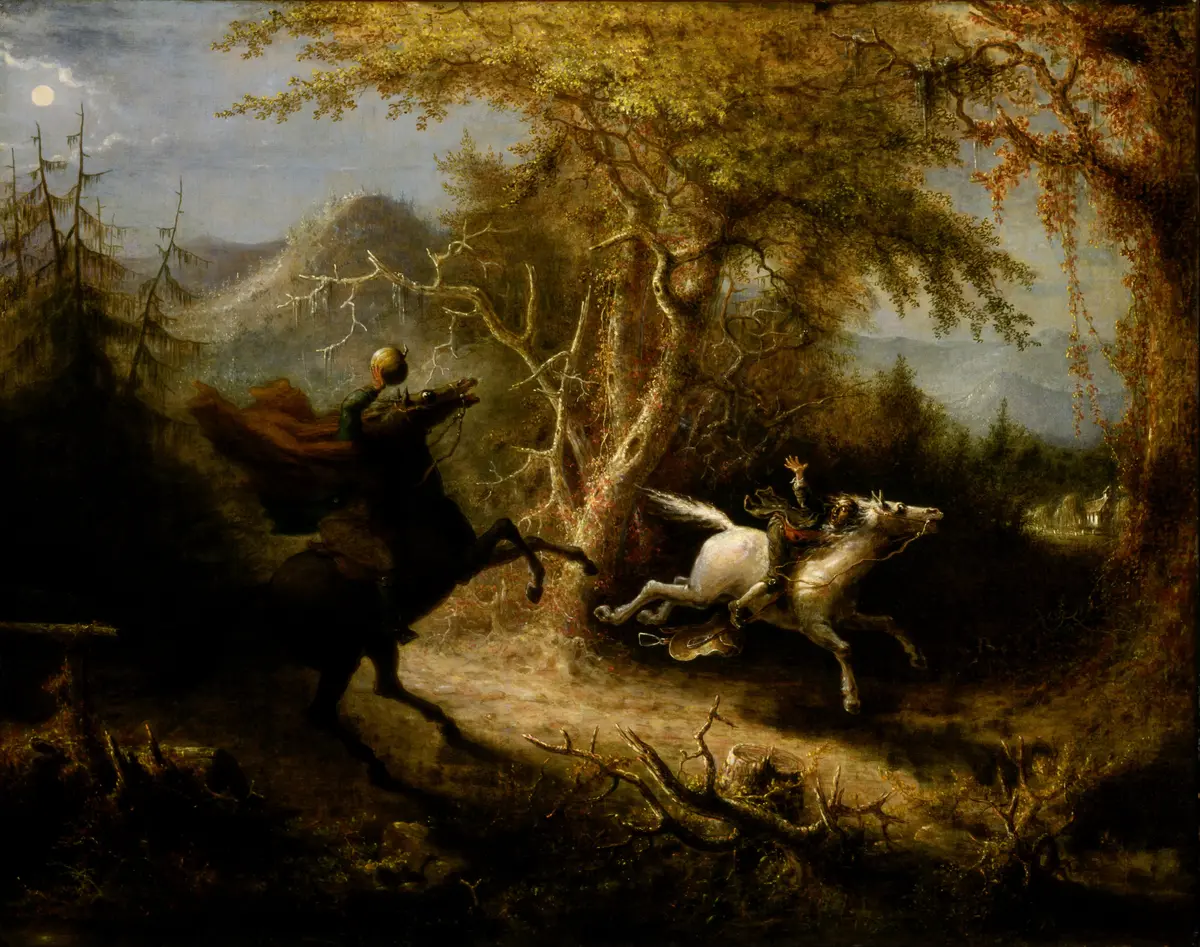
According to the story, the Horseman is the spirit of a Hessian trooper whose head was carried off by a cannonball during the American Revolutionary War; each night he rides in furious search of his missing head, haunting the wooded glen and the old Dutch burying ground, and must return to his grave before dawn. Though the figure was made famous by Washington Irving's 1820 short story, it draws on much older European folklore of headless riders and on genuine local legends of the Dutch settlers along the Hudson. The tale's climactic chase across the covered bridge, where the schoolmaster Ichabod Crane is pursued by the galloping specter, has become one of the defining images of American gothic. Sleepy Hollow embraced the legend so fully that the village officially took the name, and its old cemetery and bridge remain pilgrimage sites for those drawn to the story each autumn.
What is the history of The Headless Horseman of Sleepy Hollow?
Most haunted places begin as folklore and end, if they are lucky, in a book. Sleepy Hollow ran the other way, and the paperwork survives.
Irving wrote the tale in England. In the preface he added to the revised edition of The Sketch Book in 1848, signed at Sunnyside, he is blunt about it: "The following papers, with two exceptions, were written in England", and circumstances "compelled me to send them piecemeal to the United States, where they were published from time to time in portions or numbers". Seven such numbers were printed in New York by C. S. Van Winkle between 1819 and 1820, and "The Legend of Sleepy Hollow" was in the sixth. In London the book was issued in two volumes by John Murray — who had politely refused it, and changed his mind only after Walter Scott intervened on Irving's behalf. The Legend sits in volume II, dated 1820. America's founding ghost story was written an ocean away from the glen it describes.
The valley underneath the fiction was real, and it was Dutch. Irving opens on the Tappan Zee and the market town "more generally and properly known by the name of Tarry Town", and sets his hollow among people "who are descendants from the original Dutch settlers". The Old Dutch Church on the Pocantico, in the manorial lands of the Philipse family, was already ancient when he wrote: covering the village in 1996, The New York Times called it "the 1685 stone church" and put its bell at 311 years old. The war was real too. Westchester lay between the British lines around New York City and the American positions upriver, a contested belt known as the Neutral Ground and raided by both sides. Some 30,000 German auxiliary troops served in the Revolutionary War, roughly a quarter of whom died there.
The Horseman, though, is Irving's own, and he introduces him with three hedges inside a single sentence: "It is said by some to be the ghost of a Hessian trooper, whose head had been carried away by a cannon-ball, in some nameless battle during the Revolutionary War." Said by some. Nameless battle. And the tale ends not in terror but in a shrug: asked what his story proves, the narrator lowers his glass and answers, "Faith, sir, as to that matter, I don't believe one-half of it myself."
Then, in 1996, a real village put that fiction on its road signs — by referendum.
Timeline: the documented record of The Headless Horseman of Sleepy Hollow
- 1685 The date traditionally given for the stone Old Dutch Church on the Pocantico, in the manorial lands of the Philipse family. Reporting from the village in 1996, The New York Times described it as "the 1685 stone church" and its bell as 311 years old; other accounts date the founding of the congregation to 1697.
- 1819-1820 Living in England, Irving sends The Sketch Book "piecemeal to the United States, where they were published from time to time in portions or numbers" — seven numbers printed in New York by C. S. Van Winkle. "The Legend of Sleepy Hollow" appears in the sixth.
- 1820 John Murray publishes the London edition in two volumes, after having first declined the book and been talked round by Walter Scott. "The Legend of Sleepy Hollow" closes volume II, headless Hessian, nameless battle and closing joke intact.
- 1839 Irving writes about the valley he had made famous: "I believe it was the very peculiarity of the name, and the idea of something mystic and dreamy connected with it, that first led me, in my boyish ramblings, into Sleepy Hollow." The name, on his own account, came before the story.
- 1859 Irving dies at Sunnyside, the riverside cottage where he had returned to end his life, and is buried in the burial ground beside the Old Dutch Church — within sight of the landscape he had invented a reputation for.
- 1874 The village, formerly part of Tarrytown and then known as Beekmantown, is incorporated as North Tarrytown — a name it takes, according to local historians, from the northern branch of the Tarrytown post office.
- 1988 A first attempt to rename the village Sleepy Hollow is put to a vote and defeated by almost two to one. The idea does not return until the local economy collapses.
- June 1996 The General Motors plant that had defined the village for a century turns out its last minivan and is scheduled for demolition, leaving a 97-acre riverside site and a village without an identity. The renaming petition gathers enough signatures to force a ballot.
- 10 December 1996 North Tarrytown votes to rename itself after a work of fiction. Turnout reaches 70 per cent of eligible voters — higher, inspectors said, than in some presidential elections — and Sleepy Hollow wins by 1,304 votes to 710. The winners ring the bell of the Old Dutch Church for fifteen minutes. The change takes effect as soon as the village clerk notifies the Secretary of State and the Postal Service.
Is there a rational explanation for The Headless Horseman of Sleepy Hollow?
There is no documented legend of the Headless Horseman before Irving printed one in 1820. That is the awkward fact underneath everything else.
Irving never claimed otherwise. He attributes the ghost to "some", sets the decapitation in "some nameless battle", and closes with a joke that dismantles the genre. Writing about Westchester's war, the historian Leah Grandy treats the cannonballed Hessian as exactly that: folklore, published forty years after the events, turning a traumatic local history into satire and ghost stories.
The European ancestry usually offered — Bürger's ballads of the wild hunt, the Irish dullahan — is repeated far more confidently than it was ever documented. Irving left no note saying so. What he did leave in writing was his debt to Walter Scott, who read the American numbers and later pushed Murray into publishing the book he had already declined.
Even the place name is contested. In 1996 the renaming campaigners argued that Sleepy Hollow descended from a nearby Dutch Slaeperingh Haven; the village historian, Theodore Hutchinson, replied that it was never an actual place name at all, but came from an old Mohegan story about a spell on the inhabitants. He also forecast the outcome, fearing "hole-in-the-wall souvenir shops featuring plastic models of the headless horseman".
What exists today is largely an industry, and a successful one: the Great Jack O'Lantern Blaze carves more than 7,000 pumpkins and draws over 100,000 visitors a season. The most-sought detail is not even Irving's. The cemetery superintendent, Jim Logan, says visitors arrive hunting for a covered bridge. "That was Disney and Tim Burton."
Can you visit The Headless Horseman of Sleepy Hollow?
Sleepy Hollow and Tarrytown sit on the east bank of the Hudson, about fifty minutes north of Manhattan on Metro-North's Hudson line out of Grand Central. Tarrytown is the usual station.
The Old Dutch Church and its burying ground stand on North Broadway, opposite Philipsburg Manor (381 N Broadway), the restored Philipse mill and trading site, with guided tours May to December. In the 2026 season admission is $18 for adults, $15 for over-65s and 18-to-25s and $13 for children aged 3 to 17, $2 more on the day.
Next door, Sleepy Hollow Cemetery (540 North Broadway) covers 90 acres and holds some 47,000 burials, among them Irving, Andrew Carnegie and William Rockefeller. Entry on foot is free, daily until 16:30. It is a working cemetery with funerals most days: give way to processions, keep off the plots, and do not chip souvenirs from Irving's headstone — the one standing is his third, the previous two picked apart by visitors. Guided walks (one hour on Irving, two on the cemetery, plus evening lantern tours) must be booked ahead and sell out weeks in advance in October.
Sunnyside, Irving's cottage, is not in Sleepy Hollow but in Irvington, at 3 W Sunnyside Lane: 50-minute tours at the same prices, rising to $20 / $18 / $16 for the "Legendary" tours from mid-September to early November.
October is both the point and the problem. Book first, expect crowds — and note there is no covered bridge.
Sources consulted
- Washington Irving, «The Legend of Sleepy Hollow, in The Sketch Book of Geoffrey Crayon, Gent., vol. II» — London: John Murray, Albemarle-Street (first UK edition), 1820 book
- Washington Irving, «Preface to the Revised Edition of The Sketch Book of Geoffrey Crayon, Gent. (signed "Sunnyside, 1848")» — Author's Revised Edition, G. P. Putnam (text via Project Gutenberg), 1848 book
- Joseph Berger, «Passions Stir in 'Sleepy Hollow': Debate on a Name Change for Prestige and Profit» — The New York Times, 20 October 1996, Section 1, page 33, 1996 newspaper archive
- Joseph Berger, «North Tarrytown Votes to Pursue Its Future as Sleepy Hollow» — The New York Times, 11 December 1996, Section B, page 2, 1996 newspaper archive
- Leah Grandy, «The Legends and Reality of Sleepy Hollow, Part 1: Headless Hessians» — Atlantic Loyalist Connections, University of New Brunswick Libraries, 2017 academic
- Kayla Smith, «Sleepy Hollow: The town that renamed itself for Halloween» — BBC Travel, 2025 newspaper archive
Reviewed by V. Serrano on 2026-07-29 · How we verify our content
📎 Source: Enigma Atlas
💬 Field testimonies (0)
No testimonies yet. Add the first.
Add your testimony
🔒 Log in to add a testimony