🦶 CRYPTID SIGHTING · EXP. Nº8141
ACTIVE
Jersey Devil
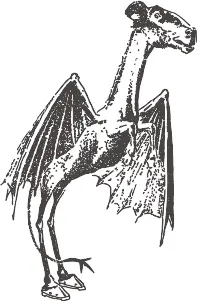
The Jersey Devil is a chimeric creature said to roam the sandy Pine Barrens of New Jersey: a kangaroo-like body on hooves, small forelegs, bat-like wings, a horse-or-goat head, and a forked tail, topped off with a bloodcurdling shriek.
Where and when was Jersey Devil sighted?
- Location
- New Jersey, United States
- Date sighted
- 1909-01-16
- Coordinates
- 39.8, -74.5
- Last updated
LOCATION
What is Jersey Devil?
The legend is rooted in South Jersey folk culture, usually traced to an 18th-century tale of a local woman, nicknamed "Mother Leeds," whose thirteenth child was supposedly born cursed and fled into the woods as a monster. It became a media sensation in January 1909, when newspapers across the region reported a week-long wave of sightings and strange tracks in the snow, while local governments imposed curfews and hunting parties went out. Folklorists see it as a regional boogeyman shaped by isolation and old rivalries; the 1909 panic is usually blamed on press exaggeration, misidentified animals, and a staged hoax. No evidence has ever confirmed it, but it remains a cherished piece of New Jersey identity.
What is the history of Jersey Devil?
The Jersey Devil is usually told as a folk tale. In the version The Philadelphia Inquirer recounted in 2019, it was the thirteenth child of a Mother Leeds who lived in the Pine Barrens in the eighteenth century, and when she cursed its birth it flew up the chimney to haunt the Pinelands. Brian Regal and Frank J. Esposito, two professors at Kean University, trace the name to a real family and its quarrels in print in The Secret History of the Jersey Devil, published by Johns Hopkins University Press in 2018.
Daniel Leeds (1652-1720) came from England in the late 1670s and settled in Burlington, in what was then West Jersey, among the Quakers, and his almanac appeared in 1687. Regal and Esposito write that civic leaders ordered the copies not yet in circulation to be collected and destroyed because of its astrology, and that the Quaker Philadelphia Meeting suppressed the book he compiled next, The Temple of Wisdom for the Little World (1688); its copies were rounded up and destroyed, and one is known to survive. Leeds answered with a series of sarcastic exposés of his fellow Quakers, who called him "Satan's Harbinger", and the authors count those feuds among the earliest political attack literature produced in America.
His son Titan Leeds took over the almanac, and in 1728, after his father's death, he replaced the figure on its masthead with the Leeds family crest: a shield crossed by a horizontal band, with three winged figures with clawed feet and pointed tails above and below it, which Regal and Esposito identify as single-headed eagles, and a cockatrice over the top. They put the crest forward as a possible source for the monster's later appearance.
Benjamin Franklin entered the almanac trade in 1732, and in Poor Richard's Almanack for 1733 he predicted from the stars that Titan Leeds would die on 17 October of that year. When Leeds called him "a fool and a lyar", Franklin replied that he had "receiv'd much abuse from the ghost of Titan Leeds", and after Titan's real death in 1738 he printed a letter from him written from beyond the grave. The Bradfords kept the Leeds almanac going until the later 1740s.
According to Regal and Esposito, the earliest confirmed mention of the Leeds Devil in print is W. F. Mayer's article in the Atlantic Monthly of May 1859, written about the rural inhabitants of the Pine Barrens, known, in the authors' word, ungraciously as "Pineys". The story returned in January 1909, and the Inquirer dates the first reports, of strange hoofprints in the snow in South Jersey, to 16 January, and its own first front-page story, "WHAT-IS-IT VISITS ALL SOUTH JERSEY", to 21 January. Newspapers carried sightings on both sides of the Delaware River from Trenton to Delaware Bay, and a party of farmers with shotguns followed the tracks for almost four miles in Springfield Township. National Geographic adds that local governments imposed curfews and that hunting parties were formed.
Timeline: the documented record of Jersey Devil
- 1687 Daniel Leeds, a Quaker settled in Burlington, West Jersey, includes astrology in his almanac. Fellow Quakers object; his book The Temple of Wisdom is burned. The feud that follows produces some of the earliest political attack literature in America.
- 1728 After his father's death, Titan Leeds replaces the figure on the almanac masthead with the Leeds family crest: a shield crossed by a horizontal band, three winged figures with clawed feet and pointed tails, which Regal and Esposito identify as single-headed eagles, and a cockatrice above. The authors offer the crest as a possible source for the monster's later image.
- 1730s In Poor Richard's Almanack for 1733 Benjamin Franklin predicts from the stars that his rival Titan Leeds will die on 17 October of that year; when Leeds calls him a fool and a liar, Franklin answers that the abuse comes from Leeds's ghost. The Leeds almanac outlives Titan, who dies in 1738: the Bradfords keep it going until the later 1740s.
- 16–23 January 1909 From 16 January newspapers report strange hoofprints in the snow across South Jersey and sightings on both sides of the Delaware River from Trenton to Delaware Bay; a party of farmers with shotguns follows the tracks for almost four miles in Springfield Township.
- January 1909 On 24 January an advertisement for the Ninth and Arch Street Dime Museum in Philadelphia, which the publicist Norman Jeffries had represented for years, announces the "captured" Leeds Devil on display. Jeffries later confesses to staging the stunt, and his obituary calls the creature a "cleverly disguised kangaroo".
- 2018 Brian Regal and Frank J. Esposito publish The Secret History of the Jersey Devil, reconstructing the legend's descent from colonial political smear to monster to publicity stunt.
Is there a rational explanation for Jersey Devil?
Regal and Esposito state their conclusion in the introduction to their book: "There is no living creature." They call the Jersey Devil of 1909 "a product of the media rather than genuine folklore", and they trace the older legend to "how their reputations—both real and manufactured—were remembered in their community", meaning the Leeds family. The two best-known early encounters, by the war hero Stephen Decatur and by Joseph Bonaparte, rest on tradition: National Geographic notes that historians have searched both men's papers for the original accounts with no results.
Their account of January 1909 names the people behind the panic. Norman Jeffries was press agent of the Ninth and Arch Street Dime Museum in Philadelphia, whose owner, Charles A. Bradenburgh, needed something to bring crowds into a struggling business, and Jeffries began planting stories about the Leeds Devil in the local press. When the editor of a paper that had not run them told him he knew it was a prank and should "kill off" the creature, the museum men turned to the taxidermist Jacob Hope, who obtained a live kangaroo from an exhibitor in Buffalo, painted stripes on it and attached a pair of homemade wings. A staged "expedition" brought it in under a blanket, the papers announced the capture, and the museum "collected thousands of dollars from curious spectators".
The Inquirer's own archive, as the paper reconstructed it in 2019, fits that sequence. On 22 January it printed a story about a missing "Australian Wonder, Cross Between a Kangaroo and Bat"; on 23 January it reported the creature captured in Fairmount Park; and on 24 January an advertisement for the Dime Museum, which Jeffries had represented for years, announced the captured Leeds Devil on display. Jeffries later confessed to staging the stunt, and his obituary called the exhibit a "cleverly disguised kangaroo". National Geographic records that The New York Times exposed the ruse in late January 1909.
Regal and Esposito also point to the place: by the middle of the nineteenth century, they write, some saw the forests of the Pine Barrens as home to dull-witted bumpkins wary of outsiders, and "the Jersey Devil legend gets a good bit of its steam from this perception of the Pineys as ragged, near savages".
Can you visit Jersey Devil?
The pin for this entry, at 39.8, −74.5, falls in Woodland Township, Burlington County, about 3.6 km (2.2 miles) south-east of the village of Chatsworth, in the middle of the Pine Barrens. It stands for the region and marks no sighting. In a straight line it is 59 km (37 miles) from Philadelphia City Hall and 49 km (30 miles) from Atlantic City.
The Pine Barrens lie within the New Jersey Pinelands National Reserve, which the New Jersey Pinelands Commission describes as approximately 1.1 million acres (about 445,000 hectares), 22 per cent of the state's land area, spread over parts of seven counties and all or part of 56 municipalities. Congress established it through the National Parks and Recreation Act of 1978, and the Commission calls it the first National Reserve in the United States. Beneath it lies the Kirkwood-Cohansey aquifer system, which the Commission estimates at 17 trillion gallons.
Batsto Village, at 31 Batsto Road, Hammonton, NJ 08037, is 21.7 km (13.5 miles) south-west of the pin, inside Wharton State Forest. The village grew around a bog-iron furnace and later a glass works; the site's own guide lists the furnace, the ironmaster's mansion, a gristmill, a sawmill, a blacksmith's shop, workers' cottages and a general store among its buildings. The mansion, begun in the eighteenth century as a small ironmaster's house, stands as Joseph Wharton remodelled it in 1878. The Wharton State Forest newsletter for September 2026 gives the Batsto office, museum and store as open daily, major holidays excepted, from 9 a.m. to 4 p.m. That month guided tours of the mansion ran Wednesday to Friday at 2 p.m. and at weekends at 11 a.m., 1 p.m. and 2 p.m., costing $3 over the age of 12 and $1 from 5 to 11. Entrance fees to the village are charged on weekends and holidays from Memorial Day to Labor Day.
Many of the forest's roads are unpaved sand tracks. In 2024 the New Jersey Department of Environmental Protection published a map defining which roads in Wharton State Forest are legal for motor vehicles (news release 24/P057).
The legend has no fixed birthplace. Wikipedia's article on the Jersey Devil records versions set at Leeds Point, a census-designated place in Galloway Township, Atlantic County, with 205 residents in 2020 and 34.8 km (21.6 miles) south of the pin, and another set at Estellville, near Mays Landing, around 1855; in some tellings Mother Leeds is from Burlington. The documented history of the legend is Brian Regal and Frank J. Esposito's The Secret History of the Jersey Devil (Johns Hopkins University Press, 2018).
Sources consulted
- Brian Regal y Frank J. Esposito, «The Secret History of the Jersey Devil: How Quakers, Hucksters, and Benjamin Franklin Created a Monster» — Johns Hopkins University Press, 2018 book
- The Philadelphia Inquirer, «The Jersey Devil, the tale of a viral story from 110 years ago — el montaje de Norman Jefferies» — The Philadelphia Inquirer, 2019 newspaper archive
- National Geographic, «The devil went down to… New Jersey?» — National Geographic History Magazine, 2023 newspaper archive
- Brian Regal, «The Jersey Devil: a political animal» — Artículo académico, 2015 academic
Reviewed by V. Serrano on 2026-07-28 · How we verify our content
📎 Source: Enigma Atlas
💬 Field testimonies (0)
No testimonies yet. Add the first.
Add your testimony
🔒 Log in to add a testimony