📜 LEGEND · EXP. Nº0270
ACTIVE
Resurrection Mary
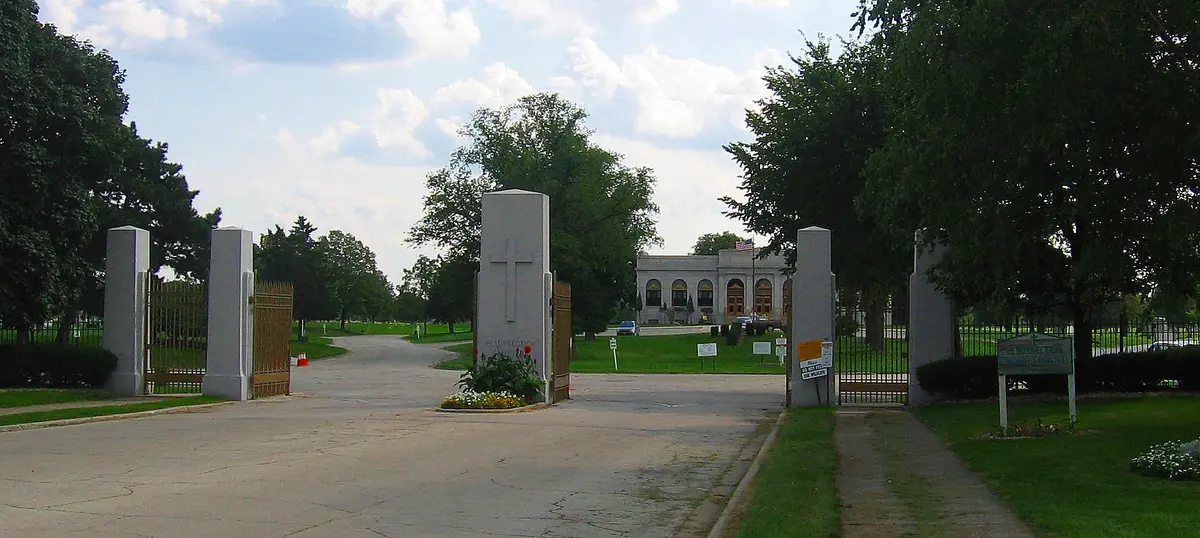
Resurrection Mary is the most famous ghost in Chicago: a young woman in a white dancing dress who is picked up along Archer Avenue, southwest of the city, and vanishes at the gates of Resurrection Cemetery in Justice, Illinois.
Where does the legend of Resurrection Mary come from?
- Location
- Justice, Chicago, Illinois, United States
- Kind of legend
- Ghost story
- Coordinates
- 41.747, -87.834
- Last updated
LOCATION
What is the legend of Resurrection Mary?
The story is normally told as if it had come down intact from the 1930s. What can actually be dated says something else. The oldest version belonging to this road that can still be read was printed in a folklore journal in 1942 and set at Summit, before 1933: a woman with no name, no dance and no white dress. The same survey watched the ballroom enter the story across the United States between 1936 and 1940. The earliest newspaper accounts of her that later writers quote date from 1974 and 1975, and both rest on Richard T. Crowe, who ran ghost tours of Chicago. And the two young women usually identified as Mary, Anna Norkus in 1927 and Mary Bregovy in 1934, both died somewhere else, in crashes the Chicago Tribune reported at the time.
What is the history of Resurrection Mary?
Archer Avenue leaves Chicago heading southwest along the line of an old portage route and, later, of the Illinois and Michigan Canal. Along one short stretch of it stand the two buildings the legend needs.
The first is Resurrection Catholic Cemetery, consecrated in 1904 at what is now 7201 Archer Road in Justice, Illinois. It grew into one of the largest burial grounds in North America — around 397 acres and some 225,000 interments — and in 1969 the archdiocese added the Resurrection Mausoleum, whose continuous wall of stained glass, finished in 1971 in roughly 2,400 panels, has held a Guinness world record. The second building stood two miles further out, at 8900 Archer Avenue in Willow Springs. John Verderbar, an Austrian immigrant, opened it in 1921 as Oh Henry Park, taking the name — and a fee — from the Chicago-made Oh Henry candy bar. The wooden pavilion burned down in 1930; a brick ballroom replaced it, opening on 3 May 1931 at a Depression-era cost of $100,000. It was renamed the Willowbrook Ballroom in 1959.
Between those two places, the story says, a girl called Mary died in the 1930s and has been trying to get home ever since. What can actually be dated is not the girl. It is the telling.
The oldest text belonging to this stretch of road that can be read today was printed in the October 1942 issue of California Folklore Quarterly, inside a survey of 79 versions of the vanishing hitchhiker assembled by Richard K. Beardsley and Rosalie Hankey. It is one paragraph, filed as “Summit, Illinois (told before 1933)”. The narrator remembered hearing, before the World's Fair, of a woman near the graveyard at Summit who stopped people and asked for a ride, gave a Chicago address and disappeared; when they called at the address they were told she had died some time before. Summit adjoins Justice, where Resurrection stands. The woman has no name, no white dress, no ballroom and no blonde hair — and the story was already circulating at least a year before Mary Bregovy, the candidate most often named, was killed.
The same survey also shows where the ballroom came from. Beardsley and Hankey separated out what they called Version C, in which the girl is met not on the road but at a dance, a night club or a beer joint, and stated it plainly: “No A or B variant heard before 1935 contains a hint of any of the characteristic C elements. Before 1935 the hitchhiker was picked up on streets and roads and not in dance halls or night clubs.” Nine of their eleven Version C texts were told between 1939 and 1940. One of them is from North Riverside, Illinois, six miles north of Resurrection, dated 1939: boys at a public dance meet “a very attractive girl in a white dress” whose hands are so cold the dancer thinks she is ill; they drive her home and lose her at Oak Ridge Cemetery, where she says “I forgot. I promised I'd get out here” and walks through a hedge. At the address she gave, the family produces photographs and the boys recognise her. Every structural element of the encounter that Chicago attributes to Jerry Palus was therefore in print in 1942, at a different cemetery, with nobody's name attached.
In the newspapers the story arrives together with a business. Michael Kleen credits Richard T. Crowe (1948–2012), who by then sold guided ghost tours of the Chicago area, with popularising it in the 1970s, and quotes him from a Chicago Tribune article of 13 May 1974: “Mary supposedly was killed in a car wreck 40 years ago, and she's been coming back and going dancing ever since.” The earliest article reproduced in full, by Chicagology, is a Tribune profile of Friday 24 October 1975, and it is Crowe's from beginning to end: he supplies the ghost, the route (“Archer from Ashland Avenue to Willow Springs”), the claim that Chicago has Jewish, Mexican and Polish hitchhiking ghosts, and the latest sightings. The article introduces the name as if it were news: “Dating from the 1930s, she even has a nickname — ‘Resurrection Mary’.”
After 1974 the record thickens quickly. On Tuesday 10 August 1976, around 10.30 p.m., a driver told Justice police that a woman in white seemed to be shut inside the cemetery; patrolman Pat Homa found nobody, but two bronze bars of the gate had been prised apart and blackened. On Wednesday 31 January 1979 the Suburban Trib columnist Bill Geist printed the account of a cab driver who would give only a first name, Ralph, and who described a young blonde in a white dress who said “The snow came early this year” and vanished from a moving taxi. On 31 October 1985 the Tribune ran “Hunting a Ghost Named Mary”, illustrated with a double-exposure photograph by Karen Engstrom of a model, Jenna Harvey, posing as the ghost. Kenan Heise, himself a Tribune writer, published a novel titled Resurrection Mary: A Ghost Story in 1990, and Ursula Bielski's Chicago Haunts followed in 1997.
The last link is the one that reaches this page. By 2002 the tour operator Troy Taylor was opening his version with an undated, atmospheric scene: a taxi on Archer Avenue on a cold night in late December, a girl in a white cocktail dress and a thin shawl who murmurs “The snow came early this year”. That line is not immemorial local lore. It is Ralph's, taken from a signed newspaper column of January 1979 and stripped of its date, its journalist and its witness.
Timeline: the documented record of Resurrection Mary
- 1921 John Verderbar, an Austrian immigrant, opens Oh Henry Park at 8900 Archer Avenue in Willow Springs. The wooden pavilion burns in 1930 and is replaced by a brick ballroom that opens on 3 May 1931; it is renamed the Willowbrook Ballroom in 1959.
- 20–22 July 1927 Anna Norkus, aged twelve, of 5421 South Neva Avenue, is killed when a car driven by William Wesnor runs off the end of the road at Harlem Avenue and 66th Street near Argo and drops into a ditch. The Chicago Tribune reports it on 21 July and again on 22 July, when a second passenger dies and a coroner's jury orders the unmarked detour to be signed. Neither report mentions Archer Avenue or a ballroom.
- Before 1933 The earliest datable version of the story on this stretch of road: a narrator recalls, before the World's Fair, a woman near the graveyard at Summit, Illinois who asks for a ride, gives a Chicago address and vanishes. Beardsley and Hankey print it in 1942 as text 24. She has no name, no dance, no white dress.
- 10 March 1934 Mary Bregovy, 21, dies when the car she is riding in hits an elevated railway support at Wacker Drive and Lake Street, in the Chicago Loop. She is buried in an unmarked term grave at Resurrection. The undertaker John Satala later recalls an orchid-coloured dress; her hair was dark brown.
- 1939 A version collected at North Riverside, Illinois, six miles north of Resurrection: boys at a public dance meet a girl in a white dress with hands so cold one thinks she is ill, drive her home and lose her at Oak Ridge Cemetery. It is printed in 1942. The same year is the one usually given for Jerry Palus's encounter, first published decades later.
- October 1942 Richard K. Beardsley and Rosalie Hankey publish their survey of 79 vanishing-hitchhiker texts in California Folklore Quarterly and date the dance-hall element: no variant heard before 1935 contains it, and nine of their eleven dance-hall texts were told between 1939 and 1940.
- 13 May 1974 Michael Kleen quotes the ghost-tour operator Richard T. Crowe from a Chicago Tribune article of this date: “Mary supposedly was killed in a car wreck 40 years ago, and she's been coming back and going dancing ever since.”
- 24 October 1975 The earliest account that can still be read in full: a Chicago Tribune profile sourced entirely to Crowe, which presents the name as new — “she even has a nickname” — and quotes him saying that Mary's recent reports suggest she is “on the verge of a breakdown”.
- 10 August 1976 A driver tells Justice police that a woman in white appears to be shut inside the cemetery. Patrolman Pat Homa finds nobody, but two bronze bars of the gate have been prised apart and blackened. Crowds come to look; the cemetery cuts the bars out.
- 31 January 1979 Bill Geist prints in the Suburban Trib the account of a cab driver called only Ralph, who describes a blonde in a white dress who said “The snow came early this year” and vanished from his moving taxi on Archer Avenue. Dale Kaczmarek places the ride on Thursday 11 January, the night before the ballroom shut for the blizzard; Geist's own “two weeks ago” points instead to 18 January.
- 1983 The identification of the ghost with Mary Bregovy is put into print by the Southtown Economist in a Halloween feature, followed months later by an interview with a friend of hers. Adam Selzer notes that the handwritten “Resurrection Mary” beside her entry in the cemetery records was photographed for the microfilm in the mid-1980s, shortly after those articles.
- 31 October 1985 The Chicago Tribune runs “Hunting a Ghost Named Mary”, illustrated with a double-exposure photograph by Karen Engstrom in which the ghost is played by a model, Jenna Harvey. The picture is still reproduced today as if it were a document.
- 25 October 1992 In the Chicago Tribune, cemetery worker Chet Kowalkowski gives the official account of the bars: a front-end loader backed into the gate during sewer work, staff heated and bent them back with a blowtorch, and the mark in the metal was a workman's glove.
- 28 October 2016 Fire breaks out in the roof of the Willowbrook Ballroom at about 2 p.m. and Fire Chief Daniel Niemeyer calls the building a total loss. Reconstruction is announced and abandoned; the site is sold for housing in February 2019. The ballroom of the legend has not existed since.
Is there a rational explanation for Resurrection Mary?
The folkloric explanation of Resurrection Mary is not a late debunking. It was published while the story was still assembling itself, by two folklorists who had no idea they were writing about Chicago's future celebrity ghost.
Beardsley and Hankey's 1942 and 1943 papers describe a tale spreading across the United States at the speed of the automobile and the radio, jumping between distant cities rather than radiating outward from a single origin. In their mapping, the local colour Chicago contributed was the Century of Progress fair of 1933 — nine of their prophecy variants concern it — while the motif of the passenger who gets out at a cemetery belonged, in 1943, to Salt Lake City and southern California and was judged a late addition. The Chicago variant they recorded in December 1941 is not a dancer at all: it is an elderly nun in a taxi who predicts the end of the war.
The two named candidates both fail against contemporary paperwork. Mary Bregovy died on Saturday 10 March 1934 when the car she was riding in struck an elevated railway support at Wacker Drive and Lake Street, in the Loop, about fourteen miles (22 km) in a straight line from Resurrection Cemetery; the undertaker John Satala recalled burying her in an orchid-coloured dress, and her hair was dark brown. Anna Norkus, aged twelve, died on the night of Wednesday 20 July 1927 when the car she was in ran off the end of the road at Harlem Avenue and 66th Street, near Argo, and dropped into a ditch; the Chicago Tribune reported it the next morning and again on 22 July, when a second passenger died and a coroner's jury told the county to sign the unmarked detour that had caused the crash. Neither death was a hit-and-run, neither happened on Archer Avenue, and neither report mentions a ballroom. Adam Selzer, citing a funeral record found by the researcher Ray Johnson, writes that Norkus "was definitely buried at St. Casimir"; Chicagology, which notes that her death certificate also names St. Casimir, raises the possibility of a temporary grave at Resurrection during a gravediggers' strike.
The identification of Bregovy has a traceable origin, and it is recent: the Chicago researcher Adam Selzer traces it to two articles in the Southtown Economist, a Halloween feature in 1983 and a follow-up interview with a friend of hers a few months later. Ray Johnson also found, on the cemetery's microfilmed records, a handwritten note reading “Resurrection Mary” beside her entry; Selzer points out that the files "were photographed for the microfilm in the mid 1980s, shortly after the Southtown Economist published a couple of big articles about Resurrection Mary".
The one piece of physical evidence has an official explanation with a name on it. In a Chicago Tribune article of 25 October 1992, the cemetery worker Chet Kowalkowski said the gate bars had been bent by a front-end loader that backed into them during sewer work, that grounds staff had heated and bent them back with a blowtorch, and that the mark in the blackened metal was a workman's glove. Dale Kaczmarek, who reports that the cemetery sawed the bars out and closed the gap with wire mesh until they could be straightened and put back, objected in 2005 that the blackened area had not oxidised back to green in more than twenty years. The Chicago History Museum's page on Mary places her death "sometime in the late 1920s to early 1930s", says that on her identity "no answer has proved conclusive", and refers to the Encyclopedia of Chicago for more.
Can you visit Resurrection Mary?
Two of the three places in this story can still be visited. The third burned down.
Resurrection Catholic Cemetery and Mausoleums stands at 7201 Archer Road, Justice, Illinois 60458 (telephone 708 458 4770), run by Catholic Cemeteries of the Archdiocese of Chicago. Its entry on the Catholic Cemeteries of Chicago site gave the grounds as open daily from 08:00 to 19:00 and the office from 09:00 to 18:00 when it was read on 22 September 2026, and the office holds a self-service kiosk for locating burials. Funerals take place there on most days, and the cemetery runs no tours, posts no signage about Mary and offers no staff commentary on her. The gate bars that made the story famous were cut out, straightened and later removed altogether, so the entrance shows nothing of the episode today. Mary Bregovy lies in an unmarked grave that researchers who have looked report is absent from the public kiosk. Entering outside opening hours is trespass.
Chet's Melody Lounge occupies 7400 Archer Avenue, almost opposite the cemetery gates, and is the one business in the story that trades on it: the staff have long left a Bloody Mary at the end of the bar on Sundays. It is a neighbourhood tavern, and none of the sources cited in this file establishes its hours.
The Willowbrook Ballroom at 8900 Archer Avenue in Willow Springs — the Oh Henry of the legend — has gone. Fire broke out in the roof at around 2 p.m. on Friday 28 October 2016, two months after an anniversary celebration held in the hall that August, and Fire Chief Daniel Niemeyer of the Tri-State Fire Protection District declared the building a total loss. Rebuilding was announced and then abandoned; half the site was sold in February 2019 for housing, and the property is now apartments. Any guide that describes dancing there is describing a building that has been gone since 2016.
Sources consulted
- Richard K. Beardsley and Rosalie Hankey, «The Vanishing Hitchhiker» — California Folklore Quarterly, vol. 1, no. 4, pp. 303–335, 1942 academic
- Richard K. Beardsley and Rosalie Hankey, «A History of the Vanishing Hitchhiker» — California Folklore Quarterly, vol. 2, no. 1, pp. 13–25, 1943 academic
- Chicago Tribune, «Report of the fatal crash at Harlem Avenue and 66th Street, near Argo (transcribed by Chicagology)» — Chicago Tribune, 21 July 1927, 1927 newspaper archive
- Chicago Tribune, «Second victim of the Argo crash and the coroner's jury on the unmarked detour (transcribed by Chicagology)» — Chicago Tribune, 22 July 1927, 1927 newspaper archive
- Chicago Tribune, «“She's a blond girl, about 19, Polish, and with a perennial penchant for dancing” (transcribed by Chicagology)» — Chicago Tribune, 24 October 1975, 1975 newspaper archive
- Bill Geist, «Cryptic rider leaves taxi driver with the willies (reprinted in full by the Ghost Research Society)» — Suburban Trib, 31 January 1979, 1979 newspaper archive
- Dale Kaczmarek, «Resurrection Cemetery (Home of “Resurrection Mary”)» — Ghost Research Society, 2005 report
- Troy Taylor, «Resurrection Mary: Chicago's Most Elusive Ghost / Who Was Resurrection Mary? / Sightings & Encounters» — Weird & Haunted Chicago, prairieghosts.com, 2002 web
- Adam Selzer, «Resurrection Mary: Mary Bregovy?» — Mysterious Chicago, 2008 web
- Adam Selzer, «Resurrection Mary: Anna Norkus?» — Mysterious Chicago, 2008 web
- Chicagology, «Resurrection Mary (page reproducing the 1975 and 1985 Chicago Tribune material and the 1927 crash reports)» — chicagology.com, 2026 web
- Chicago Sun-Times, «Historic Willowbrook Ballroom destroyed in fire» — Chicago Sun-Times, 29 October 2016, 2016 newspaper archive
- Alice Maggio, «Resurrection Mary» — Gapers Block: Ask the Librarian, 23 October 2003, 2003 web
- Chicago History Museum, «Resurrection Mary, the Hitchhiking Ghost of Archer Avenue» — chicagohistory.org, 2021 web
- Michael Kleen, «Resurrection Mary: Chicagoland's Most Famous Ghost» — michaelkleen.com, 2018 web
Reviewed by V. Serrano on 2026-08-16 · How we verify our content
📎 Source: Enigma Atlas
💬 Field testimonies (0)
No testimonies yet. Add the first.
Add your testimony
🔒 Log in to add a testimony