📜 LEGEND · EXP. Nº0270
ACTIVE
Robert Johnson and the Crossroads
The legend of the crossroads is the darkest and most seductive tale in American blues, and it clings above all to the guitarist Robert Johnson.
Where does the legend of Robert Johnson and the Crossroads come from?
- Location
- Clarksdale, Mississippi, United States
- Kind of legend
- Myth
- Coordinates
- 34.2, -90.571
- Last updated
LOCATION
What is the legend of Robert Johnson and the Crossroads?
As the story goes, the young Johnson was a mediocre player mocked by his elders in the Mississippi Delta. Then he vanished for a time and returned transformed, his fingers suddenly capable of impossible runs and aching, otherworldly tone. Whispers spread that he had gone at midnight to a lonely crossroads, guitar in hand, where a large dark figure met him, tuned the instrument, and handed it back, sealing a bargain for his soul in exchange for genius. The story drew power from Johnson's own haunted songs, with their hellhounds and devils, and from his death at just twenty-seven, reportedly poisoned. The tale echoes far older African and European motifs about spirits who guard the meeting of roads. Whether the crossroads sits in Clarksdale or nowhere at all, the myth binds forever the price of art, the pull of the devil, and the mournful sound of the Delta blues.
What is the history of Robert Johnson and the Crossroads?
The story is famous enough to have swallowed the man. A young guitarist walks to a Mississippi crossroads at midnight, hands his instrument to a figure waiting in the dark, takes it back tuned, and from that night on plays like nobody alive. It is told about Robert Johnson. It was not originally his.
The oldest documented version belongs to a different bluesman entirely: Tommy Johnson (1896-1956) of Crystal Springs, no relation. Tommy learned guitar from his older brother LeDell (1892-1972), ran off to the Delta as a teenager, and came back two years later an accomplished performer. Long after Tommy's death, LeDell told the folklorist David Evans what his brother had said about how that happened, and Evans printed the account in his 1971 book Tommy Johnson: "you take your guitar and you go to where a road crosses that way, where a crossroads is... A big black man will walk up to there and take your guitar, and he'll tune it. And then he'll play a piece and hand it back to you. That's the way I learned how to play anything I want."
No soul is sold in LeDell's account, and no devil is named; what he describes is a set of instructions. It matches the hoodoo ritual for acquiring a skill as the folklorist Cat Yronwode sets it out: the seeker brings the thing to be mastered — banjo, guitar, fiddle, deck of cards or dice — and waits at the crossroads on three or nine specified nights, and if he does not run away when a "big black man" arrives, the man borrows the item, uses it and hands it back. Yronwode adds that in the variants without soul-selling the spirit is paid with a silver coin, or with nothing at all.
The ritual is far older than any bluesman. Crossroads are portals in West African religious traditions, and shrines to the trickster who guards them stand wherever those traditions survived, from Nigeria to Haiti, Cuba, Brazil and the American South. The figure most often named is Papa Legba, who in Dahomean myth became chief of the gods precisely because he mastered music when his siblings could not; every human musician has been counted his child since. When Harry Middleton Hyatt did his fieldwork in African-American communities in the late 1930s he came back with seventy-three separate accounts of people going to a crossroads to secure a skill. They fall into two kinds: instructions on how to do it, and stories about people who attempted it, most of whom lost their nerve and ran away.
So how did it become Robert Johnson's?
Not in his lifetime, at least not in print. What is documented about him is thin and mostly mundane. He was born on the northern outskirts of Hazlehurst on 8 May 1911 (or possibly 1912), to Julia Majors and a sawmill worker named Noah Johnson. In the early 1930s he came back to the Hazlehurst area and studied with a local guitarist, Ike Zimmerman of Beauregard; the Blues Trail marker at his birthplace records that when he returned to the Delta, "House recalled that Johnson's skills had increased markedly." He recorded twenty-nine songs for producer Don Law in two sessions — San Antonio, November 1936; Dallas, June 1937 — and died on 16 August 1938. His best-selling record, "Terraplane Blues", sold roughly five thousand copies. Among the Black record-buying public of his own decade he was, as Elijah Wald puts it, a musician who "had almost no success whatsoever."
The transformation happened thirty years later, and it happened among white listeners. The records had long been out of print when Columbia issued King of the Delta Blues Singers in 1961. Its producer, Frank Driggs, opened the album with "Cross Road Blues", which the folklorist Blaine Waide reads as an effort to tap into the romantic imaginings of the early 1960s blues and folk revivalists; by Waide's account, the songs about the devil and the crossroads had not been among those popular with Johnson's contemporaries. The choice put the crossroads in the ear of every folk-revival listener before the first side was over. Then in 1966 the jazz critic Pete Welding published "Hell Hound on His Trail" in Down Beat, attributing to Johnson's early mentor Son House the suggestion that Johnson had "sold his soul to the devil in exchange for playing like that." Greil Marcus built the first extended argument on that single quote in Mystery Train (1975). Robert Palmer romanticised the scene in Deep Blues (1981). And Walter Hill's film Crossroads (1986), with a screenplay by John Fusco and a guitar duel scored by Ry Cooder and played by Steve Vai, put a literal midnight bargain on cinema screens worldwide.
The blues historian Gayle Dean Wardlow, who spent his life on the documentary record, put the conclusion bluntly in 1998: "This tall tale was developed in full view by blues writers, not in private, by unnamed folk."
Timeline: the documented record of Robert Johnson and the Crossroads
- 1896 Tommy Johnson is born near Crystal Springs, Mississippi. He learns guitar from his older brother LeDell, born in 1892, and later plays with Charley Patton and Willie Brown. He is no relation to Robert Johnson.
- 8 May 1911 Robert Johnson is born on the northern outskirts of Hazlehurst, Mississippi, to Julia Majors and Noah Johnson, a local sawmill worker. Some documents suggest 1912; the year has never been settled.
- Early 1930s Johnson studies with the guitarist Ike Zimmerman near Beauregard. The two sometimes play in a cemetery at midnight; Zimmerman's daughter Loretha later says of her father: "He wasn't never scared, but he wasn't meeting the devil neither."
- November 1936 First session: three days at the Gunter Hotel in San Antonio, Texas, for producer Don Law. "Cross Road Blues" and "Terraplane Blues" come from it.
- June 1937 Second and last session, two days in the Brunswick Records building on Park Avenue in Dallas. Twenty-nine songs survive from the two sittings.
- 16 August 1938 Robert Johnson dies in Leflore County. The Mississippi death certificate carries no medical cause: the space reads "no doctor". A note by the county registrar, Cornelia J. Jordan, records the opinion of the plantation owner on whose land he died that it was syphilis. No burial place is entered.
- 1961 Columbia issues King of the Delta Blues Singers, the first reissue of Johnson's long out-of-print records. Producer Frank Driggs opens the album with "Cross Road Blues".
- 1965 Julius Lester publishes a long interview in which Son House describes Johnson's sudden improvement in detail and never mentions the devil.
- 1966 Pete Welding publishes "Hell Hound on His Trail" in Down Beat, attributing to Son House the claim that Johnson "sold his soul to the devil in exchange for playing like that". He never named his source or published the full interview, and no tape surfaced after his death.
- 1971 David Evans publishes Tommy Johnson with LeDell Johnson's first-hand account of the crossroads instructions. It is the earliest documented version of the story, and it is about a different man.
- 1986 Walter Hill's film Crossroads dramatises a literal midnight bargain and fixes the legend worldwide. Gayle Dean Wardlow later identifies the film as the moment the myth became universal.
- 1990 Columbia releases The Complete Recordings, which sells about 1.5 million copies and makes Johnson the best-selling pre-war blues artist of all time. The first grave marker goes up at Quito the same year.
- 16 May 2007 A Mississippi Blues Trail marker is unveiled at Little Zion M.B. Church, north of Greenwood, as the most likely burial place, after Rosie Eskridge — widow of the man who dug the grave — identified the spot under a large tree at the rear of the cemetery.
- 2019 Bruce Conforth and Gayle Dean Wardlow publish Up Jumped the Devil, arguing after some fifty years of combined documentary research that Johnson's skill came from years of deliberate practice under Zimmerman and that the bargain never happened.
Is there a rational explanation for Robert Johnson and the Crossroads?
The whole legend rests on one sentence, and its author never produced the source for it.
Pete Welding never published his full interview with Son House, never identified his source for the devil line, and no tape or transcript of it has surfaced since his death. Worse for the story, Julius Lester's long interview with House appeared in print a few months before Welding's essay, and in it House talks at length about how fast Johnson improved without mentioning the devil once. The folklorist Gail de Vos, reviewing the scholarship, notes a second problem: House's telling had Johnson away from Robinsonville for six months, while most people who knew him remembered several years — long enough for a determined young man to become a professional by ordinary means.
That appears to be what happened: Johnson spent that missing time in the Hazlehurst area with the guitarist Ike Zimmerman, and according to Bruce Conforth and Gayle Dean Wardlow's biography, as summarised in the Wall Street Journal's review, he sometimes played in the cemetery at midnight, often with Zimmerman. Zimmerman's daughter Loretha put her father's attitude to graveyards at night in one line: "He wasn't never scared, but he wasn't meeting the devil neither." Zimmerman himself, in an interview cited by Steven LaVere, said he had learned "to play guitar while sitting on tombstones at midnight in graveyards".
The songs do not confess anything either; "Cross Road Blues" contains no devil: the singer is stranded at a junction as the light goes, unable to flag a ride, asking for mercy and for a friend. "Me and the Devil Blues" and "Hellhound on My Trail" are theatre of a specific and traceable kind. Elijah Wald points out that Johnson was working in the shadow of William Bunch, who recorded as Peetie Wheatstraw and advertised himself as "the devil's son-in-law, the high sheriff from hell"; Wald hears Wheatstraw's falsetto "Ooh, well, well" copied in Johnson's own records.
And there is the uncomfortable part, which the legend's fans rarely say out loud. The story explains the technical achievement of a Black musician by removing it from him. Johnson did not practise for years, learn from a named teacher and outwork his rivals; something supernatural handed it over in a single night. That framing did not come from the Delta. It was built, as Wardlow said, in full view by writers, and it was consumed by a white audience of the 1960s that wanted the Delta bluesman to be a doomed romantic rather than a working musician with a repertoire of pop songs and a good ear for the radio.
Honesty requires the counterweight, too. Not every serious writer accepts that the legend is purely a 1960s invention. In Delta Blues (2008) Ted Gioia quotes Mack McCormick, who studied Johnson for half a century, saying that record collectors in New Orleans told him the soul-selling story in the late 1940s, when almost nothing had been published about Johnson, and that he later heard it in the Black community as well; several of Johnson's relatives told McCormick they knew the crossroads where the deal was made. In a 2023 essay Gioia also cites an unpublished Library of Congress transcript from 1941-42 in which David "Honeyboy" Edwards speaks of Johnson and the devil's business. The testimony of Johnson's girlfriend Willie Mae Powell cuts the other way: by de Vos's account, she heard about the crossroads deal from Edwards, and not from Johnson. Gioia's case, even if it stands, proves something narrower than the legend claims: that people around Johnson may have believed it, or that Johnson enjoyed letting them. It does not put anyone at a crossroads at midnight.
Can you visit Robert Johnson and the Crossroads?
The Crossroads monument stands at 599 North State Street, Clarksdale, Mississippi, where the former Highways 61 and 49 met. The three oversized blue guitars on the pole were made by the local metalsmith Vic Barbieri; the Mississippi Blues Trail marker at the site records that they weigh over 1,000 pounds and were mounted in place in May 1999, the year a Mississippi state resolution proclaimed this the official location. That marker is no. 222 on the trail and was dedicated on 9 April 2026. The junction as it now stands post-dates Johnson, since Highway 61 was redesignated 161 in 2004 when the new bypass routes were completed.
Clarksdale is one claimant among many, and the marker names the others: Dockery, Cleveland, Leland, Rosedale, Ruleville, the Bonnie Blue plantation near Clayton, and Memphis. It also records that the 1986 film Crossroads used a site in Beulah.
The Delta Blues Museum is a few minutes away at 1 Blues Alley Lane, Clarksdale, MS 38614, founded in 1979 and holding a dedicated Robert Johnson exhibit. Its own visitor page, read on 22 September 2026, gives opening hours of Monday to Saturday, 10:00 to 17:00, with final admissions no later than 16:30. General admission for ages 17 and over is $15. Seniors aged 65 and over, military visitors, Blues Society members and groups pay $13. Youth aged 7 to 16 and students aged 17 and over pay $10. Children of 6 and under and residents of Coahoma County enter free.
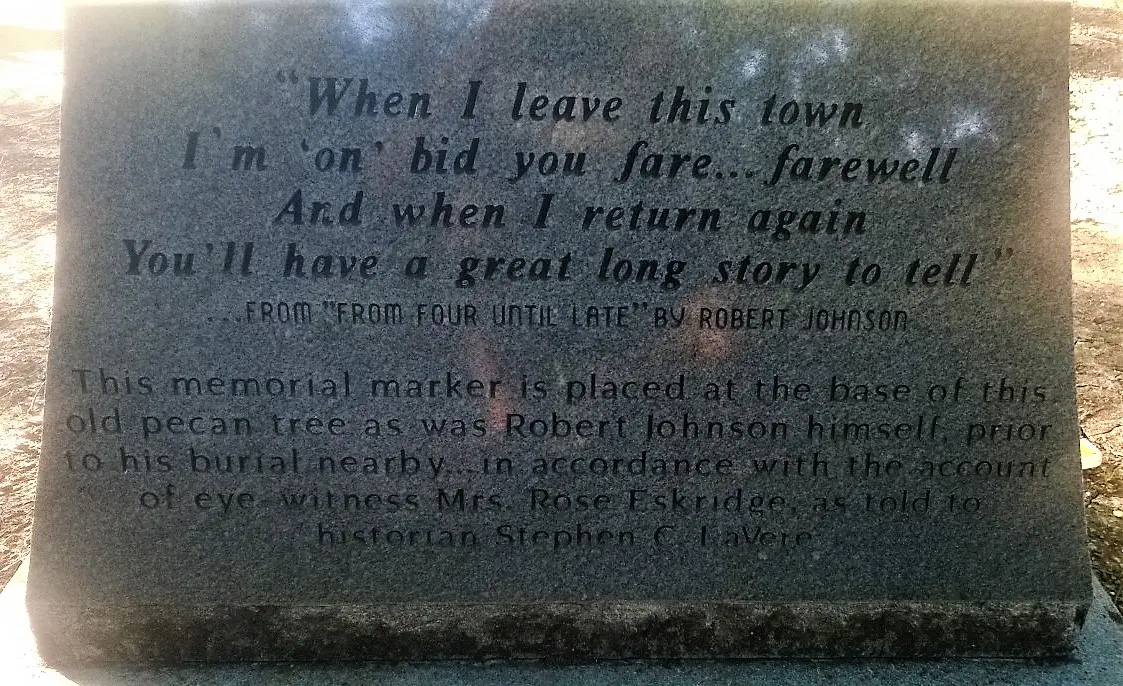
Three cemeteries claim the body, because the burial was never recorded. Payne Chapel M.B. Church at Quito holds the first grave marker, placed in 1990 by an Atlanta rock band. Mount Zion M.B. Church near Morgan City has a one-ton obelisk placed there in 1991 by Columbia Records. Little Zion M.B. Church, on Money Road a few miles north of Greenwood, received a stone from the historian Stephen LaVere in 2002 and a Blues Trail marker unveiled on 16 May 2007. The Blues Trail account of that unveiling explains why the third claim carries the most weight: after an interview with the eyewitness Rose Eskridge, whose husband dug the grave, it is now generally accepted that Johnson was buried in a simple pine box provided by Leflore County, near a large tree at the rear of the cemetery.
Two further markers complete the circuit. Blues Trail marker no. 29, dedicated on 3 January 2008, stands at the Damascus community on the northern outskirts of Hazlehurst, where Johnson was born. At Crystal Springs a marker records Tommy Johnson, who died on 1 November 1956 and whose own crossroads account predates the story told about the unrelated Robert Johnson; he is buried in the Warm Springs Methodist Church cemetery north of town. All four graves lie in church cemeteries.
Sources consulted
- David Evans, «Tommy Johnson» — Studio Vista, London, 1971 book
- Gail de Vos, «A meeting with the devil at the crossroads: A contemporary legend?» — Contemporary Legend, Series 3, vol. 1, pp. 119-59 (University of Alberta), 2011 academic
- Mississippi State Department of Health, «Death Certificate for Robert Johnson, certified copy (1938)» — eGrove, University of Mississippi — 'Murder with Southern Hospitality: An Exhibition of Mississippi Mysteries', 1938 archive
- Mississippi Blues Commission, «Featured Marker: Robert Johnson (Little Zion M.B. Church, Money Road)» — Mississippi Blues Trail, 2007 archive
- Mississippi Blues Commission, «Tommy Johnson — Crystal Springs marker» — Mississippi Blues Trail, 2026 archive
- Mississippi Blues Commission, «Robert Johnson Birthplace — Hazlehurst, marker no. 29» — Mississippi Blues Trail (dedicated 3 January 2008), 2008 archive
- Mississippi Blues Commission, «Crossroads of 49 & 61 — Clarksdale marker» — Mississippi Blues Trail, 2026 archive
- Ned Sublette (interviewing Elijah Wald), «Elijah Wald on Escaping the Delta» — Afropop Worldwide, 2005 interview
- David Kirby, «Review of 'Up Jumped the Devil: The Real Life of Robert Johnson' by Bruce Conforth and Gayle Dean Wardlow» — The Wall Street Journal (reproduced at JazzProfiles), 2019 newspaper archive
- Ted Gioia, «What Did Robert Johnson Encounter at the Crossroads? (Part 1 of 2)» — The Honest Broker, 2023 web
- Delta Blues Museum, «Visitor information and admission» — Delta Blues Museum, Clarksdale, Mississippi, 2026 archive
- Roger R. Gates, «Johnson, Robert» — Handbook of Texas, Texas State Historical Association (published 2008, revised 2015), 2015 academic
- Caleb Salers, «Blues Trail marker unveiled where Robert Johnson is rumored to have sold soul to the devil» — SuperTalk Mississippi, 2026 newspaper archive
Reviewed by V. Serrano on 2026-07-29 · How we verify our content
📎 Source: Enigma Atlas
💬 Field testimonies (0)
No testimonies yet. Add the first.
Add your testimony
🔒 Log in to add a testimony