📜 LEGEND · EXP. Nº3657
ACTIVE
Casa Matusita
Casa Matusita is a legend from Lima, PE — a folk story passed down over generations. This file collects its origins, its meaning and how it has been retold.
Where does the legend of Casa Matusita come from?
- Location
- Lima, PE
- Kind of legend
- Ghost story
- Coordinates
- -12.051, -77.043
- Testimonies
- 0
- Last updated
LOCATION
What is the legend of Casa Matusita?
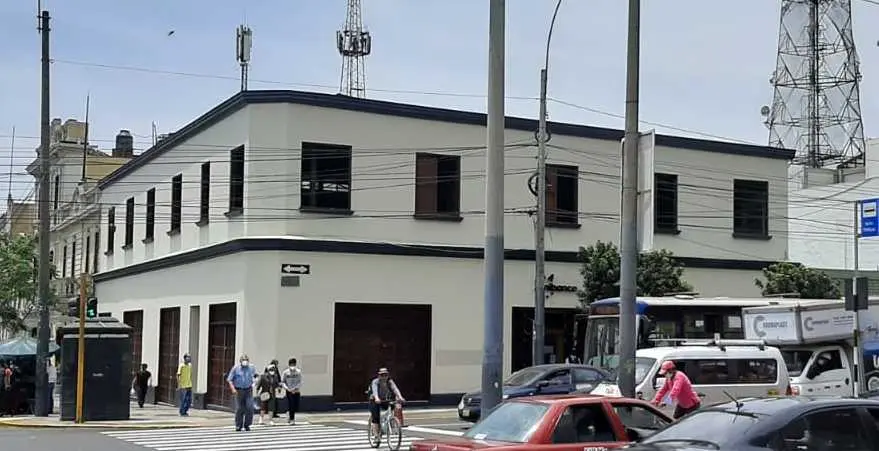
In downtown Lima, on the corner of Garcilaso de la Vega Avenue and Plaza Dos de Mayo, stands a blue-facaded building popularly known as Casa Matusita, considered by generations of Limeños to be the most haunted site in the city. Accounts of its origin vary: some say a Japanese merchant went mad and murdered his family inside the house before taking his own life; others speak of a deadly fire, or of failed experiments that left 'presences' trapped within its walls. Locals claim no tenant has ever managed to stay long inside, that lights turn on and off by themselves, that footsteps and screams can be heard at night, and that the Peruvian government keeps the building closed for 'security reasons' to hide what supposedly happens inside. The legend gained particular popularity from the 1990s onward, fueled by television programs and sensationalist news reports that filmed alleged paranormal phenomena on the facade. Journalists and researchers have pointed out that the building has had various commercial uses over the decades without any documented incidents, yet Casa Matusita's reputation as a symbol of Lima's urban horror remains fully intact among generations of schoolchildren and curious visitors alike, cementing its place as one of Peru's best-known ghost stories.
What is the history of Casa Matusita?
Casa Matusita is, before anything else, an address: Avenida Inca Garcilaso de la Vega 1390 — the avenue every limeño still calls Wilson — on the corner of Avenida España, in central Lima. Everything else about it is contested. The address is not.
Less is known about the building than its fame suggests. La República, in 2023, dates construction to the late 1890s and credits it to Francisco de Alvarado Throne; other Peruvian outlets say only "the end of the nineteenth century", and a few repeat an undocumented 1800. What nobody disputes is how it was made: two republican-era storeys of adobe and quincha, the traditional Lima technique of cane and mud packed onto a timber frame. Cheap, forgiving in an earthquake and, a century on, a structural liability. That construction detail ends up explaining almost everything.
The date that is documented precisely is the sale. On 2 December 1924 the Andrade Fernández family bought the property, and their descendants still hold it. The present owner's surname is spelled three different ways depending on the outlet — Ladislao Terry Andrade, Tery Andrade, Thierry Tiry — which is a fair measure of the care the press has taken with this subject.
The name comes from a tenant, not from the house. In 1950 Emilio Hideo Matsushita — born in Wakayama in 1918, arrived in Lima in 1937 — opened the Matusita hardware store on the ground floor: building materials and fittings for water, drainage and electrical installations, and by the 1960s ceramics, gas water heaters and air conditioning, plus the National brand's Peruvian representation. "Matusita" is simply how Matsushita is said and spelled in Lima. The shop held the corner for half a century and lent the building its sign until nobody could tell the two apart any more. It closed in 2005 for business reasons, and a Mibanco branch took the ground floor afterwards.
That leaves the upper floor. The reason it has stood shut for decades is not a state secret or a clause in an exorcism: it is hundred-year-old adobe. The Municipality of Lima declared the property unsafe. Owner and bank agreed to restore the first level and dismantle the second so it could be rebuilt in lighter materials, and in June 2016 workmen began taking it down. Reporter Óscar Paz Campuzano described it in El Comercio at the time as "an old contraption of creaking timber, roofless, its walls knocked in". On 16 June that year the municipality itself halted the work: according to Cristian Rosenthal, head of enforcement, the crew had no safety equipment and were occupying the public highway without authorisation. Peru's most famous haunted house was stopped, quite literally, by a building-code citation.
The legend, by contrast, was not born in the house. It was born in a newsroom and a television studio. The Peruvian press archive Arkivperu has gathered the advertisements: by 1964 Lima papers were already carrying notices tying Casa Matusita to "Los fantasmas se divierten", the radio and television show hosted by the announcer Humberto Vílchez Vera. By that same reconstruction the starting point was more prosaic still: the journalist Raúl Villarán, of the evening paper Última Hora, had had a bad night, had nothing to fill his page with, walked past the empty house and filed the headline "GHOSTS IN MATUSITA". The follow-up wrote itself: "THE GHOSTS DROVE HIM MAD".
What half of Peru believes it remembers — that Vílchez spent a night on the second floor, came out foaming at the mouth and was committed for thirteen months — did not happen. In 1971 he announced live on the variety show "Domingos Gigantes" that he would go in. The visit never took place. And in 1990, in his book El cazador de fantasmas, Vílchez put it in writing without hedging: "I never went in, but everyone saw me go in; I never spoke to a ghost, but they look at me as though I had become a citizen of the beyond." The retraction has been in print for more than thirty years and the legend has not noticed.
The third layer is the founding crime, and the versions are worth listing precisely so their status is clear. The most repeated one names Parvaneh Dervaspa, a foreign woman who supposedly reached Lima in the mid-eighteenth century, was condemned as a witch by the Inquisition and cursed the corner before she died. Another has a cruel master humiliating his two servants until they served a banquet laced with hallucinogens and the guests tore each other apart. A third puts a Japanese family here in 1873, the father killing his wife and children on the second floor. Not one of the three rests on a court file, a parish register, a police report or a single line of contemporary newsprint.
Timeline: the documented record of Casa Matusita
- 23 December 1736 María Francisca Ana de Castro is executed in Lima — the last woman put to death by the Holy Office in the city, according to Fernando Ayllón's study for the Peruvian Congress. No Parvaneh Dervaspa, the alleged witch of the Matusita curse, appears in the Inquisition's records.
- 1862 The Lima Penitentiary, El Panóptico, opens a few blocks down the same avenue, on the site now occupied by the Centro Cívico and the Sheraton. It is demolished in 1961 after the last inmates are moved out.
- Late 1890s The house is built in adobe and quincha over two republican-era storeys, attributed by La República to Francisco de Alvarado Throne. Other outlets date it only to "the end of the nineteenth century".
- 1899 The first Japanese immigrants arrive in Peru, contracted for the sugar estates — twenty-six years after the date the legend assigns to its Japanese murder-suicide in the house.
- 2 December 1924 The Andrade Fernández family buys the property. Their descendants still own it a century later; the current owner's name appears in the press as Ladislao Terry Andrade, Tery Andrade or Thierry Tiry.
- 1950 Emilio Hideo Matsushita, born in Wakayama in 1918 and resident in Lima since 1937, opens the Matusita hardware and building-supply store on the ground floor. The shop's sign gives the building the name it has carried ever since.
- 1964 Lima newspapers carry advertisements linking Casa Matusita to "Los fantasmas se divierten", Humberto Vílchez Vera's radio and television show. The archive Arkivperu traces the story's origin to journalist Raúl Villarán of Última Hora, who filed the headline "Ghosts in Matusita" to fill a page.
- 1971 Vílchez Vera announces live on the variety programme "Domingos Gigantes" that he will spend the night inside the house. The visit never takes place — the detail the legend has never absorbed.
- 1990 In his book El cazador de fantasmas, Vílchez Vera writes: "I never went in, but everyone saw me go in." The retraction is thirty-six years old and has changed nothing.
- 2005 The Matusita store closes after half a century on the corner, for business reasons. A Mibanco branch takes over the ground floor.
- 2014 Owner Ladislao Terry Andrade tells El Comercio the haunting is "a great lie, a total falsehood" and blames a drunken night watchman dragging a chain. The same year Dorian Fernández-Moris releases Secreto Matusita, 163,000 admissions in its opening week — filmed in a rented house on Jirón Carabaya, because the owners refused access.
- 16 June 2016 Workmen dismantling the unsafe second floor are stopped by the Municipality of Lima: no safety equipment, public highway occupied without authorisation. El Comercio describes what is left as "an old contraption of creaking timber, roofless, its walls knocked in".
Is there a rational explanation for Casa Matusita?
The documentary vacuum here is not a suspicion. It can be checked version by version, and each one collapses for a different reason.
The Inquisition curse does not fit the calendar. Fernando Ayllón, in El Tribunal de la Inquisición: de la leyenda a la historia (published by the Peruvian Congress), documents that the last woman executed by the Holy Office in Lima was María Francisca Ana de Castro, on 23 December 1736, accused of practising Judaism. No Parvaneh Dervaspa appears in those lists. And there is a simpler problem upstream: the house standing today did not exist in the eighteenth century. It went up in the 1890s at the earliest.
The Japanese family of 1873 runs into the history of immigration. The Lima researcher David Pino points out that the first Japanese immigrants reached Peru in 1899, contracted for the sugar estates. In 1873 there was no Japanese community in Lima for that family to come from, and no police or court record of the killings exists. The irony is that there really was a Japanese man in the house — Emilio Hideo Matsushita, who opened the hardware store in 1950 — and that the legend borrowed his surname and his nationality to invent a murder seventy-seven years before he arrived.
The banquet of the drugged servants fares no better. As the daily Ojo put it when it reviewed the variants, "none of these crimes was recorded by any newspaper of the period". Other versions in circulation drag in a foreign physician, or national figures of the stature of Andrés Avelino Cáceres; we have found no Peruvian source of any kind supporting them, which is why they are not retold here as history. The historian and popular writer Merlín Chambi phrased it more gently in Infobae: "all the stories are born out of popular myth, but to this day there is no real information establishing the truth of the events narrated".
The explanation the owners give is disappointingly domestic. Ladislao Terry Andrade told El Comercio in 2014 that the whole thing was "a great lie, a total falsehood", and described the mechanism: the family kept a watchman who drank at weekends and who, climbing to the house at midnight, opened a metal door halfway up the staircase and walked to his room dragging a chain and carrying a hand lantern. Boys in the street saw the light, shouted that the ghosts were out and threw stones at the windows; the old man leaned out furious, and whoever was passing saw a pale man in a broken window.
Add to that the architecture of rumour. The hardware store never really used the second floor: for decades it sat empty with its windows open, above a busy shop, in full view of thousands of people a day. An uninhabited upper storey on a central corner, with constant traffic, moving shadows and broken glass, generates a story on its own. Nothing has to happen inside.
And a commercial incentive runs through all sixty years of it. The legend was born to sell newspapers, grew to sell advertising for a radio and television show, and in 2014 paid out again: Secreto Matusita, directed by Dorian Fernández-Moris, drew 163,000 admissions in Peruvian cinemas in its opening week. Even that film was not shot inside. The director explained that no agreement could be reached with the owners — who were trying to sell the building and feared the myth would wreck the sale — so the interiors were recreated in a rented house on Jirón Carabaya. Lima's most famous haunted house could not even play itself.
Can you visit Casa Matusita?
Casa Matusita is private property and has no public access. The ground floor has been a commercial unit for three quarters of a century — the Matusita hardware shop first and a Mibanco branch after it — and the upper floor has been out of use since the Municipality of Lima declared the property dangerous. No guided tour and no night visit reaches the inside, and a ticket to the interior is a ticket to something that does not exist. The press has been let in: El Comercio published a report from inside in 2014, and the owner told La República in November 2024 that "aquí no hay más que polvo y recuerdos, nada de fantasmas o voces".
The address is Avenida Inca Garcilaso de la Vega 1390, on the corner of Avenida España, Cercado de Lima; that number comes from La República's piece of 29 October 2022. Lima remembers the avenue as Wilson, which is the same street. The same piece describes a white building with black doors and windows; the Mibanco sign was still on the ground floor above premises that had stopped trading.
The Metropolitano has an España station on the Avenida Alfonso Ugarte corridor. The chamfered corner sits at a junction of heavy traffic and narrow pavements. The shop below and the flats around it are in use.
Five or six blocks south down Garcilaso de la Vega stand the Centro Cívico and the Sheraton hotel. The block lies between Wilson and Bolivia avenues, opposite the Palace of Justice. That block held the Lima Penitentiary — El Panóptico — from 1862 until 1961; El Comercio's archive column describes a demolition done in a week.
Sources consulted
- Óscar Paz Campuzano, «Casa Matusita: ¿el fin de la leyenda más famosa de Lima?» — El Comercio (Lima), 2016 newspaper archive
- Pamela Arroyo, «La casa Matusita nunca estuvo embrujada: esta es la verdadera historia según sus dueños» — La República (Lima), 2023 newspaper archive
- María Elena Mamani, «El origen de la leyenda de la Casa Matusita y qué tan real es» — Infobae Perú, 2022 newspaper archive
- David Pino, «La Casa Matusita» — Lima la Única, 2010 web
- Arkivperu, «La leyenda de la Casa Matusita (1964)» — Arkivperu — archivo hemerográfico peruano, 2015 archive
- Percy Taira, «Vílchez Vera: el cazafantasmas de la Casa Matusita» — Expediente Oculto, 2007 web
- Carlos Batalla, «La impresionante mudanza y demolición de la Penitenciaría de Lima a inicios de los años 60» — El Comercio (Archivo), 2020 newspaper archive
- Redacción EC, «La casa Matusita por dentro: dueño rechaza leyendas urbanas» — El Comercio (Lima), 2014 newspaper archive
- Luis Tapia, «La Casa Matusita y el fin de una leyenda: ¿cómo empezó todo?» — Ojo (Lima), 2016 newspaper archive
- Sonia del Águila, «"Secreto Matusita": suceso paranormal durante el rodaje, uso de cucarachas amaestradas y más secretos del filme peruano» — El Comercio (Lima), 2022 newspaper archive
Reviewed by V. Serrano on 2026-07-29 · How we verify our content
📎 Source: Enigma Atlas
💬 Field testimonies (0)
No testimonies yet. Add the first.
Add your testimony
🔒 Log in to add a testimony