👻 HAUNTED PLACE · EXP. Nº9475
ACTIVE
Al Jazirah Al Hamra
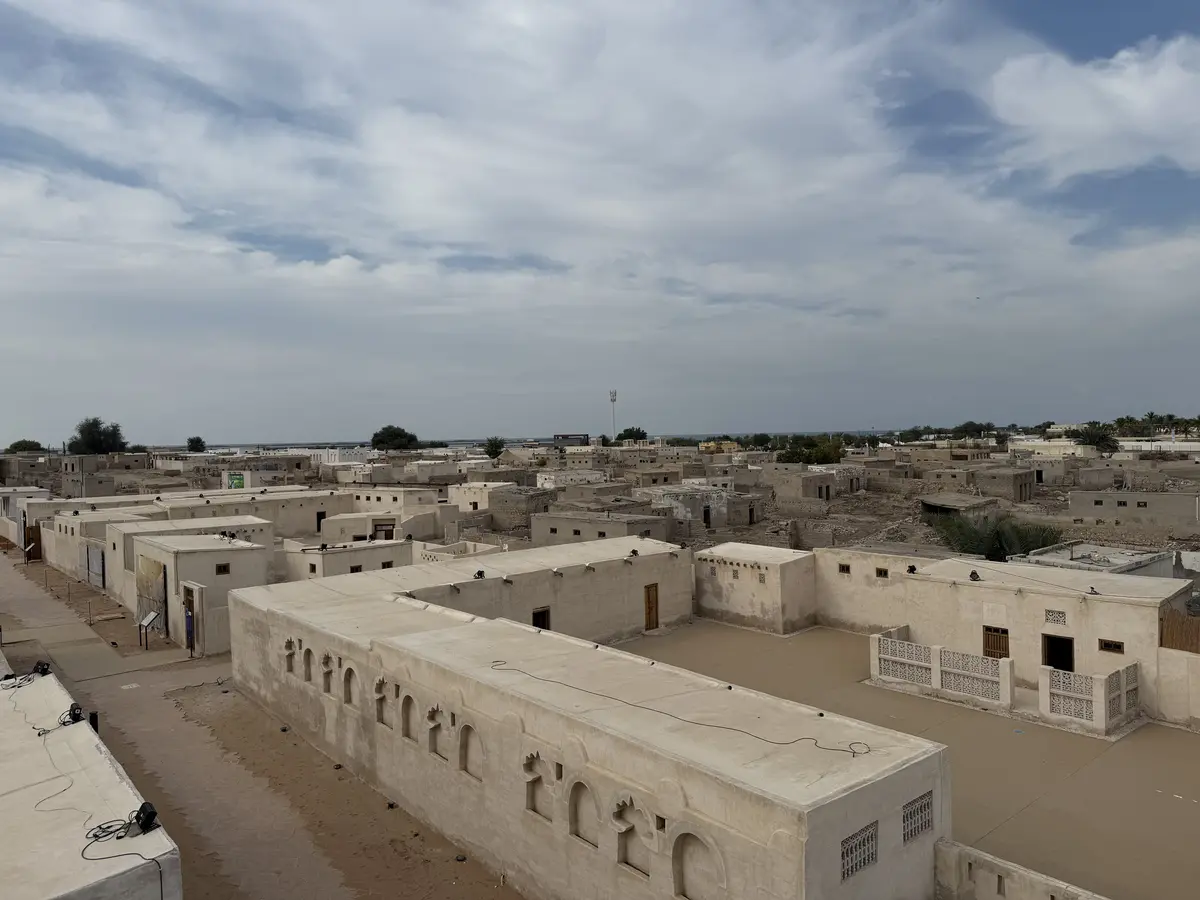
Al Jazirah Al Hamra — الجزيرة الحمراء, "the red island" — stands on the coast south of Ras Al Khaimah city, and it is the last substantially intact pre-oil pearling town left in the Gulf.
Where is Al Jazirah Al Hamra?
- Location
- Ras Al Khaimah, United Arab Emirates
- Type
- Ruin / ancient site
- Coordinates
- 25.709, 55.797
- Last updated
LOCATION
Why is Al Jazirah Al Hamra said to be haunted?
The Za'ab tribe founded it on a tidal island in the late 16th century and worked a fleet of about 25 pearling boats until the market collapsed in the 1920s. Its people did not leave overnight. Research published in 2025 dates the departure for Abu Dhabi to the years between 1968 and 1971, and the emptied houses were then let to migrant labourers rather than surrendered to the desert wind. The village's reputation for jinn is real but recent, and it belongs to the whole Gulf rather than to this village: Umm Al Duwais, the figure most often named, is a pan-Arabian jinn known from Oman to Saudi Arabia and Qatar, with no original tie to this place. Today the site is a managed heritage village open Tuesday to Sunday, on UNESCO's Tentative List since 2020 — and its own custodians have never called it haunted.
What is the history of Al Jazirah Al Hamra?
Al Jazirah Al Hamra is the Arabic الجزيرة الحمراء, "the red island", named for the colour of the sand of the tidal island it was built on. The romanisation shifts with whoever is writing: scholars tend to use Jazirat al-Hamra, the body that now runs the site writes Al Jazeera Al Hamra, and the town is also remembered as Jazirat Al Zaab, after the tribe that built it. All three are the same place, on the coast south of Ras Al Khaimah city in the United Arab Emirates.
The Za'ab established the settlement in the late 16th century, inside territory of the Al Qasimi ruling dynasty. The earliest outside description we have of it is Dutch: Baron von Kniphausen, a director of the Dutch East India Company, wrote in 1756 of "a great piece of land, which near Zur protrudes into the sea and which becomes an island with high tide and which therefore is called the Red Island by the Arabs", inhabited by a people "who live from pearl-diving. They are numerous and have many small vessels." That sentence is quoted by the village's own custodians on their history page, and it is the shape of the place for the next two centuries: an island at high water, and pearls.
The town was drawn into the imperial record in 1819, when a British punitive expedition against Ras Al Khaimah reached it and found it deserted — its people had gone. The following year its sheikh, Rajib bin Ahmed Al Zaabi, signed the 1820 General Maritime Treaty with Britain as one of only four independent signatories, under the name 'Jourat Al Kamra'. At the turn of the 20th century the British official John Gordon Lorimer recorded roughly 500 houses, almost all of them Za'ab, and a fleet of about 25 pearling boats, alongside some 500 sheep and 150 cattle. Life ran on two seasons: the men sailed to the pearl banks in summer while the women led the households more than twenty kilometres inland to the date gardens at Khatt.
Two things ended that. The pearl market collapsed in the 1920s under Japanese cultured pearls and the Depression, and oil money began reaching the Gulf in the 1950s, drawing men away for years at a time as migrant workers in Kuwait, Bahrain and Saudi Arabia. The building record shows the change: coral stone and fossilised beach rock in the old fabric, sand brick only after 1955. A 1914 agreement had placed the town under Ras Al Khaimah, and it was often at odds with its ruler; in 1968 that friction came to a head with Sheikh Saqr bin Mohammed Al Qasimi, and most of the tribe accepted an offer from Sheikh Zayed bin Sultan Al Nahyan to move to Abu Dhabi.
This is the point where the popular account goes wrong. The departure was not one night. A 2025 study of the village's fabric, published in the HERITAGE 2025 proceedings by Riccardo Liberotti, Valeria Amer and Vittorio Gusella, states flatly that "the inhabitants left the Al Jazeera Al Hamra village between 1968 and 1971". Seth Thompson, who has written twice on the site, dates the abandonment to "the late 1960s and early 1970s". The village's own custodians put the start at 1969 and the end in the early 1970s, and tie the move to the formation of the UAE in 1971. Nor did everyone go to Abu Dhabi: The National, reporting from the village in 2014, recorded families settling on the Batinah coast of Oman and elsewhere in Ras Al Khaimah too.
What was left standing is why the place matters: a fort (hisn), several mosques — one of them, with twenty domes, appears on an 1820s British map — a souq, a wind-tower house and more than a hundred courtyard houses, built of uncut coral stone, fossilised beach rock and raw-earth mortars, roofed with mangrove beams, date-palm trunks, matting and layers of seashell for drainage. The lagoon that made it an island was filled in during the late 1970s. It is the last substantially intact pre-oil pearling village in the Gulf; the others went under the bulldozer when the oil came.
Timeline: the documented record of Al Jazirah Al Hamra
- 1756 Baron von Kniphausen, a director of the Dutch East India Company, describes the peninsula near Ras Al Khaimah that becomes an island at high tide, "called the Red Island by the Arabs", inhabited by pearl divers with many small vessels. It is the earliest outside description of the settlement, and is quoted by the village's own custodians.
- 1819 A British punitive expedition against Ras Al Khaimah reaches Jazirat Al Hamra and finds it deserted; its inhabitants had left ahead of the fleet.
- 1820 Sheikh Rajib bin Ahmed Al Zaabi signs the General Maritime Treaty with Britain as one of only four independent signatories, the town appearing as 'Jourat Al Kamra'.
- 1908 The British official John Gordon Lorimer records in his Gazetteer of the Persian Gulf around 500 houses, almost all Za'ab, and a fleet of some 25 pearling boats — the high-water mark of the town.
- Late 1920s The Gulf pearl market collapses under Japanese cultured pearls and the Depression, removing the town's principal source of income.
- From 1955 Sand brick replaces coral stone in new construction, the last building phase before the village empties. Oil money is already drawing men away to work in Kuwait, Bahrain and Saudi Arabia.
- 1968 A dispute with Sheikh Saqr bin Mohammed Al Qasimi of Ras Al Khaimah leads most of the Za'ab to accept an offer from Sheikh Zayed bin Sultan Al Nahyan to resettle in Abu Dhabi. Others go to the Batinah coast of Oman or elsewhere in Ras Al Khaimah.
- 1968–1971 The departure is completed over roughly three years, not one night: Liberotti, Amer and Gusella state that "the inhabitants left the Al Jazeera Al Hamra village between 1968 and 1971", and the site's custodians date the start of abandonment to 1969 and the end to the early 1970s.
- Late 1970s The shallow lagoon around the town is infilled and the red island is joined to the mainland, ending the tidal geography that gave the place its name.
- 2011 The National visits the set of Djinn, filmed here by Tobe Hooper for Image Nation. Producer Daniela Tully says "everyone is taking it very seriously. Even the director totally believes in it"; by January 2012 the paper reports that on location the word "djinn" was banned and the film's title taped over on the director's chair.
- 28–30 October 2015 Two Halloween features fix the village's paranormal reputation in print. Gulf News lists it among "UAE's most 'haunted' places" while admitting "any sighting escaped XPRESS during a recent dusk time visit"; Khaleej Times publishes a horror film-maker's account of a handprint in a cement pillar. Neither mentions Umm Al Duwais.
- 2020 The United Arab Emirates places "the pearl trading town of Jazirat Al-Hamra" on UNESCO's World Heritage Tentative List under cultural criteria iii and v.
- 2025 Liberotti, Amer and Gusella report the original mosque fully restored and conservation continuing on many other buildings, while noting that much of the village remained in ruins as late as 2024. The 13th Ras Al Khaimah Art Festival is held in the village from 31 January to 28 February.
Is there a rational explanation for Al Jazirah Al Hamra?
Start with the people who own the place. The Department of Antiquities and Museums of Ras Al Khaimah and the Al Qasimi Foundation run Al Jazirah Al Hamra jointly and publish a full website about it. On 4 October 2026 six of its pages — history, about, visit us, bookings, events and educational programmes — contained none of the words ghost, haunted, jinn, djinn, paranormal, spirit or supernatural, while the control words "heritage" and "pearl" appeared 85 and 17 times. The only "ghost" on the site is in a press link on its media page, to a 2024 Condé Nast Traveller Middle East story about Ras Al Khaimah's "abandoned ghost village".
Then there is the superlative itself. The claim that people across the UAE call this "the country's most haunted village" is absent from the two newspaper reports usually cited for the haunting. Gulf News published "Revealed: UAE's most 'haunted' places" on 28 October 2015 — a Halloween round-up of five sites, with the word haunted inside scare quotes, in which Jazirat Al Hamra is not even the lead item; that spot goes to Al Qasimi Palace. The reporter, Abhishek Sengupta, wrote: "Any sighting escaped XPRESS during a recent dusk time visit." The next day a commenter said the piece "should have appeared on the 'comedy section' of Xpress". Two days later, on 30 October 2015, Khaleej Times ran a companion Halloween piece of first-person scares. Its Al Hamra account comes from Faisal Hashmi, a horror film-maker, who explains his own motive in the first line: "As a horror filmmaker, I'm always on the lookout for supposedly haunted places in the UAE for ideas and inspiration." What he brought back was a photograph of a handprint "etched into the cement itself" of the pillar beside which he had parked his car.
The date of the story matters more than the date of the village. The paranormal fame is traceable, and it is recent. In March 2011 Image Nation shot much of Djinn, the UAE's first major horror film, at Al Jazirah Al Hamra; Tobe Hooper directed it and it premiered at the Abu Dhabi Film Festival on 25 October 2013. Michael Bay filmed 6 Underground there for Netflix in 2018. The heritage village today advertises itself for "film productions, documentaries, and photo shoots". A ruin that has been rented as a horror set for fifteen years does not need a folk tradition to acquire a reputation.
Umm Al Duwais, the jinn most often attached to the village, belongs to the whole Gulf. The Arabic Wikipedia article on her places her stories in Oman, the UAE, Saudi Arabia and Qatar and among the Hawala Arabs of the Iranian coast, and has her appearing in the dark, especially in abandoned areas and on isolated roads. It names the places whose versions differ in detail — the village of Al Madam in Sharjah, the wilayat of Sohar and Al Salahiya in Al Sunaynah — and Al Jazirah Al Hamra is not among them. Neither of the two 2015 newspaper reports mentions her at all. She is a cautionary figure, a beautiful woman whose true form is lethal, told to warn men off forbidden relationships, and modern Gulf literature has given her two novels under her own name, by the Omani writer Khalid bin Sulaiman al-Kindi and the Emirati Ali Abu al-Rish.
None of this is a reason to be flippant about jinn. They are named in the Qur'an, and for a Muslim their existence is a point of doctrine. The best evidence of how seriously that is taken comes from the film crew. Producer Daniela Tully told The National on the set here, on the third and final day of shooting in the village, that "everyone is taking it very seriously. Even the director totally believes in it", and the cultural consultant Mohammed Al-Otaiba framed the issue as respect rather than fear: "It depends on one's level of faith, but what's important is that you don't show disrespect." By January 2012 The National reported that on location at Al Jazirah Al Hamra the word "djinn" had been banned outright, to the point that the film's title was taped over on the director's chair. What the record shows is a professional crew deciding not to be rude on someone else's holy ground.
One last fact undercuts the whole picture of an empty village howling in the wind. It was not empty. The National found in 2014 that "little by little, old homes were converted into crowded living spaces for labourers", and the film-maker in Khaleej Times says his unease was sharpened "after hearing stories from some of the workers living there". For most of its supposedly deserted decades, people were sleeping in these houses.
Can you visit Al Jazirah Al Hamra?
The old town is run today as Al Jazeera Al Hamra Heritage Village by the Department of Antiquities and Museums of Ras Al Khaimah with the Al Qasimi Foundation. The village's history page says that the UAE Ministry of Energy and Infrastructure and the Department "have stewarded the preservation of the village after 2010". On 26 July 2020 the UAE submitted "The pearl trading town of Jazirat Al-Hamra" to UNESCO's Tentative List under criteria (iii) and (v); the UNESCO record gives its position as N25 42 34 E55 47 40.
The village's website, read on 24 September 2026, gives opening hours from Tuesday to Sunday, 9am to 5pm, closed on Mondays, with the telephone numbers +971 7 236 8797 and +971 56 548 6909 and the address [email protected]. Heritage tours are led by "trained volunteer tour guides" and last one to two hours. The visit page said that day that "Tours are closed for the summer and will reopen on October 2026". No admission price appeared on the visit, bookings or events pages when they were read, and the events page listed no upcoming event. The bookings page hires out the fort for up to 250 guests and offers the village for filming at "morning, afternoon, and evening" shoots.
According to the history page, the settlement stood on a tidal island in a shallow lagoon until the late 1970s, "when it was infilled and connected to the mainland". The National described the site in 2014 as lying "near an industrial zone between a port, a water park, a gated community and a golf course".
Riccardo Liberotti, Valeria Amer and Vittorio Gusella wrote in 2025 that "until 2024 a great amount of buildings was still in ruins", with cracked raw-earth plaster and detached render exposing the coral-stone masonry, and that "the original mosque is now fully restored with work continuing on many other buildings". The same paper records that the village hosted the 13th Ras Al Khaimah Art Festival from 31 January to 28 February 2025, a festival founded in 2013.
The families who left have not stopped coming back. The National reported in 2014 that former residents had held an annual reunion party in the village since 2012, and that at weekends young people from Abu Dhabi drove through "to revisit their old family homes". The night-time visits of the paranormal press are of the same period: a contributor to Khaleej Times's Halloween feature of October 2015 wrote of driving "deep into the village" with friends "a little after midnight" around May of that year.
Sources consulted
- Riccardo Liberotti, Valeria Amer & Vittorio Gusella, «Raw Earth Construction and Restoration Technique: Experimental Protocol and Interventions in the Historic Village of Al Jazeera Al Hamra (United Arab Emirates)» — HERITAGE 2025 Proceedings, Editorial Universitat Politècnica de València, 2025 academic
- Seth Thompson, «Reclaiming Histories and the Virtual Museum: A Proposal to Preserve Al Jazeera Al Hamra» — The International Journal of the Arts in Society, 2011 academic
- Seth Thompson, «The Jazeera Al Hamra Digital Heritage Project: A Model for Digitally Preserving the Heritage of the Arabian Peninsula» — The International Journal of the Inclusive Museum, 2015 academic
- Janaan Farhat & Sara Seif, «Cultivating Cultural Memory: A Case Study of the Revitalization of Al Jazeera Al Hamra Heritage Village» — Gulf Education and Social Policy Review, 2025 academic
- Suzana Dzamtoska-Zdravkovska, Margarita Matlievska & Biljana Petrevska, «Utilizing social media to explore cultural tourism experiences at Al Jazeera Al Hamra Heritage Village» — International Journal of Innovative Research and Scientific Studies, 2025 academic
- Department of Antiquities and Museums, Ras Al Khaimah, «Al Jazeera Al Hamra Heritage Village — History, Visit Us and Bookings pages (official site of the Department of Antiquities and Museums, Ras Al Khaimah, and the Al Qasimi Foundation)» — ajah.ae, 2026 web
- Anna Zacharias, «Our guide to the living ghost town Jazirat Al Hamra, Ras Al Khaimah» — The National, 2014 newspaper archive
- Alex Ritman, «A visit to the RAK set of the UAE's first major horror movie» — The National, 2011 newspaper archive
- Alex Ritman, «Release of Arabic-English thriller Djinn delayed until summer» — The National, 2012 newspaper archive
- Abhishek Sengupta, «Revealed: UAE's most 'haunted' places» — Gulf News (XPRESS), 2015 newspaper archive
- Rohit Nair, «Dubai residents recount their scariest moments» — Khaleej Times, 2015 newspaper archive
- State Party: United Arab Emirates, «The pearl trading town of Jazirat Al-Hamra — UNESCO World Heritage Tentative List (submitted 2020, criteria iii and v)» — UNESCO World Heritage Centre, 2020 report
- Arabic Wikipedia contributors, «أم الدويس (Umm Al Duwais) — geographic spread of the jinn figure across the UAE, Oman, Saudi Arabia, Qatar and the Hawala Arabs of the Iranian coast» — ar.wikipedia.org, 2025 web
Reviewed by V. Serrano on 2026-08-11 · How we verify our content
💬 Field testimonies (0)
No testimonies yet. Add the first.
Add your testimony
🔒 Log in to add a testimony