👻 HAUNTED PLACE · EXP. Nº9475
ACTIVE
Pudu Prison
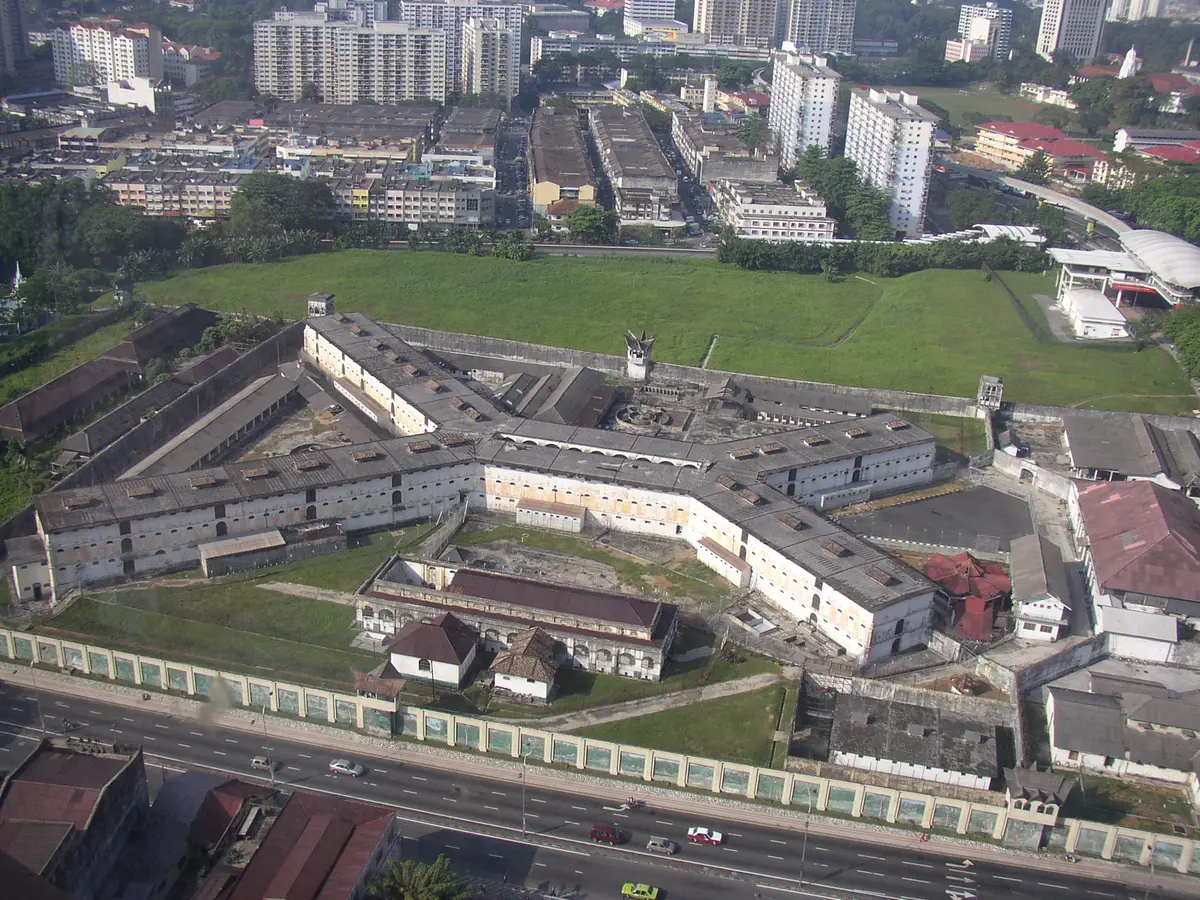
Pudu Prison no longer exists, and that is its story. Built by the British colonial government between 1891 and 1895 on ten hectares of Kuala Lumpur scrub that covered an abandoned Chinese cemetery, it held the city's prisoners for 101 years, hanged 180 people between 1960 and its closure in 1996, and carried on its outer wall a mural that the Guinness Book of Records of 1984 logged as the world's longest: 263.6 metres by 4.47, painted, in Guinness's own words, "by 4 prisoners" between February 1983 and June 1984.
Where is Pudu Prison?
- Location
- Kuala Lumpur, Malaysia
- Type
- Prison
- Coordinates
- 3.141, 101.708
- Last updated
LOCATION
Why is Pudu Prison said to be haunted?
Malaysia remembered one of the four. After a spell as the country's first prison museum, complete with staged whipping demonstrations for visitors, Pudu was pulled down in phases between October 2009 and December 2012; the deputy finance minister told Parliament it was not something to be proud of. The ghost accounts that circulate were published by The Star on 27 June 2010, six days after the mural wall fell, and belong to named former prison officers. What survives on Jalan Hang Tuah is the Moorish gate, dated 1895 — now the entrance arch of a shopping-centre food hall.
What is the history of Pudu Prison?
Pudu Prison began as a piece of paperwork about land. In 1889 the Selangor government picked a ten-hectare plot in Kampung Pudu, about a mile and a half from the centre of Kuala Lumpur — close enough to be convenient, far enough to be out of sight. Most of it was scrub over an abandoned Chinese cemetery holding, in all likelihood, the graves of tin-mine labourers from the town's first years. The acquisition file names the people whose ground it was: Haji Suleyman, Baginda Halim and See Bee Bee, with five houses standing on it. The government fixed compensation at $25 a lot and $20 to $30 a house, payable only after the houses came down, and agreed to pay for the bones to be exhumed and reburied elsewhere according to Chinese rites. Two of the landowners petitioned the acting British Resident for help; one complained in writing, in June 1891, that he had been paid far less than the others.
Construction ran from 1891 to 1895 under Charles Edwin Spooner, state engineer and director of the Public Works Department. It was built in six phases with steel, brick and cement imported from other British colonies, at a cost given as 138,000 Straits dollars — the 394-metre perimeter wall alone accounted for $16,000. The core was a three-storey cell block laid out as a St Andrew's cross, with a narrow open courtyard at the centre that served for light, for ventilation, for assembly and for floggings. It was designed for 950 inmates, in cells lit by a window the size of a shoebox. The front gate was Moorish, with two domed towers. Lieutenant-Colonel J.A.B. Ellen was the first governor.
The building started killing almost immediately. In August 1895 cholera broke through the prison; prisoners were quarantined in their cells and most were left to their fate, with deaths running into the hundreds, and it took three years to bring the outbreak under control. The cause was traced to the water: a well sunk over the old burial ground. The Selangor State Secretary's office produced a report on the outbreak in December 1895, and the file survives in the National Archives of Malaysia. Beriberi was spreading through Malaya in the same years and reached Pudu too.
In its early decades the British also used Pudu as a military command post, and Mariana Isa's 2006 conservation statement records that those who fought the colonial government "were executed, either by a firing squad or by hanging, and buried on prison grounds to prevent news about the executions from going beyond Pudu Prison walls". Between January and October 1942 the Japanese ran it as the central prisoner-of-war camp in Malaya: 56 men at first, 724 by 26 March, dysentery in epidemic proportions, and in October a dispersal — 300 Australians and 140 invalids to Singapore on the 2nd, 160 sick on the 13th, 400 fit men to Thailand on the 14th. After the war Pudu hanged Japanese personnel convicted of atrocities, and then, during the Emergency, it hanged S.A. Ganapathy, first president of the 300,000-strong Pan-Malayan Federation of Trade Unions, in May 1949. The nationalist writer Ishak Haji Muhammad, Pak Sako, was among those detained there.
The Prisons Department's own figures give 180 people hanged at Pudu between 1960 and its closure. The best known were Kevin Barlow and Brian Chambers, sentenced to death on 1 August 1985 and hanged on 7 July 1986 — the first Westerners executed under the drug laws Malaysia had tightened in 1983, which made the death penalty mandatory for trafficking. In October 1986 six inmates led by Chua Chap Seng, a former policeman held on a murder charge, seized a visiting dermatologist and his laboratory technician in the prison clinic; the siege ran six days and ended with both hostages freed unhurt.
By 1985 the crowding was extraordinary: 6,550 men in 950 cells, sleeping in shifts. Haji Aziz Haji Idris, an officer there from 1965 to 1970 and its director from 1987 to 1991, described eleven men to a cell built for one, a window two feet wide, a plastic pail for a toilet, and a stench that hit you when the door opened.
It is the wall, though, that people remember, and the record attached to it is real. The Guinness Book of Records of 1984 sets it down precisely: "A mural 864 ft 11 in 263,6 m long and 14 ft 8 in 4,47 m high was painted on the walls of Pudu Prison, Kuala Lumpur, Malaysia, by 4 prisoners from 3 Feb 1983 to 11 June 1984." Four prisoners, and nineteen months of work. Malaysia remembered one of them. Khong Yen Chong is the name attached to the mural everywhere, and he earned it — he was released before the painting was finished and came back as a free man to complete it — but he was not alone on that scaffold. Helen Ang interviewed another of the painters for the New Straits Times in April 1994: Pang Sun Qiang, known as Pha Tee, a man on crutches with one leg amputated, who painted with his bare fingers and who named the others he remembered as Khong Yen Chong, Cheng Tai Cheng and Lee Kim Seng. Four names, for a record credited to four men. Pha Tee sold paintings to a warder for sixty ringgit apiece and lost his chance of a job abroad because he was sent straight from Pudu to the penal settlement on Pulau Jerejak. Khong Yen Chong died in February 2026, aged 78; his body lay unclaimed in a hospital mortuary in Penang for some fifty days.
Pudu closed as a prison on 31 October 1996, after 101 years. It had been handed to the state developer UDA the previous May, and its inmates went to the new prison at Sungai Buloh, which opened on 1 November. In May 1997 it reopened as the Pudu Prison Temporary Museum — the first Malaysian prison opened to the public — drawing around half a million visitors a year until it shut again in 1998. It stood empty in 2002 and 2003, became the temporary Hang Tuah police station in 2004, held drug detainees from 2005, and took in eight HINDRAF supporters in 2007, its last prisoners.
The end came in stages. The government decided on demolition in June 2009; the wreckers started on 14 October 2009 with the buildings inside, the execution chamber and the hospital among the first to go. At ten o'clock on the night of Monday 21 June 2010 the mural wall along Jalan Pudu came down for a road-widening and an underpass, in front of a crowd that scrambled for bricks as souvenirs. In Parliament that same day the deputy finance minister, Awang Adek Hussin, explained why Pudu would not be listed: "It is not something we are proud of, even though it is an old jail." The last structures were gone by December 2012. On the site now stands Bukit Bintang City Centre, developed by UDA Holdings with Eco World and the Employees Provident Fund across 19.4 acres; the ground was broken on 20 June 2017 and the LaLaport BBCC mall opened on 20 January 2022. In January 2025 a two-level, 45,000-square-foot dining hall opened there under the name Tuah 1895, framed by the original prison archway.
Timeline: the documented record of Pudu Prison
- 1889 The Selangor government selects a ten-hectare site in Kampung Pudu, largely scrub over an abandoned Chinese cemetery. The acquisition file names the landowners — Haji Suleyman, Baginda Halim and See Bee Bee — sets compensation at $25 a lot and $20 to $30 a house, and commits the government to exhuming and reburying the graves according to Chinese rites.
- 1891–1895 Construction under Charles Edwin Spooner, state engineer and director of the Public Works Department: six phases, imported steel, brick and cement, 138,000 Straits dollars, a St Andrew's cross cell block for 950 inmates and a 394-metre wall costing $16,000. Lieutenant-Colonel J.A.B. Ellen becomes the first governor.
- August 1895 Cholera breaks through the prison. Inmates are quarantined in their cells and most are left untreated; deaths run into the hundreds and the outbreak takes three years to control. The cause is traced to a well sunk over the old burial ground. The Selangor State Secretary's office issues a report on the outbreak that December.
- January–October 1942 The Japanese run Pudu as the central prisoner-of-war camp in Malaya. Numbers rise from 56 men to 724 by 26 March, with dysentery in epidemic proportions. In October the camp is dispersed: 300 Australians and 140 invalids to Singapore on the 2nd, 160 sick on the 13th, 400 fit men to Thailand on the 14th.
- May 1949 S.A. Ganapathy, first president of the 300,000-strong Pan-Malayan Federation of Trade Unions, is hanged at Pudu by the British during the Emergency. The nationalist writer Ishak Haji Muhammad, Pak Sako, is among those detained there in the same years.
- 3 February 1983 – 11 June 1984 Four prisoners paint the mural on the outer wall. The Guinness Book of Records of 1984 gives the measurement and the credit exactly: 864 ft 11 in (263.6 m) long by 14 ft 8 in (4.47 m) high, painted "by 4 prisoners" between those two dates. It is the primary record for a claim usually repeated with one painter and the wrong year.
- 1985 Overcrowding peaks at 6,550 men in 950 cells, sleeping in shifts. Haji Aziz Haji Idris, an officer from 1965 to 1970 and director from 1987 to 1991, later describes eleven men in a single-occupancy cell, a two-foot window and a plastic pail for a toilet.
- 7 July 1986 Kevin Barlow and Brian Chambers, sentenced to death on 1 August 1985, are hanged at Pudu — the first Westerners executed under the drug legislation Malaysia tightened in 1983, which made the death penalty mandatory for trafficking.
- 17–22 October 1986 Six inmates led by Chua Chap Seng, a former policeman held on a murder charge, seize a visiting dermatologist and his laboratory technician in the prison clinic with improvised weapons. The siege lasts six days and ends with both hostages freed unhurt.
- 31 October 1996 Pudu closes as a prison after 101 years, its inmates transferred to the new prison at Sungai Buloh, which opens the next day. The site had already been handed to the state developer UDA the previous May. Prisons Department figures give 180 people hanged there between 1960 and the closure.
- May 1997 – 1998 The building reopens as the Pudu Prison Temporary Museum, the first Malaysian prison opened to the public, drawing around half a million visitors a year. Isa's conservation statement documents, with a photograph, whipping demonstrations staged for the crowds. It closes again in 1998.
- 14 October 2009 Demolition begins on the buildings inside the walls, the execution chamber and the prison hospital among the first to go, largely away from public view. On 20 October Badan Warisan Malaysia issues a statement calling the prison's history "chilling — one of brutality and crime" and asking that Pudu be treated as Port Arthur and Robben Island were.
- 21 June 2010, 22:00 The mural wall along Jalan Pudu is bulldozed for a road-widening and an underpass, watched by a crowd that scrambles for bricks as souvenirs. In Parliament the same day the deputy finance minister, Awang Adek Hussin, rules out heritage listing: "It is not something we are proud of, even though it is an old jail."
- 27 June 2010 Six days after the wall came down, The Star publishes its farewell package on Pudu, including two articles of staff recollections of apparitions attributed to named former employees: the ex-director Haji Aziz Haji Idris, the officer Abu Bakar Juah and the executioner Kesavan A. Arumugam. This is the earliest firmly dated publication of the prison's ghost accounts that could be traced for this file.
- December 2012 The last structures inside the walls are gone. Pudu was never declared a national heritage site. Only the Moorish main gate, dated 1895, and a short section of wall remain in place.
- 20 January 2022 The Mitsui Shopping Park LaLaport BBCC mall opens on the prison site, part of Bukit Bintang City Centre, developed by UDA Holdings with Eco World and the Employees Provident Fund across 19.4 acres after a groundbreaking on 20 June 2017.
- January 2025 Tuah 1895, a two-level dining hall of 45,000 square feet, opens on the site framed by the original prison archway. The surviving gate of Pudu is now the entrance to a food hall named after the year the prison was finished.
- February 2026 Khong Yen Chong, the one painter of the four whose name stayed attached to the record, dies aged 78. His body lies unclaimed in a hospital mortuary in Penang for some fifty days.
Is there a rational explanation for Pudu Prison?
The first thing to say about the ghosts of Pudu is where the published accounts actually come from, because it is not where our own earlier text said.
They are not anonymous, and they are not old. On 27 June 2010 — six days after the mural wall was pulled down, and in the same farewell package as its interviews with former staff — The Star ran two pieces devoted to them: "Close encounter with spirits and a headless woman" and "Executioner tells of eerie goings on". The witnesses are named former employees. Haji Aziz Haji Idris, the prison's director from 1987 to 1991, gives an account of a figure seen from a guard tower shortly after midnight when he was a young officer, and of a shape glimpsed sitting on the anchor stone above the execution chamber in Block D, gone when he looked properly. Abu Bakar Juah, an officer there from 1975 to 1986 and later an actor, says it was common to hear things at night. Kesavan A. Arumugam, who carried out a handful of hangings at Pudu before executions were moved to Kajang, contributed his own. The most repeated story in circulation, about a woman hanged whose head came away, does not appear in any source with a date, a name or a case attached, and it is not repeated here.
So the provenance runs the other way round from the version this file used to carry. The accounts belong to identifiable prison staff, published in a national newspaper at the exact moment the building was being destroyed and reporters were collecting valedictory copy. Our previous text put them in the mouths of demolition workers — cold spots, tools going missing, footsteps in cleared corridors — and of neighbours who had heard chains for decades. No source consulted for this file contains any of that, and the demolition-worker version is not the one that reached print in 2010.
There is also a commercial history worth setting beside the folklore. Pudu was the first Malaysian prison opened to the public, and between May 1997 and 1998 it drew about half a million visitors a year to a "temporary museum" where, as Isa's conservation statement documents with a photograph, whipping demonstrations were staged for the crowds. A place that sells the experience of a prison has an interest in the atmosphere of one.
What is missing is any published attempt to explain the reports, and no such attempt is now possible: there is nothing left to test. Two things can be said in plain terms instead. The first is that the graveyard under Pudu, which usually turns up in this kind of story as invention, is in the documentary record — the 1889 land file, the exhumations, and above all the 1895 cholera outbreak traced to a well sunk over the graves. The ground really was contaminated by the dead. The mechanism was epidemiological. The second is that the documented history of Pudu is far heavier than anything attributed to its ghosts: hundreds dead of cholera in locked cells, 6,550 men sleeping in shifts in 950 cells, prisoners of war dying of dysentery in 1942, 180 hangings between 1960 and 1996, and a trade union leader executed by a colonial government. Neither the Malaysian government nor its heritage body reached for the supernatural when they argued over the building. Badan Warisan Malaysia, pleading for it in October 2009, called its history "chilling — one of brutality and crime" and asked for Pudu to be treated as Port Arthur and Robben Island had been. The minister who refused said it was not something to be proud of. Both were arguing about history, not hauntings.
Can you visit Pudu Prison?
There is no prison to visit. Pudu was demolished between October 2009 and December 2012, and nothing of the cell block, the courtyard, the execution chamber or the hospital survives above ground. Any description of walking its corridors refers to the years before 2010, and any offer to tour it should be treated as a mistake or a fabrication.
What does survive, in place, is the Moorish main gate with its two domed towers — the date 1895 is set into it — and a short stretch of the adjoining wall, kept after conservationists and members of the public petitioned for them and after the then mayor of Kuala Lumpur, Ahmad Fuad Ismail, asked the contractors to leave the entrance intact for its historical significance. They stand on Jalan Hang Tuah inside Bukit Bintang City Centre (55200 Kuala Lumpur), in the open landscaped area in front of the Mitsui Shopping Park LaLaport BBCC mall and beside the development's Second World War memorial. Since January 2025 the archway also serves as the entrance to Tuah 1895, a two-level dining hall.
Practical notes. The gate is outdoors, in a public commercial precinct, free of charge, with no ticket, no opening hours of its own and no guided visit. There is no museum on the site and no interpretation centre; the surviving fabric is a fragment in a shopping and dining complex, so set expectations accordingly. Nothing paranormal is offered, sold or hinted at there.
Getting there is easy. The interchange next door, now signed BBCC–Hang Tuah, is served by the LRT Ampang and Sri Petaling lines and by the KL Monorail, and connects directly into the development; from Exit D it is roughly 120 metres on foot to the mall's west entrance. Berjaya Times Square is across Jalan Pudu, which is where several of the best surviving photographs of the prison were taken from.
If you want to see more than the gate, there is a second fragment in another state: a section of the old Pudu perimeter fence bearing the 1895 date is kept outside the rear of the Malaysian Prison Museum in Melaka. And for the building itself, the honest substitutes are photographic and digital — the aerial views and cell-block interiors taken between 1996 and 2010, K. Azril Ismail's documentation of the cell graffiti in 2002 and 2003, and the 3D reconstruction of the exterior published by Taylor's University researchers in 2021, which exists precisely because the public never got to see inside.
Sources consulted
- «Guinness Book of Records, 1984 edition — Longest Mural entry (referred to p. 85): the Pudu Prison mural, 864 ft 11 in by 14 ft 8 in, painted by 4 prisoners between 3 Feb 1983 and 11 June 1984» — Guinness Superlatives, Enfield (ISBN 0851124194, 352 pp.), 1984 book
- Mariana Isa, «Pudu Jail Conservation Statement» — University of Bath, 2006 report
- Pejabat Setiausaha Kerajaan Negeri Selangor, «Report on outbreak of cholera at the Pudoh Gaol — publication of (file 1957/0059488W, 11 pp.)» — Arkib Negara Malaysia, 1895 archive
- Julia Zappei, «Malaysia tears down iconic mural wall at prison» — Associated Press, 2010 newspaper archive
- «Pudu jail wall to be demolished Monday» — The Star (Malaysia), 2010 newspaper archive
- D. Raj and Joseph Loh, «If the prison walls could talk» — The Star (Malaysia), 27 June 2010, 2010 newspaper archive
- «Close encounter with spirits and a headless woman» — The Star (Malaysia), 27 June 2010, 2010 newspaper archive
- «Executioner tells of eerie goings on» — The Star (Malaysia), 27 June 2010, 2010 newspaper archive
- Elizabeth Cardosa, «Press statement on the demolition of Pudu Jail, 20 October 2009» — Badan Warisan Malaysia (The Heritage of Malaysia Trust), 2009 report
- Clara Chooi, «No heritage site for Pudu Jail, development will commence» — The Malaysian Insider, 21 June 2010, 2010 newspaper archive
- Esther Landau, «NST175: For 100 years a city landmark» — New Straits Times, 2020 newspaper archive
- Helen Ang, «Interview with the Pudu mural painter Pang Sun Qiang (Pha Tee), naming Khong Yen Chong, Cheng Tai Cheng and Lee Kim Seng as the other painters» — New Straits Times, 21 April 1994, 1994 interview
- «Prisoner of War Camp — Pudu Jail, Kuala Lumpur» — COFEPOW (Children, Families and Friends of the Far East Prisoners of War, reg. charity 1074474), 2024 report
- Izzul Hafiy Rosli and Roslina Abdul Latif, «Penjara Pudu: Demolished Prison of Dark Recollections» — International Journal of Research and Innovation in Applied Science VI(III), pp. 136-159, Taylor's University, 2021 academic
- Syed Muhd Khairudin Aljunied, «The Prison and the Anti-Colonialist in British Malaya» — National University of Singapore, 2012 academic
- Maran Perianen, «The hanging of Kevin Barlow and Brian Chambers» — Citizens Journal (Malaysia), 2022 newspaper archive
- Audrey Dermawan, «Record-holding Pudu Prison mural artist dies, body unclaimed 53 days» — New Straits Times, 2026 newspaper archive
- Charles Hector, «How the British suppressed the Malayan labour movement» — Malaysiakini, 2017 newspaper archive
- Syahrul Sazli Shaharir (ed.), «Penjara Pudu — Cebisan Sejarah Kuala Lumpur (compilation of archive files, press cuttings and official statements, 1889-2022)» — kl.pulasan.my, 2023 web
- «Tuah 1895 and The Labs are breathing new life into Pudu's past» — Palate Asia, 2025 web
Reviewed by V. Serrano on 2026-08-13 · How we verify our content
💬 Field testimonies (0)
No testimonies yet. Add the first.
Add your testimony
🔒 Log in to add a testimony