🦶 CRYPTID SIGHTING · EXP. Nº0555
ACTIVE
Penanggalan
The Penanggalan is a Malay birth-spirit, not an undiscovered animal, and nobody has ever proposed a zoological candidate for her.
Where and when was Penanggalan sighted?
- Location
- Kuala Langat, Selangor, Malaysia
- Date sighted
- Unknown
- Coordinates
- 2.81, 101.499
- Last updated
LOCATION
What is Penanggalan?
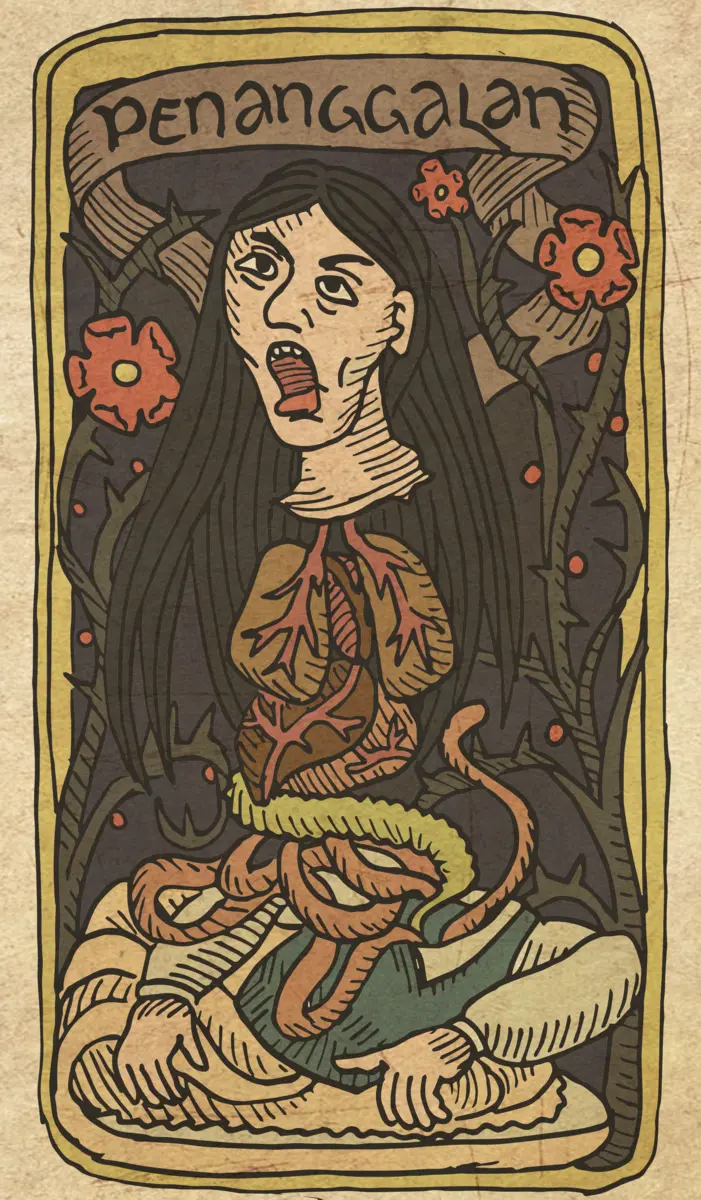
Her name is built on the Malay root tanggal, to shed or come away: she is the detaching. In the oldest account anyone can date, told by the Malay writer Abdullah bin Abdul Kadir to the missionary William Milne at Malacca, she is a woman who served a devil until the term of her agreement ran out and she gained the power to fly, her head and neck coming free with the entrails hanging beneath, shining at night like fireflies. In 1839 the army officer T. J. Newbold gave a different mechanism and one lasting phrase: a spirit that possesses women, turns them into witches and flies them out by night to gratify their vampire thirst. Walter William Skeat, in Malay Magic (1900), added a third version from Selangor in which the whole thing was an accident, and listed her among four spirits believed to attack women and children at childbirth.
What is the history of Penanggalan?
The Penanggalan is not an undiscovered animal and nobody has ever proposed one. It is a Malay birth-spirit, and its name is a grammatical description of what it does: Malay tanggal means "to shed, to let fall, to drop, to fall", and tanggalkan "to draw or pull off" — both are in John Crawfurd's dictionary of 1852. Penanggalan is the noun built on that root: the detaching. R. J. Wilkinson's abridged Malay-English dictionary of 1908 files it exactly there, not under P but under the root tanggal, where the entry reads: "penanggalan, an evil spirit; a flying head and viscera." That is why searching a dictionary for the word can come back empty when the word is sitting right there.
The three oldest accounts anyone can read today do not agree, and the differences matter more than the agreements.
The earliest belongs to a named Malay writer, Abdullah bin Abdul Kadir, in his autobiography, the Hikayat Abdullah. He tells it as a conversation, in the chapter about the founding of the Anglo-Chinese College at Malacca by the missionary William Milne. Mrs Milne could not understand what a Chinese servant meant by puntianak and polong; Abdullah was called in to explain, reeled off a list of some two dozen spirits, and Milne asked him for one story only — "tell just the story of the penanggalan: I want to hear it, and I will write it in English, in order that Europeans may know how foolish the people are who believe in such things." Abdullah then says something that is easy to skip: "I then drew the picture of a woman, the head only as far as the neck, with the entrails dangling down. Mr Milne had a Chinese man make a cut of that picture in wood, and printed the story in a magazine called the Anglo-Chinese Gleaner." The oldest illustration of the Penanggalan that these sources allow anyone to date was therefore drawn by a Malay author, cut by a Chinese engraver and printed by a Scottish missionary, as an exhibit of local foolishness. In Abdullah's version the creature is made, not born: a woman studied under a teacher, served a devil day and night until the term of the agreement expired, and gained the power to fly. Her head and neck came away with the entrails hanging in strings; the body stayed behind. She keeps vinegar in a jar at home, because the entrails swell once outside and will not go back in until they have been soaked. People who claim to have seen her flying say the entrails shine at night like fireflies.
The second account is by an army officer, T. J. Newbold, in the second volume of his Political and Statistical Account of the British Settlements in the Straits of Malacca (London, 1839). He spells it Penangalan, and his mechanism is the opposite of Abdullah's: the spirit "takes up its abode in the forms of females, and afflicts them with an unnatural craving for human blood. They become witches, and quitting their mortal bodies, except the head and intestines, fly away by night in order to gratify their vampire thirst." That last phrase is, so far as the printed record here allows, where the Penanggalan is admitted to the European vampire genre — sixty-one years before Walter William Skeat, who in 1900 would call her "a sort of monstrous vampire".
The third is Skeat's own, in Malay Magic (1900), and it is an accident rather than a pact or a possession. A woman was sitting in one of the large wooden vats Malays used for vinegar made from nipah-palm sap, performing a religious penance (dudok bertapa). A man walked in unexpectedly and asked what she was doing; she snapped back, then panicked, tried to escape, "and in the excitement of the moment, kicked her own chin with such force that the skin split round her neck", so that her head and the sac of her stomach tore free of the trunk and flew to the nearest tree. Skeat lists her as one of four spirits believed to attack women and children at childbirth, alongside the Bajang, the Langsuir and the Pontianak — three different beings, routinely melted into one another by later writers.
What the household actually did about her is the most concrete part of the record, and it is architectural. Skeat describes the birth place being chosen by dropping a hatchet blade until it stands upright in the ground below the raised floor; underneath that spot were fastened prickly pandanus leaves, the "acid" egg-plant, and a lekar jantan — a circular rattan cooking-pot stand — because the thorns would prick anything reaching up at the child and the ring would work as a snare. Abdullah records jeruju leaves (a thistle) hung at doors and windows and thorns laid wherever there was blood. A charm in Skeat's appendix calls in poultry against her under a second name: "Kur, ayam puteh, kur, ayam hitam" — cluck, white fowl, cluck, black fowl — "peck at the dangling belly of Manjang, peck at the liver, heart and spleen of Manjang." A footnote explains that Manjang, or Pemanjangan, the lengthening one, is another name for her; that the fowls let out of the hen-house in the morning would peck at the sac of her stomach and so expose her; and that once detected she "can be punished by having her stomach filled up with ground glass and sherds of earthenware, which will kill her in about seven days' time."
There is also an object. In the Kuala Langat district of Selangor, in 1896 and 1897, Skeat collected a model of her; it is now in the Museum of Archaeology and Anthropology in Cambridge, accession Z 33230, catalogued as "Penanggalan. Vampire." The physical description is a carved wooden human head "pasted with black paper strips on top and orange and green paper strip on the neck", the eyebrows and eyes painted black. It is the figure on the left of Plate 7 of Malay Magic. The dangling entrails that everyone pictures are, in the photograph that fixed her appearance for a century of English readers, coloured paper.
Timeline: the documented record of Penanggalan
- 1839 T. J. Newbold prints the earliest account we have been able to date, spelling her Penangalan: a spirit that takes up its abode in women, turns them into witches and sends them flying by night, leaving the body behind, to gratify their "vampire thirst". It is the moment the Penanggalan enters the European vampire genre, and it has an author and a page.
- 1852 John Crawfurd's Malay-English dictionary records the root — tanggal, "to shed, to let fall, to drop, to fall" — and the spirit vocabulary (antu, "a goblin, a spectre"), but has no entry for the Penanggalan, the Pontianak or the Langsuir. The absence was checked by reading the alphabetical sequence, not by searching for the word.
- 1874 J. T. Thomson publishes the first complete English version of Abdullah's autobiography — and drops the episode entirely. The word penanggalan does not occur in it once, nor do polong, pontianak or Gleaner, although Milne appears 22 times.
- 1896-1897 Walter William Skeat, then a district officer, collects a carved wooden head representing the Penanggalan in the Kuala Langat district of Selangor. It is the object photographed for Plate 7 of Malay Magic; its trailing entrails are strips of coloured paper.
- 1899 The University of Cambridge's 14th Annual Report records the gift of over a thousand Malay and Sakai objects from Skeat, formed in Kuala Langat in 1896 and 1897. The Penanggalan head is number 848 of the Skeat Collection, today accession Z 33230.
- 1900 Malay Magic appears. Skeat lists her among four birth-spirits, calls her "a sort of monstrous vampire", and gives the Selangor origin tale of the vinegar vat and the kicked chin. In the preface, C. O. Blagden states that he — not Skeat — arranged the rest of Chapter VI, where the Penanggalan sits, and that the author had revised only the first hundred pages.
- 1908 R. J. Wilkinson's abridged Malay-English dictionary gives her a lexicographic entry, filed under the root tanggal: "penanggalan, an evil spirit; a flying head and viscera". Looking her up under P returns nothing.
- 1918 W. G. Shellabear's translation of the Hikayat Abdullah names the missionary Skeat had left as "Mr M.": William Milne. It preserves Abdullah's statement that he drew the first picture of the creature himself, that Milne had a Chinese engraver cut it in wood, and that Milne printed the story to show Europeans how foolish believers were.
- 8 March 2022 At 23:10 UTC an anonymous contributor uploads an original drawing of the Penanggalan to Wikimedia Commons as own work under CC BY-SA 4.0, and sixty-five seconds later adds it to the German Wikipedia article. It is the image this file carries. The same account added no category and made no claim about the creature's status.
Is there a rational explanation for Penanggalan?
The most useful sceptic in this file is the man who told the story. Abdullah bin Abdul Kadir ends his own account, in the 1918 translation, with a flat disclaimer: "This is the story of the penanggalan as I have heard it told by old people, but I do not in the least believe it, God forbid." A few pages later he goes further, and the passage is uncomfortable to read on both sides: "Formerly I also believed all these things, and was afraid, because from my childhood I had heard of such things, and people had frightened me... But since I have obtained some little education and intelligence, and have read books, and especially have associated with intelligent people, that is with Europeans, I now know that all of that is false and a great swindle." Milne, for his part, laughed and said "the people who believe such things as that are very stupid indeed". We have not found a nineteenth-century believer on record; we have found a Malay narrator who disowned the story while transmitting it, and a missionary who printed it to be laughed at.
That leaves a documentary question rather than a biological one, and it is worth being exact about the transmission, because ours is a chain with three weak links.
First: the Penanggalan does not belong to cryptozoology and never has. Measured on 14 August 2026 in Internet Archive's full-text book search, "penanggalan" appears in 287 volumes; 230 of those also contain the word "vampire" and only 12 contain "cryptozoology". The control run the same day on a genuine cryptid, the chupacabra, returns 268 books containing both its name and "cryptozoology". The English Wikipedia article carries no cryptid category — it is filed under vampires, Asian demons and Malaysian ghosts — the German article is categorised as Blutsauger and Sagengestalt, and Spanish Wikipedia has no article on her at all. The conversion that happened to this spirit was into the vampire canon, it is datable to Newbold in 1839, and it is not the one our own catalogue performed by filing her as a cryptid.
Second: the intermediate link damages by subtraction, and it can be shown. Skeat's English rendering of Abdullah's account is a quotation from a translation he never identifies: he cites only "Hikayat Abdullah, p. 143", and the Hikayat is absent from his own List of Chief Authorities Quoted, which runs unbroken from Clifford to Yule. The one complete English version published before Malay Magic, J. T. Thomson's Translations from the Hakayit Abdulla (London, 1874), does not contain the episode at all: searching that text returns no occurrence of penanggalan, polong, pontianak, entrails or Gleaner, while the same file returns "Penang" 14 times and "Milne" 22 times. Thomson kept Milne and dropped the ghosts.
Third: the pages that made her famous are not, strictly, Skeat's. In the preface to Malay Magic, C. O. Blagden explains that Skeat left England with the Cambridge expedition before the book was finished, that only the first hundred pages or so had had the author's revision, and that "for the arrangement of the rest of Chapter VI, and for some small portion of the matter therein contained, I am responsible". The Penanggalan section is in the rest of Chapter VI.
Finally, the picture on this page. It is a drawing made in 2022 by an anonymous Wikipedia contributor who works mainly on Austrian regional dress and German-language articles, uploaded to Wikimedia Commons on 8 March 2022 at 23:10 UTC and added to the German Wikipedia article sixty-five seconds later by the same account. It is honest, freely licensed original art, and it is not evidence of anything: no historical image of the Penanggalan appears in it, and the oldest one on record — Abdullah's woodcut for Milne — is a drawing too.
Can you visit Penanggalan?
The Penanggalan belongs to the room where a birth was taking place, and she has no site of her own. Skeat's material comes from the Kuala Langat district of Selangor, and the pin on this file, at 2.8103, 101.4986, falls at Teluk Datok, near Banting, in that district. In 1899 the Cambridge museum's annual report said of his collection that many of its objects were "actually no longer in use among the people".
The object itself is in Cambridge. The wooden head Walter William Skeat collected in Kuala Langat in 1896-97 is item Z 33230 in the Museum of Archaeology and Anthropology of the University of Cambridge, catalogued under the local term Penanggalan and described as a carved human head "pasted with black paper strips on top and orange and green paper strip on the neck". It is the head on the left of Plate 7 of Malay Magic. The collections record does not say whether it is on display; the museum's research visits page says access to objects for research is by advance appointment, arranged through [email protected].
The museum is on Downing Street, Cambridge CB2 3DZ (+44 1223 333516). Its visit page, checked on 23 September 2026, gave opening hours of Tuesday to Saturday 10:00-17:00 and Sunday 12:00-17:00, with last entry at 16:30 and free admission, and asked groups of ten or more to book in advance by email. The same page said the lift was out of order, so that the first- and second-floor galleries could be reached only by stairs.
Skeat's Malay Magic (1900) is digitised in full at the Internet Archive; the Penanggalan is at pages 320, 326-329 and 334, the plate faces page 326, and the charm against her is in the appendix. Abdullah bin Abdul Kadir's account is in W. G. Shellabear's translation, The Autobiography of Munshi Abdullah (Singapore, 1918), pages 93-95, also free at the Internet Archive. The English versions are translations that do not agree with one another, so the Malay-language editions are the text to go to for anyone who reads Malay. Newbold's 1839 paragraph is in volume II, pages 191-192. For a scholarly reading rather than a colonial one, Kirk M. Endicott's An Analysis of Malay Magic (Oxford: Clarendon Press, 1970) is a book-length critique of Skeat's material, held in the Internet Archive's lending library.
Abdullah says he drew the Penanggalan for William Milne, who had a Chinese engraver cut the drawing in wood and printed it with the story "in a magazine called the Anglo-Chinese Gleaner". The Malacca mission's English-language magazine was the Indo-Chinese Gleaner.
Sources consulted
- Walter William Skeat, «Malay Magic: An Introduction to the Folklore and Popular Religion of the Malay Peninsula» — Macmillan and Co., London, 1900 book
- T. J. Newbold, «Political and Statistical Account of the British Settlements in the Straits of Malacca, vol. II» — John Murray, London, 1839 book
- Abdullah bin Abdul Kadir, «The Autobiography of Munshi Abdullah (Hikayat Abdullah), translated from the Malay by W. G. Shellabear» — Methodist Publishing House, Singapore, 1918 book
- J. T. Thomson, «Translations from the Hakayit Abdulla (bin Abdulkadar), Munshi, with comments» — Henry S. King & Co., London, 1874 book
- John Crawfurd, «A Grammar and Dictionary of the Malay Language, vol. II» — Smith, Elder and Co., London, 1852 book
- R. J. Wilkinson, «An Abridged Malay-English Dictionary (Romanised)» — F.M.S. Government Press, Kuala Lumpur, 1908 book
- Museum of Archaeology and Anthropology, University of Cambridge, «Object Z 33230 — Penanggalan, wooden head collected by W. W. Skeat in Kuala Langat, Selangor» — MAA collections database, 1899 archive
- Wikimedia Commons, «File:Penanggalan.png — file history, licence and uploader» — Wikimedia Commons, 2022 web
- Museum of Archaeology and Anthropology, University of Cambridge, «Visit — opening hours, admission and access» — maa.cam.ac.uk, 2026 web
Reviewed by V. Serrano on 2026-08-14 · How we verify our content
📎 Source: Enigma Atlas
💬 Field testimonies (0)
No testimonies yet. Add the first.
Add your testimony
🔒 Log in to add a testimony