👻 HAUNTED PLACE · EXP. Nº9474
ACTIVE
Nummela Sanatorium (Röykkä)
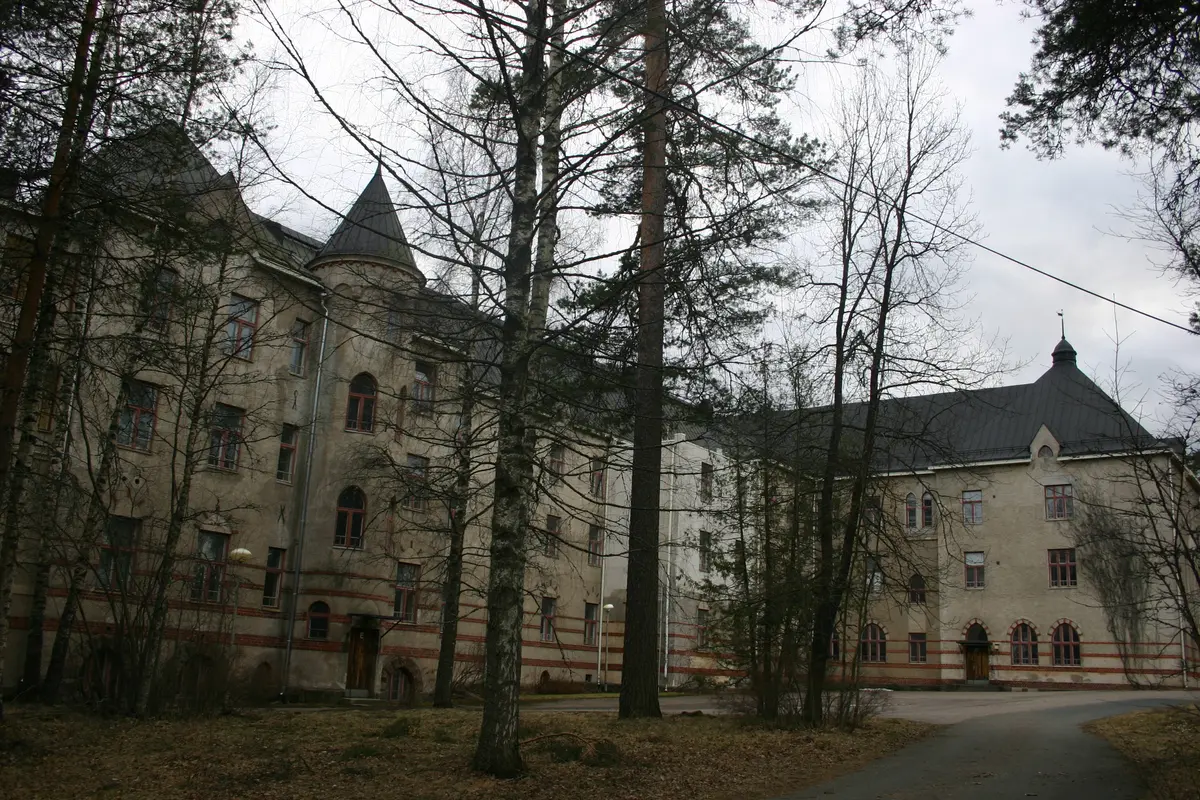
Röykkä, in the Finnish municipality of Nurmijärvi, is known for the Jugend castle on its northern edge: Nummela sanatorium, opened on 23 November 1903 as one of the country's first two tuberculosis sanatoria, designed by Svante Magnus Schjerfbeck.
Where is Nummela Sanatorium (Röykkä)?
- Location
- Uusimaa, Finland
- Type
- Hospital / asylum
- Coordinates
- 60.501, 24.648
- Last updated
LOCATION
Why is Nummela Sanatorium (Röykkä) said to be haunted?
Its patients included the composer Erkki Melartin, who wrote piano pieces during his cure in 1906, and the poet Edith Södergran, sent there at sixteen in 1909, after she contracted tuberculosis, to the same sanatorium where her father had been treated. It became the City of Helsinki's Röykkä mental hospital in the 1950s and closed at the beginning of 1997. During the two decades it stood empty and unsold it acquired a reputation for hauntings — lights in the windows, a woman on the roof ridge — which the local paper traced in 2010 to a single pseudonym on an internet forum. Since the spring of 2023 the building has been a hotel and event venue, Röykkä Resort, and is private property.
What is the history of Nummela Sanatorium (Röykkä)?
The village came after the building. Until the turn of the twentieth century Röykkä was a scatter of farms on the Salpausselkä ridge north-west of Helsinki; what made it a place was a hospital, and the traffic a hospital brings. When the Finnish Medical Society — Finska Läkaresällskapet — set out to build a people's sanatorium against tuberculosis, it took its time. A planning committee was appointed in 1895. The Senate authorised the lease of the chosen site in 1899, the year the joint-stock company was constituted with a share capital of 140,000 marks. The building programme was fixed in 1901, and the architect Svante Magnus Schjerfbeck — brother of the painter Helene Schjerfbeck — travelled through several European countries to study the new institutional type before drawing the plans, which were finished in 1902.
Nummela sanatorium was inaugurated on 23 November 1903, "with a simple opening ceremony", as Turun Sanomat recalled ten years later to the day. It was not the country's first: Takaharju, in Punkaharju, had opened on 1 October, seven weeks earlier. What made 1903 the year that mattered was that both opened in it, and a health journal writing that November said so plainly — two tuberculosis sanatoria, the first of their kind in the country. The address printed in the newspaper announcements is the best short summary of what the place was: "Nummela sanatorium, Röykkä halt". The institution's post came in by rail, and around that halt the village grew.
The sanatorium's own accounts survive because its patients published a magazine, Nummelan uutiset, and the anniversary issue of 23 November 1928 reprinted the opening balance: in the 38 days the sanatorium worked in 1903, 58 patients were admitted, with a daily average of 49 — 29 in the stone building and 20 in the wooden one. That split is the social history of the place in one line. The Jugend castle of brick and render, the building that still stands, took private patients who paid for themselves and were mostly well off. The smaller, stove-heated wooden houses beside it took the patients sent by their municipalities. When the tuberculosis era ended, the wooden houses were pulled down. The building that survives to be photographed and rented out is the rich patients' building.
The treatment was air. Two-storey open lying halls were attached to the lakeward end of the main block, because for a long time the central therapy was to have patients lie outdoors, wrapped according to the weather. Pines were planted across the grounds in the belief that they gave off ozone, thought good for consumptive lungs; every patient room had racks for fresh pine and birch branches, changed every few days, for the same reason. The doctors were amateur botanists and coaxed rare species into the park; the grounds were developed partly to a 1911 plan by Svante Olsson, Helsinki's city gardener. Axel von Bonsdorff was chief physician from 1903 to 1936, and in May 1906 the illustrated weekly Viikon Kuvat photographed him injecting Marmorek's serum, alongside pictures of the lying hall and of patients in fancy dress at his name day.
In one of those 1906 photographs the composer Erkki Melartin sits at a piano. He was a patient; Säveletär reported that March that during his stay he had composed several piano pieces. Three years later, early in 1909, a sixteen-year-old called Edith Södergran was admitted. Her translator David McDuff writes that she had contracted tuberculosis at the end of 1908, "probably as a result of infection from her father", and was sent "to the same sanatorium at Nummela where her father had died": Matts Södergran, ill since 1904, had been treated there, Edith had visited him and been horrified by what she saw, and he died in 1907. A Finnish literary magazine, summing up her life in 1928, put the following years flatly — now Raivola, now Nummela sanatorium, until in the autumn of 1911 she left for Switzerland. On 5 July 1914 the pastor and lecturer Toimi Armas Waltari died in the same building at the age of 32, leaving a five-year-old son, Mika, who would become the novelist Mika Waltari, author of The Egyptian.
What did not happen is the thing most often written about this place: the sanatorium did not close in 1932. The new Kiljava sanatorium a few kilometres away was inaugurated on 10 October 1938, and Nummela outlived it as a sanatorium by decades — in 1935 its board was still offering the whole institution to the City of Helsinki for three million marks, in 1936 the board was still holding parties there, in 1939 doctors were still training there, and a 1940 pharmacy directory still names its chief physician. According to the national heritage register, tuberculosis work at Nummela ended in the latter half of the 1950s, and it was then that Helsinki bought the institution and reopened it as a long-stay psychiatric hospital under the name Röykän sairaala. Sources differ over whether the purchase was in 1956 or 1958. The main building was overhauled and extended in 1981–1984. The hospital closed at the beginning of 1997.
Then came the empty years, which are the years the ghost stories are about. Helsinki tried and failed to sell for two decades; the buildings served as a reception centre for asylum seekers in 2015–2016; upkeep ran to some 300,000 euros a year. In January 2022 two entrepreneurs proposed a pagan experience centre with a witchcraft school and ghost tours, to be crowdfunded. Instead, on 6 April 2022, the city sold the main building, seventeen others and 45 hectares for 1.5 million euros to Röykkä Invest Oy, a company whose founders include the actor Jasper Pääkkönen. Röykkä Resort opened in the spring of 2023.
Timeline: the documented record of Nummela Sanatorium (Röykkä)
- 1895 The Finnish Medical Society (Finska Läkaresällskapet) appoints a committee to plan a people's sanatorium for tuberculosis. The heritage register records the committee, the 1899 Senate lease of the site it chose, and the 1901 building programme as three separate steps: the institution was six years in the making before a stone was laid.
- 13 June 1899 The joint-stock company behind the sanatorium is constituted with a share capital of 140,000 marks, a figure the Turku press recalls at the tenth anniversary. The Senate that year authorises the society to lease the plot on the Salpausselkä ridge above Lake Sääksjärvi.
- 1 October 1903 Takaharju sanatorium at Punkaharju opens — seven weeks before Nummela. Aamulehti reports it the next morning. This is the reason Nummela cannot be called Finland's first tuberculosis sanatorium, although a great many pages say so.
- 23 November 1903 Nummela sanatorium is inaugurated — "with a simple opening ceremony", as Turun Sanomat put it ten years later to the day. Two days earlier Helsinki papers had advertised a viewing trip out to see the building on Sunday 22 November.
- End of 1903 The house's own accounts, reprinted by the patients' magazine at the 25th anniversary: "in those 38 days during which Nummela sanatorium was in operation in 1903, 58 patients in all were admitted, and the average number of patients per day was 49, of whom 29 in the stone building and 20 in the wooden building." Those 38 days are exactly 24 November to 31 December.
- May 1906 Matts Södergran, an engineer settled at Raivola who had contracted tuberculosis in 1904, is treated at Nummela, where his daughter Edith visits him and is horrified by what she sees. He dies in 1907.
- 1906 The composer Erkki Melartin is a patient. Säveletär reports in March that "during his stay at Nummela sanatorium Melartin has composed, among other things, several piano pieces"; in May the illustrated weekly Viikon Kuvat runs a photo feature from the sanatorium showing Melartin at the piano, the chief physician injecting Marmorek's serum, the open-air lying hall, and patients in fancy dress at the chief physician's name day.
- 1909 Edith Södergran, sixteen, who had contracted tuberculosis at the end of 1908, is sent, in David McDuff's words, "to the same sanatorium at Nummela where her father had died".
- October 1911 Södergran leaves for Switzerland. A Finnish literary magazine summarised those years in 1928 without any embellishment: "she stayed now in Raivola, now at Nummela sanatorium, until in the autumn of 1911 she travelled first to Arosa".
- 5 July 1914 Toimi Armas Waltari, pastor and lecturer, dies at Nummela at the age of 32. His son Mika Waltari, then five years old, would become the novelist known abroad for The Egyptian.
- 23 November 1928 The sanatorium turns 25. The patients themselves publish the anniversary number of their own magazine, Nummelan uutiset, and the national press picks up its figures over the following two days. The magazine had been running for years and is digitised: the patients of this building left a voice behind, which is more than most hospitals of its age can say.
- Spring 1935 With the Uusimaa municipalities planning a new sanatorium at Kiljava, Nummela's board offers the whole institution to the City of Helsinki for three million marks. Committees debate for months whether to buy the old sanatorium instead of building a new one, and conclude that it is not worth it.
- 10 October 1938 The new Kiljava sanatorium, a few kilometres away, is inaugurated on Aleksis Kivi's day. Nummela does not close: the Finnish press still reports doctors training there in 1939, and a 1940 pharmacy directory still lists its chief physician.
- Latter half of the 1950s Tuberculosis work at Nummela ends and the City of Helsinki buys the institution to run it as a "B" mental hospital for long-stay patients. It is renamed Röykän sairaala. Sources give 1956 and 1958 for the purchase; the heritage register commits only to the second half of the decade.
- 1981–1984 The main building is overhauled and extended to a design by the architects Kirsti and Erkki Helamaa, an addition the heritage register judges to have been carefully weighed against Schjerfbeck's pavilion.
- Beginning of 1997 "Röykän mielisairaalan toiminta lakkasi 1997 alussa": the mental hospital shuts. Ninety-four years of continuous medical use end here, and the empty-building years begin.
- 12 August 2010 Yle publishes "Helsinki can't get rid of its old ghost castle", a national mention of the haunting. It reports that the building "has been rumoured to be haunted, which has inspired the curious to break in", and that this has not been good for the building: bonfires have been lit inside.
- 12 November 2010 The local paper Nurmijärven Uutiset prints the stories and names their source in the same breath: the Suomi24 internet forum, where "the Jugend castle is listed among the places where there is definitely a haunting". It quotes the pseudonym "Röykkäläinen" for the woman who walks the roof ridge and jumps, and sets it against what the police had actually found in the building: the remains of bonfires and graffiti.
- 24 October 2016 Iltalehti includes Röykkä in a national round-up of haunted places, repeating the mysterious lights and the woman on the roof — now with no mention of the forum — and adding "according to one rumour, the hospital is haunted by the spirit of a girl who died there young". This is the version that reached the English-language internet.
- 7 January 2022 Two entrepreneurs, Nina Sulkanen and Elina Sjöblom, propose turning the building into a "pagan experience centre" with a witchcraft school, magic shops and ghost tours, funded by a crowdfunding campaign with a 350,000-euro target. The plan does not happen.
- 6 April 2022 The City of Helsinki sells the property — the main building, seventeen more buildings and 45 hectares — for 1.5 million euros to Röykkä Invest Oy, a company founded by the actor Jasper Pääkkönen and around ten property and investment professionals. Upkeep had been costing some 300,000 euros a year, and break-ins had forced the city to install cameras and hire guards.
- Spring 2023 Röykkä Resort opens in the sanatorium: saunas, meeting rooms, a café and accommodation. The shore sauna built in 1972 is restored the same year. By 2024 the forest club and the former chief physician's log villa have been refitted too. The abandoned building of the ghost stories has been a going concern for three years.
Is there a rational explanation for Nummela Sanatorium (Röykkä)?
The ghost of Röykkä has a paper trail, and it is short and traceable, which is unusual enough to be worth setting out step by step.
It does not begin in the sanatorium. A query to the National Library of Finland's digitised press (digi.kansalliskirjasto.fi) run on 4 October 2026 for "Nummelan parantola" together with kummitus, the Finnish word for ghost, returns 38 pages; the name alone returns 3,685, the ghost word alone 31,741, and a nonsense control nothing at all. None of the 38 is about the building. Their highlighted passages are patients' obituaries, theatre and cinema advertisements, and a political column of March 1939 conjuring metaphorical "ghosts" in the same issue that mentions the sanatorium — neighbours on the page. The same query with aave and haamu, the other two Finnish words for a ghost, gives 10 and 27 pages of the same kind. The archive's reach is uneven, and that limits the result: of the pages naming the sanatorium, 3,639 date from 1900-1939 and 32 from 1940-1979, and Röykän sairaala, the name the institution took in the late 1950s, appears on two pages in all. The measurement covers the tuberculosis years and says nothing about the psychiatric or the empty ones. Within that range, the press gives no sign that anyone thought the building haunted while there were patients in it.
In national media the story is on record by 12 August 2010, when Yle ran a piece headlined "Helsinki can't get rid of its old ghost castle" about the city's failure to sell. It reported that the building "has been rumoured to be haunted, which has inspired the curious to break in", and that the consequence was bonfires lit inside a protected Jugend interior. Three months later the local paper, Nurmijärven Uutiset, printed the stories at length and named their source in the same breath. The source was an internet forum. On Suomi24, the paper wrote, the castle "is listed among the places where there is definitely a haunting"; it then quoted a user posting as "Röykkäläinen", who wrote that shadows can be seen through the windows although nobody is inside and that "on the roof ridge a woman is seen walking, and she jumps down in the middle of the night always at a certain hour; many have seen this". The same article quoted a member of the city's staff who had spent several summers at the hospital — "nothing haunted the place, and nothing there was frightening" — and set the stories against what the police had actually found in the building: the remains of bonfires and graffiti on the walls.
What happened next is the ordinary machinery by which a forum post becomes a fact. In 2016 Iltalehti repeated the lights and the woman on the roof in a national round-up, with no mention of the forum, and added a second rumour about the spirit of a girl who died there young. The English Wikipedia article on Röykkä, citing both papers in a passage whose sources were consulted in March 2019, gives the lights and the woman on the roof to "several visitors". In the 2010 article the woman on the roof belongs to one forum user.
Two documented facts sit beside the two most cited details. The stories in national circulation since 2022 include a piano in the main building said to be played by ghosts at night. There was indeed a piano in this building, and a well-known composer at it: Erkki Melartin, photographed there in 1906 while a tuberculosis patient, writing piano pieces during his cure. Nothing in the sources connects the composer to the story; what they show is that the building's musical history is documented and the ghost's is not. And the "mysterious lights in the windows of buildings that should stand empty" require the buildings to have stood empty. According to the Finnish Wikipedia article on the sanatorium, in February 2008, eleven years after closure, most of the buildings still had their basic heating on and the city was running short courses in some of the former wards; in August 2010 the chair of Helsinki's property committee told Yle that the premises were being let on a small scale.
Finally, the commercial incentive is documented and unusually explicit. In January 2022 two entrepreneurs sought at least 350,000 euros in crowdfunding for a centre whose programme would include ghost tours, witch classes and rituals. That plan failed and the property was sold instead. The buyers have taken another line: the operator's own website, read on 4 October 2026, sells saunas, meeting and party rooms and accommodation, and its home page has no ghost on it. In Yle's report on the new owners in May 2022, the piano appears in a photo caption as the one "which, according to the story, ghosts play at night".
Can you visit Nummela Sanatorium (Röykkä)?
This is not an abandoned building and it has not been one for years. The sanatorium is private property and a working business: Röykkä Resort, Parantolantie 86, 05100 Nurmijärvi ([email protected], +358 40 8010 396). Anyone planning a visit on the strength of urban-exploration videos should know that the ground rules changed in 2022, when the new owners took over a property the city had already fitted with cameras and guards after years of break-ins, bonfires lit indoors and graffiti. The buildings are listed and entering them without permission is a criminal matter.
What is actually on offer is worth knowing, because several of the rooms are the historic ones. Bookings run through the operator's site. The four-storey tower on the lake side — built as accommodation for the nursing staff and left empty for decades because it had neither running water nor drains — is now a meeting space with lake views and beds for 25 on its two top floors. The Punainen sali, the red room, was the sanatorium's billiard room and seats 20. The Päiväsali, the green day room, seats 50. The Herrainhuone occupies the 1903 log villa built as the chief physician's house, refitted in the summer of 2024, and seats 18. The Metsäklubi, refurbished in the spring of 2024, takes 150. The shore sauna, built in 1972 and restored in 2023, has a jetty for swimming in Sääksjärvi all year round, and there is a second, traditional log sauna. The Lettovilla villa also houses a café, a caterer and an art gallery.
The setting deserves more attention than the ghost. The whole ensemble — together with the Kiljava sanatorium of 1938 and the trade-union college of 1950 — is entered in Finland's national register of significant built cultural environments as "the Sääksjärvi sanatoria and Kiljava college". Much of the surrounding forest is Natura 2000 land. The pines you walk under were planted on purpose, in the belief that they gave off ozone. The northern edge of the sanatorium grounds is crossed by the ancient shoreline of the Yoldia Sea, left after the last ice age and visible as a distinctive band of stones; it is signposted and protected.
Getting there: Röykkä lies in north-western Nurmijärvi, roughly 45 km from Helsinki, on regional road 132 (Lopentie), with national road 25 running past the northern end of the village. The old railway station building of 1911 still stands but is in private hands and the line no longer carries passengers here, so the practical approach is by car. Note that the map pin for this file marks the centre of Röykkä village; the sanatorium stands about 1.6 km further north, and the postal address above is the reliable way to navigate to it. Also nearby: the beach at Kotolahti, known locally as Röykänranta, and on the northern shore of Sääksjärvi the "Rakkaudenhauta", the Tomb of Love, the private grave of a daughter of the Kytäjä manor house.
Sources consulted
- sin firma, «Nummelan parantola (aviso de apertura: «Ensi marraskuussa awataan yleisön käytettäwäksi Nummelan parantola»)» — Uusimaa, 1903 newspaper archive
- sin firma, «Nummelan parantola («Tämän k. alussa awattiin yleisön käytettäwäksi Nummelan parantola»)» — Laatokka, 1903 newspaper archive
- sin firma, «Tänään kymmenvuotias (décimo aniversario del sanatorio; fija la inauguración el 23 de noviembre de 1903)» — Turun Sanomat, 1913 newspaper archive
- redacción de los pacientes, «Nummelan parantola 25 vuotta (balance del primer ejercicio: 38 días, 58 pacientes, 29 en el edificio de piedra y 20 en el de madera)» — Nummelan uutiset : Nummelan potilaiden julkaisema lehti, 1928 newspaper archive
- sin firma, «Uusia sävellyksiä («Erkki Melartin on oleskelunsa aikana Nummelan parantolassa säveltänyt m. m. useita piaanokappaleita»)» — Säveletär, 1906 newspaper archive
- sin firma, «Nummelan parantolasta (reportaje fotográfico: Melartin al piano, von Bonsdorff inyectando suero de Marmorek, la galería de reposo, pacientes disfrazados)» — Viikon Kuvat, 1906 newspaper archive
- sin firma, «Necrológica de Toimi Armas Waltari («nukkui kuolon uneen Nummelan parantolassa t. k. 5 p:nä»)» — Sunnuntaitervehdys, 1914 newspaper archive
- Museovirasto (Agencia Nacional de Patrimonio de Finlandia), «Sääksjärven parantolat ja Kiljavan opisto (RKY, inventario de entornos culturales construidos de importancia nacional)» — rky.fi, 2009 report
- sin firma, «Kiljavannummen parantola vihittiin Aleksis Kiven päivänä 10 p. lokakuuta 1938» — Tuberkuloosilehti, 1938 newspaper archive
- sin firma, «Takaharjun parantola («Eilen awattiin waikutukseensa Takaharjun keuhkotautisten parantola»)» — Aamulehti, 1903 newspaper archive
- sin firma, «Reseña del año 1903 («silloin maassamme avattiin kaksi keuhkotautiparantolaa — ensimäiset laatuaan»)» — Suomen terveydenhoito-lehti, 1903 newspaper archive
- David McDuff, «Edith's Life (introducción a Edith Södergran, Complete Poems)» — Bloodaxe Books, 1984 book
- sin firma, «Semblanza de Edith Södergran («hän oleskeli milloin Raivolassa milloin Nummelan parantolassa, kunnes hän syksyllä 1911 matkusti ensin Arosaan»)» — Tulenkantajat, 1928 newspaper archive
- redacción, «Hurjia kummitusjuttuja (atribuye los relatos al foro Suomi24 y cita al seudónimo «Röykkäläinen»)» — Nurmijärven Uutiset, 2010 newspaper archive
- redacción, «Helsinki ei pääse eroon vanhasta kummituslinnastaan» — Yle Uutiset, 2010 newspaper archive
- Marianne Zitting, «Hui, kummituksia! Suomalaiskohteet, joihin liittyy hurjia aavetarinoita» — Iltalehti, 2016 newspaper archive
- redacción, «Onpa erikoinen ilmestys, ajatteli Jasper Pääkkönen – sitten kivilinna vaihtoi omistajaa 1,5 miljoonalla» — Yle Uutiset, 2022 newspaper archive
- Sofia Holmlund, «Helsingfors säljer magnifikt «spökslott» där Edith Södergran var patient» — Hufvudstadsbladet, 2021 newspaper archive
- Emilia Kangasluoma (Helsingin Sanomat), «Pakanallista elämyskeskusta esitetään valtavaan jugendlinnaan Nurmijärvellä – yrittäjät haaveilevat magiakaupoista ja noitakoulusta» — Rakennuslehti, 2022 newspaper archive
- Röykkä Resort, «Röykkä Resort — tilat, majoitus ja yhteystiedot (sitio oficial del operador actual)» — roykkaresort.fi, 2026 web
- colaboradores de Wikipedia, «Nummelan parantola / Röykän sairaala (historia del conjunto, edificios y usos)» — Wikipedia en finés, 2023 web
- redacción, «Tässä on Jasper Pääkkösen kummituslinna – valtavat ylläpitokustannukset (300 000 €/año; cámaras y vigilancia por los allanamientos)» — Seiska, 2022 newspaper archive
- colaboradores de Wikipedia, «Röykkä — section on the abandoned hospital: «According to several visitors the windows of the building show mysterious lights, as well as a woman who commits suicide by jumping off the roof», citing Nurmijärven Uutiset (2010) and Iltalehti (2016), sources accessed 27 March 2019» — Wikipedia en inglés, 2026 web
Reviewed by V. Serrano on 2026-08-18 · How we verify our content
💬 Field testimonies (0)
No testimonies yet. Add the first.
Add your testimony
🔒 Log in to add a testimony