👻 HAUNTED PLACE · EXP. Nº9474
ACTIVE
Tuol Sleng Genocide Museum
Tuol Sleng was a school, and the Khmer Rouge did not convert it.
Where is Tuol Sleng Genocide Museum?
- Location
- Phnom Penh, Cambodia
- Type
- Museum
- Coordinates
- 11.549, 104.918
- Last updated
LOCATION
Why is Tuol Sleng Genocide Museum said to be haunted?
They emptied Phnom Penh on 17 April 1975 and the classrooms simply stopped. The security office known as S-21, set up that August under Kaing Guek Eav, alias Duch, moved into the buildings a year later, in April 1976, and ran there until 6 January 1979. Every adult who arrived was registered, made to write a biography and photographed. The surviving lists name at least 12,273 people, and the tribunal that examined them said the real number is higher; most of the dead were the regime's own soldiers and cadres. How many walked out alive is still being counted: the museum says twelve, and research by the Documentation Center of Cambodia puts it at about twenty-three, with a further 179 released before the end.
The museum that opened here in July 1980 is not a haunted house and has never claimed to be. But twice a year, at Pchum Ben and Khmer New Year, its staff bring in monks to make offerings — because in Khmer Buddhist practice a body must be cremated with rites before the soul can be released, and almost nobody who died here received them. That is what haunting means at Tuol Sleng, and it is documented.
What is the history of Tuol Sleng Genocide Museum?
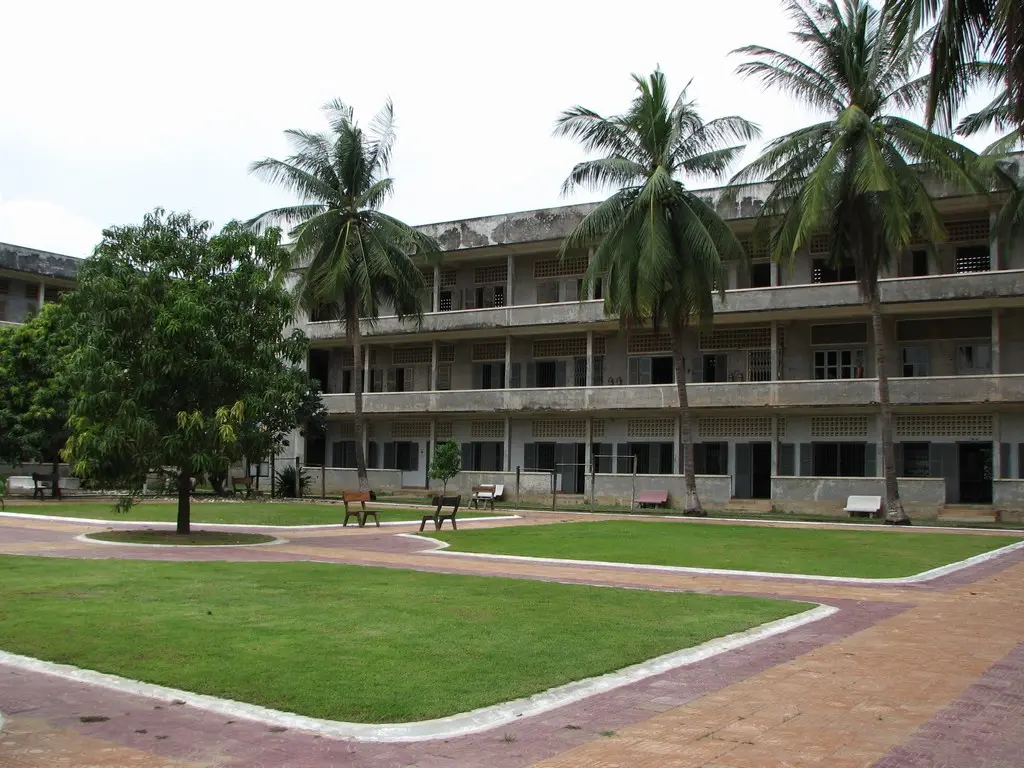
The buildings on the corner of Street 113 and Street 350 in Phnom Penh were put up to be a school, and for thirteen years that is all they were. The museum's own history dates the main block to 1962, when it opened as Ponhea Yat High School — later renamed Tuol Svay Prey — sharing its grounds with the smaller Tuol Sleng primary school next door. Tuol Sleng is the name of the low mound the compound stands on. It was a neighbourhood long before it was a byword.
The school ended on 17 April 1975, the day Khmer Rouge forces entered Phnom Penh, a year before the prison came; the Extraordinary Chambers in the Courts of Cambodia would later summarise the regime's founding act as "the forced transfer of residents of Phnom Penh and other former Khmer Republic strongholds to the countryside". The city was emptied within days, its pupils and teachers with everyone else.
S-21 began elsewhere. On 15 August 1975, according to the closing order the accused himself accepted at trial, Son Sen called two men to a meeting at the Phnom Penh railway station: In Lorn, alias Nat, and Kaing Guek Eav, alias Duch, a former mathematics teacher born in Kompong Thom in 1942. Nat was appointed chairman of the new security office and Duch his deputy, in charge of interrogation. S-21 became fully operational in October 1975, at another site in the city.
The prison reached the school in April 1976. The Trial Chamber's finding is precise: on Duch's own decision, approved by Son Sen, S-21's detainees "were moved to the premises of the Pohnea Yat Lycée, a high school located between streets 113, 131, 320, and 350", and the office operated there until 6 January 1979. The stated reason was practical — to make interrogation easier and escape harder. Duch had become chairman the month before, in March 1976.
What followed was bureaucracy: the classrooms of Buildings A to E were rebuilt, interrogation in Building A, detention in B, C and D. Every adult who arrived was registered, made to write a biography, and photographed by a dedicated photography unit. Children brought in with their parents were neither registered nor photographed, which is one of the reasons the paperwork undercounts. Prisoners were tortured until they produced a confession, and the confession marked them for execution. Killing was done on the grounds at first, and later at Choeung Ek, an orchard some fifteen kilometres to the south-west, once the bodies became impossible to conceal.
The court worked from the lists that survived. The Revised S-21 Prisoner List shows no fewer than 12,273 people detained — 5,994 entries recorded as men, 1,698 as women, 89 as children — and the Trial Chamber said plainly that this is a minimum: the list omits, among others, the survivor Bou Meng, the painter Vann Nath and the mother of the child witness Norng Chanphal, so the number of victims is "likely to be considerably greater than indicated". Most of the listed prisoners were the regime's own: of the entries, 5,609 are members of the revolutionary army, 4,371 are Party cadres and 155 are former S-21 staff. The prison ended by consuming the people who ran it.
In January 1979, with Vietnamese forces closing on the capital, almost all the remaining prisoners were executed on orders from Duch's superiors. Duch and his staff fled on 7 January along with about fifteen detainees who had been kept alive to work inside the compound. Fourteen bodies were left behind in the rooms of Building A; they lie under white markers in the courtyard, photographed there in 1980 for the International Committee of the Red Cross by Gérard Leblanc.
The site became a museum almost immediately, and for reasons of its own. A Vietnamese officer, Colonel Mai Lam — who had designed the Museum of American War Crimes in Ho Chi Minh City and had studied Auschwitz-Birkenau in Poland — took charge of the conversion, and the new People's Republic of Kampuchea used the result to justify its presence in Cambodia. The doors opened to the public on 13 July 1980; 19,060 Cambodians came in the first month alone. Duch was found living under another name in 1999. The tribunal convicted him on 26 July 2010 and sentenced him to 35 years; on 3 February 2012 the Supreme Court Chamber quashed that sentence and entered life imprisonment. He died in custody on 2 September 2020.
Timeline: the documented record of Tuol Sleng Genocide Museum
- 1962 The main block opens as Ponhea Yat High School, later renamed Tuol Svay Prey, sharing its grounds with the Tuol Sleng primary school. The museum's own history gives this date.
- 17 April 1975 Khmer Rouge forces enter Phnom Penh and force its residents into the countryside. The school stops here — a year before the prison arrives, and not in 1976 as is often repeated.
- 15 August 1975 Son Sen convenes In Lorn (alias Nat) and Kaing Guek Eav (alias Duch) at the Phnom Penh railway station to plan the establishment of S-21. Nat is made chairman, Duch his deputy over interrogation. The office becomes fully operational in October 1975, at another site in the city.
- April 1976 On Duch's decision, approved by Son Sen, S-21's detainees are moved into the former lycée between streets 113, 131, 320 and 350 — the site of today's museum. Duch had become chairman the previous month.
- 7 January 1979 Duch and his staff abandon S-21 as Vietnamese forces take Phnom Penh, taking with them about fifteen detainees kept alive to work. Fourteen bodies are left in Building A; their graves are in the courtyard, photographed there in 1980 by Gérard Leblanc for the ICRC.
- 13 July 1980 The museum opens to the public, converted under Vietnamese Colonel Mai Lam. In its first month 19,060 Cambodians visit.
- 1995 King Norodom Sihanouk proposes cremating the bones held at Tuol Sleng so the souls can be released. The government refuses, arguing that they are evidence for a future trial of the Khmer Rouge.
- 13 April 1999 The Phnom Penh Post reports the Khmer New Year ceremony at the museum. Director Chey Sopheara, on the record, says the staff invite monks twice a year and that "all of us have been haunted by ghosts, even I myself".
- 2002 The "skull map" — twelve square metres of Cambodia made from over three hundred exhumed skulls, Mai Lam's own design — is dismantled after a Buddhist ceremony. Sihanouk had called it "like hanging people twice".
- 31 July 2009 The Tuol Sleng archives are inscribed on UNESCO's international Memory of the World Register, after joining the Asia-Pacific register in 2008.
- 26 July 2010 The ECCC Trial Chamber convicts Duch and sentences him to 35 years, finding that no fewer than 12,272 detainees of S-21 died or were executed and that the documented total is a minimum.
- December 2010 The Documentation Center of Cambodia traces the famous "seven survivors" figure to Die Angkar, an East German film of 1981, and counts instead at least 179 prisoners released between 1975 and 1978 and about 23 alive after January 1979.
- 3 February 2012 The Supreme Court Chamber quashes the 35-year sentence and enters life imprisonment. Duch died in custody on 2 September 2020.
- 26 March 2015 A memorial funded by Germany as a non-judicial reparation of the Khmer Rouge tribunal is inaugurated in the grounds, ringed by marble plaques naming more than 12,000 victims.
- 11–12 April 2021 Cambodia's Ministry of Culture and Fine Arts demands that Vice remove Matt Loughrey's colourised S-21 portraits, in which smiles had been added to victims' faces. Vice withdraws the article, saying it did not meet its editorial standards.
Is there a rational explanation for Tuol Sleng Genocide Museum?
One line repeated about this place is that the eyes in the prisoner photographs follow the viewer around the room. The museum's own history of the site, read on 25 September 2026, speaks of "the desperate and sad gaze of prisoners" and "the helpless eyes of children" in the portraits, and makes no such claim.
What the museum does say is stranger and far better attested. Its own calendar of events includes a Khmer New Year ceremony, held each year on 8 April, "to bless the staff and to bring offerings to victims through a religious ritual performed by Buddhist monks", the Pchum Ben festival of "offerings and prayers to the ancestral spirits", and a Remembrance Day each 20 May that it describes as "an annual remembrance day of the spirits of victims". The institution has been doing this for decades. On 13 April 1999 the Phnom Penh Post's Chea Sotheacheath watched monks chant and sprinkle water through the cells, and reported the reason the staff gave: the ceremony was held twice a year, at Pchum Ben and at New Year, "to avoid being haunted by their ghosts". The museum's director at the time, Chey Sopheara, said so on the record: "All of us have been haunted by ghosts, even I myself."
The belief underneath is about rites. The same report explains that "Cambodians believe that the body has to be cremated to let the soul escape to be reborn"; a death without those rites strands the dead. Anne Yvonne Guillou's fieldwork in Pursat province found villagers treating the dead of the mass graves as neak ta, land guardian spirits, precisely because their violent "bad death" made them potent. Caroline Bennett's fieldwork follows the same dead across four decades as they shift from frightening to protective, absorbed into the annual cycle of Pchum Ben and the New Year. The ceremonies at Tuol Sleng belong to that practice, performed by a state institution for dead whose remains were kept as evidence.
The museum's bitterest arguments have been about those remains and about images. In 1995 King Norodom Sihanouk proposed cremating the bones kept at Tuol Sleng so the souls could go; the government refused, on the grounds that they were evidence for a trial that had not yet happened. The "skull map" — twelve square metres of Cambodia assembled from more than three hundred exhumed skulls, Mai Lam's own design and the emotional climax of the old tour — was dismantled in 2002 after a Buddhist ceremony. Sihanouk had called it "like hanging people twice".
The photographs have their own case file. Rachel Hughes documented how relatives who recognised a face in the early 1980s would write the name onto the print, and how the museum stopped the practice to protect the evidence. On Friday 9 April 2021 Vice published colourised S-21 mugshots by the Irish artist Matt Loughrey, who said his project aimed to "humanise" the victims; comparisons with the original black-and-white photographs, circulated on social media, showed that some subjects had been given smiles. Cambodia's Ministry of Culture and Fine Arts demanded their removal — "We urge researchers, artists and the public not to manipulate any historical source to respect the victims" — and by midday GMT on Sunday 11 April the article was gone, with a statement that it "did not meet the editorial standards of VICE".
Two figures in circulation have a traceable origin. The Trial Chamber of the Extraordinary Chambers found in 2010 that the Revised S-21 Prisoner List shows no fewer than 12,273 people detained at S-21, that no fewer than 12,272 of them died or were executed, and that the real numbers are "likely to be considerably greater than indicated". The Documentation Center of Cambodia's fact sheet of December 2010 sets that court minimum against "some expert's figure of approximately 20,000", without naming the expert. The same fact sheet traces the "7 survivors", which it pairs with "14,000 killed" as "the shocking numbers commonly associated with the prison", to Die Angkar, an East German film of 1981 that showed a photograph of seven survivors, and reports "some speculation" that seven was chosen to echo the 7 January liberation. DC-Cam's own research counts at least 179 prisoners released between 1975 and 1978 and approximately 23 alive after January 1979. Al Jazeera's report on the Vice affair, on 11 April 2021, still gave both old numbers: "the 14,000 Cambodians tortured and executed", of whom "only seven" survived.
Can you visit Tuol Sleng Genocide Museum?
The Tuol Sleng Genocide Museum is at St 113, Boeung Keng Kang III, Boeung Keng Kang (Chamkar Mon), 12304 Phnom Penh, with the entrance on Street 113 near the corner of Street 350. It opens every day, public holidays included, from 08:00 to 17:00.
Admission is free for Cambodian nationals. International visitors aged 18 and over pay US$5; those aged 10 to 17 pay US$3 and under-tens enter free, both on production of a passport or identity document. Holders of a K-visa enter free. The museum takes cash only, in riel or US dollars. An audio guide costs US$5, or US$1 for Cambodians; a human guide is by contribution. The museum's own contacts are 023 6655 395, bookings on 077 252 121, and [email protected].
The site is four three-storey buildings around a courtyard. Building A holds the rooms used for interrogation, with the iron bedsteads still in place and, on each wall, the photograph of the body found in that room in January 1979. Building B holds the prisoner portraits and the archive of confessions, inscribed on UNESCO's Memory of the World Register in 2009. Building C keeps the brick and timber cells built inside the old classrooms. Building D holds artefacts and the paintings that Vann Nath (1946–2011), one of the survivors, was commissioned by the government to make in the 1980s. The memorial in the grounds was inaugurated on 26 March 2015, funded by Germany as a non-judicial reparation ordered through the Khmer Rouge tribunal, and is ringed by marble plaques bearing the names of more than 12,000 victims. There is a reading room in Building B and a Lotus Room set aside, in the museum's words, as "a quiet space where visitors can sit in silence to calm their minds".
Two practical notes. This is a burial place as well as a museum — fourteen people lie in the courtyard — and it is entirely normal to find the visit distressing; the Lotus Room exists for that reason. And Tuol Sleng is only half the itinerary: Choeung Ek, where most S-21 prisoners were killed, is about fifteen kilometres to the south-west, is a separate site and charges separately.
Sources consulted
- Extraordinary Chambers in the Courts of Cambodia, Trial Chamber, «KAING Guek Eav alias Duch, Judgement (Case 001/18-07-2007/ECCC/TC)» — ECCC court document E188, 2010 report
- Extraordinary Chambers in the Courts of Cambodia, Supreme Court Chamber, «KAING Guek Eav alias Duch, Appeal Judgement (Case 001/18-07-2007-ECCC/SC)» — ECCC court document F28, 2012 report
- Dacil Keo, compiled by Nean Yin, «Fact Sheet on "S-21" Tuol Sleng Prison» — Documentation Center of Cambodia, Searching for the Truth, 2010 report
- Chea Sotheacheath, «Keeping the New Year ghosts happy» — Phnom Penh Post, 1999 newspaper archive
- Caitlin Brown and Chris Millington, «The Memory of the Cambodian Genocide: The Tuol Sleng Genocide Museum» — History Compass 13(2), pp. 31–39, 2015 academic
- Tuol Sleng Genocide Museum, «History of the Museum» — Official museum website, 2026 archive
- Tuol Sleng Genocide Museum, «Events and visitor information» — Official museum website, 2026 web
- Rachel Hughes, «The abject artefacts of memory: photographs from Cambodia's genocide» — Media, Culture & Society 25(1), pp. 23–44, 2003 academic
- Anne Yvonne Guillou, «An Alternative Memory of the Khmer Rouge Genocide: The Dead of the Mass Graves and the Land Guardian Spirits (Neak ta)» — South East Asia Research 20(2), pp. 207–226, 2012 academic
- Caroline Bennett, «Living with the dead in the killing fields of Cambodia» — Journal of Southeast Asian Studies 49(2), pp. 184–203, 2018 academic
- Al Jazeera, «Cambodia condemns Vice for altered Khmer Rouge images» — Al Jazeera, 2021 newspaper archive
- Gérard Leblanc, «Tuol Sleng. The graves of the last 14 victims executed just before the escape of Pol Pot (V-P-KH-D-00017-14)» — ICRC audiovisual archives, 1980 archive
- UNESCO, «Tuol Sleng Genocide Museum Archives, Memory of the World Register» — UNESCO Memory of the World, 2009 web
Reviewed by V. Serrano on 2026-08-14 · How we verify our content
💬 Field testimonies (0)
No testimonies yet. Add the first.
Add your testimony
🔒 Log in to add a testimony