📜 LEGEND · EXP. Nº3657
ACTIVE
Cantuña and the Church of San Francisco
Quito's best-known legend says that an indigenous man named Cantuña, unable to finish the atrium of San Francisco on time, sold his soul to the devil for a night's work by a crew of demons, then hid one stone so the job would be incomplete at dawn and the contract void.
Where does the legend of Cantuña and the Church of San Francisco come from?
- Location
- Quito, Ecuador
- Kind of legend
- Folk tale
- Coordinates
- -0.22, -78.516
- Last updated
LOCATION
What is the legend of Cantuña and the Church of San Francisco?
The trouble is that the story is young and the documents are old. Neither of the two oldest written versions contains a contract, a deadline or a hidden stone: the Franciscan Juan de Santa Gertrudis, writing around 1757-1767, has Cantuña trade his soul merely for three days' warning of his own death, and the Jesuit Juan de Velasco, writing in 1789, has him invent the pact in open court, to keep the judges away from Atahualpa's treasure. Velasco calls it "una célebre ficción" and insists Cantuña was a good Christian throughout. Meanwhile the archives give the chapel that bears his name to an indigenous confraternity building in the 1580s, the church beside it to master builders working through the 1610s and 1620s, and Cantuña himself to the ironworkers' trade — with a burial slab dated 1669 still fixed to the cloister wall.
What is the history of Cantuña and the Church of San Francisco?
Two men answer to the name Cantuña, and only one of them is in the archives.
The documented one was Francisco Cantuña, an indigenous blacksmith and locksmith from Sangolquí, a town southeast of Quito, who worked in the city in the second half of the seventeenth century. The Franciscans' own museum describes him without a trace of brimstone: a "herrero prodigioso en la ciudad de Quito del s. XVII", "un indígena original del pueblo de Sangolquí", and one of the principal patrons of a chapel that already existed long before he endowed it. He bought the right to a seat and a burial place inside it and paid for masses to be sung, and within a generation nobody called the building anything else. The chapel took its name from a benefactor.
There is an object to set beside the documents. A stone slab is fixed to the east wall of the convent's main cloister, a few metres from the entrance to the Fray Pedro Gocial museum: "Ésta es la sepultura de Francisco Cantuña y sus herederos. Año de 1669." The genealogist Fernando Jurado Noboa, as cited by Rina Artieda, dates his deed with the Franciscans for the chapel and the grave to 1668, Cantuña's will to 1699 and his last recorded activity to 1701. The iron door of the convent gatehouse is his as well; its maker's record reads "Esta obra hizo Don Francisco Cantuña herrero de esta ciudad, acabose en (1)6 de febrero de 1696".
And the building itself has an author, or rather several, all of them named. The art historian Susan Verdi Webster went through the notarial and Franciscan archives for Quito, ciudad de maestros (2012) and found that the chapel now called Cantuña is the oldest surviving piece of the whole Franciscan complex: a petition in the Archivo General de Indias records that around 1585–87 the newly constituted Cofradía de la Vera Cruz de los Naturales — the convent's indigenous confraternity, distinct from the Spaniards' — was raising its own chapel in a corner of the first cloister, "muy sumptuosa y de mucha autoridad y costa". The present church and its façade, Webster shows against the received chronology, date from the second and third decades of the seventeenth century, with the Portuguese stonemason Gaspar de Borjes contracted in 1618 as "maestro arquitecto". A Franciscan document names the men who did the work: the indigenous father-and-son team Jorge de la Cruz and Francisco Morocho, responsible for "la hechura desta iglesia y capilla mayor y coro de San Fran[cis]co", at it "mas de veinte años". Jorge de la Cruz had been brought to Quito from Guaclachiri in the 1540s by way of Lima, where he learned to build Spanish houses. Even the famous concave-convex staircase in front of the church has a known model: it reproduces a Bramante design engraved in the Spanish editions of Serlio's Tercero y cuarto libro de arquitectura.
The legend, meanwhile, arrived in stages, and every stage can be dated.
The earliest telling anyone has traced was written by the Mallorcan Franciscan Juan de Santa Gertrudis, who travelled through South America between 1757 and 1767; his manuscript stayed in Palma and was not printed until 1956, in Bogotá. His Cantuña does sign a pact, but the terms are strange: a bond "escrita de sangre propia y propia mano, con la condición que lo había de avisar tres días antes de su muerte". What he buys is three days' notice of his own death. Santa Gertrudis also passes on the talk that demons carved most of the chapel's stones.
The version that made Cantuña famous is Juan de Velasco's, written in 1789 and printed in Quito from 1841, and it has no devil at work. "El año de 1574 murió Cantuña", Velasco begins, and with his death "se declaró el gran misterio" of the treasure of Atahualpa and Huayna Cápac, buried by Rumiñahui. Cantuña was the small son of Hualca, one of Rumiñahui's men; crushed under a burning house and left for dead, he survived disfigured, was taken in by a Spanish captain, and years later repaid him with Inca gold from a secret cellar fitted with smelting tools. Hauled before a court to explain his wealth, he said he had signed his soul over to the devil in his own blood. That, writes Velasco, was "una célebre ficción", and it worked because "los españoles de aquel tiempo creían firmemente que los indianos tenían trato familiar con el demonio". Friars queued up to exorcise him; he laughed at them and went on giving alms, because "en realidad era buen cristiano, y sumamente devoto de los Dolores de la Santísima Virgen".
So neither of the two oldest written versions has a building contract, an army of demons raising an atrium overnight, or a stone hidden at cockcrow. Those three arrive together and late. Rina Artieda devoted a book to them (Universidad Andina Simón Bolívar, 2020). She dates them to "La tradición de San Francisco", by the journalist Luis Aníbal Sánchez, printed in 1947 by Editorial El Comercio in his Tradiciones y leyendas del Ecuador (pages 100-103), and reads it as an adaptation of the Spanish legend of the Devil's Bridge that turned Velasco's shrewd and vindicated Cantuña into a subordinate. In a note she adds that Sánchez's version is, "hasta el momento", the only one that names the Franciscan atrium as the object of the contract.
Timeline: the documented record of Cantuña and the Church of San Francisco
- c. 1585–1587 A petition in the Archivo General de Indias records that the newly constituted Cofradía de la Vera Cruz de los Naturales is building its own chapel in a corner of the first cloister, "muy sumptuosa y de mucha autoridad y costa". Webster identifies it as the chapel later called Cantuña, and as the oldest surviving part of the whole Franciscan complex.
- 1618 The Franciscans renew the contract of the Portuguese stonemason Gaspar de Borjes as "maestro arquitecto" of their works. A Franciscan record credits the indigenous father and son Jorge de la Cruz and Francisco Morocho with "la hechura desta iglesia y capilla mayor y coro de San Fran[cis]co", on which they worked "mas de veinte años".
- 1669 The date carved on the slab in the convent's main cloister: "Ésta es la sepultura de Francisco Cantuña y sus herederos. Año de 1669." It is the hardest evidence in the case, and it puts the man ninety-five years after the date Velasco gives for his death.
- 6 February 1696 The maker's record of the iron door of the convent gatehouse, quoted by Rina Artieda and by Infobae, reads: "Esta obra hizo Don Francisco Cantuña herrero de esta ciudad, acabose en (1)6 de febrero de 1696". His documented trade is metal, not masonry.
- c. 1757–1767, printed 1956 Juan de Santa Gertrudis writes the pages of Maravillas de la naturaleza in which Cantuña's bond buys him three days' warning of his own death and demons carve the chapel's stones. The manuscript stays in Palma de Mallorca until Bogotá prints it in 1956. No contract, no deadline, no hidden stone.
- 1789 (printed from 1841) Velasco finishes his Historia del Reino de Quito. His Cantuña invents the pact in court to protect Atahualpa's treasure — "una célebre ficción" — and is a good Christian all along, devoted to the Virgin of Sorrows. The book begins to be printed in Quito in 1841, tomes two and three first.
- 1947 (attributed) The retelling with the building contract, the dawn deadline and the hidden stone appears this year in "La tradición de San Francisco", by the journalist Luis Aníbal Sánchez, printed by Editorial El Comercio in Tradiciones y leyendas del Ecuador (pp. 100-103), according to Rina Artieda's study.
- July 2010 Susan Verdi Webster publishes "The Devil and the Dolorosa" in The Americas, separating the seventeenth-century artisan from the legend and noting that the earliest published account already presents the pact as a deliberate deception.
- May 2012 Webster's Quito, ciudad de maestros dates the present church and façade to the 1610s and 1620s against the received sixteenth-century chronology, and restores the names of the indigenous masters who built it.
- 2020 Rina Artieda publishes Cantuña: historia y leyenda, palabra y poder at the Universidad Andina Simón Bolívar, reading the modern version as a hegemonic rewriting of Velasco's vindicatory one.
Is there a rational explanation for Cantuña and the Church of San Francisco?
Start with the arithmetic, because the story fails on dates before anything supernatural needs discussing. The chapel that carries Cantuña's name was built and finished by the indigenous Cofradía de la Vera Cruz de los Naturales in the 1580s. The church and façade beside it are work of the 1610s and 1620s. Velasco's Cantuña dies in 1574, some forty years before the church was begun. The documented Francisco Cantuña, whom the genealogist Fernando Jurado Noboa places between 1629 and the first years of the eighteenth century, was born some forty years after the chapel was finished. The atrium's concave-convex staircase reproduces a design by Bramante printed in the Spanish editions of Serlio.
The atrium itself is the one structure his lifetime overlaps. Rina Artieda quotes Jurado Noboa reading in the city council's records that "en 1681 se concluye el atrio de San Francisco que, conforme la tradición, es obra de Cantuña", and she notes that the tradition Jurado Noboa means is the version printed in 1947. The documents cited for the man himself are those of a locksmith and blacksmith: a deed of 1668 with the Franciscans for his chapel and grave, in which he calls himself "indio, maestro oficial cerrajero y alfabeto", and an iron door for the convent gatehouse finished in 1696.
The second problem is who gets erased. The legend hands a night's work to demons; the Franciscan archive hands more than twenty years of it to Jorge de la Cruz and his son Francisco Morocho, indigenous master builders, named in a convent document as responsible for "la hechura desta iglesia y capilla mayor y coro". In the legend their work is done by the devil in a single night.
The physical proof moves from one teller to the next. The Ecuadorian site Ecuador al Mundo says there are "muchas historias sobre el lugar exacto" of the missing stone, and identifies it as a drain: "esta piedra no viene a ser más que un desagüe, ubicado en el lado izquierdo" of the church front. Infobae reports the companion belief, held by "algunos quiteños", that the building would collapse if the missing stone were ever set in place.
The plot came from elsewhere. Artieda reads the version every Quito schoolchild now learns as an adaptation of the Spanish legend of the Devil's Bridge, "de origen español", a story that she says "tuvo eco en varios lugares de América, Quito entre ellos".
And the version that made Cantuña famous already says the pact was false. Velasco reports a man exploiting his judges' prejudice to keep them away from Atahualpa's gold. The Franciscans' own history page for the chapel calls the legend "peculiar" and the most famous in Quito, and tells the story of the blacksmith, the confraternity and the burials, without a pact or a stone.
Can you visit Cantuña and the Church of San Francisco?
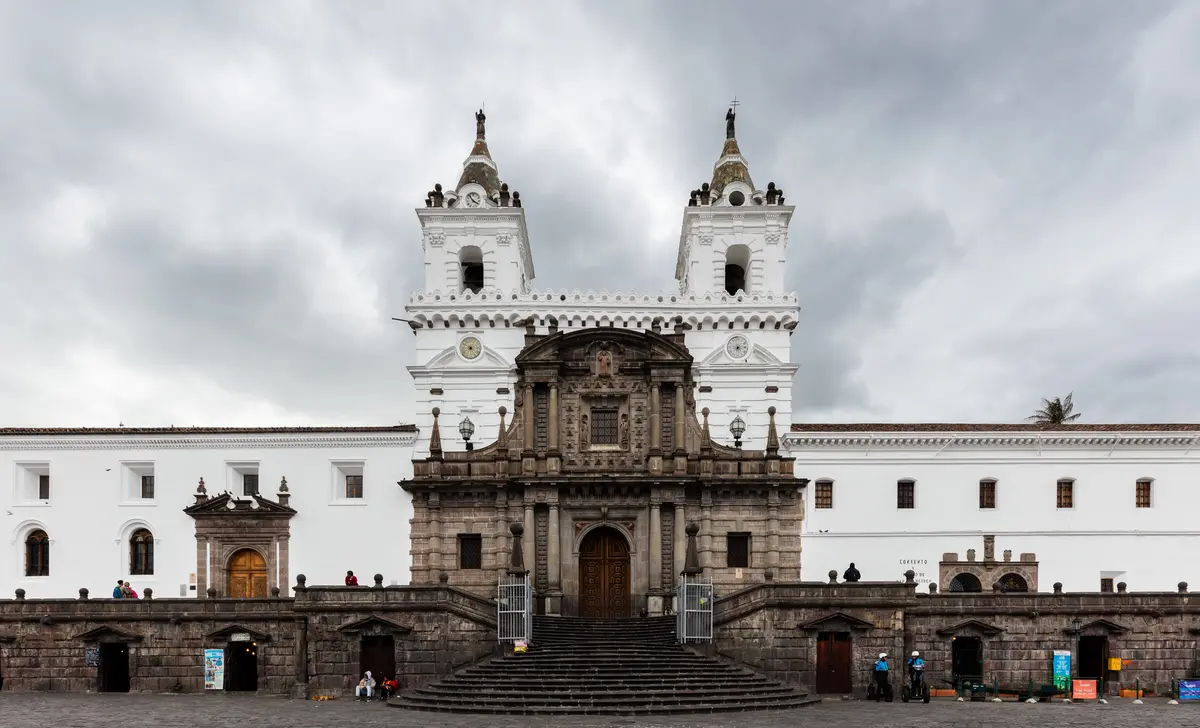
The church and convent of San Francisco occupy the west side of the Plaza de San Francisco in Quito's historic centre, on the corner of Cuenca 477 with Sucre. The plaza and the stepped atrium in front of the façade are public open space, and the atrium is where the legend places the missing stone.
The Capilla de Cantuña stands at the south end of the convent's main façade, a few metres from the church, with its door on the plaza. Its main altarpiece is the work of the Quito master Bernardo de Legarda, of the eighteenth century. The convent's own site gives the chapel's hours as 09:00 to 17:30 from Monday to Saturday and 09:00 to 12:30 on Sunday, and the telephone as (02) 295 2911.
The paying visit is the Museo Franciscano Fray Pedro Gocial, inside the convent. Quito's municipal museum system lists it as open Monday to Sunday from 09:00 to 17:00. Admission for Ecuadorians is 4 US dollars for adults, 2 for students and older visitors, 1 for children; foreign visitors pay 6, and those figures were still published on 22 September 2026. The ticket covers seven exhibition rooms, the choir, the bell towers and the cloisters.
Cantuña's burial slab of 1669 is in the Franciscan cloister. The Instituto Cervantes transcribes its inscription as "Ésta es la sepultura de Francisco Cantuña y sus herederos. Año de 1669".
Quito's historic centre stands at about 2,850 metres above sea level.
Sources consulted
- Juan de Velasco, «Historia del Reino de Quito en la América Meridional. Tomo III: Historia Moderna (§6, pp. 62-64)» — Quito: Imprenta del Gobierno (escrita en 1789; la impresión comenzó en 1841 y los tomos II y III salieron antes), 1789 book
- Susan Verdi Webster, «Quito, ciudad de maestros: arquitectos, edificios y urbanismo en el largo siglo XVII (cap. 3, pp. 59-105)» — Quito: Ediciones Abya-Yala / Universidad Central del Ecuador / Comisión Fulbright, mayo de 2012, ISBN 978-9942-09-070-6, 2012 book
- Susan Verdi Webster, «The Devil and the Dolorosa: History and Legend in Quito's Capilla de Cantuña» — The Americas, vol. 67, n.º 1, pp. 1-30 (consultado el resumen; el texto completo está tras muro de pago), 2010 academic
- Juan de Santa Gertrudis, «Maravillas de la naturaleza» — Bogotá: Biblioteca de la Presidencia de Colombia, n.os 28-29 (escrita h. 1757-1767; citada aquí por la transcripción de Fabara Espín 2023), 1956 book
- Jorge Gonzalo Fabara Espín, «La persistencia mítica de Cantuña: un ensayo interpretativo a través de los estudios del imaginario» — Kipus. Revista Andina de Letras y Estudios Culturales, n.º 54, pp. 79-97, 2023 academic
- Rina Artieda Velástegui, «Cantuña: historia y leyenda, palabra y poder. Versiones de dominación y reivindicación» — Quito: Universidad Andina Simón Bolívar, 110 pp. (leído entero en la copia del PDF del repositorio institucional archivada por la Wayback Machine el 15 de julio de 2024; el repositorio pide hoy una verificación de acceso), 2020 book
- Centro Virtual Cervantes, Instituto Cervantes, «Quito. 15. Capilla de Cantuña» — Ciudades Patrimonio de la Humanidad (transcribe la lápida de 1669), 2026 web
- Museo San Francisco de Quito, «Historia Capilla de Cantuña» — Sitio oficial del convento franciscano de San Francisco de Quito, 2026 web
- Redacción Infobae, «¿Una iglesia construida en un pacto con el diablo?: la leyenda que pervive en Ecuador» — Infobae, 3 de diciembre de 2022 (cita la investigación de Rina Artieda y, a través de ella, al genealogista Fernando Jurado Noboa), 2022 newspaper archive
- Sistema de Museos y Centros Culturales de Quito, «Museo Franciscano Fray Pedro Gocial» — Municipio del Distrito Metropolitano de Quito (horarios y tarifas consultados en agosto de 2026), 2026 web
- Ecuador al Mundo, «Leyenda de Cantuña — Iglesia de San Francisco de Quito (identifica la «piedra faltante» con un desagüe del lado izquierdo de la fachada; consultada el 1 de octubre de 2026)» — ecuadoralmundo.com, 2026 web
Reviewed by V. Serrano on 2026-08-16 · How we verify our content
📎 Source: Enigma Atlas
💬 Field testimonies (0)
No testimonies yet. Add the first.
Add your testimony
🔒 Log in to add a testimony