📜 LEGEND · EXP. Nº0270
ACTIVE
El Pombero
The Pombero is the best known being in Paraguayan folklore — first in belief and first in reported sightings in a 2020 survey of 4,015 people — and the only one of them whose name can be traced to a documented job.
Where does the legend of El Pombero come from?
- Location
- Región guaraní, Asunción, Paraguay
- Kind of legend
- Creature legend
- Coordinates
- -25.264, -57.576
- Last updated
LOCATION
What is the legend of El Pombero?
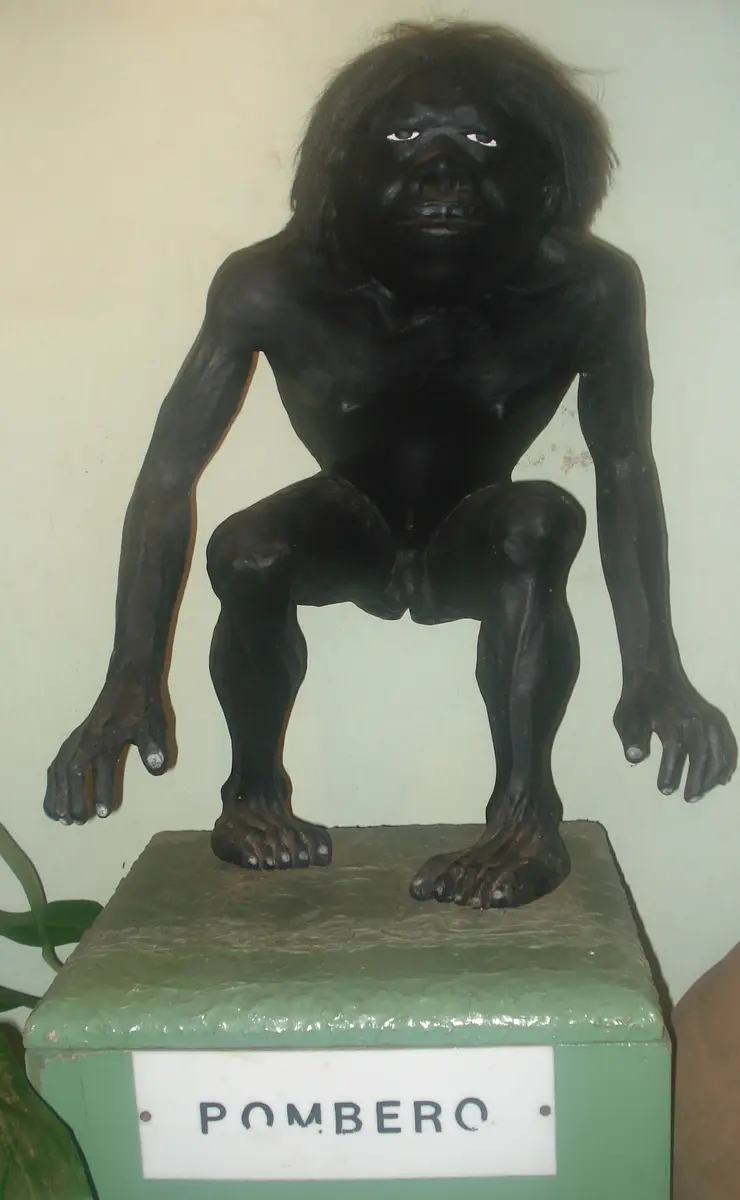
In 1639 the Jesuit Antonio Ruiz de Montoya, writing against the slave raids on the missions, recorded the indigenous agents of the São Paulo slavers, "a quien en lengua Portuguessa llaman Pomberos, y en nuestro Castellano Palomeros": men who moved by night, knew the ground, dealt in hatchets and tobacco and carried off children. He adds that the same traffic employed pomberos in Angola. The being appears in print much later. One of the earliest field descriptions was collected in Corrientes and printed in 1917: a tall, thin man in an enormous straw hat, guardian of the birds at siesta time, who takes away boys who hunt them, whistles like a bird, must be spoken of quietly and is paid in tobacco left outside the door at night. Modern Paraguayan versions keep the hat and make him short, stocky and hairy. He is not an ancient Guaraní god; he is something stranger.
What is the history of El Pombero?
The Pombero has something almost no other being of its kind can offer: the first printed appearance of its name is dated, it can be read in the original, and it does not describe a spirit. It describes men.
In 1639 the Jesuit Antonio Ruiz de Montoya published in Madrid his 'Conquista espiritual hecha por los religiosos de la Compañía de Jesús en las provincias del Paraguay, Paraná, Uruguay y Tape', written to be laid before the Spanish court as a denunciation of the slave raids on the missions. In the section on the reduction of Jesús María he explains how Father Cristóbal de Mendoza came to hear of certain Tupis "que son vanqueros, o caxeros de los vecinos de S. Pablo, a quien en lengua Portuguessa llaman Pomberos, y en nuestro Castellano Palomeros, a la similitud de los palomos diestros en recoger, y hurtar palomas de otros palomares: los naturales los llaman Mu, que quiere decir, los contratantes" (spelling as in the 1639 printing; the widely quoted 1892 reprint has 'banqueros o cajeros' and 'palomas en otros palomares').
They were indigenous agents working for the slavers of São Paulo. Montoya goes on: they divide the country between them, each keeping "su aduar, y mesa de cambio, para comprar Indios, mugeres, y niños", and the coastal towns of Brazil send them hatchets, machetes, knives, tools, old clothes, hats and "mil buxerías, para la compra de almas". Later in the same book the word returns as a simile for theft — "lo que los Pomberos, o palomos ladrones, que trae a su palomar el despojo" — and the index carries the entry "Muerte procuran dar los Indios Pomberos... a un Padre". Montoya also adds a line that almost nobody quotes: "estos Pomberos los ay también en Angola al tragín de negros".
Montoya derived the word from 'pomba', dove — hence his Spanish gloss 'palomeros'. The linguist Germán de Granda, who studied the Spanish of Paraguay, considers that etymology wrong: the older etymon is Mpumbu, a place name of Bantu stock that named three trading districts in what is now Angola, and 'pombeiro' in Brazilian Portuguese means an agent sent to obtain slaves on a merchant's account. Montoya's own aside about Angola, written in 1639 with no etymological intent whatever, sits exactly where Granda's reading puts it.
One of the earliest field descriptions of the being comes from Corrientes. It was communicated to the Argentine naturalist Juan B. Ambrosetti by the national surveyor Juan Queirel, and it was printed in the posthumous volume 'Supersticiones y leyendas' (Buenos Aires, 1917) — part of a folklore series Ambrosetti had begun publishing in 1893 in the 'Revista del Jardín Zoológico de Buenos Aires', out of notebooks he says had been filled some twenty-five years earlier.
"El Pombero o Cuarahú-Yára es un hombre alto y delgado, que lleva un grandísimo sombrero de paja, y una caña en la mano": tall and thin, in an enormous straw hat, with a cane. He walks the woods at siesta time "cuidando de todos los pájaros, pues es su protector", and carries off boys caught hunting them — "de modo que las criaturas, por temor de él, no se alejan de los ranchos y sus padres pueden dormir tranquilamente la siesta". The legend has a job, and the job is childcare. In the Chaco, Ambrosetti adds, he is an invisible companion with whom a pact can be made, who will then keep his friend out of danger, and who may appear as an Indian, a log or a drifting camalote. He whistles like a bird; of him one must speak little and low; and at night one leaves tobacco outside the house.
The modern Paraguayan version, as Dionisio González Torres tells it, keeps the hat and reverses the body: "un hombre, feo, más bien bajo, fornido, retacón, moreno, con manos y pies velludos", ragged, in a straw hat and with a bag over his shoulder. To him are left tobacco, honey and a bottle of caña, and to him are attributed the pregnancies of women who then bear a child in his likeness. Between the two, Eloy Fariña Núñez wrote in 1926 that he is "casi siempre un hombre alto, velludo, cubierto con un gran sombrero de paja", who carries off children who venture into the forest at siesta time. The straw hat is in all three descriptions; the height is reversed only in the 1998 one.
In the same passage Fariña Núñez called him "el más popular de los duendes guaraníes", and in 2020 a survey of 4,015 people put him first among twelve Paraguayan myths.
Timeline: the documented record of El Pombero
- 1629-1632 The bandeirante raids on the Guairá strip the region of its people: some 60,000 taken from the Jesuit reductions and the Spanish encomiendas in four years, on the figure Bartomeu Melià gives and Domingo Aguilera cites. The men who scouted ahead of those raids were the pomberos.
- 1639 Antonio Ruiz de Montoya prints the 'Conquista espiritual' in Madrid. Describing the reduction of Jesús María he records Tupi agents of the citizens of São Paulo "a quien en lengua Portuguessa llaman Pomberos, y en nuestro Castellano Palomeros", adds that the Guaraní themselves called them 'Mu', the traders, and notes that the same traffic employs pomberos in Angola. The word names living men.
- 1889 Daniel Granada publishes the 'Vocabulario rioplatense razonado' in Montevideo. It registers 'bombero' as 'Explorador del campo enemigo. Espía' and notes that the word had earlier meant the Indian scout.
- 1893 Juan B. Ambrosetti begins publishing his 'Materiales para el estudio del folk-lore misionero' in the 'Revista del Jardín Zoológico de Buenos Aires' (vol. I, part V, pp. 129-160), the first instalment of the series in which the Pombero chapter would later appear. His travel notebooks, he writes, had been filled some twenty-five years before the 1917 reprint.
- 1917 'Supersticiones y leyendas' appears posthumously in Buenos Aires — Ambrosetti had died on 28 May of that year — with chapter V of its second part given to "El Pombero o Cuarahú-Yára (Dueño del Sol)". The description, credited to the national surveyor Juan Queirel and to Corrientes, is of a tall, thin man in an enormous straw hat with a cane, protector of the birds at siesta time, an invisible companion in the Chaco with whom pacts are made, paid in tobacco left outside the house at night. Ambrosetti files him among the "fantasmas de la selva misionera" and calls him a modification of the Jasy Jateré.
- 1926 The Paraguayan writer Eloy Fariña Núñez publishes 'Conceptos estéticos (Mitos guaraníes)' in Buenos Aires and calls the Pombero "el más popular de los duendes guaraníes". In the same passage he describes him as almost always a tall, hairy man in a large straw hat who carries off children who venture into the forest at siesta time, and records that in Paraguay the Pombero had also become a word for a spy or lookout.
- 1948 Alfred Métraux publishes 'The Guaraní' in volume 3 of the Handbook of South American Indians. In 28 pages on Guaraní religion, shamanism and mythology the Pombero is not mentioned once, while the belief in "masters or protectors of animals, plants, trees, water places, and winds" is recorded in full. The function is indigenous; the name is not.
- 1961 Paulo de Carvalho Neto publishes 'Folklore del Paraguay. Sistemática analítica', the first study of the subject done to academic standards. It counts 24 mythological figures current in Paraguay, heads the list with the Pombero and gives him pages 91-98, describing "un hombre petiso, lleno de pelos" with invisibility, ubiquity, camouflage, intangibility and levitation — and it complains, repeatedly, of plagiarism and literary invention among the earlier compilers.
- 1998 Francisco Pérez-Maricevich's compilation 'Mitos y leyendas del Paraguay' (Asunción, El Lector) prints Dionisio González Torres's version of "El mito del Pombero o de Karaí-Pyharé": short, stocky, dark, with hairy hands and feet, ragged, in a straw hat and with a bag over the shoulder, paid in tobacco, honey and a bottle of caña, and blamed for pregnancies. The hat is Ambrosetti's; the height is the opposite of Ambrosetti's.
- 14 August - 30 September 2020 The Fundación Tapé Avirú runs the 'Primer sondeo sobre personajes mitológicos del Paraguay' online. 4,015 people from all seventeen departments and Asunción answer four questions about twelve beings. Published by Domingo A. Aguilera Jiménez in 2023: 63.9 per cent believe in one or more, 48.7 per cent claim to have seen or felt one, and the Pombero comes first both in belief and in reported experience.
Is there a rational explanation for El Pombero?
What can be checked against documents is the idea that the Pombero is an ancient Guaraní nature spirit.
Alfred Métraux's synthesis 'The Guaraní', in volume 3 of the Handbook of South American Indians (1948), covers in 28 pages the religion, shamanism and mythology of the Apapocúva, Mbyá, Pañ and Kaingwá, and does not mention the Pombero. In the text extracted on 6 October 2026 from the PDF at etnolinguistica.org, about 12,400 words, 'Pombero' and 'pombeiro' return no occurrences, while 'forest' returns 8 and 'spirit' 5. What Métraux does report, following Nimuendajú, is the complex the Pombero is usually taken for: the Kaingwá "feel themselves surrounded by spirits or demons, who appear in human or animal forms. They are the masters or the protectors of animals, plants, trees, water places, and winds. These genii, if offended, can be harmful." The function, an owner of the wild, is documented in the Guaraní ethnography; the name reaches the written record by another route.
That route is the slave trade, and the 1639 text says so itself: Montoya's Tupi agents of the São Paulo slavers are men "a quien en lengua Portuguessa llaman Pomberos". Germán de Granda, as Domingo Aguilera cites him, gives the Brazilian Portuguese pombeiro the sense of an "agente o emisario encargado de obtener esclavos para el tráfico comercial de los mismos por cuenta de un mercader". River Plate Spanish had a near-homophone with a related sense: Daniel Granada's 'Vocabulario rioplatense razonado' (Montevideo, 1889) defines bombero as "Explorador del campo enemigo. Espía", with the note "Antiguamente llamaban bombero al indio espía ó explorador". And in 1926 Eloy Fariña Núñez wrote that the Pombero "se trasformó, a su vez, en el Paraguay, en espía o 'escucha'", adding that there had been a regiment called Pombero in the war of the Triple Alliance.
The physical description is the least stable part. In Paulo de Carvalho Neto's repertory, as Aguilera quotes it, backward-turned feet belong to another being, the Kurupi: "un duende petiso, feo, bronceado, con ojos negros y melena, pies al revés, desnudo y con un miembro desproporcionado". The straw hat and cane that Ambrosetti's informant gave the Pombero belong in the same repertory to the Jasy Jateré, "un enano rubio, bonito, que anda cubierto con un sombrero de paja, y lleva un bastón mágico de oro en la mano", and Ambrosetti himself filed the Pombero as "una modificación" of the Jasy Jateré. Fariña Núñez identified him with yet another figure, the Cuarahy-Yara, "todo rojo y cubierto con un gigantesco sombrero de paja". Ambrosetti's informant made him tall and thin, Fariña Núñez tall and hairy, and Dionisio González Torres short and stocky.
The chronology that the documents support is short. The word is in print in 1639, for men. The being is in print by 1917, in a description from Corrientes, and in 1926 Fariña Núñez calls him "el más popular de los duendes guaraníes". Aguilera argues the step from one to the other: the raids of the slave hunters, prowling round the mission settlements "sobre todo de noche, con tácticas y códigos de ocultamiento", explain in his view "la transfiguración del cazador de esclavos al mito", and most of their traits, he writes, survive in the habits that Carvalho Neto records for the modern being. The article rests that argument on the resemblance and cites no document recording the change.
The belief is alive. In the online survey run by the Fundación Tapé Avirú between 14 August and 30 September 2020, answered by 4,015 people from all seventeen Paraguayan departments plus Asunción, 63.9 per cent said they believed in one or more of twelve mythological beings and 48.7 per cent said they had seen or felt one. Broken down by figure, the Pombero came first both in the number who believe and in the number who report a first-hand experience.
Can you visit El Pombero?
There is no site to visit, because the story has no setting. The Pombero belongs to the countryside at large: Paraguay, the Argentine provinces of Corrientes, Misiones and Formosa, and the neighbouring parts of Brazil. The pin on our map marks Asunción as a convention, and nothing in the tradition is placed there.
The nearest thing to a physical stop is the Museo Mitológico Ramón Elías, on Ruta PY02 Mcal. Estigarribia in Capiatá, about twenty kilometres east of Asunción on the road to Ciudad del Este, reachable by the frequent buses along that route. It is a private museum founded by the sculptor and collector Ramón Elías; his daughter Elsa Elías runs it today and gives the guided tours herself. The opening hours published by the Asunción daily ABC Color on 2 January 2024 were Tuesday to Saturday 09:00-12:00 and 15:00-17:00, Sundays and public holidays 09:00-12:00, with a booking telephone of 0983 152428 and the museum at kilometre 19. The Asunción daily Crónica, on 27 July 2026, put the museum at kilometre 21. It opened Monday to Saturday on those same two shifts and Sundays and holidays 09:00-12:00, at 15,000 guaraníes for an adult and 10,000 for a child.
The mythology room is built around Narciso R. Colmán's canon of the seven children of Tau and Kerana. The thirteen figures ABC Color names —Teju Jagua, Mbói Tu'ĩ, Moñái, Jasy Jateré, Kurupi, Ao Ao, Luisõ, Kuarahy Ra'y, Pajé, Malavisión, Mbói Jagua, Yagua Ru and Plata Yvyguy— leave the Pombero out.
The documents are free and immediate. Montoya's 'Conquista espiritual' of 1639 is online as a complete scan of the Madrid edition at the Biblioteca Digital Curt Nimuendajú; Ambrosetti's 'Supersticiones y leyendas' is a free PDF on Wikimedia Commons, with the Pombero in chapter V of its second part; Métraux's 1948 Guaraní chapter is on the Nimuendajú library too; and Domingo Aguilera's 2023 article, with the full survey results, is open access at SciELO Argentina. Paulo de Carvalho Neto's 'Folklore del Paraguay' of 1961, which remains the systematic study of these figures, is out of print, and no copy has been consulted for this file.
In rural Paraguay and Corrientes the Pombero is taken seriously. The tradition warns against whistling at night and against speaking of him loudly, and tobacco left on a fence post is the customary politeness.
Sources consulted
- Antonio Ruiz de Montoya, S. I., «Conquista espiritual hecha por los religiosos de la Compañía de Iesus, en las prouincias del Paraguay, Parana, Vruguay, y Tape» — Madrid: Imprenta del Reyno — scan of the 1639 first edition (Biblioteca Brasiliana Guita e José Mindlin), read as full text; the pombero passages are in the section on the reduction of Jesús María, in a later simile, and in the index entry 'Pomberos', 1639 book
- Juan B. Ambrosetti, «Supersticiones y leyendas: región misionera, valles calchaquíes, las Pampas» — Buenos Aires: La Cultura Argentina (posthumous, introduction by Salvador Debenedetti). Part II, chapter V, 'El Pombero o Cuarahú-Yára (Dueño del Sol)', pp. 97-98. Material communicated by the national surveyor Juan Queirel; the series had begun in the Revista del Jardín Zoológico de Buenos Aires in 1893, 1917 book
- Alfred Métraux, «The Guaraní» — Handbook of South American Indians, vol. 3: The Tropical Forest Tribes (Julian H. Steward, ed.), Bureau of American Ethnology Bulletin 143, Washington, pp. 69-94, 1948 academic
- Domingo A. Aguilera Jiménez, «Personajes mitológicos conocidos en Paraguay. Un estado de la cuestión a partir de un sondeo en línea» — Revista del Museo de Antropología (IDACOR-CONICET / Universidad Nacional de Córdoba), vol. 16, no. 1, pp. 155-168. Our source for the 2020 survey figures and for the citations of Paulo de Carvalho Neto (1961), Germán de Granda (1988) and Bartomeu Melià (1988), none of which we have been able to consult directly, 2023 academic
- Daniel Granada, «Vocabulario rioplatense razonado» — Montevideo — entries 'Bombear' and 'Bombero'; no entry for 'Pombero'. Read as full text (about 107,000 words) in the copy digitised by Anaforas, Universidad de la República, 1889 book
- Dionisio M. González Torres, «El mito del Pombero o de Karaí-Pyharé» — In Francisco Pérez-Maricevich (comp.), Mitos y leyendas del Paraguay, Asunción: El Lector, 187 pp. Read in the transcription published by Portal Guaraní; the printed volume was not consulted, 1998 book
- Lucía González, «Turismo interno: Museo Mitológico de Capiatá, excelente opción para vacaciones» — ABC Color, Asunción, 2 January 2024 — address, opening hours, telephone, rooms and the list of thirteen named mythological figures on display, 2024 newspaper archive
- Eloy Fariña Núñez, «Conceptos estéticos. Mitos guaraníes» — Buenos Aires: Talleres gráficos M. Pastor — the Pombero passage ('el más popular de los duendes guaraníes', 'casi siempre un hombre alto, velludo, cubierto con un gran sombrero de paja', his later sense of 'espía o escucha' in Paraguay and the 'regimiento Pombero' of the war of the Triple Alliance); University of North Carolina copy, read as full text, 1926 book
Reviewed by V. Serrano on 2026-08-16 · How we verify our content
📎 Source: Enigma Atlas
💬 Field testimonies (0)
No testimonies yet. Add the first.
Add your testimony
🔒 Log in to add a testimony