📜 LEGEND · EXP. Nº0270
ACTIVE
El Sombrerón
El Sombrerón is one of Guatemala's best known legends, although the figure is not exclusive to the country: anthropologists have recorded a very different Sombrerón in the Altos de Chiapas, in Mexico, where he is the owner and protector of the wild uplands and the keeper of the cave that opens onto the other world.
Where does the legend of El Sombrerón come from?
- Location
- Ciudad de Guatemala, Guatemala
- Kind of legend
- Folk tale
- Coordinates
- 14.641, -90.513
- Last updated
LOCATION
What is the legend of El Sombrerón?
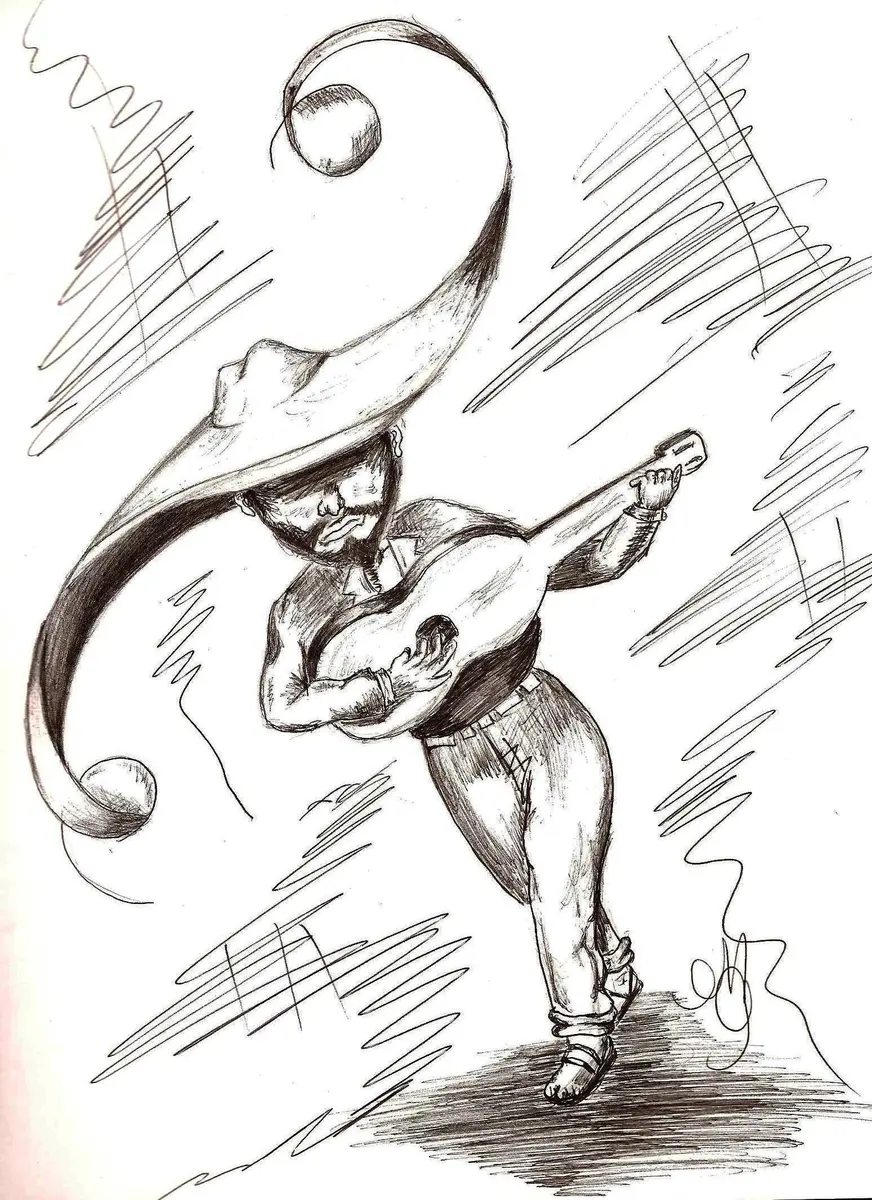
In the Guatemalan version associated with the folklorist Celso Lara Figueroa, at eight in the evening a mule train is heard and a tiny charcoal seller appears, with a gleaming belt, patent-leather ankle boots with silver spurs, a guitar over his shoulder and a vast wide-brimmed hat that hides most of his face. He pursues women with long hair and large eyes, sings and dances for them, tangles their hair and throws earth into their plates so that they waste away, unable to eat or sleep; he also ties tiny knots in the tails and manes of horses. In that account the young woman is called Nina Candiales; her mother shuts her in the convent of Santa Catarina, and there she dies. The Leyenda del Sombrerón that Miguel Ángel Asturias published in 1930 is an entirely different story: a monk, a rubber ball and a black hat over a child's head.
What is the history of El Sombrerón?
El Sombrerón is always introduced the same way: a short Guatemalan goblin dressed in black who falls for girls with long braids, sings beneath their windows, plaits their hair and knots the manes of horses. Most of that can be found in print. What cannot be found is that it is a single legend, that it is only Guatemalan, or that the country's most famous writer told the version everyone repeats.
The literary Sombrerón: Asturias, 1930. Miguel Ángel Asturias published his first book, Leyendas de Guatemala, in Madrid with Editorial Oriente in 1930, during his Paris years. The following year Francis de Miomandre translated it into French and published it in Marseille at the press of the Cahiers du Sud, prefaced by an enthusiastic letter from Paul Valéry which afterwards appeared in every Spanish edition; the translation won the 1931 Sylla-Monsegur prize for the best book translated in France that year. The nuance matters: Valéry did not preface the Spanish book of 1930, but the French version, and his text reached Spanish readers by the back door. Two further pieces, «Los brujos de la tormenta primaveral» and «Cuculcán», were added in the Buenos Aires edition of 1948. That book, not a folklorist's fieldwork, is how these Guatemalan legends entered European literature.
And the «Leyenda del Sombrerón» it contains is not the tale of the amorous goblin. Selena Millares summarises it: a monk of unimpeachable purity finds a small rubber ball — an echo of the sacred Maya ball game — is flooded with delight and seduced by its bare roundness, a stand-in for Eve's apple, until the ball turns diabolical in his eyes; a child claims it, and the monk hands it back in a liberating impulse, «¡Lejos de mí, Satán!» — get thee behind me, Satan. Outside the convent, Millares quotes, the ball «opened as if by enchantment into the shape of a black hat over the head of the boy running after it. It was the devil's hat. And so the Sombrerón is born into the world.» No braids, no serenades, no girls: a religious, a rubber ball and a hat.
There is more. The opening sketch «Guatemala» lists the phantoms of the sleeping city, and hands out the roles the opposite way round from how we hand them out today. Giuseppe Bellini reproduces the passage in full: «La Tatuana prowls around Casa-Mata. El Sombrerón runs the length of the arcades from one end to the other; the rubber Satan leaps and rolls. And out over the meadows comes el Cadejo, who steals girls with long braids and ties knots in the manes of horses.» The two traits that define today's Sombrerón — the braids and the knotted manes — belong in Asturias to el Cadejo; and the «Leyenda del Cadejo» in the same book turns on a novice who escapes the poppy-man by cutting off her braid. It was posterity, not the writer, that fused the two figures.
The popular Sombrerón: the charcoal man and his mules. The Guatemalan version now in circulation is a different story, and it carries a name: that of the folklorist Celso Lara Figueroa, who led the study of the capital's oral tradition and whose narrative Prensa Libre reprinted in October 2025. In it, at eight in the evening you hear the slow tread of a mule train and a tiny charcoal seller appears, seemingly up from the interior: a gleaming belt, patent-leather ankle boots with silver spurs that shine in the dark, a guitar over his shoulder and a vast wide-brimmed hat that hides him almost completely. As he passes, the barking of dogs turns to weeping. From the corner of the Callejón del Brillante he heads for the Candelaria neighbourhood, crosses the Calle de la Amargura and stops before an old dovecote, where he sings all night beneath a door.
The serenades are for Nina Candiales, a young woman with grey-green eyes and long honey-coloured hair, daughter of doña Rosario Candiales, who wanted her married into a good family. A neighbour watches from her window until she sees him go into the house. The girl wastes away, her mother shuts her in the convent of Santa Catarina, and he follows her there; she goes on hearing the click of his heels and the voice. She dies during the feast of Saint Cecilia. She is waked at home, and at eight in the evening the suitor's mournful singing is heard. Next day a rosary of tears appears along the streets of the neighbourhood, running down into the ravines of the city; ever since, four mules loaded with nets of charcoal reach the cemetery each night, and at dawn a wild rose covered in dew lies on the grave. The same report gives the generic portrait — he pursues women with long hair and large eyes, tangles their hair, dances and sings to them with his small box guitar, and throws earth into their plates so that they waste away, unable to eat or sleep — and adds a detail rarely told: he likes to tie tiny knots in the tails and manes of horses.
How historians read it. In that same piece two Guatemalan historians offer a social reading. Aníbal Chajón argues that «El Sombrerón is an interesting character because he represents and counsels obedience to the norms of Catholic morality, which have held sway for centuries»: he appears to women who comb their hair at the window, which in his day counted as immodesty; his invisible face links him to the devil, and the vihuela — the guitar's predecessor, played above all by mestizos and mulattoes — links him to sin, just as the charcoal mules allude to the colonial mulatto and mestizo population. Fernando Urquizú puts it as an explicit moral lesson: keeping creole ladies from taking an interest in «just any gentleman», at a time when Spaniards from the peninsula sought marriages in Guatemala that would give them the standing they lacked at home. Both place the story in a rigid Catholic morality that ran on into the mid-twentieth century.
Not only Guatemalan. The anthropologist María-Cruz La Chica published in 2020, in the Boletín de Literatura Oral, three narratives and two interviews recorded in 2019 among Tsotsil, Tzeltal and Spanish speakers of the Altos de Chiapas, in Mexico. There the Sombrerón is an ambivalent and rather different being: owner and protector of the wild uplands, guardian of the seeds, keeper of the cave that opens onto the other world, and at the same time the one who offers money or wealth in exchange for people who go on to labour as slaves in the beyond. Every narrator agrees about the enormous hat; about the rest they do not. Yet one "Guatemalan" trait survives intact: Carmen Rodríguez Hernández, of San Cristóbal de las Casas, said he went about with the white horses and «made braids for the animals», so that next morning they woke «with the horse's hair tangled, knotted». La Chica also points to earlier studies showing the Sombrerón in mestizo and indigenous traditions across Mesoamerica beyond the Maya world; in her earlier work on the Tojolabal he appears as an image of the Other and as the underworld's presence inside the human world.
And before the twentieth century? We could not document it. Antonio Batres Jáuregui published Vicios del lenguaje y provincialismos de Guatemala in 1892, a philological study of several hundred pages devoted precisely to local speech, and it has no entry for the Sombrerón. What that silence does not prove has to be said at once: the same book has no entry for the Cadejo, the Siguanaba or the Sisimite either, because it is a lexicon, not a repertory of folklore. It serves as a reminder that the figure's antiquity is asserted far more often than it is documented: the earliest printed text we were able to read is Asturias's, from 1930, and it tells a different story. The popular version reached a mass audience through two twentieth-century popularisers — Celso Lara Figueroa and the chronicler Héctor Gaitán — and it keeps being remade: in May 2024 it was announced that Jayro Bustamante would film El Sombrerón, a dystopian thriller starring Adria Arjona and Edgar Ramírez, with the character turned into a stranger who promises to smuggle a woman across to "paradise".
Timeline: the documented record of El Sombrerón
- 1892 — a silence Antonio Batres Jáuregui publishes Vicios del lenguaje y provincialismos de Guatemala, a philological survey of local speech, with no entry for the Sombrerón. It has none for the Cadejo, the Siguanaba or the Sisimite either: it is a lexicon, not a folklore repertory.
- 1930 — the book Miguel Ángel Asturias publishes Leyendas de Guatemala in Madrid, with Editorial Oriente. Its Leyenda del Sombrerón tells of a monk, a rubber ball and a child, not of a goblin who courts girls with braids.
- 1930 — the braids belong to the Cadejo In the opening sketch Guatemala, Asturias writes that it is el Cadejo who "steals girls with long braids and ties knots in the manes of horses", while El Sombrerón merely runs the arcades as a rolling rubber Satan.
- 1931 — Valéry and the prize Francis de Miomandre's French translation appears in Marseille (Cahiers du Sud), prefaced by a letter from Paul Valéry that later accompanied every Spanish edition, and wins the Sylla-Monsegur prize for the best book translated in France that year.
- 1948 The Buenos Aires edition adds two texts absent from the original book and from the French translation: Los brujos de la tormenta primaveral and Cuculcán.
- May 2013 — the knotted mane explained A Tojolabal field-diary entry recorded by María-Cruz La Chica: when a horse wakes with its mane so tangled that it must be cut, an informant explains, it is because the Sombrerón spent the night tying knots in it.
- April 2019 — Chiapas Fieldwork in the Altos de Chiapas. Carmen Rodríguez Hernández, of San Cristóbal de las Casas, describes a Sombrerón who rides white horses and "made braids for the animals"; Pedro Gómez Díaz, interviewed on 23 April, describes instead an owner of the mountain who trades wealth for people.
- 2020 La Chica publishes the Chiapas material in the Boletín de Literatura Oral, concluding that all her narrators agree only on the enormous hat, and that the figure ranges far beyond Guatemala.
- May 2024 Jayro Bustamante announces El Sombrerón, a dystopian thriller starring Adria Arjona and Edgar Ramírez, in which the character becomes a stranger who promises to smuggle a woman into "paradise".
- 12 October 2024 At the Night of Legends in the Palacio Nacional de la Cultura, Victoria de Jesús Ochoa tells Prensa Libre that her husband, in San Pedro Ayampuc, heard "the little guitar", followed the sound and lost his way. She did not see anything herself.
- 27 October 2025 Prensa Libre prints the version associated with the folklorist Celso Lara Figueroa — the charcoal seller, the mule train and Nina Candiales — alongside the readings of the historians Aníbal Chajón and Fernando Urquizú.
Is there a rational explanation for El Sombrerón?
There is nothing here to refute in the usual sense: nobody claims a goblin in a giant hat walks the neighbourhoods of Guatemala City. What is worth taking apart is the idea that what is told today is an ancient tradition handed down intact.
The first thing that fails is the unity of the character. The three versions we were able to read do not tell the same story or describe the same being. In Asturias (1930) he is a rubber ball that opens into a hat above a child's head, and the braids and manes belong to the Cadejo. In the narrative popularised by Celso Lara Figueroa he is a charcoal seller with a mule train who courts Nina Candiales until grief kills her. In the Altos de Chiapas he is the owner of the wild uplands and of the cave, who buys people in exchange for wealth. Presenting all of that as "the Guatemalan legend of El Sombrerón" is a recent editorial simplification.
The functional explanation is better documented than the creature. The historians Aníbal Chajón and Fernando Urquizú, quoted by Prensa Libre, agree that the story works as social control: he appears to young women who comb their hair at the window — behaviour then considered immodest — and serves to discourage creole ladies from noticing "just any gentleman". Chajón also reads the vihuela and the charcoal mules as markers of class and caste: the instrument and the trade of mestizos and mulattoes. On that reading, the Sombrerón does not explain a night-time phenomenon; he explains whom a girl was not supposed to marry.
The knotted manes need no supernatural cause. The sign that betrays his passage, in Guatemala and in Chiapas alike, is always the same: manes and tails found tangled in the morning. It is an ordinary event in any stable, and the legend supplies its retrospective cause. La Chica's own fieldwork shows the mechanism undisguised: a Tojolabal field-diary entry of May 2013 records an informant explaining that when a horse wakes with its mane so tangled that it has to be cut, it is because the Sombrerón spent the night tying knots in it. The same logic covers a sleeping person's long hair.
The testimony that exists is attributed and late. The most concrete account we read was gathered by Prensa Libre on 12 October 2024, at the Night of Legends in the Palacio Nacional de la Cultura: Victoria de Jesús Ochoa said that her husband, in San Pedro Ayampuc, heard "the little guitar" while walking with their children to fetch her from the river where she was washing, followed the sound and lost his way. She did not see anything herself; she tells it as a memory of her youth, decades later, at a legend show. It is precisely the kind of account a living tradition needs, and precisely the kind that allows nothing to be checked.
And the legend is still being manufactured. The Palacio Nacional stages its night of legends every autumn; the character has been used as a national costume at an international beauty pageant; and in May 2024 it was announced that Jayro Bustamante would turn him into a dystopian thriller with international stars. Each of those steps adds traits and erases others, exactly as Asturias did in 1930 with what he had been told.
A warning about what we do not assert. A version circulates everywhere in which the bewitched girl is called Susana, lives in the La Recolección neighbourhood, and is freed by cutting off her hair and hiding it. We found no checkable source for it; the version that does have identifiable authorship — Lara Figueroa's — names Nina Candiales and sets the story between the Callejón del Brillante, La Candelaria and the convent of Santa Catarina. The Susana version may well exist in oral tradition; we simply could not document it, and so we do not treat it as established.
Can you visit El Sombrerón?
There is no house, cave or monument of El Sombrerón. His is an urban legend in the literal sense: he lives in the old neighbourhoods of Guatemala City and in the voice of whoever is telling the story. Even so, there is one concrete place where he is staged and where the visit is worth making.
Palacio Nacional de la Cultura. The building stands at 6.ª calle and 6.ª avenida, zona 1, in the historic centre of Guatemala City. According to the Ministry of Culture and Sports it opens Monday to Friday, 9:00 to 16:00, with Saturday and Sunday tours temporarily suspended; admission is free for Guatemalans (on showing proof of nationality) and Q40 for foreign visitors. It includes the permanent exhibition, printed information and guided tours in Spanish — none are advertised in English — subject to the state ceremonies still held in the building. Telephone (502) 2237-1100; [email protected]. Phone ahead: weekend hours have been suspended, and the Ministry itself acknowledges ongoing conservation problems with the fabric.
The Night of Legends. This is when the Sombrerón is officially performed. It is held in the Palacio itself, as part of the Festival del Centro Histórico, in autumn. At the edition of 12 October 2024, visitors went through four floors of the building in groups of fifty to hear, among others, the legends of the Sombrerón, the Siguanaba and the Vanushka. For the edition of 5 November 2025 the Ministry offered 1,500 free tickets, handed out that same day from 10:00 at the door of the Palacio, up to three per person on presentation of the Guatemalan identity document (DPI), while stocks lasted. Dates, capacity and the ticketing method change every year: check the Ministry's own listings before counting on any of it.
The settings of the story. Celso Lara Figueroa's version runs through the Callejón del Brillante, the Candelaria neighbourhood, the Calle de la Amargura and the convent of Santa Catarina, all within the old grid of zona 1, a short walk from the Palacio. It is a walk through a historic street plan, not a waymarked route: there are no plaques, no interpretation centre, nothing to tell a visitor where the dovecote stood. And an honest practical warning: zona 1 is a busy working district by day, but it empties after dark and walking it at night is not advisable; for the Night of Legends, arrive and leave by taxi or arranged transport.
Antigua Guatemala. The figure is also placed in the old colonial capital, a good hour away by road. A note on method: we could not verify opening hours or ticket prices for the ruins of La Recolección or the other convent complexes, because the official pages did not respond to us. The competent body is the Consejo Nacional para la Protección de La Antigua Guatemala (CNPAG), telephone (502) 7873-4646; ask them before planning a visit, and treat the hours circulating on tourist aggregators with suspicion.
And if you would rather check this file than trust it, everything we used is free to read: María-Cruz La Chica's article on the Sombrerón in Chiapas is open access in the Boletín de Literatura Oral; Giuseppe Bellini's and Selena Millares's studies of the Leyendas de Guatemala are complete on the Biblioteca Virtual Miguel de Cervantes; and Batres Jáuregui's 1892 dictionary of Guatemalan provincialisms, with its telling silence, is digitised on the Internet Archive.
Sources consulted
- María Alejandra Guzmán, ««El Sombrerón»: la leyenda del hombre que no olvida a las mujeres que ha amado — the version attributed to the folklorist Celso Lara Figueroa (Nina Candiales, the mule train, the Callejón del Brillante) and the readings of the historians Aníbal Chajón and Fernando Urquizú» — Prensa Libre, Guatemala, 2025 newspaper archive
- María-Cruz La Chica, «El Sombrerón en la tradición oral de Chiapas, Boletín de Literatura Oral, nº 10 (2020), pp. 27-45 — three unpublished narratives and two interviews recorded in 2019 among Tsotsil, Tzeltal and Spanish speakers» — Boletín de Literatura Oral, Universidad de Jaén; DOI 10.17561/blo.v10.5465, 2020 academic
- Giuseppe Bellini, «Mundo mágico y mundo real: la narrativa de Miguel Ángel Asturias — the 1930 Editorial Oriente edition, Miomandre's translation, Valéry's letter-prologue, the 1948 additions, and the full text of the opening sketch «Guatemala»» — Roma, Bulzoni, 1999; digital edition, Biblioteca Virtual Miguel de Cervantes, 1999 book
- Selena Millares, «En el agua de los sueños: las leyendas de Miguel Ángel Asturias — summary and quotation of the «Leyenda del Sombrerón»: the monk, the rubber ball and the black hat over the child's head» — In Miguel Ángel Asturias: aspectos y problemas de la narrativa hispanoamericana del siglo XX, Roma, Bulzoni, 1997, pp. 257-265; digital edition, Biblioteca Virtual Miguel de Cervantes, 1997 academic
- Antonio Batres Jáuregui, «Vicios del lenguaje y provincialismos de Guatemala: estudio filológico — no entry for the Sombrerón (nor for the Cadejo, the Siguanaba or the Sisimite)» — Guatemala, Encuadernación y Tipografía Nacional; digitised on the Internet Archive, 1892 book
- César Pérez Marroquín, ««Oyeron la guitarrita»: asistente a la Noche de las Leyendas dice que su esposo se encontró con El Sombrerón — the 12 October 2024 event and Victoria de Jesús Ochoa's account» — Prensa Libre, Guatemala, 2024 newspaper archive
- Prensa Libre, «Noches de leyendas: el Palacio Nacional de la Cultura revive la tradición oral guatemalteca — 1,500 free tickets, handed out at the door with DPI, for the 5 November 2025 edition» — Prensa Libre, Guatemala, 2025 newspaper archive
- Ministerio de Cultura y Deportes de Guatemala, «Palacio Nacional de la Cultura — official visitor information: address, opening hours, tariffs (Q0 nationals / Q40 foreign visitors), guided tours in Spanish and contact details» — mcd.gob.gt, 2026 report
- Prensa Libre, «Adria Arjona y Edgar Ramírez coprotagonizan El Sombrerón, thriller distópico de Jayro Bustamante — announcement of 18 May 2024» — Prensa Libre, Guatemala, 2024 newspaper archive
- Prensa Libre, «Leyendas cortas de Guatemala: 5 relatos que combinan terror, tradición e historia — on Celso Lara and Héctor Gaitán as the two twentieth-century popularisers of Guatemalan oral tradition» — Prensa Libre, Guatemala, 2025 newspaper archive
Reviewed by V. Serrano on 2026-08-01 · How we verify our content
📎 Source: Enigma Atlas
💬 Field testimonies (0)
No testimonies yet. Add the first.
Add your testimony
🔒 Log in to add a testimony