📜 LEGEND · EXP. Nº3657
ACTIVE
El Tío of the Potosí Mines
El Tío of the Potosí Mines is a legend from Potosí (Cerro Rico), BO — a folk story passed down over generations. This file collects its origins, its meaning and how it has been retold.
Where does the legend of El Tío of the Potosí Mines come from?
- Location
- Potosí (Cerro Rico), BO
- Kind of legend
- Folk tale
- Coordinates
- -19.614, -65.752
- Testimonies
- 0
- Last updated
LOCATION
What is the legend of El Tío of the Potosí Mines?
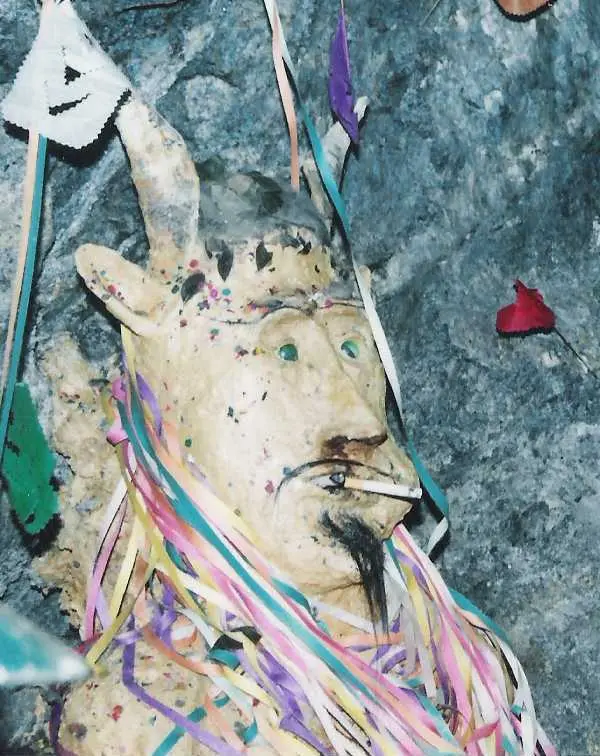
At Cerro Rico in Potosí, the silver mountain that sustained the Spanish colonial empire for centuries, Bolivian miners still venerate El Tío, a horned figure with glass eyes and an exaggerated phallus who presides over every mine shaft from plaster or clay statuettes placed in the underground galleries. According to mining tradition, passed down since colonial times, El Tío is the absolute lord of the mountain's interior, and no miner enters to work without first offering him coca leaves, pure alcohol, cigarettes, and the smoke of the ritual 'ch'alla' ceremony, to secure his protection and avoid accidents or cave-ins. The name 'Tío' is said to have emerged from a mispronunciation of the Spanish word 'Dios' (God) by Quechua and Aymara-speaking workers, and the figure is thought to fuse an Andean underworld deity with Christian depictions of the devil imposed by colonizers as a warning against mine labor. Miners maintain that ignoring El Tío brings bad luck, strange noises, or presences in the tunnels, while honoring him every Friday guarantees rich veins and safe shifts. The custom, documented by anthropologists since the mid-twentieth century, remains very much alive in Potosí today and forms part of Bolivia's officially recognized intangible cultural heritage, still practiced daily by working miners.
What is the history of El Tío of the Potosí Mines?
On 1 April 1545 Diego de Centeno, Juan de Villarroel and two other captains took possession of the Cerro Rico "in the name of the Father, the Son, the Holy Spirit and the most august Emperor of Germany, of Spain and of the Kingdoms of Peru, Don Carlos V". According to today's miners, those men brought something else: the devil.
In 1573 Viceroy Francisco de Toledo institutionalised forced labour as the mita: every year the caciques had to send Potosí a share of their tributaries, from Cuzco to Tarija. Carmen Salazar-Soler has followed those accounts: around 9,000 mitayos in the first year, more than 14,000 by 1578, still some 12,500 on paper around 1650. Those were rotating shifts, not a death toll. The silver came out, was struck into coin at the Potosí mint, and financed an empire.
El Tío is not in a display case. He is inside, down the galleries. Each crew models its own from mineral-bearing clay dug out of the mine, and a larger one presides over the main tunnel. He has horns, a tail, glass eyes and a huge erect phallus; a toad sits on his head and a snake runs down his body. In Potosí he is naked — in La Paz and Oruro he wears a red cape — except sometimes for a pair of boots put on back to front. Once finished he must be baptised: Jorge Tío, Lucas, or whatever name arrives in a dream. Don Severo, a retired cooperative member, told the anthropologist Pascale Absi how his came to be Juan Carlos: "the name just came to me, out of nowhere".
He is given coca, cigarettes — the ash piles up on his chest — and 96-proof cane alcohol, held to be "cool" and so better than singani, which costs more but is "hot". At Carnival they wrap paper streamers round his neck, as they do round each other. His big day is Friday, sometimes Tuesday: the ch'alla.
And the moral geography is strict. Above ground, God, the Virgin and the Pachamama are in charge. Past the mine mouth nobody crosses themselves or says the name of Jesus Christ, on pain of frightening off El Tío and the vein with him; candles offered to him are set upside down, and no priest may say mass inside. Absi warns that El Tío is not simply an Andean god turned satanic, but "a mosaic made of disjointed and sometimes antagonistic pieces": he borrows from the Renaissance devil the evangelisers imported as a scare, but also from European guild patron saints — seventeenth-century Lima invoked "the devil of Potosí" — and his iconography echoes Saint Michael. By proclaiming the devil their patron, she writes, the miners give the fallen angel a positive identity back.
Timeline: the documented record of El Tío of the Potosí Mines
- 1 April 1545 Diego de Centeno, Juan de Villarroel, Francisco de Centeno and Luis Santandía de Cotamito take possession of the Cerro Rico in the name of the Trinity and of Charles V. Two of the mountain's largest veins would later carry their names. In the miners' own account of their history, the devil arrived with those captains.
- 1573 Viceroy Francisco de Toledo institutes the mita for the working of the Cerro Rico: caciques must send a fixed share of their tributaries to Potosí every year. Roughly 9,000 mitayos are assigned in the first year.
- 1578 The mita gruesa exceeds 14,000 mitayos as the draft spreads to more and more communities between Cuzco and Tarija. By around 1650 the figure on paper is still about 12,500 — annual rotating shifts, not a count of the dead.
- 1987 UNESCO inscribes Potosí and its Cerro Rico on the World Heritage List.
- 2005 Pascale Absi publishes Los ministros del diablo in La Paz, the Spanish edition of her fieldwork in the Potosí cooperatives during the mid-1990s: how the tíos are modelled and named, what is offered to them, and how ritual roles map onto who holds power inside a cooperative.
- 2014 The City of Potosí enters UNESCO's List of World Heritage in Danger over the deterioration and risk of collapse of the Cerro Rico's summit. It is still on that list.
- 16 February 2022 A joint inspection by Bolivia's Ombudsman's Office, the departmental Labour Bureau and the Children's Ombudsman finds 23 minors — 21 boys and 2 girls, aged 13 to 17 — working in mining areas of the Cerro Rico, some of them going underground.
- August 2025 COMIBOL's Potosí regional office, the federation of mining cooperatives and the cooperative presidents agree emergency measures on the summit: heavy machinery restricted above the 4,400 m level, a 200-metre exclusion zone from that level to the top, no night or weekend mining, and an increase of about 1,500 truckloads a day of dry fill to stabilise the subsidences.
- 2026 Police figures cited by Fundación Jubileo record 86 workers killed underground in Potosí in the first seven months of the year — 76 men and 10 women, among them eight or nine adolescents — after 425 deaths between 2022 and 2025. Around 30,000 people work the mountain in three shifts, and fourteen cooperatives are still operating above the banned 4,400 m level.
Is there a rational explanation for El Tío of the Potosí Mines?
The useful question is not whether El Tío exists but what the cult does. What Absi documented after years of fieldwork in the cooperatives is that it is not folklore: it is part of the relations of production. Ritual roles distribute entitlements — access to a working face, control of output and of labour — and the man who can afford to sacrifice a llama every year is the man who ends up elected delegate. Risk gets translated into manageable terms too: August and Carnival are saqra killa, months when accidents spike and the mountain claims what it is owed. For someone going back down tomorrow, a cave-in that is an unpaid debt rather than blind chance is an enormous difference.
Michael Taussig read such pacts as a proletarian reaction to wage labour; Absi qualifies that: the individual pact is also an old Andean peasant formula, and only it — not the ordinary ch'alla — is judged immoral. The theology follows the economy as well: as the tin industry collapsed, miners began saying El Tío has grown old. "He's gone deaf from all the dynamite we set off," as don Julio put it.
Miners put the colonial death toll at eight million mitayos, and say it is their blood that gives the mountain its red colour. Absi records this as a belief, not a census, and none of the sources read for this file documents that total: what is documented is the annual quota. The present shows why round numbers deserve suspicion. For 2025, Erbol counted 102 deaths in cooperative workings, while the police report cited by Fundación Jubileo gave 123. Two serious sources, twenty-one deaths apart. Four centuries back there is no possible census. Not knowing how many died makes the harm no smaller: it makes rounding an invention.
Can you visit El Tío of the Potosí Mines?
The figures of El Tío stand inside the working galleries of the Cerro Rico, which the mining cooperatives of Potosí hold and work. Potosí lies at 4,067 metres and the adits are higher still. On 11 July 2025 COMIBOL, the state mining corporation, reported 144 recorded subsidences on the mountain, 55 of them already packed with roughly half a million tonnes of dry metallurgical waste; everything above the 4,400-metre line is what COMIBOL calls a zona prohibida.
Potosí has been on the UNESCO World Heritage List since 1987 as site 420. The Committee meeting in Doha added it to the List of World Heritage in Danger on 17 June 2014 "because of continued and uncontrolled mining operations in the Cerro Rico Mountain that risk degrading the site".
In the city below, the Casa Nacional de Moneda occupies the mint where the mountain's silver was struck into coin. The municipal tourism office of Potosí gives its address as calle Ayacucho between Quijarro and Bustillos, its telephone as 2 622 2777, and admission as a guided tour. The opening hours and the ticket price on that page did not match the ones the Potosí press was publishing when this entry was checked on 9 September 2026, so neither figure is reproduced here.
The galleries are a workplace. The Defensoría del Pueblo verified in 2022 that adolescents were working in the mining areas of the Cerro Rico, and for 2025 Erbol counted 102 deaths in the cooperative workings against the 123 of the police figure cited by Fundación Jubileo.
Sources consulted
- Pascale Absi, «Los ministros del diablo. El trabajo y sus representaciones en las minas de Potosí» — IRD / IFEA / Fundación PIEB, La Paz (Travaux de l'Institut Français d'Études Andines, 152), 2005 book
- Carmen Salazar-Soler, «Los capitanes de mita y el conteo de indios en las minas del Cerro Rico de Potosí durante el siglo XVI» — Pontificia Universidad Católica del Perú, Fondo Editorial, 2013 academic
- Defensoría del Pueblo del Estado Plurinacional de Bolivia, «Verificación defensorial evidencia trabajo de adolescentes en áreas mineras del Cerro Rico de Potosí» — Defensoría del Pueblo — Delegación Defensorial de Potosí, 2022 report
- Corporación Minera de Bolivia (COMIBOL), «COMIBOL-Fedecomin: Restringen acceso de maquinaria pesada al Cerro Rico» — COMIBOL, Últimas noticias, 2025 report
- Liliana Carrillo V., «Trasladar a miles de mineros o hundirse: la disyuntiva del Cerro Rico» — Erbol / La Región, 2026 newspaper archive
- Germaine Barriga Velarde, «Pese a prohibición legal de contratar personal, cooperativas mineras de Potosí reproducen un sistema de peones y esclavos sin derechos laborales» — eju.tv, 2026 newspaper archive
Reviewed by V. Serrano on 2026-07-29 · How we verify our content
📎 Source: Enigma Atlas
💬 Field testimonies (0)
No testimonies yet. Add the first.
Add your testimony
🔒 Log in to add a testimony