📜 LEGEND · EXP. Nº3657
ACTIVE
Malin Kundang, the Son Turned to Stone
Malin Kundang is the Minangkabau tale of a fisherman's son who sails away poor, comes back rich, refuses to recognise his mother in front of his crew and his wife, and is turned to stone when she asks God to petrify him if he really is her child.
Where does the legend of Malin Kundang, the Son Turned to Stone come from?
- Location
- West Sumatra, Indonesia
- Kind of legend
- Curse
- Coordinates
- -0.994, 100.364
- Last updated
LOCATION
What is the legend of Malin Kundang, the Son Turned to Stone?
It is taught across Indonesia as the model story of the undutiful son, and it belongs to a family of Southeast Asian tales that includes Si Tanggang in Selangor and Nakhoda Manis in Brunei; the oldest printed version cited here was published in London in 1900 by Walter Skeat, who offered it as evidence of an old Malay belief that stones and trees were once people. What is not old is the stone. The figure lying face down among the rocks at Air Manis beach, south of Padang, is not a formation that happens to look like a man: it is a work of art made in the 1980s by two artists, Dasril Bayras and Ibenzani Usman. They are two things: an old story, and a rock that is younger than the film about it.
What is the history of Malin Kundang, the Son Turned to Stone?
The story is told all along the coast of West Sumatra and taught across Indonesia, and in outline it never changes. A poor woman's son leaves his fishing village to seek his fortune at sea. He does well: a ship of his own, a rich wife, a captain's authority. Years later the ship puts in near his village, his mother recognises him and comes to him in front of his crew, and he will not admit who she is. She goes back to the shore and asks God to punish him if what he has said is a lie. A storm takes the ship, and the man is left on the rocks as stone.
What can actually be dated is not the Sumatran telling but its family. The oldest printed version this file has read is not Indonesian at all: it is Malay, from Selangor, and it was published in London in 1900 by Walter Skeat, in Malay Magic, under the title Charitra Megat Sajobang. Skeat did not present it as a moral fable for schoolchildren. He offered it as evidence for what he called the Malay "theory of Human Origin" — the idea that stones, trees and animals were once people, changed for some wrong they had done. In it the son is the child of a Sakai couple at Ulu Klang; he returns with a pregnant wife, seven midwives and a bodyguard with a drawn sword; his wife urges him to acknowledge his parents "even if they were pigs or dogs", and he refuses. Then the mother lays her hand on her shrivelled breast and says: "If thou art really my son, reared at my breast, mayest thou be changed into stone." Milk comes from the breast, and the ship and all aboard are petrified. Both parents turn into pauh trees, one leaning towards the sea, its fruit sweet, the other towards the land, its fruit bitter. And the ship "has now become a hill, and originally was complete with all its furniture, but the Malays used to borrow the plates and cups, etc., for feast days and did not return them, until at last there were none left."
That last detail is the opposite of what happens at Air Manis. In Skeat's version the petrified ship is being quietly emptied by the living. At Air Manis the petrified man was quietly built by them.
The Minangkabau name itself surfaces late in the written record available from Europe. A sweep of the Dutch-language press of the Netherlands Indies turns up two hits, and they are the same notice printed twice on 22 December 1941: the Indonesian youth association Obor Pemoeda has had to postpone its first congress and, with it, a stage production of "Si Malin Koendang" set for 27 December at the Batavia city theatre, a benefit night for the Red Cross fund and two Muslim charities. The reason given is "the tense situation in this country". Japan had entered the war a fortnight before. So the first datable European trace of the name is a performance that never took place.
The tale entered mass culture through the cinema. Malin Kundang (Anak Durhaka), directed by D. Djajakusuma from a screenplay by Asrul Sani, opened in 1971, with Rano Karno as the boy and Putu Wijaya as the grown man. The film changed the ending, and its own catalogue record says so: the Indonesian Film Center's synopsis has Malin destroyed by a typhoon and "consumed by his own oath", and adds that "it is this ending that differs from the original legend". The mother's curse had been taken out. Three years later the story was a children's book: Sardewa's Malin Kundang: dongeng daerah Minangkabau, Bandung, 1974.
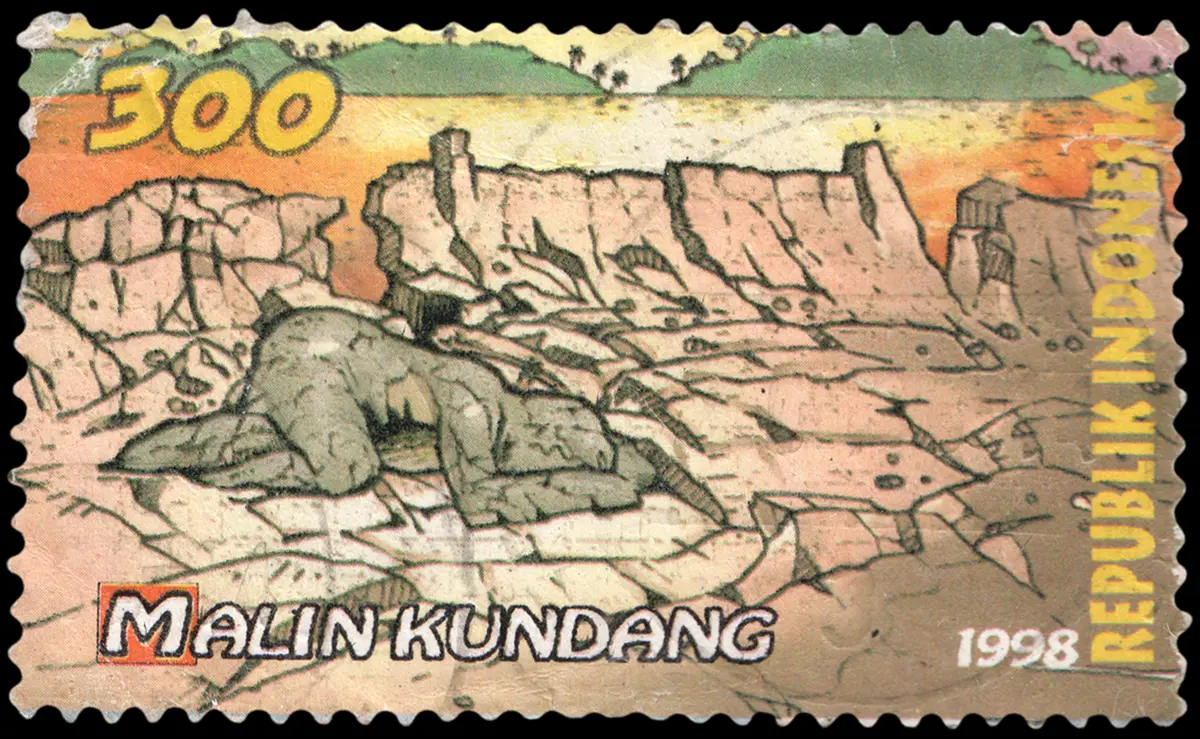
The rock came last. At some point in the 1980s two artists, Ibenzani Usman and Dasril Bayras, made the prostrate human figure and the stones shaped like a wrecked hull at Air Manis beach, in South Padang. The rock is now the thing the beach is known for, and in 1998 its pose was on a postage stamp.
The story did not stop moving once it had a rock. On 2 February 1986 the Kompas newspaper in Jakarta published a short story by A. A. Navis, the leading Minangkabau writer of his generation, called "Malin Kundang, Ibunya Durhaka" — Malin Kundang, His Mother Was the Undutiful One. The scholar Ronidin has read it as a parody aimed at a modern, materialistic Minangkabau society; whatever else it is, it is the moral of the tale being turned over by someone from inside the tradition, in the national press, a few years after the rock had given the moral a shape on the beach.
Timeline: the documented record of Malin Kundang, the Son Turned to Stone
- 1900 Walter Skeat prints, in Malay Magic, a Selangor version of the tale under the title 'Charitra Megat Sajobang'. The son sails from Ulu Klang, comes back rich, refuses his parents, and his mother lays her hand on her breast and says: "If thou art really my son, reared at my breast, mayest thou be changed into stone." The ship and everyone aboard are petrified; the parents become pauh (mango) trees, one leaning seaward with sweet fruit, one landward with bitter. It is the oldest printed version of the story cited in this file.
- 22 December 1941 Two Netherlands Indies dailies, the Soerabaijasch handelsblad and the Bataviaasch nieuwsblad, carry the same notice: the Indonesian youth association Obor Pemoeda has postponed both its first congress and the stage play 'Si Malin Koendang', billed for 27 December at the Batavia city theatre in aid of the Netherlands Indies Red Cross Fund and two Muslim charities, 'in view of the tense situation in this country'. The Pacific War had begun a fortnight earlier. It is the earliest dated appearance of the Minangkabau name that a sweep of the Dutch-language press produced.
- 1971 Malin Kundang (Anak Durhaka) reaches Indonesian cinemas: directed by D. Djajakusuma, produced by Elly Joenara for PT Remadja Ellynda Film, screenplay by Asrul Sani, with Rano Karno as the boy and Putu Wijaya as the grown man. The Indonesian Film Center's record of the film ends its long synopsis by noting that Malin is undone by his own oath and adding: "It is this ending that differs from the original legend." The short synopsis on the same page still has the mother cursing him, so the catalogue contradicts itself. The motive attributed to Sani for dropping the curse - that a Muslim mother would not curse her son whatever his sins - comes from Salim Said's Pantulan Layar Putih (1991) and is repeated here at second hand, no copy having been consulted.
- 1974 Sardewa's Malin Kundang: dongeng daerah Minangkabau is published in Bandung by Tarate and catalogued abroad. It is the earliest printed Indonesian edition of the story that a library catalogue search located; the story is by then a children's book, three years after the film and six before the rock.
- The 1980s The Batu Malin Kundang is made at Air Manis: a prostrate human figure among stones shaped like a wrecked hull, the work of the artists Dasril Bayras and Ibenzani Usman in the 1980s. Okezone, reporting it in 2022, says that little is known about how it was made and gives no precise year.
- 2 February 1986 A. A. Navis, the best-known Minangkabau writer of his generation, publishes in the Jakarta daily Kompas a short story titled 'Malin Kundang, Ibunya Durhaka' — Malin Kundang, His Mother Was the Undutiful One. Six years after the rock was carved, the country's most famous moral tale is turned upside down in the national press by a writer from the region that owns it. The clipping is catalogued by the Jakarta public library under call number A.2.35.
- 1998 Indonesia issues a 300-rupiah stamp headed MALIN KUNDANG. The design shows a rocky shore with a human figure lying face down among the stones — the pose that the Air Manis sculpture had fixed eighteen years earlier. The picture our own file carries is a scan of this stamp, not a photograph of the beach.
- September-December 2019 Air Manis is refurbished. ANTARA reports on 11 November that the works include the 'revitalisation of the ornaments and fittings on the body of the boat' beside the stone; a beach manager named Riki explains that the icon had been getting buried by drifting sand and that clarifying its shape would 'strengthen the standing of the legend'. Widening the access road, parking and a walkway towards Pulau Pisang are part of the same job.
- 13 February 2020 With the works finished, Arfian, head of the Padang city tourism and culture office, tells KlikPositif that admission will not go up: 10,000 rupiah for adults and 5,000 for children, plus 4,000 for a car and 2,000 for a motorcycle, because raising them would mean amending municipal by-law No. 1 of 2019.
- 9-12 October 2020 A high tide covers the Batu Malin Kundang on 9 October. A video posted by the account @infosumbar on 11 October spreads it, and on 12 October Arfian tells Kompas.com that this had never happened before and that the site had already been drained and the stone had reappeared. A figure said to have been petrified by divine judgement had to be pumped out.
- 25 March 2026 Perumda Padang Sejahtera Mandiri, the municipal company now running the beach, sets up three payment posts and Bank Nagari card terminals for the Eid holiday. Its head of business, Henki Setiawan, says every charge is now recorded officially, 'with no room for illegal charges' — an answer to the extortion complaints that a 2026 study of the site had recorded.
Is there a rational explanation for Malin Kundang, the Son Turned to Stone?
The rock at Air Manis holds no mystery: the figure, a man prostrate face down with stones around him shaped like the wreck of a ship's hull, is a work of art with two authors, and Okezone reported in 2022 that it was made by Dasril Bayras and Ibenzani Usman "pada tahun 1980-an", in the 1980s. The same article says that little is known about how it was made ("Tak banyak diketahui tentang proses pembuatan batu ini") and gives no more precise year.
Two measurements support the late date rather than depending on it. The first is negative and controlled. Searching the Dutch-language press held in Delpher, an index of over a million articles, "Ajer Manis" appears 69 times together with Padang, 35 times with zee (sea), 22 with strand (beach), 11 with batoe (stone) and 5 with steen (stone) — so the beach was perfectly visible to colonial journalism — and 0 times together with Malin, and 0 with legende. A control term invented for the purpose also returned 0. The second is bibliographic: Ian Proudfoot's Early Malay Printed Books, a catalogue of Malay books printed in the Singapore-Malaysia area up to 1920, runs to 886 pages and some 334,000 words, and contains the word Hikayat 844 times, Nakhoda 52, Batu 52 and derhaka 4 — and Kundang, Malin and Tanggang zero times each. So no printed Malay book of this story was catalogued before 1920.
Neither measurement says the story is recent: Skeat printed a full version in 1900 with a mother's conditional curse practically identical to the one told today, and offered it as evidence of what he called the Malay "theory of Human Origin", the belief that stones, trees and animals had once been people. The oral tradition is at least as old as its first record and probably much older. What is recent is the rock, and the useful thing about separating them is that neither claim has to lean on the other.
The rock also needs maintenance: ANTARA reported in November 2019 that drifting sand was blurring its shape and that the refurbishment of the beach included "revitalising" the ornaments on the body of the boat. On 9 October 2020 a high tide put it under water for the first time in living memory, and the head of the city tourism office told Kompas.com three days later that the site had been drained and the stone had come back. A judgement of God does not normally need draining.
None of the sources cited here names a historical person behind the name, describes or photographs a man-shaped rock at Air Manis before 1980, or gives the exact year of the sculpture. The date of A. A. Navis's inversion of the tale, 2 February 1986, comes from the Jakarta public library's catalogue record of the newspaper clipping, call number A.2.35. That the 1971 film changed the ending is documented in the film's own catalogue record, but the reason attributed to the screenwriter Asrul Sani for removing the curse comes from Salim Said's 1991 book Pantulan Layar Putih and is repeated here at second hand. The same catalogue page carries two synopses that disagree with each other about whether the mother curses him at all.
The 2026 study of the site by Putra and colleagues records complaints about unclean facilities, expensive rentals and informal charges; the municipal operator's answer, in March 2026, was card terminals and three official payment posts.
Can you visit Malin Kundang, the Son Turned to Stone?
The stone stands at the southern end of Pantai Air Manis, in the Air Manis neighbourhood of Padang Selatan, Padang, West Sumatra 25217, behind the Bukit Gado-Gado ridge and Gunung Padang. The road in runs round the back of the hill and was widened during the works of 2019. This file's coordinate, 0.99434 S and 100.36411 E, is the rock itself; the point Wikidata carries for the beach lies about half a kilometre away, and the beach is long enough for that to matter.
The site is run by Perumda Padang Sejahtera Mandiri, the Padang municipal company. On 13 February 2020 the head of the city tourism department, Arfian, gave the tariff set by Perda number 1 of 2019 as 10,000 rupiah for adults and 5,000 for children, with 4,000 for a car and 2,000 for a motorcycle, and said the revitalisation would not raise it: "Kami tidak akan menaikan harga tiketnya meskipun saat ini kondisi Pantai Air Manis Padang semakin baik dibanding sebelumnya." Since March 2026 there are three payment posts, two for four-wheeled vehicles and one for two-wheeled, with Bank Nagari terminals at the counter. The stated purpose is recording: "Dengan sistem ini, kami memastikan seluruh retribusi tercatat secara resmi dan tidak ada lagi ruang untuk pungutan di luar ketentuan."
The sculpture sits on the tideline of an open stretch of coast, and the tide governs what is above water. On 11 October 2020 a video of it underwater went round Instagram; Arfian dated the flooding to heavy rain and a spring tide from Friday 9 October, and the stone was dry again by Monday 12 October. Reporting at the time called it the first such submersion. Low water is also when the crossing to Pulau Pisang Kecil, the islet off the beach, is walkable.
There are toilets, showers, parking, seating and food stalls, with ATVs and horses for hire on the sand. A study of the site published in 2026 singles out rental prices and informal charges as the complaint visitors make most.
The figure is a sculpture made in the 1980s, and nobody at the site hides it. The visit is therefore to a monument a city built in order to hold on to a story.
Sources consulted
- Walter William Skeat, «Malay Magic: Being an Introduction to the Folklore and Popular Religion of the Malay Peninsula (pp. 54-55, 'Charitra Megat Sajobang')» — Macmillan and Co., London, 1900 book
- Unsigned news item, «„Obor Pemoeda” (notice postponing the play 'Si Malin Koendang', art. 41)» — Soerabaijasch handelsblad, 22 December 1941 (Delpher, Koninklijke Bibliotheek), 1941 newspaper archive
- Unsigned news item, «„Obor Pemoeda” (same notice, art. 85)» — Bataviaasch nieuwsblad, 22 December 1941 (Delpher, Koninklijke Bibliotheek), 1941 newspaper archive
- Ian Proudfoot, «Early Malay Printed Books: A Provisional Account of Materials Published in the Singapore-Malaysia Area up to 1920» — Academy of Malay Studies and The Library, University of Malaya, Kuala Lumpur, 1993 book
- Indonesian Film Center, «Malin Kundang (Anak Durhaka) (1971) — film record» — Indonesian Film Center film database, 1971 archive
- Sardewa; record held in the Dutch union catalogue (GGC), «Malin Kundang: dongeng daerah Minangkabau — catalogue record (PPN 244774528)» — Bandung: Tarate; record via Koninklijke Bibliotheek SRU, 1974 archive
- ANTARA Sumbar, «Pantai air manis direvitalisasi untuk manjakan pengunjung» — ANTARA News Sumatera Barat, 11 November 2019, 2019 newspaper archive
- Redaksi KlikPositif, «Pantai Air Manis Selesai di Revitalisasi, Intip Harga Tiket Masuknya?» — KlikPositif, 13 February 2020, 2020 newspaper archive
- Kompas.com (Padang desk), «Ketika Batu Malin Kundang Tenggelam untuk Pertama Kalinya...» — Kompas.com, 12 October 2020, 2020 newspaper archive
- Kiki Oktaliani, «Bukan karena Kutukan, Batu Malin Kundang 'Si Anak Durhaka' Ternyata Buatan Manusia» — Okezone, 26 December 2022, 2022 newspaper archive
- Ronidin, «Malin Kundang, Ibunya Durhaka: Suatu Pendekatan Genetik» — Lingua Didaktika: Jurnal Bahasa dan Pembelajaran Bahasa 4(2), pp. 114-125, Universitas Negeri Padang, 2011 academic
- A. Putra, Y. Fitria, N. Afnita and F. Nasrul, «Destination Competitiveness and Sustainability of Cultural Tourism: A Qualitative Study of Malin Kundang Stone Tourism at Air Manis Beach, Padang» — Dampeng: Journal of Art, Heritage and Culture 2(1), pp. 10-17, 2026 academic
- A. A. Navis (1924-2003); record held by Dinas Perpustakaan dan Kearsipan DKI Jakarta, «Malin Kundang, Ibunya durhaka — catalogue record of the story as printed in Kompas, 2 February 1986» — JAKLITERA catalogue, call number A.2.35, 1986 archive
- Republic of Indonesia (issuing authority); scan by Wikimedia user Crisco 1492, «Malin Kundang, 300 rupiah postage stamp (1998) — scanned file page» — Wikimedia Commons, 1998 archive
- Redaksi Padangkita, «Libur Lebaran 2026, Pantai Air Manis Padang Tingkatkan Kenyamanan dengan Layanan Bebas Pungli dan Antikemacetan» — Padangkita, 25 March 2026, 2026 newspaper archive
Reviewed by V. Serrano on 2026-08-16 · How we verify our content
📎 Source: Enigma Atlas
💬 Field testimonies (0)
No testimonies yet. Add the first.
Add your testimony
🔒 Log in to add a testimony