📜 LEGEND · EXP. Nº3657
ACTIVE
Nyai Roro Kidul, Queen of the Southern Sea
The Queen of the Southern Sea is presented almost everywhere as timeless oral tradition, and almost everything told about her can in fact be dated.
Where does the legend of Nyai Roro Kidul, Queen of the Southern Sea come from?
- Location
- Yogyakarta (Bantul), Indonesia
- Kind of legend
- Deity
- Coordinates
- -8.025, 110.331
- Last updated
LOCATION
What is the legend of Nyai Roro Kidul, Queen of the Southern Sea?
The pact with Panembahan Senapati, founder of Mataram, is written down in the court chronicle Babad Tanah Jawi, chapters 205 to 211: he is fishing at the mouth of the River Samas, the sea boils under his prayer, and a queen named Rara Kidul surfaces to promise that he and his descendants will rule Java. She also refuses the role of wife outright, saying that a queen is better off single. The princess-with-a-curse origin story, with the name Dewi Kadita, is printed in Dutch in 1924, and in that text the sea sings to her and promises a bridegroom; she is not transformed into a radiant ruler but into a queen feared by all, who punishes those who withhold offerings. The prohibition on wearing sea green on the south coast is attested in the colonial press in 1912, in the lending rules of a government pawnshop. The famous reserved room is room 308 of a hotel opened on 15 February 1966.
What is the history of Nyai Roro Kidul, Queen of the Southern Sea?
The Queen of the Southern Sea is usually introduced as timeless oral tradition. She is not. Almost every element of the story that gets told about her can be pinned to a text, a newspaper or a building, and the dates are close enough together to be read as a chain.
The oldest link that can be read today is the court chronicle. In the Babad Tanah Jawi, the Mataram dynastic history, the encounter occupies chapters 205 to 211. (What is quoted here is Willem Remmelink's 2022 English translation of the revised prose version prepared by C. F. Winter Sr in the nineteenth century, not the Javanese verse manuscripts; the wording is his.) Senapati is not praying on a cliff: he is fishing at the mouth of the River Samas with casting nets and fyke nets, and has just released an enormous sea fish called Olor after having it clad in gold and naming it Tunggulwulung. He then goes ashore and prays, and the sea boils. "In the South Sea there ruled a queen of great beauty," the chronicle says. "Her name was Rara Kidul and she ruled over all the invisible beings in Java." She surfaces, makes a sembah, touches his feet, and tells him his prayer is granted: he and his descendants will rule Java, and her ghosts, fairies and spirits will come whenever he calls. He spends three days and three nights with her, is taught the art of kingship, and is shown how to summon her — arms folded, feet together, eyes to the sky. Only on the way back does he reach Parangtritis, where Sunan Kalijaga is meditating under the overhanging cliffs and rebukes him for trusting in supernatural powers.
Two details of that passage are routinely dropped, and both matter. The first is that she declines the frame of marriage outright: "To be a queen, it is better to be single. I can do whatever I want, without there being one to give me orders." The word wife appears far later in the same chronicle, at chapter 398, and it is attached to Sultan Agung, not to Senapati — the chronicle notes that Agung had two palaces, Karta and one in the Southern Ocean, "since His Majesty had taken Rara Kidul as wife". The second is that she has an earlier incarnation in the same book: at chapter 36 she is Ajar Cemaratunggal, a princess of Pajajaran who fled the court because she refused to marry, and who promises Raden Susuruh she will settle at Pamantingan, and that whoever rules Java will marry her.
The Dutch philologist J. J. Ras showed in 1987 why that pact sits where it does. The chronicle does not open with a sacred marriage, as comparable Indonesian court chronicles do; it opens with a genealogy running from Adam. The pact was welded into a text whose rewriting can be dated: according to the Babad Sengkalaning Momana, a table of dates of Yogyakarta origin, the king Panembahan Seda ing Krapyak ordered the Babad Demak to be put in order in 1612, and the man who did it was the carik — clerk and poet — Panjang Mas. This is not anonymous folklore. It is dynastic legitimation, commissioned, with a name attached.
The origin story most readers know — the princess disfigured by a curse — has its own datable text, and it is not medieval. It is printed in Dutch in 1924, in Jos Meijboom-Italiaander's Javaansche sagen, mythen en legenden, chapter IV, pages 204 to 212, under the heading "What tradition tells of Ratoe Loro Kidoel, and who she was". There she is Dèwi Kadita, nicknamed Dèwi Srengenge, "Princess Sun"; her father is Praboe Moendang Wanggi; the second wife who destroys her is Poetri Moentiara; and the instrument is a banished witch called Djahil, hired to cast rapals. The curse is leprosy, and it strikes both the girl and her mother, who are exiled together and of whom the mother dies in the forest. That mother has vanished from almost every modern retelling, ours included.
The ending of the 1924 text is the part that has been quietly reversed. Kadita does not jump in despair. Wandering and driven out of village after village as onreine, unclean, she reaches the shore and the sea sings to her: "Come, Dèwi Kadita, come, you are weary of wandering. Come to me and rest in my cool arms. Here in the depths you will be happy again. Here your bridegroom waits for you, his bride!" She throws herself in where she expected to find her bridegroom — and, the text says, when she was disappointed in that too, she grew angrier still. "From that day the gods changed Dèwi Kadita into Ratoe Loro Kidoel, the queen feared by all, of the Southern Ocean, who punishes all who do not make offerings to her and do not show her the honour that is her due." No cure, no restored beauty, no radiance. The offerings exist in that text because she punishes those who withhold them.
The same 1924 volume carries a fourth Loro Kidul tale, "The Senapati's bride", pages 229 to 234, which is worth reading against the chronicle. Here Senapati is a boastful upstart whose vanity curdles into delusion; he brags to the Sultan of Pajang that the sea queen has chosen him as husband and is building himself a palace for the wedding; he is beaten in battle, forgiven, and repays it by poisoning the Sultan with a fruit drink. Consumed by remorse, he goes back to the beach and calls her. A voice answers from the sea: does he wish to follow her, to serve her as her slave? "I come, my bride, I come!" he screams, and jumps. The court chronicle turns that beach into a divine mandate; the version the Dutch collectors heard turns it into the death of a murderer.
The prohibition on wearing green can also be dated, and the earliest attestation found for this file is unusually concrete. On 9 October 1912 the Bandung paper De Expres ran a short item, "Fatal colour", quoting a correspondence sent from Purworejo to the Soerabaijasch Handelsblad about the government pawnshop service. Pawnshop officials in the Bagelen region, it said, had learned to lend as little as possible on garments of gadoeng colour — sea green — however fine the silk, "because that is the colour of her sea" and no one in Bagelen could be persuaded, even for good money, to wear it; such goods fetched nothing at auction. The article adds that at the recent Lebaran crowds had gone down from Ketawang and Ambal to the sea to make offerings. Four weeks later the same paragraph was reprinted in Amsterdam by the Algemeen Handelsblad of 5 November 1912 under the title "Undesirable colour". A superstition measurable in the resale value of silk is a far better fact than "long avoided".
The royal offering, the labuhan, is likewise documented rather than merely asserted. On 14 May 1927 the Algemeen handelsblad voor Nederlandsch-Indië reported that on Sunday 8 May, Pangeran Hangabehi, as envoy of the Susuhunan of Surakarta, had gone to the south shore at Parangtritis and thrown costly garments into the high surf with some ceremony. On 25 November the same paper reported the Yogyakarta equivalent: for the Sultan's birthday, kraton officials had gone that Wednesday to the shore near Parangtritis and thrown in "a number of brand-new and costly women's clothes, packed in a fine copper box", beyond the breakers — adding, without a source, that the ceremony "dates from the time of Buddhism on Java". Today the Yogyakarta palace publishes its own account: the Hajad Dalem Labuhan falls on 30 Rejeb, one day after the anniversary of the Sultan's accession, and goes to four places — Parangkusumo, Mount Merapi, Mount Lawu and Dlepih Khayangan — with Dlepih served only once every eight years, in Dal years. The Parangkusumo list of uborampe does include Pethetan Rikma lan Kenaka Dalem, the Sultan's hair and nail clippings, alongside cloths and headwear.
The last link is a building. The Samudra Beach Hotel at Palabuhanratu in West Java, one of the hotels the Indonesian government put up with Japanese war reparations money in the early 1960s, opened on 15 February 1966. Sukarno was personally involved in choosing the site. Room 308, on the third floor, is furnished in green and kept for the queen: green carpet and green quilted silk, a red gown, a kebaya, batik cloth and gold slippers, eight paintings of her — one of them by Basuki Abdullah — and two portraits of Sukarno. The Jakarta Post visited in March 2001 and found the hotel's head of food and beverage acting as caretaker: "We never prepare anything as our obligation is only to regularly clean the room like the others." Devotees do the rest, usually on Friday nights. The reserved room is real; its foundation stone is younger than the Second World War.
Timeline: the documented record of Nyai Roro Kidul, Queen of the Southern Sea
- 1575 Panembahan Senapati founds the Islamic state of Mataram II, of which the courts of Yogyakarta and Surakarta are the successors. Wessing notes that he was in reality a usurper, and that the supernatural pact was one of the supports he used to hold the position.
- 1612 According to the Babad Sengkalaning Momana, a Yogyakarta table of dates, King Panembahan Seda ing Krapyak orders the Babad Demak to be put in order. The man who carries out the commission is the carik Panjang Mas, a court clerk and poet related to Senapati's counsellor. Ras identifies this as the moment the pact with the Queen of the Southern Sea is written into dynastic history.
- 1618 (A.J. 1540) The year traditionally given for the founding of the labuhan offering. Ras points out that it does not match the claim that Senapati instituted it: A.J. 1540 falls in the reign of Sultan Agung, and is the year the Babad Sengkalaning Momana records Agung moving into his new kraton at Karta.
- 9 October 1912 The Bandung paper De Expres prints "Fatal colour", quoting a correspondence from Purworejo about the government pawnshops. It is the earliest attestation of the green taboo found for this file: officials in Bagelen were warned to lend as little as possible on sea-green (gadoeng) garments, since no one there would wear the colour to the south shore and such goods fetched nothing at auction.
- 5 November 1912 The same paragraph is reprinted in Amsterdam by the Algemeen Handelsblad under the title "Undesirable colour", carrying the Javanese taboo into the Dutch metropolitan press four weeks after it appeared in the colony.
- 1924 Jos Meijboom-Italiaander publishes Javaansche sagen, mythen en legenden in Zutphen. Chapter IV, pages 204-212, prints the Dewi Kadita origin story in full, with the stepmother Poetri Moentiara, the witch Djahil, leprosy striking mother and daughter, the mother's death, the sea that sings to Kadita and promises her a bridegroom, and her transformation into a queen feared by all who punishes those who withhold offerings.
- 8 May 1927 Pangeran Hangabehi, as envoy of the Susuhunan of Surakarta, goes to the south shore at Parangtritis and casts costly garments into the high surf, an offering the press describes as annual.
- 8 July 1927 The Algemeen handelsblad voor Nederlandsch-Indie reports that the village head of Grogol, on the coast near Parangtritis, has announced that the queen appeared to him in a dream demanding five thousand Javanese lives. The village responds with weeks of slametan feasts, some households selling possessions to keep up. The correspondent's own conclusion is that the lurah was fond of a party and had not attended a slametan in some time.
- 23 November 1927 For the Sultan of Yogyakarta's birthday, kraton officials go to the shore near Parangtritis and throw a number of brand-new and costly women's garments, packed in a fine copper box, beyond the breakers. The paper adds, without a source, that the ceremony dates from the time of Buddhism on Java.
- 8 June 1928 Go Oen Kwie, a trader from Semarang, drowns at the Goa Langse cave near Parangtritis while making his annual offering, after saving one of his companions from a wave. He had had an iron ladder built at the cave the same year, after nearly being cut off by the tide the year before. His body was not recovered.
- 15 February 1966 The Samudra Beach Hotel at Palabuhanratu opens, built with Japanese war reparations money in a programme that also produced Hotel Indonesia, the Bali Beach and the Ambarrukmo. Sukarno was involved in choosing the site. Room 308 is furnished in green and reserved for the queen — the room that later gets generalised into "hotels along the southern coast".
- 1987 J. J. Ras publishes "The Genesis of the Babad Tanah Jawi" in Bijdragen tot de Taal-, Land- en Volkenkunde, showing that the pact and Senapati's genealogy were two originally separate elements welded together, and dating the commission that produced the text.
- 1997 Robert Wessing publishes "A Princess from Sunda" in Asian Folklore Studies, mapping the competing origin stories, recording that most authors have her called into the waves rather than jumping in despair, and noting that informants at Parangtritis distinguish Nyai Roro Kidul from an older Ratu Kidul.
- 18 March 2001 The Jakarta Post visits room 308 and describes its contents: green carpet and green quilted silk, a red gown, kebaya, batik and gold slippers, eight paintings of the queen and two portraits of Sukarno. The hotel's head of food and beverage, acting as caretaker, says the staff prepare nothing and only clean the room like any other.
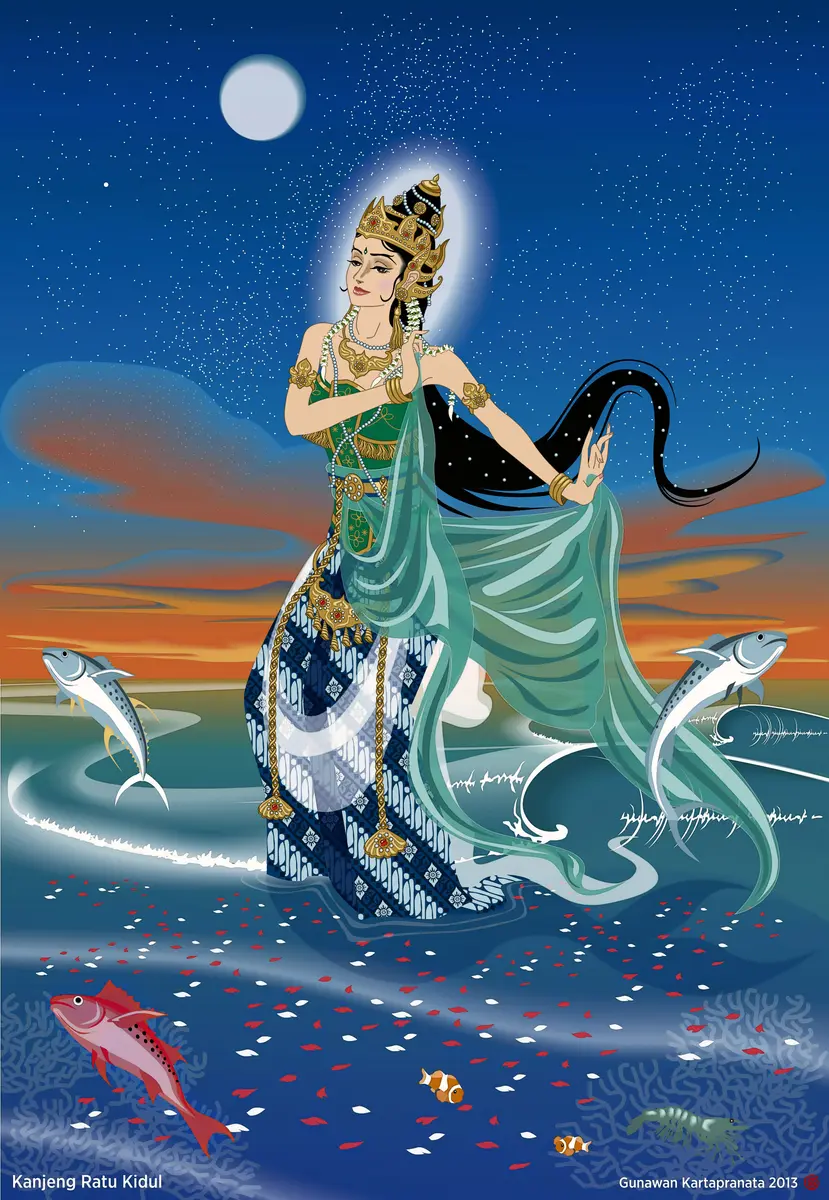
- 4 May 2013 The Indonesian illustrator Gunawan Kartapranata uploads his own digital drawing of the queen to Wikimedia Commons under the title Kanjeng Ratu Kidul. It becomes the standard image of her on the web, heads the English Wikipedia article, and is the picture that illustrates this file.
- 2022 Willem Remmelink's complete English translation of the Babad Tanah Jawi, from the revised prose version of C. F. Winter Sr, is published open access by Leiden University Press, making the pact readable in full for the first time outside Dutch and Javanese.
Is there a rational explanation for Nyai Roro Kidul, Queen of the Southern Sea?
There is nothing to debunk here in the usual sense. The Labuhan is a real ceremony, performed by a living court; the coastal cult is a living devotion. What can be checked is what we and others have written about it, and on that the record is unflattering.
The first check is a negative one, and it is the strongest thing in this file. The English translation of the Babad Tanah Jawi published in 2022 runs to some 569,000 words. Swept for the word green, it returns three hits: a green velvet harness for a horse, a house decorated with greenery, and a casuarina described as an evergreen. Swept for the Javanese colour term itself — gadhung, gadoeng, mlathi — it returns nine, and every one is either the gadhung yam (a seed produced in an omen, and a glossary entry) or the place name Gadhungmalathi, a military camp in the chapters on the war of the 1740s. Not one refers to the Queen of the Southern Sea. Swept for labuhan, it returns four hits, all of them the Palabuhan River, a place name. In the same sweep, as a positive control, Kidul appears 47 times, Ratu Kidul 14 and Pamantingan 4. So the court chronicle that founds the royal pact describes neither the colour taboo nor the offering ceremony. Both are attested elsewhere; neither is in the text that is usually cited for them.
The second is a chronological problem inside the tradition itself. Ras noted in 1987 that the labuhan is said to have been instituted in the time of Panembahan Senapati, but the year given for it, A.J. 1540, corresponds to A.D. 1618 — which falls in the reign of Sultan Agung, two rulers later. According to the Babad Sengkalaning Momana that is the year Agung moved into his new kraton at Karta. Ras took the rite to be genuinely old; his point was that its own founding date does not support the founder it is attached to.
The third is the origin story. Comparing our own text with the 1924 Dutch printing, three things had been altered. We said she "threw herself into the southern sea in despair": the 1924 text has the sea sing to her and promise her a bridegroom, and she goes in expecting to find him. We said she was "transformed into an immortal, radiant ruler": the 1924 text has her disappointed a second time, growing angrier, and becoming "the queen feared by all". And we said nothing at all about her mother, who in the 1924 text is cursed with her, exiled with her and dies. Robert Wessing's 1997 survey of the variants confirms the direction of the error: only "a minority of the authors" have her jump in desperation, while "most authors" have her called into the waves by voices. The mistake is not invention. It is a motive quietly reversed.
The fourth is a warning against treating the whole figure as one person. Wessing recorded that some informants at Parangtritis insist Nyai Roro Kidul is the patih, the chief minister, of an older and separate entity, Ratu Kidul, who actually rules the ocean; in that account Ratu Kidul favours purple and Nyai Roro Kidul favours green. Groneman considered the distinction an error. It is not settled, and a page that fuses the two names should say so — the picture at the head of this file is filed under the other name.
As for the sea itself, the danger needs no folklore. Ras, writing as a philologist and not as a sceptic, described the Indian Ocean off the south coast as "extremely dangerous", claiming lives every year while making the coast difficult of access to shipping. The colonial press supplies named cases. On Friday 8 June 1928, De Locomotief reported, a Semarang trader named Go Oen Kwie went to the Goa Langse cave near Parangtritis with two women and two servants to make his annual offering; the sea caught them mid-ceremony, a wave dragged one of the women off, and he saved her at the cost of his own life. His body had not been recovered. Het Vaderland of 2 August 1928 filled in the background: he had been making the pilgrimage every year, on a Friday morning, since making his fortune in the district, and after nearly being cut off the previous year he had had a heavy iron ladder built at the cave so that he could climb clear of the surf. The ladder did not save him. Parangtritis has since become a well-studied rip-current coast; the Indonesian search and rescue agency states plainly that it is not a beach for swimming.
Finally, the picture. Our illustration is not a historical portrait: it is a digital drawing made by the Indonesian illustrator Gunawan Kartapranata and uploaded to Wikimedia Commons on 4 May 2013, where it is filed as Kanjeng Ratu Kidul. It reached this file through an automated image pass rather than from the record the text was written from, and it is the same image that heads the English Wikipedia article — which is where the errors corrected above can be traced. That article's own Kadita paragraph cites Meijboom-Italiaander 1924 and then adds "attempting suicide" and "cured and restored to beauty", neither of which is in the pages it cites.
Can you visit Nyai Roro Kidul, Queen of the Southern Sea?
Three places on the ground carry this story, and they are far apart.
Parangtritis and Parangkusumo (Yogyakarta). Both lie in Desa Parangtritis, Kecamatan Kretek, Kabupaten Bantul, in the Special Region of Yogyakarta, about 27 km south of the city along Jalan Parangtritis. Parangkusumo is roughly a kilometre west of the main Parangtritis beachfront and is the site the palace names in its own account of the Labuhan. Its walled enclosure, the Cepuri, holds two stones that tradition identifies with the meeting of Senapati and the queen, and pilgrims come on the Friday Kliwon and Tuesday Kliwon nights of the Javanese calendar. A tariff list published on 30 March 2026 gives the gate charge under Bantul regional regulation 6 of 2023 as "Rp15.000 per orang (termasuk asuransi Rp500)", a single through-ticket for Parangtritis, Parangkusumo and Depok, with parking at Rp5.000 for a motorcycle and Rp10.000 for a car. Since 1 July 2026, under Bantul regental regulation 48 of 2026, the collection posts have been moved off the Jalan Parangtritis trunk road into the lanes that lead down to the beach. The Gumuk Pasir dunes and the horse carts are on the same stretch of coast.
The water. This is a rip-current coast with steep and uneven bathymetry. Supriono, then head of the Yogyakarta office of the national search and rescue agency, said on 5 July 2018 that "karakter laut selatan ini memang tidak untuk mandi bagi wisatawan tetapi sekadar untuk dinikmati saja keindahannya" — the southern sea is there to be looked at. Lifeguard posts fly coloured flags, loudspeakers carry the same warning at the Parangtritis post, and SAR crews are stationed at five beaches across the Special Region. The death of Go Oen Kwie at the Goa Langse cave in 1928 and the modern rescue figures describe the same water.
The Labuhan. The Yogyakarta palace holds the Hajad Dalem Labuhan on 30 Rejeb of the Javanese calendar, the day after the Tingalan Jumenengan Dalem that marks the Sultan's accession, so the Gregorian date moves each year. In 2026 the accession fell on Sunday Kliwon 18 January, the thirty-eighth year of the reign; the offerings left Bangsal Srimanganti at 08:00 the next morning and the ceremonies ran to 23 January. Parangkusumo, Mount Merapi and Mount Lawu receive offerings every year. For 1959, a Dal year in the Javanese cycle of eight, the palace added Dlepih Khayangan in Wonogiri and doubled the load carried up Mount Lawu from two containers to four. The offerings pass to the juru kunci, the hereditary keeper of each site. The procession is public.
Palabuhanratu, West Java. A different province and a different cult, about four hours from Bandung. The hotel is the Grand Inna Samudra Beach, on Jalan Raya Cisolok-Pelabuhanratu at Cikakak in Sukabumi Regency. It went up between November 1962 and February 1966, eight storeys high, with a hundred rooms. Room 308 cannot be booked. The hotel keeps it furnished for the queen. Inside there are paintings of her and garments treated as consecrated, and people who are not staying at the hotel go in to pray and to leave written petitions. The fishing town holds its own sedekah laut, a community sea-offering rather than a palace rite.
At the Cepuri and during the Labuhan there are people praying, and the devotion has living institutions behind it.
Sources consulted
- Willem Remmelink (translator), «Babad Tanah Jawi, The Chronicle of Java: The Revised Prose Version of C.F. Winter Sr» — Leiden University Press, 2022 book
- J. J. Ras, «The genesis of the Babad Tanah Jawi; Origin and function of the Javanese court chronicle» — Bijdragen tot de Taal-, Land- en Volkenkunde 143 (2-3), pp. 343-356, 1987 academic
- Robert Wessing, «A Princess from Sunda: Some Aspects of Nyai Roro Kidul» — Asian Folklore Studies 56 (2), pp. 317-353, 1997 academic
- Jos Meijboom-Italiaander, «Javaansche sagen, mythen en legenden (ch. IV, 'Sagen van Ratoe Loro Kidoel', pp. 204-234)» — W. J. Thieme & Cie, Zutphen, 1924 book
- Unsigned, «Fatale kleur. Javaansch bijgeloof» — De Expres, 9 October 1912, 1912 newspaper archive
- Unsigned, «Ongewenschte kleur» — Algemeen Handelsblad, 5 November 1912, 1912 newspaper archive
- Unsigned, «Een oud gebruik te Djocja» — Algemeen handelsblad voor Nederlandsch-Indie, 14 May 1927, 1927 newspaper archive
- Unsigned, «Een oud gebruik. Het offer aan Njai Loro Kidoel» — Algemeen handelsblad voor Nederlandsch-Indie, 25 November 1927, 1927 newspaper archive
- Unsigned, «Bijgeloof (Djokja, 8 Juli)» — Algemeen handelsblad voor Nederlandsch-Indie, 8 July 1927, 1927 newspaper archive
- Unsigned, «Bij Parangtritis door den vloed overvallen / Het offer van Prang Tritis» — De Locomotief, 14 June 1928, and Het Vaderland, 2 August 1928, 1928 newspaper archive
- Ida Indawati Khouw, «Room No. 308 still retains its mystery» — The Jakarta Post, 18 March 2001, 2001 newspaper archive
- Kraton Ngayogyakarta Hadiningrat, «Hajad Dalem Labuhan» — kratonjogja.id, 2026 web
- Gunawan Kartapranata, «File:Kanjeng Ratu Kidul.jpg (uploaded 4 May 2013)» — Wikimedia Commons, 2013 archive
Reviewed by V. Serrano on 2026-08-16 · How we verify our content
📎 Source: Enigma Atlas
💬 Field testimonies (0)
No testimonies yet. Add the first.
Add your testimony
🔒 Log in to add a testimony