📜 LEGEND · EXP. Nº0270
ACTIVE
Mami Wata
Mami Wata is a living devotion, not a story: a water divinity honoured from Senegal to Tanzania and across the Atlantic, served by priestesses and priests in working shrines, and credited with wealth, healing, fertility and danger in equal measure.
Where does the legend of Mami Wata come from?
- Location
- Niger Delta, West Africa, Nigeria
- Kind of legend
- Deity
- Coordinates
- 4.452, 7.171
- Last updated
LOCATION
What is the legend of Mami Wata?
What can be dated is her face. The image reproduced in more African shrines than any other is a Hamburg circus poster, Der Schlangenbandiger, printed in the 1880s by Adolph Friedlander for the animal dealer Carl Hagenbeck and modelled on a snake charmer billed as Maladamatjaute. It reached West Africa within a few years: by 1901 the photographer J. A. Green recorded a Niger Delta headdress carved from it. The version sold today is not even the German original but an Indian reprint, made in Bombay in 1955 by the Shree Ram Calendar Company from a copy sent by traders in Kumase, Ghana. None of that makes the devotion foreign. Africa had named water divinities long before (Olokun, Tingoi/Njaloi, Ogbuide of Oguta Lake) and the print gave a very old belief a portrait everyone could agree on.
What is the history of Mami Wata?
In 1975 or thereabouts, in an Igbo shrine in Nigeria, the art historian Henry John Drewal asked a Mami Wata priestess how she knew what the spirit looked like. She pointed at a coloured print hanging on the wall and answered: "Someone with special powers must have gone under the water to snap her picture." Drewal published the exchange in 1988. The print is the single most reproduced image of Mami Wata anywhere in Africa, and its history can be traced with dates, cities and a printing firm.
It was made in Hamburg. In 1848 a fish merchant in the St. Pauli docks, Carl G. C. Hagenbeck, was brought some sea lions by a fisherman working Arctic waters and exhibited them; the success grew into a menagerie of animals from Greenland, Africa and Asia, and then into the Völkerschauen, the "People Shows", in which human beings were displayed as attractions. To advertise them Hagenbeck used Adolph Friedländer, a leading Hamburg lithographer who turned out cheap colour posters by the hundred. Around 1880 Hagenbeck's collector Breitwieser came back from Southeast Asia and the Pacific with snakes, insects and a wife, who began performing as a snake charmer under the stage name Maladamatjaute. A Hamburg studio photograph of her, dated about 1887 and kept in the private circus archive of Wilhelm Zimmermann, matches the poster detail for detail: the cut of the bodice, the rows of buttons, the coins at the waist, the armlets, the snake around her neck and a second one beside her, the non-functional bifurcated flute, the coiffure. The poster is titled "Der Schlangenbändiger" — The Snake Charmer.
The print reached West Africa within a few years, probably in the luggage of African sailors who had seen it in Hamburg and on the walls of European trading houses. The earliest hard evidence of its impact is a photograph taken by the Bonny photographer J. A. Green in the Niger Delta by 1901: a water-spirit headdress carved with the print's parted black hair, its earrings, its neckline, the arrangement of the arms and snakes, and even a low-relief copy of the small inset showing a kneeling flute player among snakes. Fifteen years after a Hamburg press run, a European circus poster was being carried on an African head as a water divinity.
The second leg of the journey is even better documented, because a company answered its post. The version now sold and framed across West Africa is not the German original — which Drewal reported in 2008 had still not been located — but an Indian reprint. Two merchants in Kumase, Ghana, sent a copy to the Shree Ram Calendar Company of Bombay, which reprinted it in 1955; in 1955–56 the firm shipped 12,000 copies, ten by fourteen inches, to those traders. In a letter to Drewal dated 17 June 1977 the manager stated that it had been copied "without changing a line even from the original".
None of which means the devotion arrived from Europe. What arrived was a face. Long before it, African water divinities had names, priesthoods and their own arts: Tingoi/Njaloi, the primordial female water spirit of Sierra Leone and Liberia invoked in Sande/Bondo initiation headdresses; Olokun, god of the sea and of wealth in the Edo kingdom of Benin and among the Owo- and Ijebu-Yoruba, carved as a fish-tailed figure on ivory bells and lodge doors; Ogbuide/Uhammiri, the goddess of Oguta Lake in Igboland. Mermaids were being absorbed just as early: an ivory saltcellar carved on Sherbro Island for a Portuguese client in the late fifteenth century bears the earliest known African image of a mermaid, and the Sapi sculptor immediately flanked her with two crocodiles. The name is old too, and its oldest datable trace is not African: Drewal cites eighteenth-century evidence from Suriname, where by 1775 colonial writers were describing the Watra Mama dances of enslaved people, many of them shipped from the Ewe-Mina coast. Mami Wata is not one spirit but a crowd — including male ones, the papi watas such as Densu — and the print gave that crowd a portrait it could agree on.
Timeline: the documented record of Mami Wata
- late 15th century A Sapi sculptor on Sherbro Island, off present-day Sierra Leone, carves an ivory saltcellar for a Portuguese client from a European model. It bears the earliest known African image of a mermaid — and the carver flanks her with two crocodiles, the local water-spirit animal. It is now in the National Museum of Denmark.
- January 1493 Christopher Columbus records sighting three mermaids off the coast of Hispaniola. They "came quite high out of the water", he writes, but were "not so beautiful as painted". European belief in the creature is not metaphorical at this date.
- 1775 In Suriname, colonial writers describe the Watra Mama dances of enslaved Africans, many of them shipped from the Ewe-Mina coast. This is the eighteenth-century evidence Drewal cites for a creole name of the spirit — and it is documented in the Americas, not in Africa.
- 1848 A fisherman working Arctic waters brings sea lions to Carl G. C. Hagenbeck, a fish merchant in the St. Pauli docks of Hamburg. Hagenbeck exhibits them; the success becomes a menagerie, and then the Völkerschauen, shows in which people were exhibited as attractions.
- about 1880 Hagenbeck's collector Breitwieser, nicknamed "the snake gripper", returns from Southeast Asia and the Pacific with snakes, insects and a wife, who begins to perform as a snake charmer under the stage name Maladamatjaute. Adolph Friedländer's Hamburg press prints her poster, "Der Schlangenbändiger", in the same decade.
- 1885 A circus courier published in Philadelphia advertises her as "Nala Damajanti — the Empress of the Reptile World — the Greatest and Most Astounding snake charmer of Hindoostan". The Indian identity is marketing copy: the stage name pairs Nala and Damayanti, two characters from the Mahabharata.
- 18 February and 17 March 1887 "Nala Damajanti" debuts at the Folies Bergère in Paris on 18 February. A month later, on 17 March, the court column of Le Gaulois reports a lawsuit in which her given name comes out: research in the civil registers of the Jura identifies her as Mathilde Marie Amélie Poupon, born at Nantey, France, in 1861.
- about 1887 A Hamburg studio photograph of the performer, labelled in Wilhelm Zimmermann's private circus archive "Maladamajaute ca. 1887 im circus C. Hagenbeck spetere Frau Breitwieser", matches the poster item by item: bodice, buttons, coins, armlets, the snake at the neck and the bifurcated flute that cannot be played.
- by 1901 The Bonny photographer J. A. Green photographs a Niger Delta water-spirit headdress carved directly from the Hamburg print: the parted black hair, the earrings, the neckline, the arms and snakes, even a low-relief copy of the small inset with a kneeling flute player. Some fifteen years after the poster was printed.
- 1955-56 Two merchants in Kumase, Ghana, send a copy of the print to the Shree Ram Calendar Company of Bombay, which reprints it and ships them 12,000 copies measuring ten by fourteen inches. In a letter to Drewal dated 17 June 1977 the company's manager states it was copied "without changing a line even from the original".
- 1967 The Nigerian musician Sir Victor Uwaifo releases "Guitar Boy", whose refrain — "if you see Mami Wata, never you run away" — becomes the best-known sentence ever spoken about her. Uwaifo told interviewers he wrote it after seeing a glittering figure in the surf at Bar Beach, Lagos.
- 1988 Henry John Drewal publishes the reconstruction of the chain — Hamburg, Friedländer, Maladamatjaute, Bombay — in TDR and in African Arts, based on fieldwork in Togo, Ghana and Nigeria and on European archive work funded in 1980 and 1984.
- 6 April 2008 "Mami Wata: Arts for Water Spirits in Africa and Its Diasporas", curated by Drewal, opens at the Fowler Museum at UCLA and runs to 10 August before touring to Madison, Washington, Newport News and Stanford. It is the first exhibition to lay the whole visual history out in one room.
Is there a rational explanation for Mami Wata?
The honest sceptical question here is not whether the spirit exists. It is where the picture came from, and the answer is documented: a commercial poster printed for a Hamburg animal dealer to advertise a show in which people were exhibited alongside animals.
The exoticism was manufactured twice. For European audiences the woman on the poster was an "Oriental" mystery; for African viewers her light brown skin and long wavy hair proved she came from overseas. And the performer herself was a costume. Drewal, working from Wilhelm Zimmermann's circus archive, suggested in 2008 that she had come "possibly from Samoa or Borneo" with Hagenbeck's collector Breitwieser. Later research on the performer who toured as "Nala Damajanti" — the name she used in a Philadelphia circus courier of 1885 and on a Folies Bergère poster of about 1890 — identifies her, from the civil registers of the Jura department and a court item in the Paris daily Le Gaulois of 17 March 1887, as Mathilde Marie Amélie Poupon, born in Nantey (Jura, France) in 1861. I have not been able to open the Gallica scan of that newspaper myself, so this entry reports it as what it is: a documented identification that contradicts Drewal's conjecture. If it holds, the "Hindoo snake charmer of Hindoostan" was a Frenchwoman, and the most venerated face of an African water divinity is a French woman photographed in Germany, reprinted in India and sold in Ghana.
Two further cautions belong here. First, the German original of the poster had not been found when Drewal published in 2008; what survives and circulates is the 1955 Bombay reprint, and the 1880s dating rests on the expertise of the poster historian Ruth Malhotra and on the numbering of Friedländer's early sheets. Second, our own previous version of this entry said that the image "absorbed influences from many sources over the centuries, from indigenous water deities to foreign prints of mermaids". That sentence is not wrong so much as empty: it hides a chain with names and dates behind a vagueness, and it silently merges into one being what the sources keep apart — Tingoi/Njaloi in Sierra Leone, Olokun in Benin, Ogbuide/Uhammiri at Oguta Lake, Watramama in Suriname, Mamba Muntu in Central Africa, Dona Fish in Angola, Lasirèn in Haiti. Drewal is explicit that mami watas and papi watas form "a vast and uncountable school" of local spirits with their own names and personalities, which "may or may not" be shared with Mami Wata. Anything claimed about all of them at once should be treated as our summary, not as their belief.
Can you visit Mami Wata?
The pin on this page sits at 4.4517° N, 7.1706° E, on Bonny Island in Rivers State, about two kilometres from the position the English Wikipedia gives for the town of Bonny. It marks the place of the earliest datable African use of the snake-charmer image, J. A. Green's photograph at Bonny by 1901, and claims nothing about where the devotion belongs. Mami Wata is honoured from Senegal to Tanzania and across the Atlantic. Most of that honouring happens in domestic shrines and in the compounds of priests and priestesses: working places of worship entered by invitation, where many households do not allow photography.
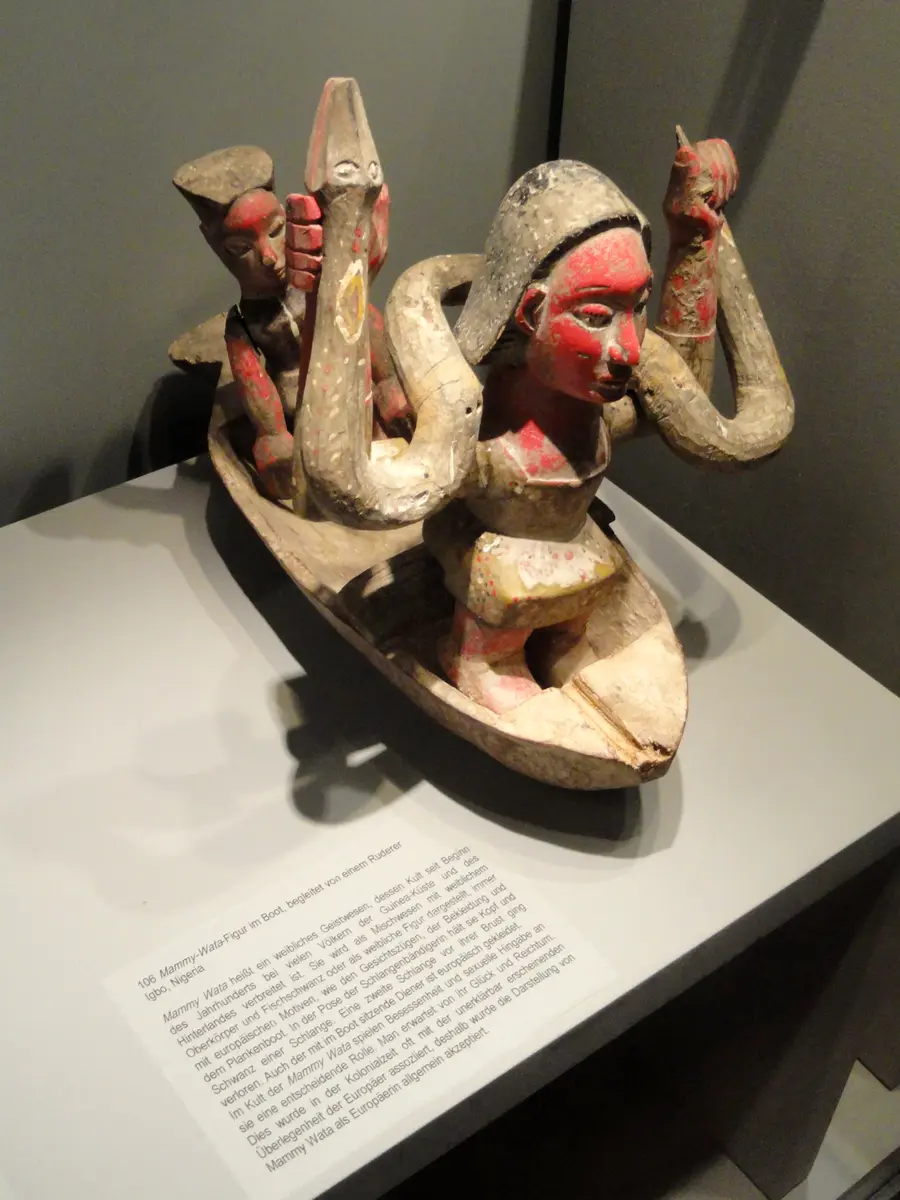
The object photographed for this page is a Yoruba figure of Mammy Wata in a boat, from Nigeria, held by the Museum Fünf Kontinente at Maximilianstraße 42, 80538 Munich, telephone +49 89 210136100. Its permanent sub-Saharan gallery is "Subsahara-Afrika. Lebendige Traditionen – Kreative Gegenwart", drawn from an African collection of some 26,000 objects. Checked on 11 September 2026, the city portal muenchen.de gives opening hours of 09:30 to 17:30 from Tuesday to Sunday, with Mondays closed. Admission is 5 €, 4 € reduced and 1 € on Sundays; under-18s and school pupils enter free. Daderot took the photograph on 3 May 2011 and released it into the public domain, and its credit line still reads Staatliches Museum für Völkerkunde München, the name the museum carried until 9 September 2014. Whether the figure is on display on a given day is a question for the museum.
The largest gathering of this material was "Mami Wata: Arts for Water Spirits in Africa and Its Diasporas", curated by Henry John Drewal at the Fowler Museum at UCLA, 308 Charles E. Young Drive North, Los Angeles, California 90024. It ran from 6 April to 10 August 2008 and then travelled to the Chazen Museum of Art in Madison, the National Museum of African Art in Washington, the Mariners' Museum in Newport News and the Cantor Arts Center at Stanford. The exhibition is over; the Fowler's holdings are not. Checked on 11 September 2026, the Fowler opens Wednesday from noon to 8 pm and Thursday to Sunday from noon to 5 pm. It closes Monday and Tuesday, and admission is always free. Mami Wata pieces are also held by the National Museum of African Art in Washington, the High Museum in Atlanta and the Michael C. Carlos Museum at Emory.
Sources consulted
- Henry John Drewal, «Performing the Other: Mami Wata Worship in Africa» — TDR (The Drama Review), vol. 32, no. 2 (Summer 1988), pp. 160-185, The MIT Press, 1988 academic
- Henry John Drewal, with Marilyn Houlberg, Bogumil Jewsiewicki, John W. Nunley and Jill Salmons, «Mami Wata: Arts for Water Spirits in Africa and Its Diasporas (exhibition preview)» — African Arts, vol. 41, no. 2 (Summer 2008), pp. 60-83, UCLA James S. Coleman African Studies Center, 2008 academic
- Daderot (photographer and uploader), «Figure of Mammy Wata in Boat, Nigeria - Staatliches Museum fur Volkerkunde Munchen (file page)» — Wikimedia Commons; photograph taken 3 May 2011, uploaded 3 July 2011, released into the public domain, 2011 web
- Wikipedia contributors, «Nala Damajanti» — English Wikipedia; compiles the identification from the Archives departementales du Jura (etat civil, 1790-1912) and from Le Gaulois, 17 March 1887, p. 2 and 18 February 1887, p. 4, 2026 web
- Fowler Museum at UCLA, «Mami Wata: Arts for Water Spirits in Africa and Its Diasporas (exhibition record)» — fowler.ucla.edu; exhibition 6 April - 10 August 2008, guest curator Henry John Drewal, 2008 web
- Kensedeobong Okosun, «Remembering Victor Uwaifo, Guitar Boy and the quest to meet Mami Wata» — Nigerian Observer, 28 August 2025, 2025 newspaper archive
- Landeshauptstadt Munchen, «Museum Funf Kontinente (visitor information)» — muenchen.de; address, hours and admission prices consulted August 2026, 2026 web
Reviewed by V. Serrano on 2026-08-15 · How we verify our content
📎 Source: Enigma Atlas
💬 Field testimonies (0)
No testimonies yet. Add the first.
Add your testimony
🔒 Log in to add a testimony