📜 LEGEND · EXP. Nº3657
ACTIVE
Peer Gynt and the Trolls of Dovre
Peer Gynt and the Trolls of Dovre is a legend from Macizo de Dovrefjell, NO — a folk story passed down over generations. This file collects its origins, its meaning and how it has been retold.
Where does the legend of Peer Gynt and the Trolls of Dovre come from?
- Location
- Macizo de Dovrefjell, NO
- Kind of legend
- Folk tale
- Coordinates
- 62.3, 9.5
- Testimonies
- 0
- Last updated
LOCATION
What is the legend of Peer Gynt and the Trolls of Dovre?
Two different men have been called Peer Gynt, and they are easily run together. The first is a hunter from Kvam in Gudbrandsdalen, told to Peter Christen Asbjørnsen in 1842 by a man named Peer Fugleskjelle and printed in 1848 — and before he began, Fugleskjelle warned that he would only be telling a rægle, a tall tale that people took for a lie locally too. In that version Peer wrestles the Bøyg in the dark at Høvringen, empties a pot of soup over a troll's nose, drives four named hill-trolls out of a mountain dairy, and clears a farm on Dovre one Christmas Eve by setting a tame white bear on the trolls in it. There is no mountain king in it at all. The troll court, the Dovregubbe's daughter in green, the offer to slit Peer's left eye and cut out his right so that the world would look handsome to him, and the church bells that scatter the hall all belong to Henrik Ibsen's dramatic poem of November 1867 — and even in Ibsen the palace is not under Dovre but inside the Ronde. Before that book, the word Dovregubben turns up once in sixty-six years of Norwegian newspapers.
What is the history of Peer Gynt and the Trolls of Dovre?
Two different men have been called Peer Gynt, and they are easily run together.
The first was written down on a shooting trip. Peter Christen Asbjornsen went up into the Rondane in 1842 and turned his notes into a framed sketch, «Høifjeldsbilleder II: Reensdyrjagt ved Ronderne», printed in the second collection of Norske Huldre-Eventyr og Folkesagn (Christiania, 1848). Everything in it is given to a named man. Anders tells about Ola Storbækkjen, then about the ptarmigan hunter Ola Helle; when Anders says nothing more comes to mind, the narrator turns to Peer Fugleskjelle, who talks fast, stammers a little and then lets the speech run out again in a broader, quicker stream. What Fugleskjelle says before he starts is the most important sentence in the whole source and the one nobody quotes: «I could tell you stories that old folk believe are true and say happened in olden days; but maybe you think it is a lie; so I will just tell you a rægle, one they take for a lie here too.» Asbjornsen's own glossary at the back of the book defines rægle as «Historie, Eventyr» — a story, a wonder tale. Teller and collector both filed it under tales.
The tale opens: «There was a hunter in Kvam in the old days, and his name was Peer Gynt.» He shot bear and elk on the mountain, because in those days there was more forest up there for such beasts to live in. Coming up towards Høvringen in the dark he walks into something cold, big and slippery that answers him three times, «Oh, it is the Bøyg» — the great Bøyg of Etnedalen — and he puts three bullets into its head and drags it out of the doorway. He shoots a bear that had been a girl calling sheep up a hillside, and a fox, and nails the heads to the wall of the saeter with their jaws gaping; a troll pushes its nose in through the window and he empties the soup pot over it. Then he walks north to the Vala saeter and finds four hill-trolls, all named — Gust i Væré, Thron Valfjeldet, Kjøstøl Aabakken and Rolf Eldførpungen — forcing their company on the three dairymaids, and clears them out with dogs, rifle and rifle-butt.
Only after all that, and only once, does the story go to Dovre. Peer hears of a farm there so full of trolls every Christmas Eve that the household has to go and sleep with the neighbours. He dresses in rags, takes along a tame white bear, an awl, pitch and waxed twine, sews a shoe out of a whole pigskin big enough to catch every troll foot at once, and then sets the bear on them. Years later a troll calls out of the wood to the farmer: «Have you still got that big white cat of yours?» — «Yes, she is at home behind the stove, and she has seven cubs now, much bigger and fiercer than herself.» «Then we will never come to you any more.» That is the entire Dovre content of the folk Peer Gynt. There is no troll king in it, no daughter, no royal hall, no crown and no offer to operate on anybody's eyes. Anders closes the evening with a verdict on the man: «That Peer Gynt was one on his own. He was a real tale-maker and a yarn-smith; he always made out that he himself had been in all the stories people said had happened in the old days.» Fugleskjelle then supplies the link in the chain of transmission: «My grandmother had known him; she told me these after him more than once.»
The rest is Henrik Ibsen's, and he documented it himself in letters to his publisher Frederik Hegel. On 5 January 1867, from Rome, the new work is «a long dramatic poem, having as its chief figure one of the Norwegian peasantry's half-mythical, fantastic heroes of recent times». On 8 August, sending the first three acts from the Villa Pisani at Casamicciola on Ischia, he adds the sentence that has been quoted ever since: «It may interest you to know that Peer Gynt is a real person, who lived in Gudbrandsdal, probably at the end of last, or beginning of this, century; but of his exploits not much more is known than is to be found in Asbjörnsen's Norwegian Fairy Tales, in the section Pictures from the Mountains.» And he adds: «Thus I have not had very much to build upon; but so much the more liberty has been left me.» Morgenbladet announced on 25 October that the book could be expected in a few weeks; it was published on 14 November 1867.
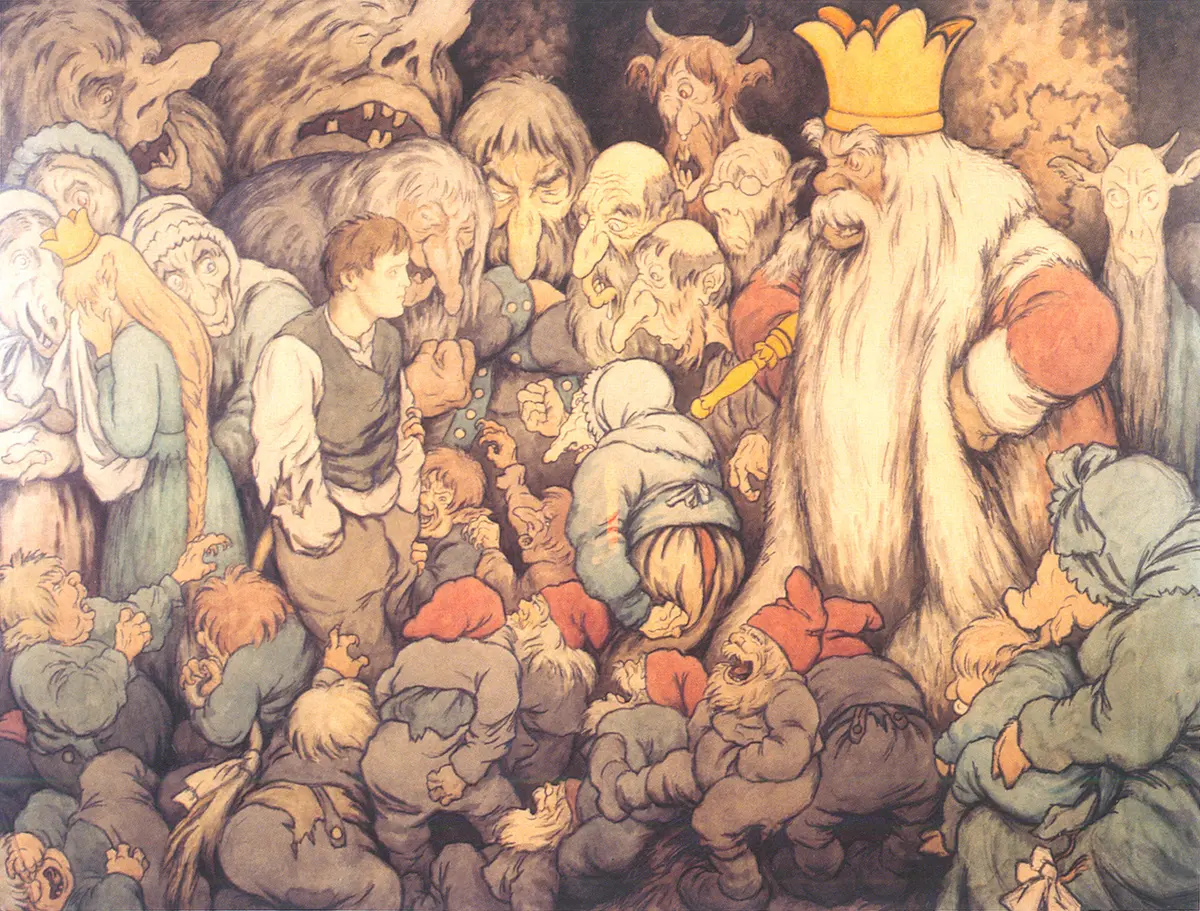
What Ibsen built is the second act. Peer, on the run after carrying off another man's bride from the wedding at Hæggstad, meets a woman in green who tells him her father's castle is «inde i Ronden», and they ride in through the Rondeporten. In the royal hall the Old Man of the Dovre offers him a crown, half the kingdom now and half at his death, the girl, and then the operation: «In your left eye, first, I'll scratch you a bit, till you see awry; but all that you see will seem fine and brave. And then I'll just cut your right window-pane out.» Peer asks when his sight would heal back into human sight and is told «Nevermore», and it is at that word that he refuses. The Old Man then tells him the green woman is carrying his child, orders the imps to dash him to shards on the rock walls, and goes to bed complaining that he is worried and sleepy. Peer is buried under the imps calling for his mother when the stage direction arrives: «Kirkeklokker ringer langt borte», church bells ring far away. The imps shout «Bells in the mountain! It is the Black-cassock's cattle!», the trolls scatter and the palace collapses. William Archer, who translated the play in 1907 and printed Asbjornsen's original beside it, put the relation plainly: «the Peer Gynt of the drama has really nothing in common with the Peer Gynt of the story.»
Timeline: the documented record of Peer Gynt and the Trolls of Dovre
- by 1617 The timber for the loftstue at Hågå in Nord-Fron is felled. The dating is not traditional: Maihaugen had tree-ring analyses done on the building in 2001, and they broadly confirmed Anders Sandvig's own guess of the mid-1600s. Maihaugen presents the building as having belonged to the historical Per Gynt; the rings date the house, not the man.
- 1842 Asbjornsen travels in Gudbrandsdalen and the Rondane and takes the field notes behind the sketch. The Peer Gynt narrative is told to him by Peer Fugleskjelle, who prefaces it by saying he will tell only a rægle, «one they take for a lie here too», and afterwards adds that his grandmother had personally known Peer Gynt.
- 1848 «Høifjeldsbilleder II: Reensdyrjagt ved Ronderne» is printed in the second collection of Norske Huldre-Eventyr og Folkesagn, Christiania. It contains the whole of the folk Peer Gynt: the Bøyg at Høvringen, the four named hill-trolls at the Vala saeter, and the single Dovre episode of the Christmas farm cleared with a tame white bear. No troll king appears anywhere in it.
- 30 January 1850 Morgenbladet prints the earliest mention of «Peer Gynt» in the whole digitised Norwegian newspaper archive, seventeen years before Ibsen. It calls the tale «remarkably grand and grotesquely whimsical», describes Peer as «en Høifjelds-Nimrod» who hunted wild beasts up there, and retells the saeter episode with the troll-men and the bold dairymaids.
- 5 January 1867 Ibsen writes to his publisher Frederik Hegel from Rome that his new work is well under way: a long dramatic poem whose chief figure is «one of the Norwegian peasantry's half-mythical, fantastic heroes of recent times». It is the first unmistakable reference to Peer Gynt in his correspondence.
- 8 August 1867 From the Villa Pisani at Casamicciola on Ischia, Ibsen sends Hegel the first three acts and names his source: Peer Gynt «is a real person, who lived in Gudbrandsdal, probably at the end of last, or beginning of this, century», and of his exploits little more is known «than is to be found in Asbjörnsen's Norwegian Fairy Tales, in the section Pictures from the Mountains» — which is exactly the Høifjeldsbilleder section of the 1848 book.
- 25 October 1867 Morgenbladet tells its readers that Ibsen's previously mentioned new work is «a dramatic poem with the title Peer Gynt» and can be expected in a few weeks. It is the earliest 1867 newspaper trace of the book, three weeks before publication.
- 14 November 1867 Peer Gynt: et dramatisk Digt is published in Copenhagen by Gyldendal. The Dovregubbe, his hall, his daughter in green, the offer to operate on Peer's eyes and the church bells that break the scene all enter the world on this date; none of them is in Asbjornsen.
- 22 November 1867 Eight days after publication, Morgenbladet summarises the new poem and prints the first occurrence of «Dovregubben» in the digitised Norwegian press since a single stray hit in 1860: Peer «has been taken into the mountain by the Dovregubbe». Before the year is out it appears in four more issues: two more of Morgenbladet (29 November and 1 December), Tunsbergeren (27 November) and Aftenbladet (28 December).
- 23 February 1876 Morgenbladet carries the theatre bill announcing Peer Gynt «for the first time», «a dramatic poem in five acts by Henrik Ibsen; the music by Edvard Grieg». The staging is what turns the Dovregubbe into an international property, through the piece Grieg wrote for the hall scene. Papers over the following days already report cast substitutions because of illness.
- 1903–1904 Anders Sandvig buys the loft from Hågå in 1903, and in 1904 it is among the first buildings erected at Maihaugen in Lillehammer. He was unsure of its age and estimated the mid-1600s from the notching and the interior. Photographs of it still standing at Hågå, taken in 1902 by H. H. Lie, remain in the museum's collection.
- 1913 Theodor Kittelsen signs and dates «Peer Gynt i Dovregubbens hall», the picture on this page: mixed technique on paper laid on parchment, about 90 by 120 cm. It illustrates Ibsen's scene, not the folk tale — the crown, the sceptre and the court of trolls are all from the play. Kittelsen died the following year.
- 2001 Tree-ring analysis is carried out on the timber of the Per Gynt loft at Maihaugen. The samples show the wood was felled in the years up to 1617, which the museum reads as construction beginning that year and the house being finished shortly after — roughly 180 years before the date Ibsen gave for the man himself.
- 2026, and next in 2027 The Peer Gynt culture festival at Gålå closes its 2026 season reporting about 30,200 visitors across its arenas, and announces the next open-air production of the play for 30 July to 13 August 2027, with Thorbjørn Harr returning in the title role. The festival is in Sør-Fron in Gudbrandsdalen, some ninety kilometres south of Dovre.
Is there a rational explanation for Peer Gynt and the Trolls of Dovre?
There is no haunting here to explain away. What can be checked is who said what and when, and two things easily assumed about the troll king do not survive the check.
First, the place: the Dovregubbe's title invites a hall under the Dovre mountain and a folk tale behind it. Counted in the sources themselves, the geography runs the other way. In Asbjornsen's Norwegian text the root Ronde- appears 17 times (Ronderne, Rondene, Rondetinden, Rondebræerne and so on) against 2 for Dovre- and 1 for Kvam: it is a Rondane story with a single Dovre episode. In the scanned first edition of Ibsen's book at the National Library of Norway the wildcard Dovre* returns 74 hits and Ronde* returns 5, but those five are load-bearing: the green-clad woman says her father's castle is inside the Ronde, they enter through the Rondeporten, and the Old Man makes Peer swear never to heed anything beyond «Rondernes Grænser», and Kvam* returns 0. In the play the hall is inside the Ronde, and Dovre supplies only the king's title. (The library's search matches whole words: «Gendin» returns 0 because Ibsen spells it Gjendin, which returns 5, and the wildcard is what makes the counts safe.)
Second, the age of the material. That the Dovregubbe is ancient is easy to write and impossible to disprove, and it can be measured instead. In the National Library's digitised Norwegian newspapers, the years 1800 to 1866 return exactly 1 hit for «Dovregubben», and that single hit is genuine — a poem printed in Lørdags-Aftenblad for Arbeidsklassen in 1860. The same window returns 251 for «Dovrefjeld», 118 for «Huldren», 23 for «Jutulen», 2 for «Troldkongen», 1 for «Bergkongen» and 0 for «Dovrekongen». The mountains, the hulder and the jutul were in the papers constantly; the Old Man of the Dovre was not. From 1867 to 1900 «Dovregubben» returns 697, and the first hit after the book came out is Morgenbladet of 22 November 1867 — eight days after publication — summarising the new poem's hero as having been «bleven bjergtagen hos Dovregubben». Newspaper corpora grow with time, so the argument rests on the ratios inside the pre-1867 window, where the controls show that the corpus and the query both work; rerun through the library's API on 28 September 2026, the counts are unchanged. The pre-Ibsen Peer Gynt is measurable too, and he is the folk one: the earliest «Peer Gynt» in the whole newspaper archive is Morgenbladet of 30 January 1850, which calls him «en Høifjelds-Nimrod», a highland Nimrod who hunted wild beasts, and retells the saeter episode with the troll-men and the bold dairymaids. Seventeen years before Ibsen, and with no mountain king in it.
One date check cuts the other way. Maihaugen's loft from Hågå, presented as the home of the historical Per Gynt, was dendrochronologically dated in 2001 to timber felled in the years up to 1617. Ibsen placed his model «at the end of last, or beginning of this, century», that is around 1800, and in 1842 Peer Fugleskjelle said his own grandmother had known the man. Those two datings are about 180 years apart, and both can stand, since farm buildings outlive their owners by centuries. The tree rings date the building; Maihaugen's record calls Hågå «den historiske Per Gynts hjemsted», the historical Per Gynt's home, and cites no document for it.
Can you visit Peer Gynt and the Trolls of Dovre?
Start with what the map pin on this page is and is not. Neither source anchors the mountain hall to a coordinate. Asbjornsen names «a farm on Dovre» without naming the farm; Ibsen names no place on any map and puts the palace inside the Ronde. The point used here, 62.3 N 9.5 E, is given to one decimal on purpose: it is a convention marking the Dovrefjell plateau a few kilometres from Hjerkinn, not a site, and one decimal of latitude is already about eleven kilometres of uncertainty. Nothing at that point commemorates anything. Treat it as a label on a massif.
Dovrefjell itself is easy to reach and worth the trip on its own terms. The E6 and the Dovre railway line both cross it, with Dombås and Hjerkinn as the practical bases. The main draw is the musk oxen of Dovrefjell-Sunndalsfjella, the largest herd in Europe, which are dangerous at close range and are normally seen on a guided safari rather than alone. Viewpoint Snøhetta stands on Tverrfjellet just west of Hjerkinn: about twenty minutes on foot from the car park on an easy, well-kept path, open around the clock in the summer season from 1 June and closed in winter, with staff inside during the day. The one thing at Dovre that actually carries the troll king's name is a hotel: Dovregubbens Hall, Trondheimsvegen 2100, 2660 Dombås (tel. +47 61 24 29 17), a farmstead between Vålåsjø and Avsjø on the old road that says of itself that it has served food and lodging on Dovrefjell since 1936, and which arranges musk-ox safaris with local guides. It is a good place to sleep. It is not a rock formation and it is not old.
If what you came for is Peer Gynt, the living sites are ninety kilometres to the south, in Gudbrandsdalen, where both the folk hero and Ibsen's model belong. Kvam, the village the tale gives as his home, and Hågå in Nord-Fron, traditionally named as the farm, are both in the Fron district. The loft from Hågå no longer stands there: Anders Sandvig bought it in 1903 and it was among the first buildings raised at Maihaugen in Lillehammer in 1904, where it can be visited with the rest of the open-air museum. It is properly a loftstue rather than a loft — a grain store below, and above it a heated room of twenty-six square metres with a soapstone fireplace in the corner — and its timber was felled by 1617. Photographs of it standing at Hågå in 1902, before the move, survive in the museum's collection.
The play is performed outdoors every other summer beside Lake Gålå in Sør-Fron, by the Peer Gynt culture festival, whose office is at the Peer Gynt House, Kapellvegen 1, 2640 Vinstra. The 2026 season has finished; the organisers report about 30,200 visitors across their arenas and have announced the next open-air production for 30 July to 13 August 2027, with Thorbjørn Harr again in the title role. Book directly through the festival, and expect an evening outdoors at altitude — dress for it.
The texts cost nothing and are the best visit of all. Asbjornsen's original is transcribed in full at bokselskap.no as «Høifjeldsbilleder II: Reensdyrjagt ved Ronderne», with the editorial glosses that explain words like rægle and hoga. The first edition of Ibsen's Peer Gynt of 1867 is scanned page by page at the National Library of Norway and is full-text searchable. William Archer's 1907 English translation is free at Project Gutenberg, and its appendix prints Asbjornsen's Peer Gynt in English — the two texts side by side, which is the fastest way to see how little of the play is in the folk tale.
Sources consulted
- Peter Christen Asbjørnsen, «Høifjeldsbilleder II: Reensdyrjagt ved Ronderne, in Norske Huldre-Eventyr og Folkesagn, second collection» — Christiania. Full Norwegian text consulted in the bokselskap.no transcription with its editorial glosses; contains Peer Fugleskjelle's rægle preface, the whole Peer Gynt narrative and Anders's closing verdict. The book's own Glossarium defines «Rægle, f., Historie, Eventyr». Counted in this text: Ronde- 17, Dovre- 2, Kvam 1, Peer Gynt 14, 1848 book
- Henrik Ibsen, «Peer Gynt: et dramatisk Digt, first edition» — Gyldendalske Boghandel, Copenhagen. First-edition scan at the National Library of Norway, searched full-text: Dovre* 74 hits, Ronde* 5, Kvam* 0, Gjendin 5, Kirkeklokker 1. The stage direction «Kirkeklokker ringer langt borte» and the imps' cry «Bjelder i Fjeldet! Det er Svartekjolens Kjer!» are quoted from this copy, 1867 book
- Henrik Ibsen, translated by William and Charles Archer, «Peer Gynt, with introduction and appendix, in The Collected Works of Henrik Ibsen, vol. IV» — William Heinemann, London. Archer's introduction quotes the letters to Hegel of 5 January and 8 August 1867 and dates publication to 14 November 1867; the appendix prints Asbjørnsen's Peer Gynt and Gudbrand Glesnë in English after H. L. Brækstad's version, and states that «the Peer Gynt of the drama has really nothing in common with the Peer Gynt of the story», 1907 book
- unsigned, «Notice on Asbjørnsen's tales, including Peer Gynt «en Høifjelds-Nimrod»» — Morgenbladet, Christiania, 30 January 1850. The earliest occurrence of «Peer Gynt» in the National Library's digitised Norwegian newspaper archive; retells the saeter episode with no troll king in it, 1850 newspaper archive
- unsigned, «Review of Ibsen's new dramatic poem: Peer Gynt «bleven bjergtagen hos Dovregubben»» — Morgenbladet, Christiania, 22 November 1867. The first occurrence of «Dovregubben» in the digitised Norwegian press after the 1860 stray hit, eight days after the book was published, 1867 newspaper archive
- Christiania Theatre (advertisement), «Theatre bill: «for første Gang: Peer Gynt, et dramatisk Digt i 5 Akter af Henrik Ibsen; Musiken af Edvard Grieg»» — Morgenbladet, Christiania, 23 February 1876, 1876 newspaper archive
- Nasjonalbiblioteket, «Full-text counts in the digitised Norwegian newspaper archive (aviser), by year range» — Queried 16 August 2026 through the library's catalogue API. 1800–1866: Dovregubben 1, Dovregubbe 0, Dovrekongen 0, Bergkongen 1, Troldkongen 2, Jutulen 23, Huldren 118, Dovrefjeld 251, Peer Gynt 1, Ronderne 17. 1867–1900: Dovregubben 697, Dovregubbe 53, Dovrekongen 14, Jutulen 158, Huldren 1771, Peer Gynt 2745. Also the 25 October 1867 Morgenbladet announcement of the forthcoming book. The single pre-1867 Dovregubben hit was opened and verified: a poem in Lørdags-Aftenblad for Arbeidsklassen, 1860, 2026 archive
- Kjell Marius Mathisen, Maihaugen, «Per Gynt-loftet fra 1617» — DigitaltMuseum record for the loftstue from Hågå in Nord-Fron: bought by Anders Sandvig in 1903, erected at Maihaugen in 1904, tree-ring dated in 2001 to timber felled by 1617, with the 1902 photograph by H. H. Lie of the building still standing at Hågå, 2001 report
- Olav Solberg, «Innleiing til Norske Huldreeventyr og Folkesagn» — Det norske språk- og litteraturselskap / bokselskap.no. Dates the first collection to 1845 and the second to 1848, places «Reensdyrjagt ved Ronderne» in the Høifjeldsbilleder group of the second collection, and traces it to Asbjørnsen's field notes from an 1842 journey through Gudbrandsdalen, 2010 academic
- Theodor Kittelsen (1857–1914), «File:Per gynt i dovregubbens hall.jpg» — Wikimedia Commons file page: attributed to Kittelsen, dated 1913, public domain, uploaded in March 2011. Pixel-compared against the copy served on this page and found to be the same image at 1500×1139 against our 1200×911, 1913 web
- Dovregubbens Hall, «Dovregubbens Hall — overnatting og servering på Dovrefjell» — Official site. Trondheimsvegen 2100, 2660 Dombås; states it has offered food and lodging on Dovrefjell since 1936; lists musk-ox safaris with local guides and gives Viewpoint Snøhetta as about twenty minutes on foot from the car park, open around the clock from 1 June in summer and closed in winter, 2026 web
- Peer Gynt AS, «Kulturfestivalen Peer Gynt, Gålå» — Official site, Peer Gynt-huset, Kapellvegen 1, 2640 Vinstra. Reports about 30,200 visitors to the 2026 season and announces the next open-air production for 30 July to 13 August 2027 with Thorbjørn Harr in the title role, 2026 web
Reviewed by V. Serrano on 2026-08-16 · How we verify our content
📎 Source: Enigma Atlas
💬 Field testimonies (0)
No testimonies yet. Add the first.
Add your testimony
🔒 Log in to add a testimony