🦶 CRYPTID SIGHTING · EXP. Nº9046
ACTIVE
Kraken
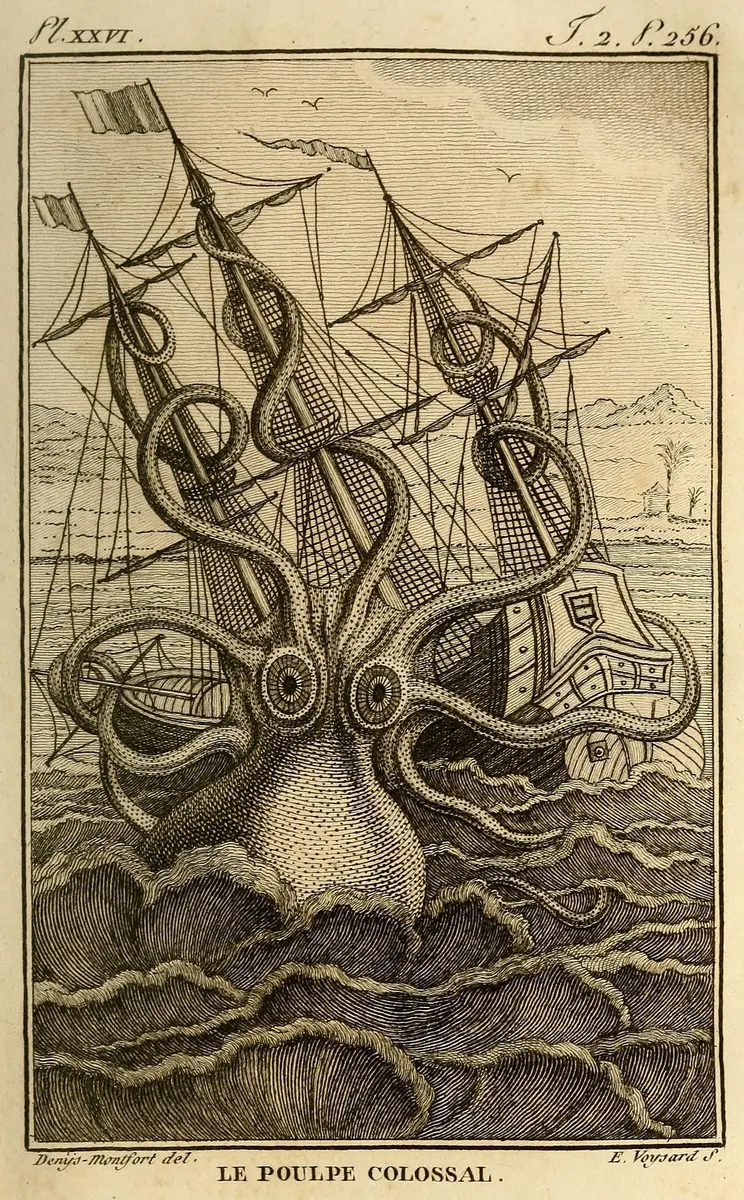
The Kraken is a legendary sea monster of Scandinavian folklore, imagined as a colossal, tentacled creature capable of dragging entire ships beneath the waves of the Norwegian Sea.
Where and when was Kraken sighted?
- Location
- Norwegian Sea, Norway
- Date sighted
- 1752-01-01
- Coordinates
- 66.0, 4.0
- Last updated
LOCATION
What is Kraken?
Norse sagas and later Scandinavian accounts described it less as a single beast than as an island-sized entity whose surfacing could create whirlpools and swallow vessels whole, blending sailors' fear of the deep with genuine maritime hazards. The creature's definitive description came in 1752, when Norwegian bishop and naturalist Erik Pontoppidan published his "Natural History of Norway," writing that sailors mistook its broad back for "a number of small islands" rising suddenly from calm water. The legend likely drew on real encounters with giant squid, whose enormous size and rarely seen carcasses would have seemed monstrous to sailors long before marine biologists documented the species. Over the centuries the Kraken shifted from local seafaring lore into wider European literature and popular culture, becoming a broad symbol of the ocean's untamed vastness rather than a creature anyone still claims to track scientifically.
What is the history of Kraken?
The oldest layer of the kraken story is Norse. The Icelandic Örvar-Odds saga, a thirteenth-century story, names two sea monsters, the hafgufa ('sea-mist') and the lyngbakr ('heather-back'), and the Norwegian encyclopedia Konungs skuggsjá, the King's Mirror, from around 1250, later described their habits. Rodrigo Salvador and Barbara Tomotani, who traced the pedigree in 2014, list what the two shared with the kraken, a size "as big as an island or mountain" and an inclination to attack ships and their crews, and note that for that reason they have been treated as the same monster.
The kraken became a scientific claim in 1735, when Linnaeus listed Microcosmus marinus in the first edition of Systema naturae. In Fauna Svecica (1746) he called it a "singular monster" of the Norwegian seas while stating that he had never seen one, and he later removed it from Systema naturae.
Erich Pontoppidan, Bishop of Bergen, described the creature in Det første Forsøg paa Norges naturlige Historie (1752-53), printed in English translation in London for A. Linde in 1755. He gives its names as Kraken, Kraxen and Krabben, and also Horven, Soe-horven and Anker-trold, and says he wrote "according to what has been related to me by my correspondents". His fishermen report that when they expect 80 or 100 fathoms of water and find only 20 or 30, the kraken is beneath them and the fishing is unusually rich; if the bottom keeps rising they row away, and minutes later its back surfaces, about an English mile and a half round. Arms "as high and as large as the masts of middle-siz'd vessels" rise from it, and when it sinks again it pulls everything near it into a whirlpool. Salvador and Tomotani add that almost all later naturalists discredited his reports "due to his exaggerations and plain inventions".
The animal behind the legend entered science in the 1850s. In December 1853 a giant cephalopod stranded on Raabjerg beach in Denmark was cut into pieces for bait, and only its beak was recovered; the Danish zoologist Japetus Steenstrup used it to describe the giant squid. His note naming Architeuthis dux fills pages 182 to 185 of the proceedings of the meeting of Scandinavian naturalists, published in 1857.
Riley Black wrote in 2011 that most of what is known about Architeuthis comes from squid stranded at the surface or hauled up in fishing nets, or from beaks found in the stomachs of sperm whales. The best-known record of the period is the French vessel Alecton's: on 30 November 1861 near Tenerife its crew harpooned a squid of about 7.5 m, whose body broke apart as they tried to haul it aboard. The first images of a live giant squid in its natural habitat were taken at 09.15 on 30 September 2004, 900 m down off the Ogasawara Islands.
Timeline: the documented record of Kraken
- c. 1250 The Norwegian encyclopedia Konungs skuggsjá (King's Mirror) describes the habits of the hafgufa and the lyngbakr, two sea monsters named in the Icelandic Örvar-Odds saga. Both are as big as an island or mountain and given to attacking ships and their crews, traits they share with the kraken.
- 1735 Linnaeus lists Microcosmus marinus in the first edition of Systema naturae, giving the kraken a scientific name. He calls it a singular monster of the Norwegian seas in Fauna Suecica (1746), admits he has never seen one, and removes it from later editions.
- 1752-53 Erik Pontoppidan, bishop of Bergen, publishes Det første Forsøg paa Norges naturlige Historie. His kraken is round, flat and full of arms, looks at first like a number of small islands, lies under grounds where fishermen find unusually rich fishing, draws everything down in a whirlpool when it sinks and, in some months, voids excrement that leaves the water thick and turbid. Andreas Berthelson's English translation appears in London in 1755.
- December 1853 Japetus Steenstrup obtains the beak of a huge cephalopod stranded on the Danish coast. It is the physical evidence on which the scientific description will rest.
- 1857 Steenstrup publishes "Oplysninger om Atlanterhavets colossale Blæksprutter" and names Architeuthis dux. The giant squid becomes a named species.
- 30 November 1861 The French vessel Alecton harpoons a squid about 7.5 m long near Tenerife, in the Canary Islands. The body breaks up as the crew try to haul it aboard and only the rear of the mantle is recovered — but the fragment is real, and it is seen by officers of a navy.
- 1870s A run of specimens reaches shore in Newfoundland. The Reverend Moses Harvey obtains squid from local fishermen and photographs one before sending it to naturalists in Connecticut; among the material is a tentacle some 19 feet long, cut from an animal that fishermen said had come at their boat.
- 30 September 2004 At 09:15, at 26°57.3'N 142°16.8'E off the Ogasawara Islands, a baited camera rig lowered by Tsunemi Kubodera and Kyoichi Mori photographs a live giant squid at 900 m. More than 550 images are recorded over about four hours; the animal tears free leaving a 5.5 m tentacle behind, confirming a specimen over 8 m long. The images show an active hunter, not the drifting animal that had been assumed.
- 2008 The Museum of New Zealand Te Papa Tongarewa puts on display a colossal squid (Mesonychoteuthis hamiltoni) taken in the Ross Sea. It remains the only colossal squid on public display in the world.
Is there a rational explanation for Kraken?
Salvador and Tomotani open their 2014 review with the identification that settles the kraken: "Today we know the legends of this monster were based on sightings of giant squids." The same review limits how far that identification can be pushed. It notes that nearly all sea monsters had some or all of the kraken's traits, an island-like size and a readiness to attack ships, and that many of them were "linked to or confused with" it over the centuries. Pontoppidan's own chapter shows how little of his animal matches a squid: a back "about an English mile and an half in circumference" that looks "like a number of small islands", and a descent that causes "such an eddy or whirlpool, that it draws every thing down with it".
The detail most often read as ink is weaker in the 1755 English text than its reputation. Salvador and Tomotani write that Pontoppidan had reported "the monster's habit of blackening the sea with a gush of dark liquid", and they link it with the ink of cephalopods. In Berthelson's translation the passage describes the creature voiding "his excrements", after which the surface of the water "appears quite thick and turbid" and draws fish to it. The Store norske leksikon summarises the same passage as excrement that makes the water murky and foul-smelling.
The sizes in circulation are larger than the measured ones. Kubodera and Mori, who photographed a live giant squid in 2004, give 18 m as the longest total length on record, more than 12 m of it the two feeding tentacles, and add that because these tentacles "can stretch as they decay, upper size claims for giant squids may be overestimated". Salvador and Tomotani note that the tentacles of Architeuthis lack the musculature to be used as constricting weapons, and that adult giant squid are preyed upon almost exclusively by sperm whales. Riley Black, writing in Smithsonian in 2011, tells the 1873 story of a giant squid that allegedly attacked fishermen in Conception Bay, Newfoundland, and tried to sink their boat, and warns that "the details are a little murky due to some creative retelling over the years". Her conclusion is that "the squid are not man-eating ship sinkers, but capable predators in an utterly alien world devoid of sunlight".
The name still attracts speculative science. At the Geological Society of America meeting in 2011, Mark and Dianna McMenamin proposed that a Triassic "kraken" about 30 m long had killed the ichthyosaurs of Berlin-Ichthyosaur State Park in Nevada and arranged their vertebrae in patterns. When McMenamin presented further evidence in 2013, the palaeontologist David Fastovsky told LiveScience that "a kraken isn't really necessary", and explained the arrangement as a spine that, once its tendons and ligaments had rotted or been eaten, "sort of starts to fall over almost like a row of dominoes".
Can you visit Kraken?
The pin on this file, at 66° N 4° E, is a nominal point in the open Norwegian Sea, the water off the coast where Pontoppidan collected his fishermen's accounts. No sighting is recorded at that spot; the round figures stand for the sea the legend belongs to. The nearest land at that latitude is the Træna archipelago off the Helgeland coast, about 370 km (230 miles) to the east.
NTNU Vitenskapsmuseet in Trondheim keeps several giant squid from the Trondheimsfjord. In the description of its photo album of them, which carries no date, the museum says the Norwegian finds have been dead or dying animals, stranded or taken near the shore, and adds "Dessverre er det ikke mulig å stille dem ut": unfortunately it is not possible to put them on show, because of the state they were in.
The Museum of New Zealand Te Papa Tongarewa, 55 Cable Street, Wellington, describes its specimen as "the only colossal squid on display in the world": a Mesonychoteuthis hamiltoni from the Ross Sea, one of three the museum holds. On 23 September 2026 its visitor page gave the hours as 10:00 to 18:00 every day except Christmas Day, with entry free for people living in New Zealand and NZ$35 for international visitors aged 16 and over.
At the Natural History Museum in London, the giant squid known as Archie, an 8.62-metre female caught off the Falkland Islands in 2004, lies in a nine-metre tank in the Darwin Centre, where it has been since 1 March 2006. It is kept in the Spirit Collection, outside the public galleries, and is shown on the museum's Spirit Collection tour; on 23 September 2026 that tour was priced at £35 (£28 for members), lasted 45 minutes, was open to ages 10 and over, and had no dates available to book.
In Washington, the Sant Ocean Hall of the Smithsonian's National Museum of Natural History has shown two giant squid since it opened in September 2008, a female and a smaller male, both from Spanish waters and obtained through the Coordinadora para el Estudio y la Protección de las Especies Marinas (CEPESMA). Smithsonian Magazine gave the female as "36 feet long at the time of her capture, 22 feet of which were accounted for by her feeding tentacles", about 11 metres in all. Admission to the museum is free.
At Luarca, in Asturias, the Museo del Calamar Gigante was wrecked by the storm of 2 February 2014 and reopened on 15 July 2022 in the former Villa Blanca nightclub, Calle Nicanor del Campo 35, with six complete giant squid among its specimens. The Valdés municipal tourism site, consulted on 23 September 2026, gives general admission at €4, free under 11, and seasonal hours, with the museum closed on Mondays and Tuesdays outside public holidays.
Sources consulted
- Erich Pontoppidan (trans. Andreas Berthelson), «The Natural History of Norway, in Two Parts» — A. Linde, London — English translation of Det første Forsøg paa Norges naturlige Historie (1752-53), 1755 book
- Japetus Steenstrup, «Oplysninger om Atlanterhavets colossale Blæksprutter (original description of Architeuthis dux)» — Forhandlinger ved de Skandinaviske Naturforskeres Møde, 7 (1856): 182-185 — record consulted in the World Register of Marine Species, 1857 academic
- Tsunemi Kubodera and Kyoichi Mori, «First-ever observations of a live giant squid in the wild» — Proceedings of the Royal Society B: Biological Sciences, vol. 272, no. 1581, pp. 2583-2586, 2005 academic
- Rodrigo B. Salvador and Barbara M. Tomotani, «The Kraken: when myth encounters science» — História, Ciências, Saúde-Manguinhos, vol. 21, no. 3, pp. 971-1002, 2014 academic
- Riley Black, «The Giant Squid: Dragon of the Deep» — Smithsonian Magazine, 2011 newspaper archive
- Museum of New Zealand Te Papa Tongarewa, «Colossal squid» — Collections and visitor information, Wellington, 2026 web
- Mark A. S. McMenamin and Dianna L. Schulte McMenamin, «Triassic kraken: the Berlin Ichthyosaur death assemblage interpreted as a giant cephalopod midden — abstract proposing a Triassic cephalopod about 30 m long that killed shonisaurs and arranged their vertebrae» — Geological Society of America Abstracts with Programs, vol. 43, no. 5, p. 310 (archived copy, Wayback Machine), 2011 academic
- Stephanie Pappas, «The kraken rises! New fossil evidence revives sea monster debate — McMenamin's 2013 GSA presentation and David Fastovsky's reply (the 'row of dominoes' collapse)» — NBC News Science (originally LiveScience), 2013 newspaper archive
- Sveinung Lutro and Anne-Sofie Schjøtner Skaar, «kraken — Store norske leksikon (Pontoppidan's account, including the excrement that makes the water murky and foul-smelling)» — Store norske leksikon (last updated 5 February 2026), 2026 web
Reviewed by V. Serrano on 2026-07-29 · How we verify our content
📎 Source: Folclore (curado)
💬 Field testimonies (0)
No testimonies yet. Add the first.
Add your testimony
🔒 Log in to add a testimony