📜 LEGEND · EXP. Nº3657
ACTIVE
Sidi Chamharouch: Shamharush, King of the Jinn
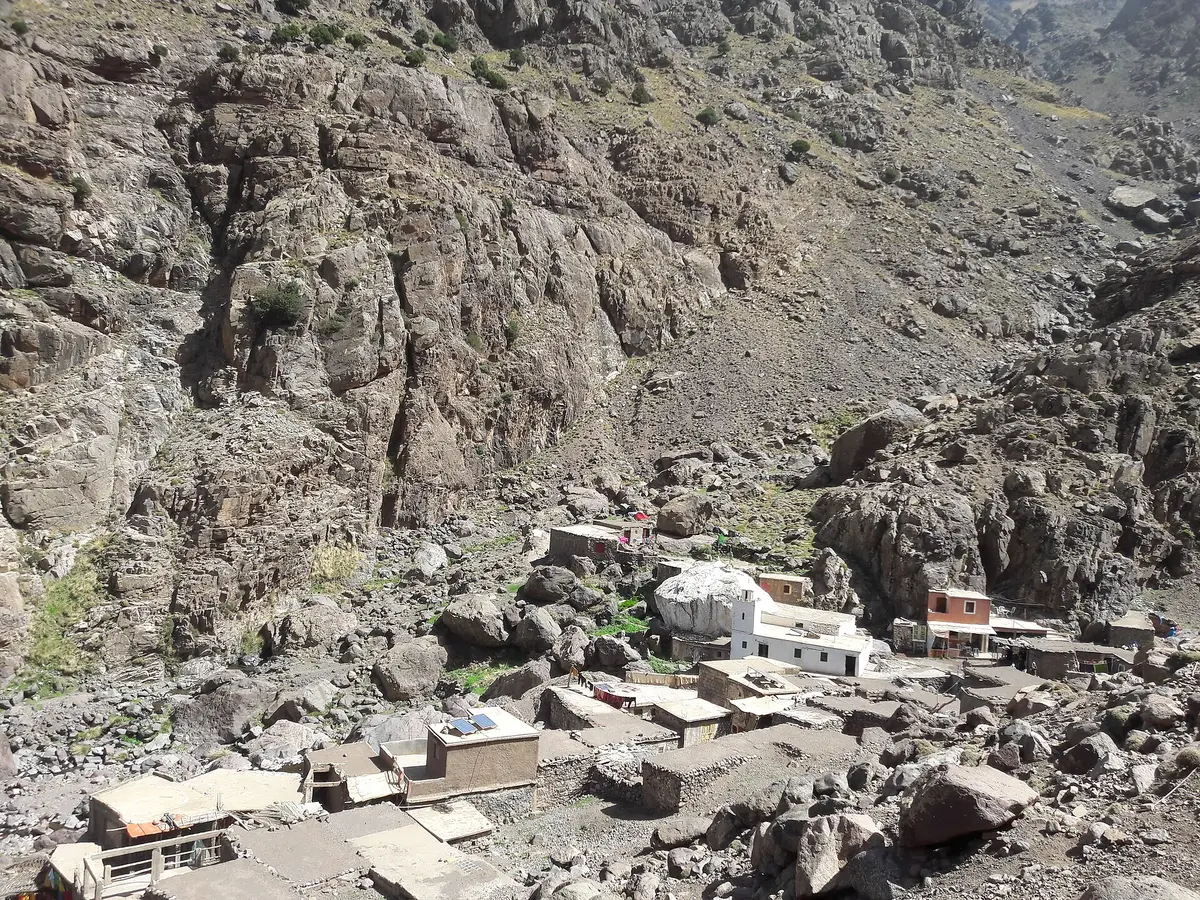
Two hours above the village of Imlil, on the mule track that climbs the Aït Mizane valley towards Mount Toubkal, a boulder painted white marks the shrine of Sidi Chamharouch, said to be the seat of Shamharush, king of the jinn.
Where does the legend of Sidi Chamharouch: Shamharush, King of the Jinn come from?
- Location
- Toubkal massif / Imlil, High Atlas, Morocco
- Kind of legend
- Spirit or familiar
- Coordinates
- 31.098, -7.912
- Last updated
LOCATION
What is the legend of Sidi Chamharouch: Shamharush, King of the Jinn?
The name is older than the shrine, and it is written: a Maghrebi manual of the occult sciences attributed to an author who died in 1523-24 lists him among the seven kings of the jinn, each paired with an angel, a day of the week and a planet — his are Thursday and Jupiter. The sanctuary first reaches print in 1914, when Edmond Doutté described a cave-cult of the same name in the Goundafa country; Edward Westermarck placed one in this valley in 1926, a cave where the neighbouring tribes sacrificed black cattle every year. Both of those sources, and the Arabic inscription over the shrine door read by the anthropologist Hassan Rachik, agree on something our earlier text had backwards: Shamharush is spoken of as dead. What is alive is the pilgrimage. People come for infertility, for rheumatism and above all for illnesses read as jinn affliction, and they stay. The shrine itself is closed to non-Muslims.
What is the history of Sidi Chamharouch: Shamharush, King of the Jinn?
The oldest datable thing about Shamharush is not the shrine. It is the name, and it comes out of a book.
In Magie et religion dans l'Afrique du Nord (Algiers, 1909) the French ethnographer Edmond Doutte printed a long treasure-hunting incantation which he had taken from a cheap, widely circulated Maghrebi manual of the occult sciences, the Shumus al-anwar wa-kunuz al-asrar attributed to Ibn al-Hajj al-Tilimsani, who died in 930 AH (1523-24) and whose text Doutte read in a Cairo printing of 1322 AH. On page 121 the incantation calls out to "the seven earthly kings of the jinn: Mudhhib, Marra, al-Ahmar, Burqan, Chemhourech, al-Abyad and Maymun", and the following page pairs each king with the angel who is said to have defeated him — for Shamharush, Sarfiya'il. On page 154 Doutte reproduced a seven-by-seven talismanic table from the same manual, and explained it line by line: the fifth line is the seven kings, the sixth the days of the week, the seventh the planets, and the whole point of the object, he wrote, is that "there are precise correspondences between these various elements". In the column that belongs to Shamharush stand Thursday and Jupiter. Doutte never states that in a sentence, and it matters that he does not; but the correspondence is there, in an early-Ottoman Maghrebi manual, and beside the name he noted that it was "very popular in North Africa".
The belief in spirits living in the summits is attested in the High Atlas before any European wrote the name down. The botanists Joseph Dalton Hooker and John Ball climbed a peak of the range in 1871 and published the scene in 1878: caught in a blizzard, their Amazigh porters begged them to turn back, "firmly believing that the heights of the Atlas are inhabited by djinns, or demons", and one of them cut the throat of a live cock he had been carrying under his arm to appease the anger of the spirits at the intrusion of strangers. No name is given.
The first shrines of Shamharush to reach print appear a generation later, and both are caves. In Missions au Maroc: en tribu (1914) Doutte reported what an informant he names, Si T'ayeb, told him about a cavern in the Goundafa country, above Tagadirt el Bour, with a pool of green water at its mouth and a great juniper beside it: "This cavern is the dwelling of a well-known genie, Muslim and revered as a Muslim saint; it is Sidi Chemharouj, who is there the object of a genuine cult." Petitioners, and fever sufferers above all, slept three consecutive nights in a dry-stone shelter next to it, and once a year, "as if he were an orthodox saint", a moussem drew people from all over Goundafa during the dog days of summer, with sacrifices of hens, a sheep, sometimes a black bull. Twelve years later Edward Westermarck placed a second one in the valley that concerns us. Told at Amzmiz that afarit live among the snows of the Great Atlas, he recorded "that in the district of the Ait Mizan, belonging to the tribe Igigain, there is a cave which is the shrine of Sidi Semharush, the sultan of the jnun", where the neighbouring tribes sacrificed black cattle every year to bring the spirits out to drink the blood, dance and foretell the year.
What the jinn king had, in the accounts of the people who described him, was a state. Vincent Crapanzano, working with the Hamadsha brotherhood in the 1960s, wrote in 1973 that the jnun "are organized into a world which mirrors the Moroccan world. There is a king of the jnun, Sidi Shamharush, who is venerated as a saint in some parts of the country, around Marrakech, as well as a court of ministers, pashas, and other traditional civil servants" — with a communications network "likened to a river with a thousand tributaries". In a footnote Crapanzano adds that he is believed to be buried at the foot of Jebel Toubkal. Some of his informants made the jinniya 'Aisha Qandisha his daughter.
The shrine as it stands now was studied by the Moroccan anthropologist Hassan Rachik, who did fieldwork in the Ait Mizane valley between 1983 and 1992 and published Le sultan des autres: rituel et politique dans le Haut Atlas in 1992. Sidi Chamharouch, he writes, does not belong to the world of humans: "he is of the 'others'" — the euphemism for the jinn — "but he is not to be confused with those invisible beings: he is their sultan", and his power is bounded, for "he governs only once a week, on Thursday". Rachik describes an hour's walk up from Aremd, the last village of the valley, to a sanctuary at about 2,300 metres, reached across a river and along a narrow lane of small shops with modest rooms rented to pilgrims behind them, ending at a little bridge. And he quotes the flat sentence carved in Arabic on the gravestone set above the shrine door: "Sidi Chamharouch, sultan of the jinn and of humans, lived for centuries." The saint, Rachik concludes, is therefore dead.
Timeline: the documented record of Sidi Chamharouch: Shamharush, King of the Jinn
- Died 930 AH (1523-24) The Maghrebi occult manual Shumus al-anwar wa-kunuz al-asrar, attributed to Ibn al-Hajj al-Tilimsani, fixes Shamharush as one of the seven kings of the jinn in a treasure-hunting incantation, each king paired with an angel, a day of the week and a planet. It is the oldest link in the chain that can be given a work, a passage and a date.
- 1871 (published 1878) Caught in a blizzard high in the Great Atlas, the porters of the botanists Joseph Dalton Hooker and John Ball beg them to turn back, "firmly believing that the heights of the Atlas are inhabited by djinns, or demons", and one cuts the throat of a live cock to appease them. It is the earliest dated European eyewitness account of the belief and of the sacrifice, and it names nobody.
- 1909 Edmond Doutte publishes Magie et religion dans l'Afrique du Nord. Page 121 lists "the seven earthly kings of the jinn" with Chemhourech among them; page 154 reproduces the talismanic table in which his column holds Thursday and Jupiter; a note beside the name records that it is "very popular in North Africa".
- 1914 In Missions au Maroc: en tribu Doutte publishes the first ethnographic description of a shrine of Shamharush: a cave in the Goundafa country, named to him by an informant he calls Si T'ayeb, with three-night incubation for the sick, an annual moussem in the dog days and sacrifices of hens, a sheep and sometimes a black bull. Doutte calls it "a barely Islamised cave cult".
- 1926 Edward Westermarck records a shrine of "Sidi Semharush, the sultan of the jnun" in the district of the Ait Mizan — this valley — described as a cave where the neighbouring tribes sacrifice black cattle each year and listen to the spirits foretell the coming year. In the same volume his Fez informants state that Shamharush is dead and that a jinniya named Nejma now rules in his place.
- 15 January 1942 Toubkal National Park is created by viziral decree, the first national park in Morocco. By then, according to the Moroccan press, the shrine had already been drawing pilgrims since the beginning of the century.
- 1973 Vincent Crapanzano publishes The Hamadsha: A Study in Moroccan Ethnopsychiatry, describing Sidi Shamharush as the king of the jnun "venerated as a saint in some parts of the country, around Marrakech", with a court of ministers and pashas, believed to be buried at the foot of Jebel Toubkal. Some of his informants make the jinniya 'Aisha Qandisha his daughter.
- 1992 (fieldwork 1983-1992) Hassan Rachik publishes Le sultan des autres, the monograph on this shrine and this valley. He records that Sidi Chamharouch "governs only once a week, on Thursday", places the sanctuary an hour above Aremd at about 2,300 metres, and quotes the Arabic inscription on the gravestone over its door: "Sidi Chamharouch, sultan of the jinn and of humans, lived for centuries."
- 13 July 2004 The Moroccan daily Aujourd'hui le Maroc describes the site: "Sidi Chamharouch is in fact only a rock painted white, which in winter blends into the snow." It reports that the pilgrimage is guarded by the Ait Mizane, that visiting is forbidden to non-Muslims, that stays run from a day to a week, and that the high season is summer and the feast of Ashura.
- 2009 Céline Aufauvre publishes a comparative ethnography of Sidi Chamharouch and Bouya Omar. She describes the maqam as a small draped dome inside a fitted-out white cave, records that people come not on a fixed pilgrimage but on a retreat whose length is decided by dreams, and notes in a footnote that chaining the sick, very frequent at Bouya Omar, is not practised here.
- 17 December 2018 Two Scandinavian hikers are murdered while camping in the Toubkal foothills near Imlil.
- 8 September 2023 The magnitude 6.8 Al Haouz earthquake strikes 45 km west of the shrine at 22:11 UTC, killing close to 3,000 people in the province. The valley's mule paths were repaired and the Toubkal route reopened by 19-20 September; the refuges were due to reopen on 1 October.
Is there a rational explanation for Sidi Chamharouch: Shamharush, King of the Jinn?
There is no event here to verify: nobody claims that anything in particular happened at this rock on a given day. What can be dated is the paper trail, and it is worth laying out because it does not run the way the phrase "ancient tradition" suggests.
The name is the old part. It is textual, it belongs to the written Solomonic demonology of the Islamic occult sciences, and in the version Doutte used it is fixed by an author who died in 1523-24. The shrine is the recent part. No text I have been able to read places a sanctuary of Shamharush anywhere before Doutte's cave in the Goundafa in 1914, and none places one in the Ait Mizane valley before Westermarck's note of 1926. What his informants described — a cave — is not some other place: the anthropologist Céline Aufauvre, who did fieldwork at this shrine and at Bouya Omar, describes the maqam of Sidi Chamharouch as a cloth-draped dome about 50 cm high standing in a corner of a fitted-out white cave, under a sloping rock face. The cave of 1926 and the painted boulder of today are the same object seen from inside and from outside. The Moroccan daily Aujourd'hui le Maroc, writing in 2004, dated the flow of pilgrims to "the beginning of the 20th century", before the creation of the Toubkal National Park in 1942. On the evidence available, the cult of the rock is roughly a century old and the name it carries is roughly five.
The second thing the sources agree on is one our own earlier text got backwards. Shamharush is not described as an available intermediary in the present tense: he is described as dead. Westermarck's Fez informants told him in 1926 that Shamharush "had his government there while alive, but now that he is dead a jinniya, by name Nejma, rules over the spirits in the cave", and elsewhere that when he died he left a daughter who assists women in witchcraft. Sixty-six years later Rachik read the same conclusion off a stone above the shrine door. Crapanzano was told he lies buried at the foot of Toubkal.
Criticism of the cult from inside Islam is not a modern development either, and it does not need to be attributed to an anonymous collective. Doutte set it down in 1914 in his own voice: "although Muslim doctrine formally recognises the existence of the genies, the personality of Chemharouj is, so to speak, on the margin of orthodoxy" — and he noted that the stricter Muslims of Goundafa who wanted a favour went instead to the recognised saints of the country, above all Moulay Ibrahim. Westermarck, who spent seven years collecting this material, was blunter about the figure himself: the seven kings, Shamharush included, are "very shadowy beings without any distinct personality".
The part that deserves care rather than scepticism is the people. Shamharush's speciality, as the sources have it since Doutte's feverish petitioners of 1914, is illness — female infertility and rheumatism, and above all what Aujourd'hui le Maroc called "spiritual illnesses": conditions read as jinn affliction, which in practice include epilepsy and severe mental illness. Pilgrims stay from a day to a week. The writer Erik Davis, who walked up in 2023, was told by the shrine's guard that he "basically ran a hospital, by which he meant a mental hospital", with clients sleeping in the shrine room while the Qur'an was chanted over them and others housed in a building beside the stream, divided into men's and women's quarters. That is not a ghost story and it is not a curiosity; it is an account of where sick people go when they go somewhere. Aufauvre is precise about what this is: not a classic pilgrimage but a retreat whose length nobody fixes in advance, because it depends on what the dreams say, and some of those who come settle for good as khuddâm, servants of the saint. She is equally precise about what it is not. In a footnote she states flatly that chaining the sick is not practised at Sidi Chamharouch, while it was very frequent at Bouya Omar, the other shrine she studied — and Bouya Omar is the one the Moroccan state finally emptied, in an operation announced by the health minister Houcine El Ouardi that ran from 11 to 30 June 2015 and moved some 795 people into psychiatric hospitals. Crapanzano's book on Moroccan jinn belief carries the subtitle A Study in Moroccan Ethnopsychiatry for a reason. What can honestly be said of Sidi Chamharouch is narrower than the comparison invites: the healing claims are untested, the arrangement is unregulated, and the practice that made the other shrine notorious is, according to the anthropologist who worked in both, not done here.
Can you visit Sidi Chamharouch: Shamharush, King of the Jinn?
Sidi Chamharouch is a shrine on the mule track that climbs the Ait Mizane valley from Imlil towards Toubkal. The file's coordinates, 31.0978 N, 7.9119 W, are about 4.4 km south of Imlil in a straight line. Hassan Rachik, quoted by Yabiladi in 2022, counted an hour's walk from Aremd, the last village at the head of the valley, to a sanctuary "situé à 2300 mètres d'altitude", and noted that visitors must rely on their own strength or on mules. Céline Aufauvre, in 2009, gave about two hours from Imlil and an altitude of 2,700 metres. The SRTM 30-metre elevation model, queried on 24 September 2026, returns 2,334 metres at the file's coordinates, which is Rachik's figure.
The shrine is closed to non-Muslims. Aujourd'hui le Maroc wrote in 2004 that the pilgrimage site is guarded by the Ait Mizane and that visiting it "est interdite aux non musulmans". Erik Davis, who walked up in 2023, described a small building set against the whitewashed boulder where the saint is entombed, sharing a wall with a slightly larger mosque, all of it "off limits to non-Muslims". On the day he passed, one or two restaurants on the edge of the hamlet were feeding trekkers while the souvenir shops and tea stalls were mostly shut. Aufauvre, citing Rachik, describes the running of the shrine and its income in money and offerings passing in turn between three tribal fractions, the system called the nouba.
Pilgrims stay on site: Aujourd'hui le Maroc gave stays of one day to a week, with the high season in summer and at Ashura. Davis wrote that the shrine's guard "basically ran a hospital, by which he meant a mental hospital", with some patients sleeping in the shrine room and others lodged in a building beside the stream.
The path is watched. Davis stopped at a trailside police station where trekkers' identity documents were checked, the guides handling the paperwork, and saw every group on the path from the Imlil villages led by a local guide. The two Scandinavian hikers murdered in December 2018 were found near a trail connecting Imlil with Toubkal.
The Al Haouz earthquake of 8 September 2023, magnitude 6.8, had its epicentre at 31.058 N, 8.385 W according to the USGS, about 45 km west of the shrine. The Kasbah du Toubkal, a hotel in Imlil, reported on 20 September 2023 that the muleteers' association had repaired the valley's mule paths the day before, that the Toubkal summit was open again and that the refuges were due to reopen on 1 October. Its update of 15 September described Imlil and its valley as having escaped much of the devastation suffered by other villages.
Sources consulted
- Edward Westermarck, «Ritual and Belief in Morocco, vol. I (pp. 270, 283-284, 328, 391, 571)» — Macmillan and Co., London, 1926 book
- Attributed to Ibn al-Hajj al-Tilimsani (d. 930 AH / 1523-24), «Shumus al-anwar wa-kunuz al-asrar (pp. 27-29 and 58 of the Cairo printing of 1322 AH, as cited and translated by Doutte)» — Cairo, 1322 AH (1904-05), 1523 book
- Joseph Dalton Hooker and John Ball, «Journal of a Tour in Marocco and the Great Atlas (p. 223)» — Macmillan and Co., London, 1878 book
- Edmond Doutte, «Magie et religion dans l'Afrique du Nord (pp. 121-122, 154, 160-161, 412)» — Adolphe Jourdan, Alger, 1909 book
- Edmond Doutte, «Missions au Maroc: en tribu (pp. 89-91)» — Paul Geuthner, Paris, 1914 book
- Vincent Crapanzano, «The Hamadsha: A Study in Moroccan Ethnopsychiatry (pp. 44 and 142)» — University of California Press, 1973 book
- Aujourd'hui le Maroc, «Sidi Chamharouch: le saint du Toubkal» — Aujourd'hui le Maroc, 13 July 2004, 2004 newspaper archive
- Zainab Aboulfaraj, «Nomad #62: Sidi Chamharouch, le sultan des genies (quoting Hassan Rachik, Le sultan des autres, 1992)» — Yabiladi, 8 July 2022, 2022 newspaper archive
- Wikipedia contributors, «Murders of Louisa Vesterager Jespersen and Maren Ueland» — Wikipedia, 2026 web
- United States Geological Survey, «M 6.8 - Al Haouz, Morocco (event us7000kufc)» — USGS Earthquake Hazards Program, 2023 report
- Kasbah du Toubkal, «Earthquake Response, Imlil valley (dated updates, September-December 2023)» — Kasbah du Toubkal, Imlil, 2023 web
- Erik Davis, «King of the Jinn» — Burning Shore, 1 September 2023, 2023 web
- Céline Aufauvre, «Des procès en chair et en songe. Sainteté et exorcisme à Bouya Omar et Sidi Chamharouch (Maroc), pp. 93-114 (esp. 97-99, 103 and n. 17)» — Altérités, vol. 6, no. 2, 2009 academic
- TelQuel, «Fin de l'opération d'évacuation des patients de Bouya Omar» — TelQuel, 30 June 2015, 2015 newspaper archive
- NASA Shuttle Radar Topography Mission, served by Open Topo Data, «SRTM 30 m elevation at 31.09777, -7.9119: 2,334 m (Open Topo Data API, dataset srtm30m, queried 24 September 2026)» — api.opentopodata.org, 2026 archive
Reviewed by V. Serrano on 2026-08-16 · How we verify our content
📎 Source: Enigma Atlas
💬 Field testimonies (0)
No testimonies yet. Add the first.
Add your testimony
🔒 Log in to add a testimony