📜 LEGEND · EXP. Nº0270
ACTIVE
The Golem of Prague
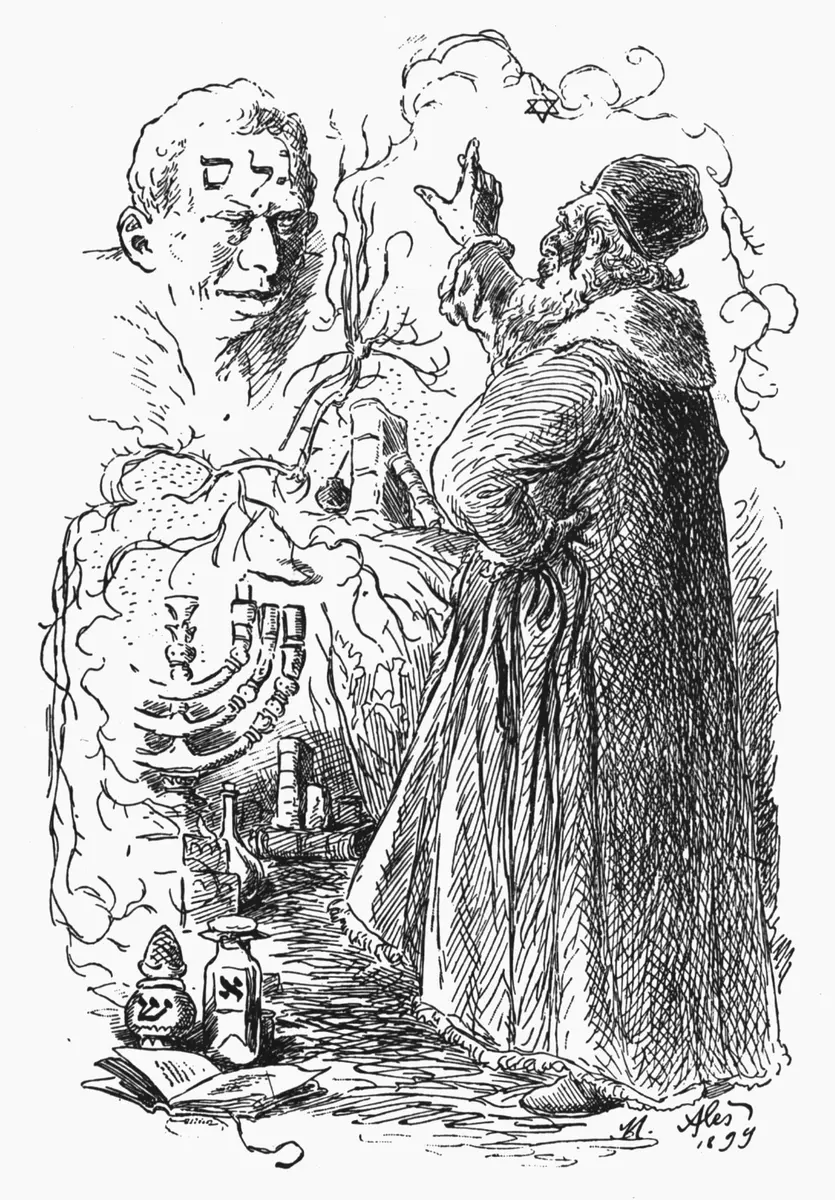
In the sixteenth century, when the Jews of Prague lived under the constant threat of violence, Rabbi Judah Loew ben Bezalel, the revered Maharal, is said to have moulded a giant from the clay of the Vltava's banks to protect his people.
Where does the legend of The Golem of Prague come from?
- Location
- Prague, Josefov, Czech Republic
- Kind of legend
- Creature legend
- Coordinates
- 50.09, 14.418
- Last updated
LOCATION
What is the legend of The Golem of Prague?
Following secret instructions, he brought the figure to life by placing in its mouth a shem, a slip of parchment inscribed with a holy name of God, or by writing the word emet, meaning truth, upon its forehead. The Golem walked, worked and guarded the ghetto, tireless and mute. But a creature of raw earth cannot be governed forever; in some tellings it grew violent, in others it had to be stilled each Sabbath. At last the rabbi removed the sacred word, erasing the first letter so that emet became met, meaning death, and the giant crumbled back into lifeless clay. Its remains, the story insists, still lie hidden in the attic of Prague's Old-New Synagogue, which no one is permitted to enter. Whether allegory of power and its limits or genuine folklore, the Golem remains the city's most enduring shadow.
What is the history of The Golem of Prague?
Rabbi Judah Loew ben Bezalel died in Prague in 1609. The oldest known text that ties him to a golem was printed in 1834, two hundred and twenty-five years later, in German, by a writer he never met. That gap is the story.
The man needs no legend. Born in the 1520s, Loew was for two decades the leading rabbinic authority in Moravia, based at Mikulov, before settling in Prague, where he ran a talmudic academy known as the Klaus and wrote steadily — Gur Aryeh, his commentary on Rashi's commentary on the Torah, alongside volumes on ethics, education and the defence of rabbinic tradition. In 1592 he was received by the Holy Roman Emperor Rudolf II, an audience recorded by his disciple, the chronicler and astronomer David Gans. He was not a practising kabbalist, and nothing written in his lifetime, by him or by the students who eulogised him, mentions a creature of clay.
The golem itself is far older than Loew and far older than Prague. The word appears once in the Hebrew Bible, at Psalm 139:16, where it means something unfinished — an embryo. In the Babylonian Talmud, at Sanhedrin 65b, Rava makes a man and sends it to Rabbi Zeira, who speaks to it, receives no answer, and tells it to return to its dust. On the same page Rav Hanina and Rav Oshaya study the Sefer Yetzirah every Sabbath eve and produce a calf to eat in honour of the Sabbath. Medieval Ashkenazi tradition built on the Sefer Yetzirah a practice of shaping a human figure and animating it through combinations of the letters of the divine Name — the shem, written on parchment and placed in the mouth or on the forehead. The point was never sorcery. It was an act of literacy: the study of how God had made a world out of letters.
When that tradition acquired a named hero, the name was not Loew's. The Jewish Encyclopedia of 1906 records Elijah of Chelm, in the middle of the sixteenth century, as the first person credited with making a golem by means of a shem. The legend belonged to Poland. How it crossed to Prague, changed rabbis, acquired a mission it never had, and finally became a souvenir shelf is a story of the nineteenth and twentieth centuries — and it can be dated almost year by year.
Timeline: the documented record of The Golem of Prague
- 1592 Rabbi Judah Loew is received by Emperor Rudolf II — the documented high point of his public life, recorded by his disciple David Gans. No account of it, then or later in his lifetime, mentions a golem.
- 1609 Loew dies in Prague. Neither his own writings nor those of his students nor the eulogies delivered for him say anything about a creature of clay — a silence that will hold for over two centuries.
- 1808 Jakob Grimm publishes a short golem notice in the Zeitung für Einsiedler, including the erasure of the first letter of emet to leave met. He takes it from a seventeenth-century Latin account of the golem of Chelm, but removes the rabbi's name and the city, leaving the story free to be relocated.
- 1834 Josef Seligmann Kohn's novel Das jüdische Gil Blas, printed in Leipzig, carries the earliest known text linking the golem to Prague and to Rabbi Loew — tucked into a long footnote describing the Old-New Synagogue.
- 16 November 1836 The Viennese poet Ludwig August Frankl publishes in the Oesterreichische Zeitschrift für Geschichts- und Staatskunde the first folkloric report of the Prague version, and the first to place a lump of clay in the attic of the Old-New Synagogue, untouched because workmen fear misfortune.
- 1847 Leopold Weisel's "Der Golem", in Wolf Pascheles's hugely popular Prague anthology, becomes the standard version for sixty years. Its golem is a household servant who chops wood and sweeps streets and runs amok when the rabbi forgets to deactivate him before the Sabbath.
- 1906 The Jewish Encyclopedia records the Prague golem as the most famous of all — and still describes it as a weekday servant, with the shem removed every Friday afternoon. There is no blood libel and no ghetto to defend.
- 1909 Rabbi Yudl Rosenberg publishes Nifla'ot Maharal in Poland, presenting his own fiction as a manuscript by Loew's son-in-law Isaac Katz, kept for three hundred years in the royal library of Metz. It is a bestseller, reprinted at least ten times, and it invents the golem as protector of the Jews against the blood libel.
- 1920 The Prague reporter Egon Erwin Kisch obtains permission from the Jewish community to climb into the attic of the Old-New Synagogue. He describes the iron beam, the ladder and the debris, and reports no remains of any golem. Radar sounding in the 1980s found nothing unusual either.
Is there a rational explanation for The Golem of Prague?
The Golem of Prague can be dated, and the dates are unkind to it.
There is no golem in the Maharal's writings, in those of his students, or in the eulogies for him. Shnayer Z. Leiman's survey of the rabbinic sources is blunt: "There is certainly no evidence contemporary with the Maharal that he created a Golem." The silence holds another century and a half: Rabbi Yedidiah Tiah Weil, who lived in Prague and wrote in the eighteenth century about golems made by Avigdor Kara and by Elijah of Chelm, says nothing of one made by the Maharal.
The elements then arrive one at a time. In 1808 Jakob Grimm printed a golem notice complete with the truth/death wordplay on the forehead — but with no rabbi and no city, because he had quietly stripped both from a seventeenth-century Latin account of the golem of Chelm. Edan Dekel and David Gantt Gurley track what followed: Prague appears in 1834, the Altneuschul attic in 1836, and Leopold Weisel's 1847 retelling fixes the story for six decades. Their explanation of why Loew was chosen is the sharpest part of the argument — "it is exactly because he was not a kabbalist that he makes such an attractive agent for the story".
The famous ancient manuscript is later still. In 1909 Rabbi Yudl Rosenberg published Nifla'ot Maharal as an eyewitness account by Loew's son-in-law Isaac Katz, preserved for three centuries in the royal library of Metz. The manuscript has never been produced and the library is an invention; the book also seats Rudolf II on a throne he did not yet hold. Rosenberg wrote it himself, and with it the golem most people now picture: the defender of the ghetto against the blood libel, a role absent from every earlier version.
Can you visit The Golem of Prague?
Josefov, Prague's old Jewish quarter, is ten minutes on foot from the Old Town Square. Visit it as what it is: the surviving fragment of a community persecuted for centuries here and then almost entirely murdered in the Shoah. The Pinkas Synagogue, inscribed with the names of the Bohemian and Moravian Jews killed in the Holocaust, sets the tone better than any ghost story.
The Old-New Synagogue, on Červená street, is the oldest in Europe still in use, built in the last third of the thirteenth century. Since 2024 it has no separate ticket: entry is through the Jewish Town circuit sold by the Jewish Museum in Prague, which in 2026 costs 600 CZK for adults, 400 CZK for students under 26 and 200 CZK for children aged 7 to 15, free under 6. It is valid three days and covers five synagogues and the cemetery. Everything closes on Saturdays and Jewish holidays; hours run 9:00 to 16:30 in winter, later in summer.
Men must cover their heads inside — kippot are handed out — and modest dress is expected. Photography is not allowed. The attic where the golem is said to lie has no public access, and never has.
The Old Jewish Cemetery, entered from Široká 3, was in use from 1439 to 1787 and holds some 12,000 stones over graves many layers deep. The Maharal's tomb is the most visited; people leave slips of paper with requests on it. Leave the stones and other people's notes alone.
Sources consulted
- Edan Dekel and David Gantt Gurley, «How the Golem Came to Prague» — The Jewish Quarterly Review, vol. 103, no. 2, pp. 241-258, 2013 academic
- Shnayer Z. Leiman, «The Adventure of the Maharal of Prague in London: R. Yudl Rosenberg and the Golem of Prague» — Tradition 36:1 (excerpted in Jewish Action), 2002 academic
- Allan Nadler, «The Golem of Montreal» — Jewish Review of Books, 2022 newspaper archive
- The William Davidson Talmud (Koren-Steinsaltz), «Babylonian Talmud, Sanhedrin 65b» — Sefaria, 2017 book
- Ludwig Blau, Joseph Jacobs and Judah David Eisenstein, «Golem» — The Jewish Encyclopedia, vol. VI, pp. 36-37, 1906 book
- Prague City Tourism, «The Old-New Synagogue, resting place of the mythical Golem» — prague.eu, official visitor portal, 2026 web
Reviewed by V. Serrano on 2026-07-29 · How we verify our content
📎 Source: Enigma Atlas
💬 Field testimonies (0)
No testimonies yet. Add the first.
Add your testimony
🔒 Log in to add a testimony