👻 HAUNTED PLACE · EXP. Nº9474
ACTIVE
Zvíkov Castle
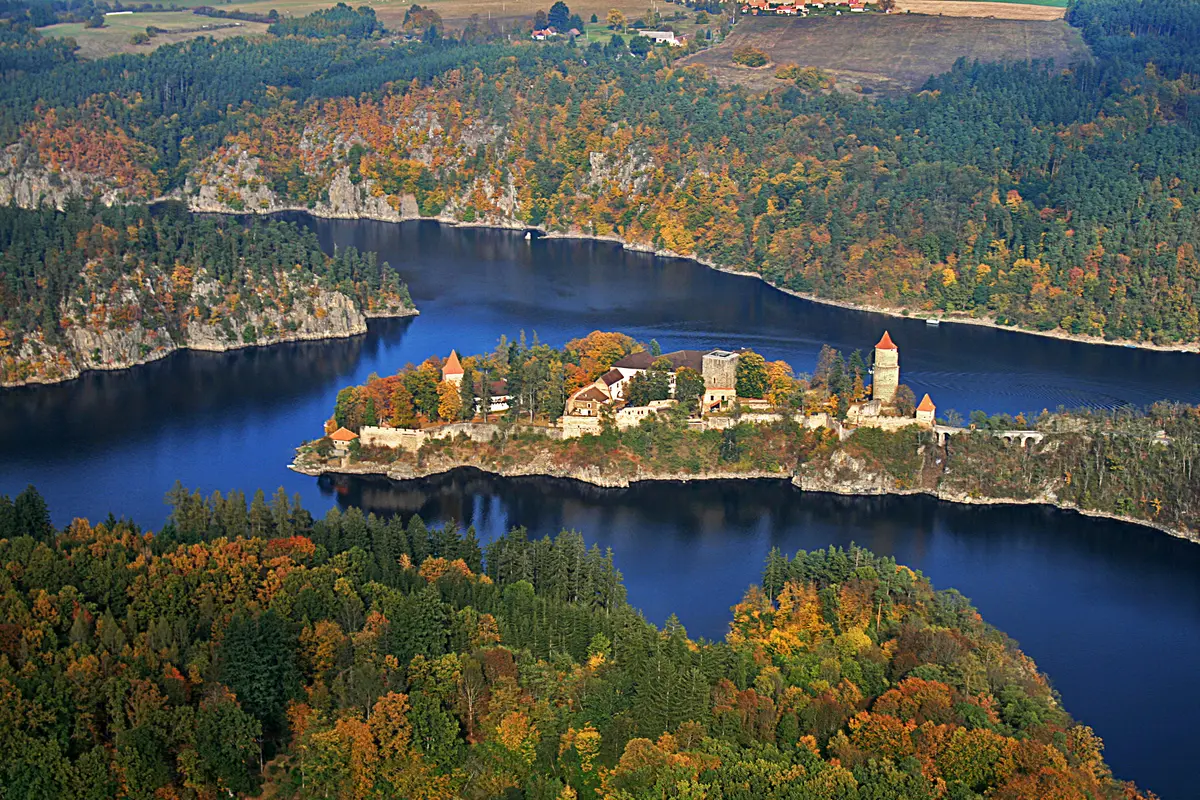
Zvíkov stands on a granite spur where the Vltava meets the Otava in South Bohemia, a Přemyslid royal castle begun in the first half of the 13th century and, since the 19th, widely called "the king of Czech castles" — a title the Czech heritage institute credits to the historian August Sedláček rather than to tradition.
Where is Zvíkov Castle?
- Location
- South Bohemia, Czech Republic
- Type
- Castle
- Coordinates
- 49.437, 14.189
- Last updated
LOCATION
Why is Zvíkov Castle said to be haunted?
Its ghost is better documented than most, and the documentation points the wrong way. The "Zvíkovský rarášek" is not an old imp of the courtyard: it is the title of a one-act comedy Ladislav Stroupežnický submitted for performance in March 1883 and premiered that May, in which the "imp" is the mischievous fourteen-year-old son of the castle's Renaissance lord. Neither of the two great Czech digitised corpora contains a single page pairing the imp with Zvíkov before 1883, though both words are common in print. The castle's own administration tells the ghost story only in English, and only about the Hlíza Tower. What is real is stranger: the town below the castle, church and all, lies under the Orlík reservoir, and its bell and altar are now exhibits inside the walls.
What is the history of Zvíkov Castle?
Zvíkov was a royal castle before it was anything else, and its whole shape follows from a decision about land. In 1226 Přemysl Otakar I traded the so-called Oslov újezd, which belonged to the Doksany convent, for six other villages — and in the exchange he acquired the rocky spur where the Vltava meets the Otava. The Národní památkový ústav (NPÚ), the Czech state heritage institute that runs the castle today, dates the first move towards a foundation to that swap.
By 1234 enough of the castle stood for its burgrave, Konrád of Janovice, to be named in writing. Václav I (Wenceslas I) built the great palace wings and liked the place: when his son Přemysl Otakar rose against him in July 1247, Zvíkov was one of only three castles — with Loket and Most — that stayed loyal. Václav received his rebel son's envoys here, led by Mikuláš, bishop of Prague, and had them locked in the tower. His son, once king as Přemysl Otakar II (1253–1278), appointed Hirzo of Klingenberg burgrave in 1250 and pushed on with the royal palace, the ring wall and the Chapel of St Wenceslas. The same masons' lodge was working simultaneously on the king's buildings in Písek.
The oldest surviving structure is the Hlízová věž — the "Bulb Tower", from the 44 courses of rough-hewn granite blocks that face it — twenty metres high, walls three and a half metres thick, put up around 1240. Because some blocks carry incised marks, nineteenth-century antiquarians read them as Marcomannic runes and dated the tower to the second century AD, which is why it is still nicknamed "Markomanka". They are masons' marks: signatures and tallies cut at the quarry, and the same marks appear on the royal castle, the bridge and the parish church in Písek. The room on its upper floor is called the Crown Hall, and an old tradition holds that the Bohemian coronation jewels were kept there until Karlštejn was finished. NPÚ repeats that story on its history page but calls it, on the page devoted to the tower itself, a "nedoložená pověst" — an unattested legend.
The Přemyslids died out in 1306 and Zvíkov began a long slide from crown property to pledge. Charles IV redeemed it in 1335 and listed it in his draft law code among the castles a king could never mortgage; his successors mortgaged it anyway. A Hussite army from Tábor besieged Zvíkov in 1429 and failed to take it — siegeworks survive in the ground outside, and a collection of stone cannonballs inside. In 1473 Jindřich of Rožmberk passed the castle to Bohuslav Krušina of Švamberk, whose family bought it outright from the royal chamber in 1574 and gave it its Renaissance skin: sgraffito, square window frames, a brewery in the old cattle sheds, the Hláska tower raised in 1554.
Then the wars. After the Bohemian Estates were crushed at White Mountain the garrison refused to give up, held out until 1622, and surrendered only to overwhelming force; imperial troops sacked the castle and wrecked the Švamberk archive. The Eggenbergs took over in 1623 and the Schwarzenbergs in 1719, by which time nobody lived there. Fire gutted much of it in 1751, the New Gate collapsed in 1829 and part of the palace slid towards the river. Serious rebuilding ran from after 1880 to about 1900 — the reused medieval stone is faintly pink and easy to tell from the new. The state took the castle from the Schwarzenbergs in 1948; it has been a state castle since 1950 and a national cultural monument since 1978.
The last chapter is not medieval at all. Between 1954 and December 1961 the Orlík dam was built downstream at Solenice, the largest structure of the Vltava cascade, and the reservoir backed water 68 km up the Vltava and 23 km up the Otava. Fourteen mills and some 650 houses and farm buildings went under. Among them was the little town below Zvíkov, with its Gothic church of St Nicholas: the whole slope where those houses stood is now under water, and the rivers the castle looks down on are a lake. Two objects survive from it inside the castle — the altar carried up from St Nicholas, and a bell found by chance below Zvíkov at the confluence in 1946, dated to about the mid-fourteenth century, which hung for seventy years in the village chapel of St Wenceslas and went on display in the Royal Palace on 1 June 2016.
Timeline: the documented record of Zvíkov Castle
- 1234 First written mention: Konrád of Janovice is named burgrave of Zvíkov, so at least part of the castle must already stand. NPÚ traces the foundation back to 1226, when Přemysl Otakar I traded the Oslov újezd for six villages and so acquired the rock above the confluence.
- July 1247 When Přemysl Otakar rebels against his father Václav I, only Zvíkov, Loket and Most stay loyal. Václav receives the rebels' envoys here, led by Mikuláš, bishop of Prague, and has them imprisoned in the tower.
- 1429 A Hussite army from Tábor besieges Zvíkov and fails to take it. Siegeworks survive in the ground outside the castle and a collection of stone cannonballs inside it.
- 1473 Bohuslav Krušina of Švamberk obtains Zvíkov. Ottův slovník naučný records that his sack of the Teplá monastery — sometimes miscited as a siege of Zvíkov — happened in 1467, six years earlier and 150 km away.
- 1622 After holding out beyond the defeat of the Bohemian Estates, the Zvíkov garrison surrenders to overwhelming imperial force. The castle is plundered and the Švamberk archive, catalogued only six years earlier by Václav Březan, is wrecked.
- 30 March 1883 Národní listy reports that Ladislav Stroupežnický has submitted a one-act historical comedy titled Zvíkovský rarášek: "the material for it is taken from the end of the sixteenth century and the action is set at Zvíkov castle." No legend is mentioned. This is the earliest page in either Czech corpus on which the words rarášek and Zvíkov appear together.
- 21 May 1883 The play premieres at the Nové české divadlo in Prague on a bill of three one-acters; the theatre column of 23 May advertises the second performance for Friday the 25th. The National Theatre, reopened on 18 November after its fire, stages it on 21 November.
- 1888 In Paměti zvíkovské, quoted today by NPÚ, the priest František Tyl writes of the Hlízová tower that "many tales circulate about this tower among the people, and many disputes among the learned about its origin" — and describes the tower's marks as masons' signatures, not runes. He records no imp.
- 1897 A popular Czech almanac describes Zvíkov, repeats that Václav I is said to have kept his crown here, and mentions the rarášek only as the title of Stroupežnický's comedy, "known today throughout Bohemia". Fourteen years after the premiere it is famous as a play, not as a legend.
- 25 March 1898 Národní listy and Katolické listy, describing a panorama exhibition in Prague, both call Karlštejn "the king of Czech castles" and list Zvíkov separately. The earliest dated printed use of the epithet for Zvíkov that we found is an illustrated Czech geography of 1911.
- 10 October 1915 Vítězslav Novák's comic opera on Stroupežnický's practically unaltered text premieres at the National Theatre. From 1919 the play is performed regularly at Zvíkov itself, which is how the title entered general knowledge.
- 22 December 1961 The Orlík dam is commissioned after seven years of building, backing water 68 km up the Vltava and 23 km up the Otava. Fourteen mills and some 650 buildings are drowned, among them the whole slope of the little town below Zvíkov with its church of St Nicholas.
- 1 June 2016 A bell found by chance below Zvíkov at the confluence in 1946 and dated to about the mid-14th century — almost certainly from the drowned church of St Nicholas — goes on show in the Royal Palace, lent by the municipality after seventy years hanging in the village chapel of St Wenceslas.
Is there a rational explanation for Zvíkov Castle?
The famous ghost of Zvíkov turns out to be a stage character, and the evidence is unusually clean.
Zvíkovský rarášek — "the Zvíkov imp" — is a one-act historical comedy by Ladislav Stroupežnický. Národní listy announced on 30 March 1883 that he had submitted it for performance, adding that "the material for it is taken from the end of the sixteenth century and the action is set at Zvíkov castle" — and saying nothing about any legend. It opened at the Nové české divadlo in Prague on Monday 21 May 1883, on a triple bill; the paper's theatre column of 23 May lists the second performance for Friday the 25th. The National Theatre, closed since its fire, reopened on 18 November 1883 and staged the piece three days later.
There is no imp in it. The play is set at Zvíkov in 1585 and turns on an invented episode in the life of a real man, the Kutná Hora chronicler and libertine Mikuláš Dačický of Heslov. The "rarášek" of the title is Petr of Švamberk, the fourteen-year-old son of the castle's lord, whose meddling — a stolen ruff, a purloined love poem, a quarrel over a honey cake — nearly wrecks his parents' marriage. NPÚ says so plainly in its own exhibition text: "the castle spirit of the play's title is represented in it by little Petr of Švamberk." Vítězslav Novák set Stroupežnický's text to music, practically unaltered, as an opera first performed at the National Theatre on 10 October 1915, and the play has been performed at the castle itself, on and off, since 1919. That is how a title became common property.
Was there an older legend behind it? Two Czech digital corpora say no. In the Moravian Library's Kramerius (77.5 million pages) the exact phrase Zvíkovský rarášek appears on 5,857 pages and not one predates 1883; rarášek and Zvíkov share a page 218 times, again never before 1883. In the Czech Digital Library (153 million pages) the phrase returns 11,146 pages, none before 1883, and the two words meet twice before that date — both coincidences, a figure of speech in a political column of 6 November 1861 and a list of subscription agents in the same paper. The control matters more than the zero: under the same date filter, Zvíkov alone returns 1,901 pre-1883 pages and rarášek alone 659. Both words were everywhere in Czech print. They simply never met until Stroupežnický put them together.
What came after fits the same pattern. The earliest text found linking the imp, Zvíkov and the Markomanka tower is a popular almanac of 1897, and it mentions the rarášek only to say that "the late writer Lad. Stroupežnický set at this castle the scene of the excellent historical comedy, known today throughout Bohemia, called Zvíkovský rarášek." Fourteen years after the premiere, the name was famous — as a play.
The headless knight does not survive contact with the archive at all. "Bezhlavý rytíř" is a stock Czech ghost: 1,993 pages in the Czech Digital Library. Paired with Zvíkov, six — the earliest a 1948 local paper page that is actually about a canoe race, then two 1994 newspaper pages, then page 95 of a ghost gazetteer published in 2000, Přehled hradních a zámeckých strašidel. That is a motif filed under Zvíkov by compilers in the late twentieth century, not a tradition of the place.
The well in the courtyard and the wish granted to whoever knows the words appear in no source we could find, Czech or English; the phrase "zvíkovská studna" returns nothing. Where NPÚ does mention the creature it puts it somewhere else and only in English: the English version of its page on the Hlíza Tower says the room "ties together two realities — the Crown Jewels were supposed to be stored here until Karlštejn Castle was built, and the Zvíkov Trickster is active here, haunting the halls at night." The Czech version of the same page says nothing of the kind. The ghost is offered to foreign visitors and withheld from Czech ones, and the castle's own literature exhibition notes, drily, that Zvíkov has only "a few legends" (nemnoha pověstí), which the collector Ondřej Fibich later expanded in his Prácheňský poklad.
Two more claims need pinning down rather than repeating. The nickname "king of Czech castles" is not ours to sign: NPÚ credits it to the historian August Sedláček, and the earliest printed uses we located run the other way — on 25 March 1898 both Národní listy and Katolické listy, describing a panorama exhibition in Prague, gave the title to Karlštejn and listed Zvíkov separately. The first dated use we found for Zvíkov is an illustrated Czech geography of 1911: "for its grandeur and splendid position amid the fresh green of dense forests, Zvíkov is called the king of Czech castles." And the siege sometimes dated to 1467 belongs elsewhere: Ottův slovník naučný (1906) records that Bohuslav of Švamberk sacked the Teplá monastery in 1467 and obtained Zvíkov only in 1473. The documented sieges here are 1429, which failed, and 1622, which did not.
Can you visit Zvíkov Castle?
Zvíkov is a state castle run by the Národní památkový ústav, in the Písek district of South Bohemia, about 20 km north of Písek and a kilometre north of the village of Zvíkovské Podhradí (N 49°26.33085', E 14°11.54732'). Contact: Státní hrad Zvíkov, 397 01 Písek; +420 382 285 676; [email protected].
The grounds are free and open all year — 8:00–21:00 April to September, 8:00–18:00 October to March — and a path runs right through the site down to the boat landing under the castle. The best views of the two rivers and their confluence are from the walls and from the bridge at the entrance.
Only one tour is offered and it is unguided: the Royal Palace, about 55 minutes, maximum 50 people, no booking. In 2026 it runs Tuesday to Sunday, 9:00–17:00 from 8 July to 31 August, then on shortened hours with a midday break until the season closes on 1 November; outside July and August the ticket office shuts between 12:00 and 13:00. Admission is 180 CZK for adults 25–64, 140 CZK for over-65s, 18–24s and holders of disability cards, 50 CZK for children 6–17, free under 6; cards and cash both accepted. Inside are the archaeological display, the cellars, transferred Renaissance wall paintings, the Chapel of St Wenceslas with its late-Gothic murals, the altar brought up from the drowned church of St Nicholas, and the bell recovered from the river in 1946. The Zvíkov literature exhibition, included in the ticket, is where Stroupežnický's play is explained.
NPÚ's accessibility page is honest: a wheelchair user needs assistance. There is a paid car park past Zvíkovské Podhradí with disabled bays and a 400 m asphalt path down to the gate. Inside, the first stretch is compacted fine gravel, level from the Písek Gate to the courtyard, then falling at roughly 15% through the New and Iron Gates to the landing stage. Four viewpoints are unreachable because of steps, roots and loose stone, but the rivers are visible from the entrance bridge and from behind the souvenir shop. The palace has raised thresholds between rooms, wooden stairs to the cellars and a single stone flight to the first floor; the Hlíza Tower platform is reached by steep stairs inside the wall. Accessible toilets are in the parkán opposite the Iron Gate.
Getting there: by car from Prague on the D4, exit 74; from Písek towards Tábor on road 29 and the marked turn at Záhoří. Weekday buses run from Písek, Čimelice and Milevsko; nearest stations are Vlastec (7 km), Smetanova Lhota (10 km) and Čimelice (12 km). Cycle route 1149 ends here, as does the 150 km Pootavská trail from Modrava, and in season a scheduled boat runs Orlík–Zvíkov to the landing below the walls.
Summer theatre is part of the place, not an add-on: the Prácheňská scéna company plays in the castle park by day and in the Royal Palace courtyard at night, and in 2026 Zvíkovský rarášek itself is billed for 22 August during Castle and Château Night. Bring a torch — the path back is unlit — and a raincoat rather than an umbrella; evening shows are not recommended for under-12s and recording is forbidden. A souvenir stall sells books April to October, a bistro by the old Executioner's House runs June to September, and flying a drone over the site without prior written permission is prohibited.
Sources consulted
- Redakce, «Nové české divadlo — P. L. Stroupežnický zadal k provozování historickou veselohru „Zvíkovský rarášek“» — Národní listy, 30 March 1883, p. 2, 1883 newspaper archive
- Redakce, «Nové české divadlo — repertoár (Únos Heleny · Zvíkovský rarášek · Damoklův meč)» — Národní listy, 23 May 1883, p. 3, 1883 newspaper archive
- Národ: občanský kalendář na obyčejný rok, «Hrad Zvíkov (kalendářní stať)» — Almanac, 1897, p. 86, 1897 book
- Redakce, «České hrady a zámky — panorama Národní jednoty pošumavské» — Národní listy / Katolické listy, 25 March 1898, 1898 newspaper archive
- J. Otto, «Illustrovaný zeměpis všech dílů světa (obr. 352: Zvíkov)» — Prague, 1911, 1911 book
- J. Otto, «Ottův slovník naučný — Švamberk (Bohuslav ze Švamberka)» — Prague, vol. 24, 1906, p. 850, 1906 book
- Národní památkový ústav, «Historie hradu Zvíkova» — Státní hrad Zvíkov — official site, 2026 report
- Národní památkový ústav, «Hlízová věž (with an extract from František Tyl, Paměti zvíkovské, 1888)» — Státní hrad Zvíkov — official site, 2026 report
- Národní památkový ústav, «Hlíza Tower — English version ("the Zvíkov Trickster is active here")» — Státní hrad Zvíkov — official site, 2026 report
- Národní památkový ústav, «Výstava Zvíkov v krásné literatuře» — Státní hrad Zvíkov — exhibition text, 5 April – 1 November 2026, 2026 report
- Národní památkový ústav, «Zvon z bývalého podhradního kostela sv. Mikuláše» — Státní hrad Zvíkov — official site, 2026 report
- Wikipedie, «Zvíkov (hrad) — Historie a stavební podoba» — Czech Wikipedia, 2026 web
- Moravská zemská knihovna / Česká digitální knihovna, «Full-text search of the digitised Czech press and book corpora (Kramerius, MZK · Česká digitální knihovna)» — Corpus queries run 11 August 2026, 2026 archive
- Národní památkový ústav, «Přístupnost, vstupné a návštěvní doba 2026» — Státní hrad Zvíkov — visitor information, 2026 report
Reviewed by V. Serrano on 2026-08-11 · How we verify our content
💬 Field testimonies (0)
No testimonies yet. Add the first.
Add your testimony
🔒 Log in to add a testimony