📜 LEGEND · EXP. Nº3657
ACTIVE
The Prague Astronomical Clock and Master Hanuš
Every guidebook tells the same story: that the Prague Orloj was built by master Hanuš, that the councillors had him blinded so no other city could have one, and that he took revenge by reaching into the machine.
Where does the legend of The Prague Astronomical Clock and Master Hanuš come from?
- Location
- Old Town Square, Prague, Czech Republic
- Kind of legend
- Folk tale
- Coordinates
- 50.087, 14.421
- Last updated
LOCATION
What is the legend of The Prague Astronomical Clock and Master Hanuš?
Almost none of it is old. Jan Táborský, who kept the clock, wrote in 1570 that it had been made 'around 1490 by a certain master Hanuš' — no surname, no crime, and he admitted he could find out no more. The blinding does not appear in print in Prague, as far as I can trace it, until Josef Svátek in 1883, and in his version the master pulls out a spring, does not die and curses nobody; Svátek himself notes the same tale is told of Olomouc and of Strasbourg. Alois Jirásek gave it in 1894 the shape we repeat. Meanwhile the real builder was sitting in a letter of 9 October 1410, copied into a book that vanished for three centuries and was identified again in 1962. This is the story of how a machine acquired a martyr.
What is the history of The Prague Astronomical Clock and Master Hanuš?
The Prague Orloj is not a legend with a clock attached: it is a machine with an unusually complete paper trail, and the legend grew in the gaps of that paper trail.
The Old Town of Prague was allowed to establish a town hall in 1338; the tower was finished in 1364 and Petr Parléř's chapel consecrated in 1381. An ordinary striking clock went up on the tower in 1402. The astronomical machine came eight years later. A letter of the burgomaster and council of the Old Town, dated 9 October 1410, praises master Mikuláš of Kadaň for the "astrolabium" he had built for the town hall, describes what it showed, and lists what he was paid: a house by the Havel Gate, 3,000 groschen in cash, a salary of 600 groschen a year and guarantees that extended to his heirs. The letter names no collaborator and no adviser. The German original is lost; what survives is a copy with a Czech translation, and where that copy was hiding is half of this story.
The clock was working in 1459, when a horoscope in the library of Bohuslav Hasištejnský of Lobkovice notes that its figures for 17 March were read off the Prague orloj. Around 1490 a Prague clockmaker from Jilská Street, Jan Růže — nicknamed Hanuš — overhauled it, improved it and added the calendar dial, and probably the first moving figure, the skeleton with the clacking jaw. His assistant Jakub, identified with Jakub Zech, looked after the machine until 1530. Then nobody could. A steward called Jiří Zvůnek did not understand it; a clockmaker summoned from Nuremberg did not either; Jan Steinmaissel is said to have returned the keys the next day.
Its rescuer was Jan Táborský of Klokotská Hora (c. 1500–1572), a calligrapher who ran one of Prague's finest manuscript workshops and had attended astronomy lectures at the university as a young man. He was put in charge in 1552 and finished his Report on the Prague Orloj in 1570 — the first detailed technical description of the machine, in a beautiful manuscript with a self-portrait at the age of seventy. And in it he wrote the sentence that would mislead everyone for four centuries: that the clock had been made "around 1490 by a certain master Hanuš". He gave no surname and no birthplace, and he admitted he had been unable to find out more. Táborský was a chronicler; he did not invent, he reported the limit of his own research. In 1587 the councillors had his report copied into a bound book with blank pages, and handed it to the clock-keepers. Somebody later wrote the word omyl — error — beside the date 1490, and copied into the blank leaves the 1410 letter about Mikuláš of Kadaň. That book sat by the clock for about a century, the last dated entry in it is from 1689, and then it vanished.
What happened after that was pure attrition. A repair is recorded in 1629; the important one is 1659, when the striking train was moved down to the clock and wooden statues probably appeared on the façade. Balbín still mentions the skeleton in 1681. Then a gap with no records at all. In 1760 the Jesuit astronomer Jan Klein offered to put the orloj back in order for the price of the materials, and the council did not answer. In 1787, during building work, the magistrate wanted to sell the movement for scrap. It was saved by Antonín Strnad, director of the Clementinum observatory, who with the clockmaker Jan Landsberger repaired it in 1791 — the clock only; the astronomical dial stayed dead for almost another century.
The face that tourists photograph today is largely the work of the 1860s. A public subscription in 1861 failed, a second one succeeded, and on 9 June 1864 the council appointed a commission that included the city archivist Karel Jaromír Erben and the painter Josef Mánes. The orloj was restarted with great ceremony on 1 January 1866, already with the apostles but still without Mánes's calendar plate, which was unveiled that August. On 8 May 1945, hours before the end of the war in Europe, an incendiary shell burned the Old Town Hall, its tower, its whole eastern wing and its archive; the orloj burned with them and, standing on an inner wooden frame, collapsed. The brothers Vesecký spent three years rebuilding it from twisted parts and Vojtěch Sucharda carved new apostles; it ran again on 1 July 1948. It was overhauled in 1994, taken fully apart in 2005, and rebuilt again in 2017–2018, when the calendar plate was replaced by a new copy whose faithfulness to Mánes is still disputed by Czech conservators.
Timeline: the documented record of The Prague Astronomical Clock and Master Hanuš
- 9 October 1410 The burgomaster and council of the Old Town of Prague reward master Mikuláš of Kadaň for the 'astrolabium' he built for the town hall: a house by the Havel Gate, 3,000 groschen, 600 groschen a year and guarantees for his heirs. The letter describes the machine in detail and names no collaborator. This is the first mention of the clock, and it was invisible for five and a half centuries.
- c. 1490 Jan Růže of Jilská Street, nicknamed Hanuš, overhauls the eighty-year-old clock, adds the calendar dial and probably the first moving figure, the skeleton. His work is so visible that eighty years later he is taken for the maker.
- 1570 Jan Táborský of Klokotská Hora finishes his Report on the Prague Orloj, the first technical description of the machine. He writes that it was made 'around 1490 by a certain master Hanuš', gives no surname or birthplace, and states plainly that he could find out no more. There is no blinding in it.
- 1587 The councillors have Táborský's report copied into a bound book with blank pages and hand it to the clock-keepers. Someone later writes 'omyl' — error — beside the date 1490, and copies the 1410 letter into the blank leaves. The last dated entry is from 1689; then the book disappears.
- 1681 Bohuslav Balbín prints an abstract of Táborský in his Miscellanea and adds a detail that is not in the manuscript: that Hanuš was a professor of mathematics and astronomy at Prague University. Because the printed book was easier to consult than the manuscript, everyone who wrote afterwards repeated it. Josef Smolík called the addition invented in 1864.
- 1791 After the magistrate had tried to sell the movement for scrap in 1787, Antonín Strnad, director of the Clementinum observatory, and the clockmaker Jan Landsberger repair the clock and save it. Only the going train: the astronomical dial stays dead for almost another century.
- 1864 Josef Smolík publishes a full chapter on master Hanuš, quoting Táborský word for word and arguing over Balbín's addition. It contains no blinding, no revenge and no curse. In the same year the council appoints the commission that will restore the clock.
- 1 January 1866 The orloj is ceremonially restarted, already with the apostles but still without Mánes's calendar plate, which is unveiled that August. Five months later Prussia invades Bohemia. The coincidence will be turned into a prophecy in print seventeen years afterwards.
- 1883 Josef Svátek prints the oldest Prague version of the blinding I have been able to read: an unnamed blind youth whose eyes the councillors have put out, who pulls out one of the clock's main springs, who does not die and lays no curse, and who prophesies a war in the year the clock runs again. Svátek supplies the fulfilment himself, and notes that the same tale is told of Olomouc, of Strasbourg 'and elsewhere'.
- 1894 Alois Jirásek welds the name Hanuš to the blinding in Staré pověsti české: three hooded men, the shout 'you will build no second clock now', the right hand in the machine, the death at home. He drops the 1866 war into a separate chapter. There is no curse anywhere in the text.
- 8 May 1945 An incendiary shell burns the Old Town Hall, its tower, its eastern wing and its archive during the Prague uprising. The orloj burns with them and collapses off its wooden frame. The brothers Vesecký spend three years rebuilding it and Vojtěch Sucharda carves new apostles; it runs again on 1 July 1948.
- 1962 Dr Stanislav Macháček identifies, in a manuscript that had surfaced in a private collection, the lost clock-keepers' book of 1587 — with the 1410 letter about Mikuláš of Kadaň copied into its blank leaves. Four centuries of wrong attribution end with a book bought back from private hands.
- 1964 Zdeněk Horský and Emanuel Procházka publish the hypothesis that reconciles the two incompatible sources: that Mikuláš of Kadaň built the clock in 1410 to calculations by the astronomer Jan Šindel. It rests on a single undated marginal note Horský had found in 1959. In 2016 Petr Skála argued in Staletá Praha that the evidence for Šindel is too weak for the bronze plaque that now credits him.
Is there a rational explanation for The Prague Astronomical Clock and Master Hanuš?
There is no mystery about whether Hanuš was blinded. The interesting question is when the story starts, and that can be answered link by link, because almost every link is dated.
The name comes from 1570, the blinding does not. Táborský's report gives a master Hanuš, a date of about 1490 and nothing else — no surname, no crime, no revenge. The one embellishment that can be pinned on a named author is not the blinding but the doctorate: Bohuslav Balbín, printing an abstract of Táborský in his Miscellanea (1681), added that Hanuš had been professor of mathematics and astronomy at Prague University. Josef Smolík, who compared the two in 1864, called the addition přimyšlený — made up — and explained why it spread: Balbín's printed book was far easier to consult than Táborský's manuscript, so everyone who wrote afterwards copied Balbín.
Smolík's 1864 study is a dated negative. It is a full chapter on master Hanuš, it quotes Táborský at length and word for word, it argues about whether he was Czech and whether he taught at the university — and it contains no blinding, no revenge and no curse. A scholar assembling everything then known about Hanuš, in the very year the restoration commission was appointed, had not heard the story.
The oldest printed Prague version I have been able to read is Josef Svátek's, 1883 (read in the F. Topič reprint of 1922), and it does not match what is told today. Svátek's maker is an unnamed "blind youth"; the councillors have his eyes put out, not burned; he asks to be taken to the clock and quietly pulls out one of the most important springs; he does not thrust his hand into the gears, he does not die, and he lays no curse. What he leaves is a prophecy: that in the year the old clock starts running again, a great war will rage in Bohemia. Svátek then supplies the proof himself — the clock was restarted on New Year's night of 1866, and everyone knows there was a war in Bohemia that year. A prophecy printed seventeen years after its own fulfilment is not evidence of an old tradition; it is evidence of a story assembled around a recent, memorable event. And in the same passage Svátek notes that exactly the same tale is told of the town hall clock in Olomouc, of the cathedral clock in Strasbourg "and elsewhere". The man who transmitted the Prague version told his readers it was a travelling story.
The digitised Czech print record agrees. Searching the full text of the Czech National Library's digital library, the pairing of "orloj" with any Czech word for blinding produces zero documents dated before 1885 — the query run twice, to the same result. The controls, run in the same sweep and inside exactly the same date window: 256 documents dated before 1885 mention the orloj, and nine of them mention mistr Hanuš and the orloj together. Across the whole corpus, "orloj" returns 28,340 documents and "master Hanuš" with "orloj" returns 744, attested from 1849; the earliest dated hits pairing the clock with a blinding are an annual of 1885, then 1894 and 1895. A German control behaves the same way — Rathhausuhr returns 163 documents from 1865 on, and the first German text pairing a blinded clockmaker with Prague is from 1890. The blinding is missing from a corpus in which the clock and its supposed maker are abundantly present, and it appears in the decade after the 1866 restart.
Jirásek fixed the version we tell, in 1894 — and it still has no curse. In Staré pověsti české the name Hanuš is finally welded to the blinding: three hooded men break into his workshop at night, one of them shouts "well, you will build no second clock now", and the dying master later reaches his right hand into the machine, withdraws it, and the clock stops; he faints, is carried home and dies there. Searching the whole of that chapter plus Jirásek's separate chapter on the blind prophet — 3,696 words, in which orloj appears 46 times, Hanuš 17 and slep- (blind) 16 — the words for curse (kletba, proklít) appear zero times. The only mention of going mad is a remark by a councillor before the blinding, a clockmaker named Jan who says he would not want to look after such a machine because it would surely drive him out of his mind. The "curse that whoever repaired the clock would go mad or die within the year" is not in Jirásek, not in Svátek and not in Táborský; it is a later, English-language accretion, and it should not be repeated as if it were Czech folklore. Jirásek also split the story: the prophecy of the blind youth became a separate chapter, and the 1866 war — the detail that had made Svátek's version work — was dropped.
And the real correction is better than the legend. In 1962 Dr Stanislav Macháček identified, in a manuscript that had turned up in a private collection, the lost 1587 clock-keepers' book, with the 1410 letter copied into its blank leaves. Zdeněk Horský built the case that followed. But the tidy sentence "built by Mikuláš of Kadaň to calculations by the astronomer Jan Šindel" is not a document: Mikuláš is documented, Šindel rests on a single undated, unsigned marginal note that Horský found in 1959 in the Strahov copy of a 1557 treatise by Tadeáš Hájek of Hájek — written at the earliest a century and a half after the clock was built — which says Šindel himself fabricavit et erexit, made and erected it. The division of labour between clockmaker and astronomer was a hypothesis proposed by Horský and Emanuel Procházka in 1964 to reconcile two incompatible sources, and Petr Skála argued in Staletá Praha in 2016 that the evidence for Šindel is not strong enough to be cast in bronze, as it has been on the plaque at the clock. Four centuries of a wrong attribution, corrected by a book found in a private collection, is a better story than the councillors with the hot poker.
Can you visit The Prague Astronomical Clock and Master Hanuš?
The Orloj is on the south face of the Old Town Hall tower, Staroměstské náměstí 1/3, Prague 1, and it can be watched from the square without a ticket. Prague City Tourism, which runs the building, gives the procession of the twelve apostles in the two windows above the dials as taking place every hour from 8:00 to 23:00.
A ticket is needed for the tower. On 23 September 2026 the Prague City Tourism page listed it as open daily 10:00–19:00 from January to March and 9:00–20:00 from April to December. Its prices on that date were 350 CZK for an adult and 280 CZK for ages 16–26. The reduced ticket, 230 CZK, covers ages 6–15, over-65s and ZTP disability cardholders, and the family ticket of 750 CZK covers two adults with up to four children. Children under five go free, as do ZTP/P cardholders with one companion, and Lítačka cardholders pay 330 CZK. The lift is charged separately at 100 CZK, or 50 CZK for over-65s. The historical interiors are shown only on guided circuits with a surcharge: 150 CZK for circuit A, which takes in the chapel, the state rooms and the underground, and 100 CZK for circuit B, the underground alone. The tower is barrier-free for wheelchair users through the Mikulášská Street entrance and its lift; the historical interiors are not.
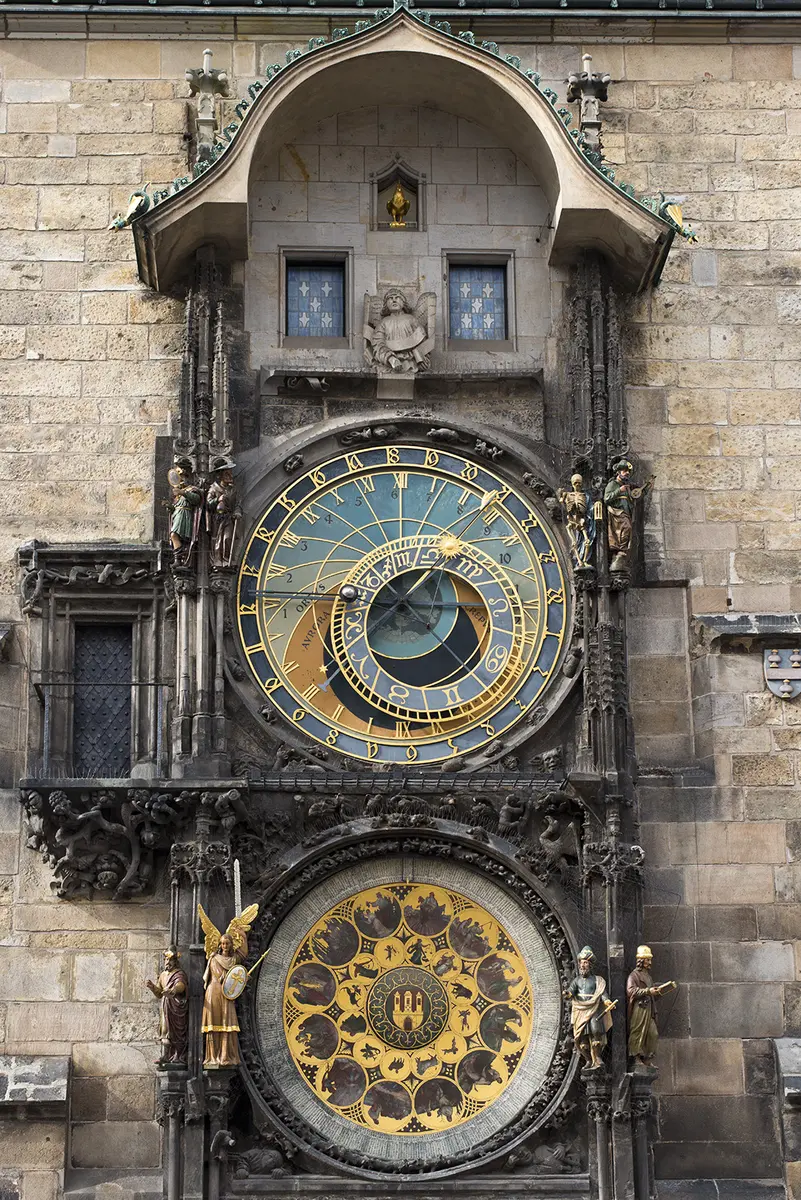
Most of what faces the square is younger than the clock. The calendar plate by Josef Mánes was unveiled in August 1866; his original is in the Museum of the City of Prague, and the copy fitted during the 2017–2018 restoration has been criticised by Czech conservators for departing from it in details of dress and hairstyle. The apostles are Vojtěch Sucharda's replacements for the figures that burned with the tower on 8 May 1945, and the clock ran again on 1 July 1948. The Czech Horological Society reckons that the mechanism still has about three quarters of its old parts, and on that basis calls the Orloj the best preserved of its kind; it does not claim it as the oldest astronomical clock, since Padua (1344), Strasbourg (1352) and Lund (1380) came earlier.
On the side wall of the clock, by the entrance gate of the Old Town Hall, a plaque with a long history of the building states, in the transcription published by the inventory Pamětní desky v Praze in October 2020, that the clock was made "in 1410 by master Mikuláš of Kadaň according to the calculations of Jan Šindel" and that its late Gothic decoration dates from 1490, "when the clock was repaired by master Hanuš of Růže". The plaque at the clock therefore carries both the Šindel attribution that Petr Skála judged too weak to be cast in bronze and the Hanuš of the legend, as a repairer. A separate plaque to Mikuláš, with no mention of Šindel, was unveiled in his home town of Kadaň on 15 September 2010, according to the Czech Horological Society.
Sources consulted
- Burgomaster and council of the Old Town of Prague, «Letter of the burgomaster and council of the Old Town of Prague rewarding master Mikuláš of Kadaň for the astrolabe clock, 9 October 1410 (German original lost; copy with Czech translation in the clock-keepers' book, Archive of the City of Prague, sign. 7619, ff. 51 and 53) — read in the transcription and description published by the Czech Horological Society» — Archiv hlavního města Prahy, 1410 archive
- Jan Táborský z Klokotské Hory, «Zpráva o orloji Pražském (Report on the Prague Orloj), manuscript, Archive of the City of Prague, sign. 1867 — passages read in the verbatim transcription printed by J. Smolík in 1864» — Archiv hlavního města Prahy, 1570 archive
- Josef Smolík, «Mathematikové v Čechách od založení university Pražské do r. 1620 — chapter on master Hanuš, with Táborský quoted verbatim and Balbín's addition rejected» — Praha, 1864 book
- Josef Svátek, «Starý orloj na věži radnice, in Pražské pověsti a legendy (1883); read in the F. Topič reprint of 1922» — F. Topič, Praha, 1883 book
- Alois Jirásek, «Staroměstský orloj and Proroctví slepého mládence, in Staré pověsti české (1894); full text consulted in the 1959 edition» — Staré pověsti české, 1894 book
- Petr Skála, «Nový pohled na hypotézu o účasti Jana Šindela na stavbě pražského orloje (New view on the hypothetical participation of Jan Šindel in the construction of the Prague astronomical clock)» — Staletá Praha 32/1, pp. 24–45, 2016 academic
- Petr Král, Petr Skála, Stanislav Marušák (Český spolek horologický), «Stručná historie Pražského orloje, Mistr Hanuš později určený jako Jan Růže, Otazníky a omyly – autorství, Sedm pověstí o orloji and Hypotéza se nestane faktem odlitím v bronzu» — orloj.eu, 2010 web
- Národní knihovna České republiky, «Full-text search of the digital library of the National Library of the Czech Republic (Kramerius), sweep of 16 August 2026: before 1885, 256 documents mention 'orloj' and nine mention 'mistr Hanuš' with 'orloj', while the pairing of 'orloj' with any Czech word for blinding returns zero (query repeated twice). Whole corpus: 'orloj' 28,340 documents; 'mistr Hanuš' + 'orloj' 744, from 1849; earliest dated blinding hit 1885.» — Kramerius digital library, 2026 archive
- Prague City Tourism, «Old Town Hall with Astronomical Clock — opening hours, admission, lift and accessibility» — prague.eu, 2026 web
Reviewed by V. Serrano on 2026-08-16 · How we verify our content
📎 Source: Enigma Atlas
💬 Field testimonies (0)
No testimonies yet. Add the first.
Add your testimony
🔒 Log in to add a testimony