📜 LEGEND · EXP. Nº3657
ACTIVE
The White Lady of Rožmberk
Perchta of Rožmberk was real: born at Český Krumlov in 1429 or 1430, married off in November 1449 to Jan V of Lichtenštejn, dead in Vienna on 2 May 1476.
Where does the legend of The White Lady of Rožmberk come from?
- Location
- Castillo de Český Krumlov, Bohemia del Sur, Czech Republic
- Kind of legend
- Ghost story
- Coordinates
- 48.813, 14.318
- Last updated
LOCATION
What is the legend of The White Lady of Rožmberk?
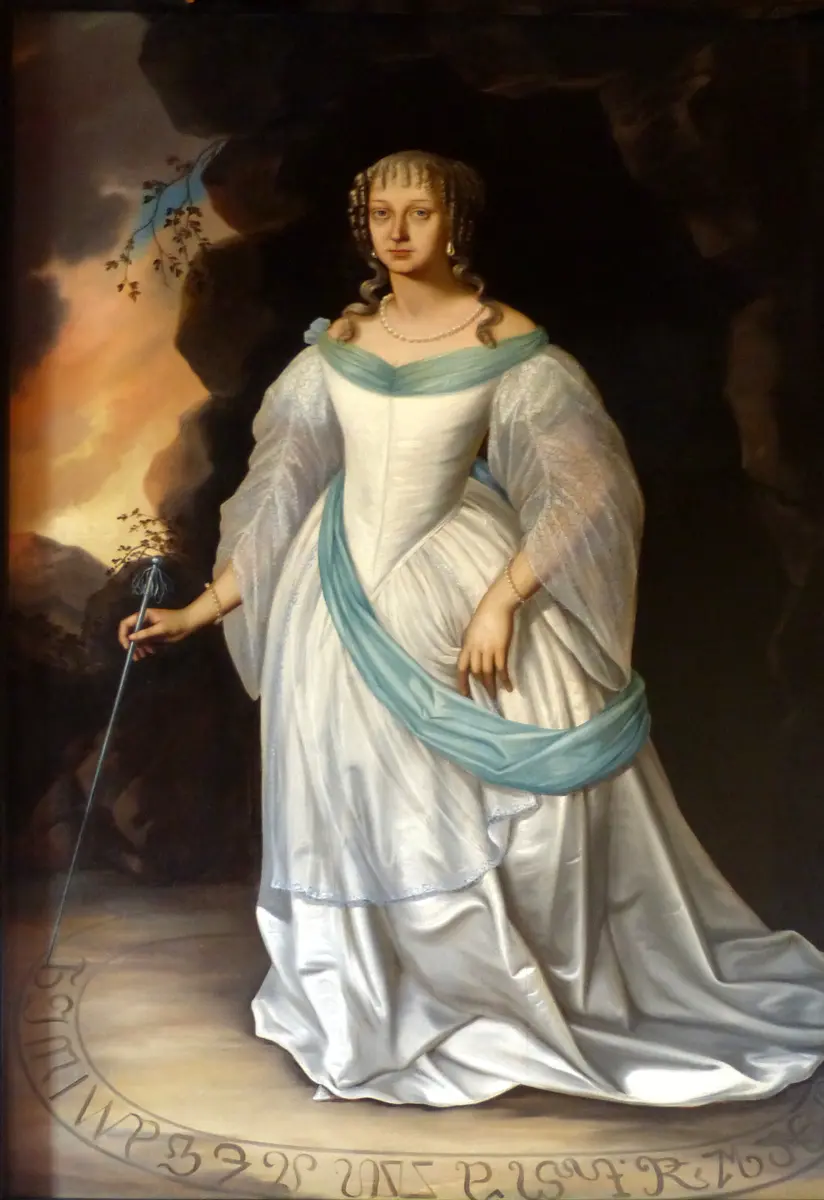
Thirty-two of her letters survive in the family archive at Třeboň, and they are the reason anyone remembers her — but they do not say what her legend says. Her complaint, on 20 February 1450, is that she is 'a veritable beggar of that lady', her mother-in-law, because her father had not handed over the dowry he had promised; he withheld it for eleven years. The ghost came afterwards. In 1891 August Sedláček named the Jesuit historian Bohuslav Balbín as the man who read those letters and decided their author was the White Lady of the Rožmberks — a figure Sedláček flatly called invented and German in origin. And the famous coded message that supposedly leads to the family treasure is painted on a canvas: a full-length portrait made for the Buquoy counts during their neo-Gothic refit of Rožmberk castle between 1840 and 1857, in a script John Dee's circle did not record until 1583, 107 years after Perchta was buried.
What is the history of The White Lady of Rožmberk?
Perchta of Rožmberk was born at Český Krumlov in 1429 or 1430, the daughter of Oldřich II of Rožmberk (1403-1462), the most powerful Catholic lord in Bohemia during and after the Hussite wars, and of Kateřina of Vartenberk. In November 1449 her father married her to Jan (Hanuš) V of Lichtenštejn, whose seat was the castle at Mikulov in southern Moravia. The betrothal agreement is unusually well documented: Oldřich promised a dowry of 60,000 groschen, Lichtenštejn added 90,000 of his own, and Perchta was to draw an annual income of 15,000 groschen secured against Lichtenštejn's castle of Steiregg near Linz.
Oldřich did not pay. The full dowry was not handed over until 1460, eleven years after the wedding, while the money went instead into his diplomacy and into turning Český Krumlov into a court. That default is the hinge of the story: a bride whose dowry has not arrived has no standing in her husband's household, and the letters Perchta wrote from Mikulov are about exactly that.
Thirty-two letters survive from her years at Mikulov, written to her father and later to her brothers Jindřich and Jan. They are held in the Rožmberk family archive, today in the State Regional Archive at Třeboň, in a box catalogued under the Lichtenštejn family. August Sedláček printed the Czech ones in volume XI of Archiv český in 1892; the German ones remain unpublished. An English translation by John Klassen, Eva Doležalová and Lynn Szabo appeared in 2001.
In the first surviving letter (November-December 1449) she is still hoping: "And dear lord, I beseech Your Grace not to forget me, but to please be loving towards me, for I would never want to lose Your Grace." On 11 January 1450 she is warier: "I am afraid that Your Grace only wants to see me [in company] with him." By 20 February 1450 the complaint is specific, and it is about her mother-in-law: "I am in such a disorderly residence that there is no way I can get used to it. I am a veritable beggar of that lady and have to wait for everything from her hands." The grievance is domestic authority and access to money — the two things the unpaid dowry had taken from her.
Her husband died in 1473. Perchta outlived him by three years and died in Vienna on 2 May 1476. Nothing in her lifetime connects her to a ghost.
Timeline: the documented record of The White Lady of Rožmberk
- November 1449 Oldřich II of Rožmberk marries his daughter Perchta to Jan (Hanuš) V of Lichtenštejn. The contract promises a 60,000-groschen dowry, 90,000 more from the groom, and an annual income of 15,000 groschen secured on the castle of Steiregg near Linz. The dowry will not be paid in full for eleven years.
- 20 February 1450 Perchta writes to her father from Mikulov: 'I am in such a disorderly residence that there is no way I can get used to it. I am a veritable beggar of that lady and have to wait for everything from her hands.' The lady is her mother-in-law. It is the earliest precise statement of what her marriage actually cost her, and it is about money and household rank, not about cruelty.
- 1460 The dowry is finally handed over, eleven years after the wedding, after Perchta's brother Jan of Rožmberk negotiates its payment. In an undated letter of that year, printed as letter 34 in the modern edition, she ends: 'I often wrote with great sorrow, but this letter with great joy.'
- 2 May 1476 Perchta of Rožmberk dies in Vienna, three years after her husband. No source from her lifetime associates her with a ghost, a curse, a treasure or a coded message.
- 26 March 1583 Edward Kelley reports to John Dee the vision of a twenty-one-letter alphabet in the crystal. This is the conventional date, taken from Dee's spiritual diaries (British Library, MS Sloane 3188-3189), for the first appearance of Enochian — the script in which the supposed 'message of Perchta' is written on the Rožmberk canvas. It postdates her death by 107 years. Dee and Kelley were themselves guests of the Rožmberks: Dee's son, born on 28 February 1588, was baptised Theodorus Trebonianus after Třeboň, the family seat where the letters were kept.
- 1688 (death of Balbín) The Jesuit historian Bohuslav Balbín dies. Two centuries later August Sedláček will name him as the man who fused the two stories: Balbín, 'having learned of the unhappy marriage of Perchta of Rožmberk, and perhaps also hearing the White Lady called Perchta, greatly contributed to the fates of the two being tangled into a new legend.'
- 1816 The Brothers Grimm print "Frau Berta oder die weiße Frau" as no. 267 of their Deutsche Sagen. Their White Lady appears at Neuhaus in Bohemia (Jindřichův Hradec) and in other princely castles; her visit means an approaching death, or something joyful when she is not wearing a black glove. She carries keys, rocks children in the nursery when the nurses fall asleep and founded a meal of sweet porridge. "According to some", she was Perchta of Rosenberg, wife of Johann von Lichtenstein.
- 1840-1857 The Buquoy family rebuilds Rožmberk castle in the romantic neo-Gothic manner, as the castle's own website states. The refit produces the Rosenberg Hall, a pseudo-Gothic 'White Lady's room', and the full-length portrait of the White Lady attributed to Bedřich Ströbl (born 1814) that carries the Enochian inscription. That painting, not any medieval document, is the physical object the treasure story is attached to.
- 1874 František Dvorský publishes 'Perchta z Rožmberka zvaná bílá paní' (Perchta of Rožmberk, called the White Lady) in Prague, in the mass-circulation series Matice lidu. This is the book that carries Balbín's identification out of the archives and into ordinary Czech reading.
- 1891 August Sedláček's entry 'Bílá paní' appears in volume IV of the Ottův slovník naučný, p. 49. In 196 words he calls her an invented personage of German mythological origin, blames Balbín for the conflation, and records that study of the medieval sources showed 'Perchta of Rožmberk was never in any connection with Hradec'. The entry mentions no gloves, no colours, no treasure and no inscription.
- 1892 The same Sedláček prints Perchta's Czech letters in volume XI of Archiv český, edited by Josef Kalousek. Her German letters remain unpublished. The English translation by John Klassen, Eva Doležalová and Lynn Szabo follows in 2001.
- 15 March 2010 After a two-month appeal to its readers, the regional daily Deník publishes a decipherment of the painted inscription by Josef Trhlík, a painter signing as Zlatoděj, who reads three painted words as an anagrammatic and kabbalistic message giving Perchta's dates, the name of a lover and the whereabouts of the Rožmberk treasure. Deník prints it as a reader's contribution; no historian or palaeographer is involved.
Is there a rational explanation for The White Lady of Rožmberk?
The oldest printed account of the Bohemian White Lady among this file's sources is in the Brothers Grimm's Deutsche Sagen (vol. I, Berlin, 1816, no. 267, "Frau Berta oder die weiße Frau"), and it already carries most of what modern retellings repeat. She appears in the castles of several princely houses, "namely at Neuhaus in Bohemia" — Jindřichův Hradec — and her visit "signifies an approaching death, sometimes also something joyful, namely when she is not wearing a black glove". She carries a bunch of keys and a white veiled cap, rocks the children in princely nurseries at night "when sleep overcomes the nurses", and founded a meal of sweet porridge for the castle's people. "According to some", the Grimms add, she was called Perchta of Rosenberg in life, lived at Neuhaus and was married to Johann von Lichtenstein, "an evil, obstinate man". For all this they cite a Latin treatise printed at Königsberg in 1723 by Johann Jacob Rohde and Erasmus Francisci's Höllischer Proteus.
Seventy-five years later, August Sedláček's entry in volume IV of the Ottův slovník naučný (Prague, 1891, p. 49) takes that account apart. Sedláček opens by calling her "osobnost vymyšlená a bytost mythická" — an invented personage and a mythical being — of German mythological origin, a legend kept alive at Hradec, Telč and Krumlov, at the first two probably because the German wives of the first lords of Hradec brought it with them. He then names the man he holds responsible for attaching Perchta to her: "Balbín, having learned of the unhappy marriage of Perchta of Rožmberk (d. 1476), and perhaps also hearing the White Lady called 'Perchta', greatly contributed to the fates of the two being tangled into a new legend." And he closes the door on the connection: careful study of medieval records, he writes, showed that "Perchta of Rožmberk was never in any connection with Hradec" — the Neuhaus where the Grimms had her living as a widow. Bohuslav Balbín (1621-1688) was a Jesuit historian. Sedláček does not say how Balbín learned of the marriage; the account of him reading Perchta's letters in the Rožmberk archive comes from later Czech art-historical scholarship.
Sedláček's entry is short, and it is explicit about what the ghost does: dressed in a white robe, she appears "only when some danger threatens the family, or if there is danger that something might happen to one of them (for example when the nurse falls asleep beside the child)". It has no gloves, no keys, no treasure and no inscription. The glove is older than the entry. In the Grimms' text of 1816 there is a single black glove, and good news is marked by its absence. The pairing of white gloves for happy events with black ones for sad events is what Czech Wikipedia's list of White Ladies gives for Český Krumlov, where she announced good news "with white gloves and keys at her belt" and bad news with black gloves, citing Vendula Dvořáčková's popular guide 222 tajemných míst (Prague, 2003).
Sedláček also records that Theodor Wagner, the archivist at Třeboň, explained the old tradition that the White Lady, in her lifetime, supervised the workmen building at Hradec and instituted the distribution of sweet porridge, by identifying her with Markéta of Maidburg (d. 1369) — a different woman, who died some sixty years before Perchta was born.
The inscription at the centre of the treasure story is painted on the portrait of the White Lady that hangs in the Rosenberg Hall of the lower castle at Rožmberk, the same painting this page uses as its photograph. The castle's own website dates a reconstruction "in spirit of the romantic Gothic style" to 1840-1857, carried out to make the castle a monument to the Buquoy family; Czech scholarship attributes the canvas to Bedřich Ströbl, born 1814, and the photographer who took our image dated the hall and the painting to the 1840s. Deník identifies the script as Enochian, the "angelic" alphabet of John Dee and Edward Kelley, whose reception began on 26 March 1583, when Kelley reported the letters in the crystal. Perchta died on 2 May 1476. The alphabet of her supposed message dates from 107 years after her death, and the canvas from roughly 370 years after it.
As for the decipherment: in early 2010 the regional daily Deník ran a two-month reader appeal to crack it, and on 15 March 2010 published a solution by Josef Trhlík, a painter writing under the name Zlatoděj, who read the three painted words as an anagrammatic and kabbalistic message naming Perchta's true love, her dates and the location of the Rožmberk treasure. Trhlík describes his own method as a kabbalistic numerological system, no historian or palaeographer is quoted in the article, and Deník prints it as the latest response to its appeal.
Can you visit The White Lady of Rožmberk?
Two different castles carry this story, and they are 17.8 km apart.
Český Krumlov Castle, where Perchta was born and where our map pin falls, is the state castle and chateau run by the National Heritage Institute, in the UNESCO-listed town of Český Krumlov. In the 2026 season Tour Route I runs 1 June to 31 August, Tuesday to Sunday 9.00-17.00, and 1 September to 31 October, Tuesday to Sunday 9.00-16.00; Tour Route II runs 1 July to 31 August, Tuesday to Sunday 9.00-17.00, and weekends only through September. Full admission is 300 CZK for Route I and 260 CZK for Route II, with reduced rates of 240 and 210 CZK for over-65s and 18-24s, and 90 and 80 CZK for children aged 6-17. The Castle Museum and Tower are self-guided at 280 CZK full and stay open to 20 December; the Baroque Castle Theatre is a separate ticket at 400 CZK; the castle garden is free and open 1 May to 30 September, 7.00-19.00.
One thing is absent from the Krumlov offer. A sixteenth-century portrait said to be Perchta hangs in the Krumlov collections, and the White Lady is no part of what the castle administration sells: a scan of all 71 pages listed in the castle's own sitemap returned zero occurrences of "Perchta", "bílá paní", "White Lady" or any word for ghost, against 360 occurrences of the word for guided tour in the same sweep. Ghost walks in Krumlov are sold by private operators in the town.
Rožmberk Castle, at Rožmberk nad Vltavou some 18 km south towards the Austrian border, is where the painting with the inscription actually is, in the Rosenberg Hall of the lower castle, along with a neo-Gothic "White Lady's room" from the same 1840-1857 refit. Its English pages state that the tour "acquaints visitors with the oldest members of the Buquoy family. The last Rožmberks and the White Lady, who appeares in this castle, are mentioned too." The 45-minute main route costs 220 CZK full, 180 CZK reduced, 70 CZK for children aged 6-17; the Private Rooms route is 180/140/50 CZK and the Jakobínka tower 180 CZK. The season is short: 7 July to 31 August, Tuesday to Sunday 9.15-16.30; 1-27 September, Tuesday to Sunday 9.30-15.30; weekends only in October, then closed from 2 November to 31 December. The routes run on calendars that differ from one another.
Prices and hours here are those published by the two castle administrations and read on 22 September 2026; both are seasonal and change yearly.
Sources consulted
- John M. Klassen, with Eva Doležalová and Lynn Szabo, «The Letters of the Rožmberk Sisters: Noblewomen in Fifteenth-Century Bohemia» — Library of Medieval Women. Cambridge: D. S. Brewer, 2001 book
- August Sedláček, «Bílá paní» — Ottův slovník naučný, čtvrtý díl, Praha: J. Otto, p. 49, 1891 book
- Redakce Denik.cz, «Tajemný nápis na obraze bílé paní Perchty z Rožmberka konečně rozluštěn!» — Deník.cz, Magazín / Cestování, 15 March 2010, 2010 newspaper archive
- Národní památkový ústav — Hrad Rožmberk, «About the castle / Plan your visit (admission, opening hours, tours)» — hrad-rozmberk.cz, official site of the state castle (consulted 16 August 2026), 2026 web
- Národní památkový ústav — Státní hrad a zámek Český Krumlov, «Plan your visit: tours, admission and opening hours» — zamek-ceskykrumlov.cz, official site (consulted 16 August 2026), 2026 web
- Wolfgang Sauber, «File: Rožmberk Untere Burg — Rosenberger Halle 2 Weiße Frau.jpg (photographer's record of the portrait and the hall)» — Wikimedia Commons; heritage record 21001/3-1393, 2018 web
- Jacob y Wilhelm Grimm, «Deutsche Sagen, tomo I, n.º 267: «Frau Berta oder die weiße Frau», pp. 357-358 (guante negro, llaves, gachas dulces, «Perchta von Rosenberg» casada con Johann von Lichtenstein; cita a J. J. Rohde, 1723, y a E. Francisci)» — Nicolai, Berlín; transcripción en Wikisource alemana, 1816 book
- Colaboradores de Wikipedia, «Bílá paní — Český Krumlov: «Šťastné události ohlašovala bílými rukavicemi a klíči u pasu, nešťastné černými rukavicemi» (con cita de V. Dvořáčková, 222 tajemných míst, Praga, 2003; consultado el 25 de septiembre de 2026)» — Wikipedia en checo, 2026 web
Reviewed by V. Serrano on 2026-08-16 · How we verify our content
📎 Source: Enigma Atlas
💬 Field testimonies (0)
No testimonies yet. Add the first.
Add your testimony
🔒 Log in to add a testimony