📜 LEGEND · EXP. Nº3657
ACTIVE
The Well of Barhut
Islamic tradition gives Barhut an address rather than an idea: a well, in a valley, in Hadramawt, whose water a hadith transmitted by al-Tabarani calls the worst on the face of the earth — the exact counterweight to Zamzam, named as the best in the same breath.
Where does the legend of The Well of Barhut come from?
- Location
- Hadhramaut / Wadi Barhut (As Sawm), Yemen
- Kind of legend
- Myth
- Coordinates
- 16.017, 49.433
- Last updated
LOCATION
What is the legend of The Well of Barhut?
A report attributed to 'Ali and preserved by 'Abd al-Razzaq places in it the gathering of the souls of the unbelievers, and al-Qazwini collected the stories of a stench that rose from the valley whenever a chief of the unbelievers died. What fourteen centuries never settled is where the address is. Yaqut already listed the disagreements in the thirteenth century; the Bents were turned back twice in the 1890s without seeing it. On 15 September 2021 an Omani caving team descended 112 metres to the floor of a sinkhole in al-Mahra that locals call the Well of Barhut, and found waterfalls, cave pearls, snakes and dead birds — and no overwhelming smell. Ten days later a Hadrami writer replied in print that they had gone down the wrong hole, 336 kilometres from the tomb of Hud.
What is the history of The Well of Barhut?
Barhut is one of the few places in the Islamic tradition that is described as an address rather than an idea: not "hell" in the abstract, but a named well, in a named valley, in a named province. What almost nobody notices is that fourteen centuries of writing about it have never settled where that address actually is.
The oldest surviving layer is a pair. 'Abd al-Razzaq al-San'ani (d. 827) preserves in his Musannaf a report attributed to 'Ali ibn Abi Talib that works by symmetry: the two best valleys among people are the valley of Mecca and a valley in India; the two worst are the valley of al-Ahqaf and a valley in Hadramawt called Barahut; and the worst well is Balahut, "a well inside Barahut, in which the souls of the unbelievers gather". Note what the report actually says. Barahut is the valley. Balahut is the well inside it. They are two different things, and later writers merged them.
The saying that circulates today comes from al-Tabarani (d. 971), who records on the authority of Ibn 'Abbas a hadith with the same two-sided shape: "The best water on the face of the earth is the water of Zamzam, in it is food and a cure from sickness; and the worst water on the face of the earth is the water of Barhut in Hadramawt", described as swarming like a flight of locusts, gushing in the morning and dry by evening. Our previous version of this page quoted only the second half. The first half is Zamzam, and without it the sentence is not a curse on a well but a piece of religious geography that ranks the best and the worst water of the world in one breath.
The classical geographers then hedge. Al-Zamakhshari (d. 1144) calls Barhut a well in Hadramawt where the souls of the unbelievers are said to dwell, and adds that the name also belongs to the district around it. Yaqut al-Hamawi (d. 1229) opens his entry in the Mu'jam al-Buldan with "a valley in Yemen where the souls of the unbelievers are placed", then immediately gives the alternatives: some say Barhut is a well in Hadramawt, some say it is the name of the country containing that well, and Ibn Durayd (d. 933) vocalised it Burhut. Al-Qazwini (d. 1283) collects the stories: al-Asma'i heard from a man of Hadramawt that "we find a terrible stench from the direction of Barhut, and then news reaches us that a great man among the chiefs of the unbelievers has died"; another man who spent a night in the valley heard a voice calling all night, which a scholar told him was the name of the angel set over the souls of the unbelievers. The angel is Duma in the Arabic version of the story and appears as Roumeh in the English translation the Bents used in 1900 — the same anecdote, a different name.
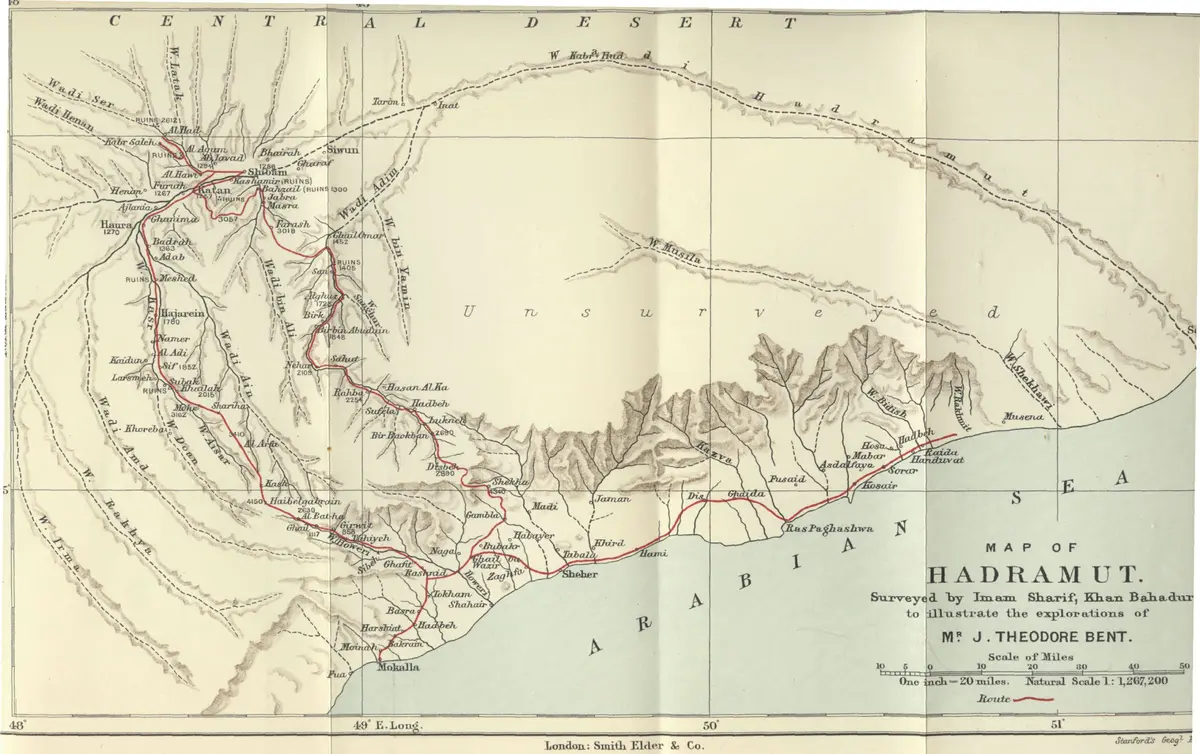
Europeans could not check any of it. Adolph von Wrede, travelling disguised, was unmasked as a Christian at the pilgrimage of Qaydun and turned back. Leo Hirsch reached the main Wadi Hadramawt in 1893, the first European to do so. Theodore and Mabel Bent tried twice. In the winter of 1893-94 they costed the trip to Bir Borhut at 130 pounds and were blocked by the Kathiri, who had sworn on the Qur'an not to let them pass; the following season the journey was agreed and then withdrawn, because as Christians they could not go near Qabr Hud, the tomb of the prophet Hud, and Barhut lies beyond it. Mabel Bent's account is the reason we know what the well was believed to be at the time: a solfatara, with "much brimstone" on the heights nearby that the Bedouin collected for gunpowder, and which al-Mas'udi in the tenth century had called the greatest volcano in the world, throwing up masses of fire and thundering for miles.
The Hadrami writer 'Alawi bin Sumayt lists who did get in, at the cave near the village of Tan'ah: Sayyid Muhammad bin 'Aqil bin Yahya, who went down with ropes in April 1913 and published the trip in the Cairo magazine al-Muqtataf in 1928; the Dutchman Daniel van der Meulen and the geographer Hermann von Wissmann in the 1930s; and the Yemeni explorer Salih Balfaqih, who made four visits in 2005 and 2006 and published a book of maps and photographs called simply Barhut. None of them, bin Sumayt writes, found a well.
Timeline: the documented record of The Well of Barhut
- d. 827 'Abd al-Razzaq al-San'ani preserves in his Musannaf a report attributed to 'Ali ibn Abi Talib: the two worst valleys are al-Ahqaf and Barahut in Hadramawt, and the worst well is Balahut, a well inside Barahut where the souls of the unbelievers gather. The valley and the well are named separately.
- 10th century Al-Mas'udi describes Barhut as the greatest volcano in the world, throwing up masses of fire with a roar audible for miles — the earliest description of the site as a physical phenomenon that the Bents could trace in 1900.
- d. 971 Al-Tabarani records from Ibn 'Abbas the hadith that pairs the best and the worst water on earth: Zamzam against Barhut in Hadramawt, which gushes in the morning and is dry by evening. Al-Albani later grades it hasan.
- d. 1229 Yaqut al-Hamawi's Mu'jam al-Buldan opens its entry with "a valley in Yemen where the souls of the unbelievers are placed" and then lists the disagreements: a well, a district, or Burhut as Ibn Durayd vocalised it. The location is already unstable in the standard geographical dictionary.
- d. 1283 Al-Qazwini collects the two anecdotes that gave Barhut its sensory reputation: al-Asma'i's Hadrami informant who smells a stench whenever a chief of the unbelievers dies, and the traveller who hears an angel's name called all night in the valley.
- 1893 Leo Hirsch becomes the first European to reach the main Wadi Hadramawt. Adolph von Wrede had tried earlier in disguise and was unmasked as a Christian at the pilgrimage of Qaydun and turned back before getting near Barhut.
- 1894 Theodore and Mabel Bent budget 130 pounds for the journey to Bir Borhut and are blocked: the Kathiri swear on the Qur'an not to let them pass. The following season the trip is agreed and then withdrawn, because as Christians they may not go near Qabr Hud. They never see the well; their index lists it on three pages of hearsay.
- April 1913 According to 'Alawi bin Sumayt, Sayyid Muhammad bin 'Aqil bin Yahya descends the Barhut cave near Tan'ah with ropes and a few companions, and publishes the account in the Cairo magazine al-Muqtataf in 1928. Van der Meulen and von Wissmann follow in the 1930s.
- 2005-2006 The Yemeni explorer Salih Balfaqih makes four visits to the Hadramawt cave and publishes a book titled Barhut, with maps and photographs of its halls and passages. Bin Sumayt notes that none of the explorers of the cave found a well in it.
- 15 September 2021 Ten members of the Omani Caves Exploration Team rig a pulley over the sinkhole at Fujayt, in al-Mahra, and lower eight of them 112 metres to the floor — the first recorded descent to the bottom. They find waterfalls at 65 metres, stalagmites over nine metres, cave pearls, snakes, frogs, beetles and fallen dead birds. Mohammed al-Kindi tells AFP there was no overwhelming bad smell.
- 25 September 2021 Ten days after the descent, the Hadrami writer 'Alawi bin Sumayt publishes a rebuttal in Shabwah Press: Barhut is an 80-kilometre valley in the As Sawm district of Hadramawt that drains into Wadi Hadramawt, and the al-Mahra pit is locally called Bi'r al-Kasfa, near Shahan. The identification of the famous sinkhole with the well of the hadith is contested from the week it was made.
Is there a rational explanation for The Well of Barhut?
On 15 September 2021 the question stopped being literary. A team of ten from the Omani Caves Exploration Team (OCET) rigged a pulley over a sinkhole in eastern Yemen that locals call the Well of Barhut, and lowered eight of its members to the floor. It is the first descent to the bottom on record, and it produced numbers.
The pit is 112 metres deep. Its mouth is a near-perfect circle 30 metres across; the shaft keeps that width for the first 65 metres and then flares out to roughly 116 to 120 metres at the base. Water seeps out of the walls at about 65 metres down, where a permeable limestone sits on a marlier one, and falls as small waterfalls; the eastern one is the most active. The floor is uneven and spiked with stalagmites, some over nine metres tall, and patched with cave pearls. The team found snakes, frogs, beetles and birds, plus the rotting carcasses of animals that had fallen in. Mohammed al-Kindi, a geology professor at the German University of Technology in Oman who went down with the team, told AFP that they collected samples of water, rock, soil and dead animals — and, on the detail that had built the legend, that "there was no overwhelming bad smell". Their gas detectors read normal oxygen and no toxic air. They drank the water.
That accounts for most of the tradition without invoking anything. A pit full of dead birds smells. Sulphur explains the rest, and it is not a hypothesis: Mabel Bent recorded in 1900 that the heights near Bir Borhut carry so much brimstone that the Bedouin gathered it for gunpowder. As for the shape of the hole, Philip van Beynen, a sinkhole specialist at the University of South Florida who had nothing to do with the expedition, told Live Science that collapse and subsidence sinkholes are the ordinary furniture of karst country, and that dating one is usually impossible: "unless it occurs when people live at the site and record the event, then it's almost impossible."
The harder problem is that the pit they measured may not be the well the texts are talking about. It sits in Fujayt, in the Shahan district of al-Mahra governorate, about 33 kilometres from the Omani border and some 336 kilometres east of Qabr Hud. Every classical source places Barhut in Hadramawt, and the gazetteers agree with them: GeoNames lists a Wadi Barhut and a Bi'r Barhut in the As Sawm district of Hadramawt, 13 and 17 kilometres from the tomb of Hud. Ten days after the descent, on 25 September 2021, the Hadrami writer 'Alawi bin Sumayt published a rebuttal in Shabwah Press arguing exactly this: that Barhut is an 80-kilometre valley in As Sawm that drains into the main Wadi Hadramawt, that the al-Mahra pit is locally known as Bi'r al-Kasfa or al-Khasfa near Shahan, and that a third candidate sometimes offered, Shawran near ancient Qana in Shabwa, is a flooded volcanic crater and not it either. Bin Sumayt is not a neutral witness and he gets a fact wrong — he writes that no water was found in the al-Mahra pit, and the team drank from it — but on the geography the classical texts are on his side. Arabic Wikipedia's article states flatly that no reliable source confirms any of the identifications.
The reports themselves are also graded, and by name. Al-Haythami judged the narrators of the Ibn 'Abbas hadith trustworthy and Ibn Hibban declared it sound; Ibn Hajar noted problems with some transmitters but held that corroboration strengthens it; al-Albani graded it hasan, in Silsilat al-Ahadith al-Sahiha no. 1056 and Sahih al-Targhib no. 1161. The report about the souls of the unbelievers is a different matter: it is mawquf, stopped at 'Ali and not raised to the Prophet, al-Albani called its chain weak, and Ibn al-Qayyim in Kitab al-Ruh treated this family of material as probably Isra'iliyyat, to be neither affirmed nor denied. So "the authenticity is debated" is true, but it has names attached, and the two halves are debated differently.
Can you visit The Well of Barhut?
The United Kingdom's Foreign, Commonwealth and Development Office advises against all travel to the whole of Yemen "due to the unpredictable security conditions" and tells anyone in the country to leave immediately. Its advice page, last updated on 31 July 2026 and read on 24 September 2026, states that British Embassy services in Sana'a are suspended, that all diplomatic and consular staff have been withdrawn and that "there are no evacuation procedures in place". It names Hadramawt, together with Abyan, Marib and Shabwah, among the governorates where the terrorist threat is heightened, and describes "a very high and constant threat of kidnap across Yemen".
The sinkhole descended in 2021 is at Fujayt, in the Shahan district of al-Mahra governorate; the English Wikipedia article on it places it at 17.3403 N, 52.4439 E. AFP described it in June 2021 as a hole 30 metres wide in the desert, closer to the Omani border than to Sana'a. Measured between that coordinate and the GeoNames coordinate for Sana'a, the capital is about 906 kilometres away in a straight line. In that report Salah Babhair, director-general of al-Mahra's geological survey and mineral resources authority, said his team had gone "more than 50-60 metres down into it" and that "there's little oxygen and no ventilation". The Omani team that reached the floor in September 2021 used a pulley system that lowered eight of its ten members while two stayed at the top, and it carried gas detectors.
The Hadramawt candidate lies in the As Sawm district, near the village of Tan'ah according to 'Alawi bin Sumayt. The GeoNames gazetteer records Bi'r Barhut as a cave at 16.01667 N, 49.43333 E, at an elevation of about 826 metres, and Wadi Barhut at 16.08333 N, 49.45 E; the pin on this file sits on the Bi'r Barhut record. Measured from the coordinate the English Wikipedia gives for Qabr Hud (16.1017 N, 49.5684 E), the wadi is 13 kilometres away and the cave 17. The cave and the al-Mahra sinkhole are 353 kilometres apart.
Qabr Hud, the tomb of the prophet Hud, is the place that decided the Bents' attempt. In 1894 their journey to Bir Borhut and Kabr Houd had been agreed and the day of departure fixed when, Mabel Bent wrote, "it became apparent that we Christians could by no means be permitted to go near Kabr Houd"; they gave up the trip for that year.
Sources consulted
- Theodore Bent and Mabel Bent, «Southern Arabia» — Smith, Elder & Co., London, 1900 book
- Harry Baker, «Cavers discover snakes and waterfalls inside Yemen's infamous 'Well of Hell' in world-first descent» — Live Science, 2021 newspaper archive
- Nada AlTaher, «'Well of Hell': Omani cave team discover what lurks in Yemen's strange sinkhole» — The National (Abu Dhabi), 2021 newspaper archive
- Alawi bin Sumayt, «برهوت بئر في حضرموت.. وليس خارج حدودها الإدارية (Barhut is a well in Hadramawt, not outside its administrative borders)» — Shabwah Press, 2021 newspaper archive
- Fatwa Centre, «شرح حديث شر ماء على وجه الأرض (Commentary on the hadith of the worst water on earth), fatwa 37520» — Islamweb, 2003 web
- Islam Question & Answer, «مدى صحة كون أرواح الكفار في بئر برهوت (On the soundness of the reports that the souls of the unbelievers are in the well of Barhut), fatwa 383601» — IslamQA, 2022 web
- GeoNames, «Gazetteer entry for Bi'r Barhut (feature code S CAVE, geonameId 76784; 16.01667 N, 49.43333 E, elevation ca. 826 m), As Sawm district, Hadramawt» — GeoNames geographical database, 2026 web
- Foreign, Commonwealth & Development Office, «Yemen travel advice» — GOV.UK (last updated 31 July 2026; consulted 24 September 2026), 2026 report
- GeoNames, «Gazetteer entry for Wadi Barhut (feature code H WAD, geonameId 77118; 16.08333 N, 49.45 E), As Sawm district, Hadramawt» — GeoNames geographical database, consulted 24 September 2026, 2026 web
- AFP, «Yemen's strange sink hole: the mysterious 'Well of Hell' — AFP report quoting Salah Babhair, director-general of Mahra's geological survey and mineral resources authority» — The National (Abu Dhabi), 22 June 2021, 2021 newspaper archive
- English Wikipedia contributors, «Well of Barhout — article coordinates 17.3403 N, 52.4439 E (consulted as a dated document for the position of the sinkhole)» — Wikipedia, consulted 24 September 2026, 2026 web
- English Wikipedia contributors, «Qabr Hud — article coordinates 16.1017 N, 49.5684 E (consulted as a dated document; origin of the 13, 17 and 336 km distances)» — Wikipedia, consulted 24 September 2026, 2026 web
- GeoNames, «Gazetteer entry for Sanaa, capital of Yemen (geonameId 71137; 15.35452 N, 44.20646 E)» — GeoNames geographical database, consulted 24 September 2026, 2026 web
Reviewed by V. Serrano on 2026-08-16 · How we verify our content
📎 Source: Enigma Atlas
💬 Field testimonies (0)
No testimonies yet. Add the first.
Add your testimony
🔒 Log in to add a testimony