🦶 CRYPTID SIGHTING · EXP. Nº0555
ACTIVE
Krampus
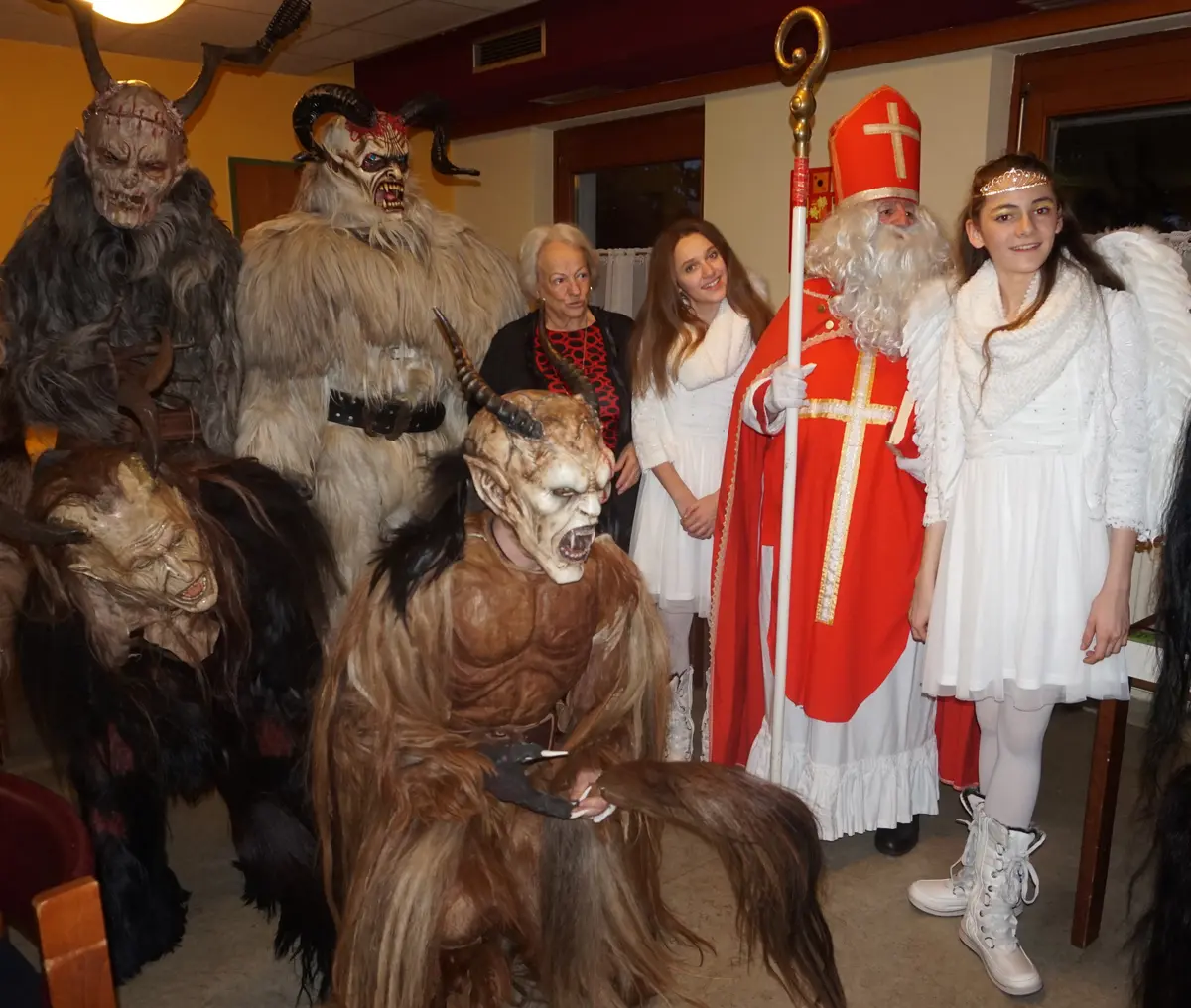
Krampus is the horned, fur-clad companion of Saint Nicholas in the Alpine Advent custom, and the masked runs held around 5 and 6 December in Salzburg and Tyrol are its public face.
Where and when was Krampus sighted?
- Location
- Salzburg / Alpine region, Austria
- Date sighted
- Unknown
- Coordinates
- 47.81, 13.055
- Last updated
LOCATION
What is Krampus?
The documentary record is younger than the legend. The earliest written evidence for the masked custom is a payment recorded in 1582 at Diessen in Bavaria to those who had "hunted the Percht", and the reports of the seventeenth and eighteenth centuries all call the practice Percht; the word Krampus spread with a Viennese craze for red greeting postcards after the postcard reached Austria-Hungary in 1897. The horned devil has a traceable ancestor in the Jesuit Nicholas plays of the Counter-Reformation. The story of a pagan survival thousands of years old was put into circulation by German-nationalist folklorists in the early twentieth century, and the anthropologists Matthäus Rest and Gertraud Seiser, after five years of fieldwork, class most of today's events as invented traditions that boomed after 2000.
What is the history of Krampus?
The oldest document anyone has produced on this subject is an account book. In 1582, in the Bavarian town of Diessen, the men who had "hunted the Percht" were paid for the job. The entry was found by Hans Schuhladen, the ethnologist who in the 1980s became the first researcher to work systematically through the historical records; he found no pagan origins, and Matthäus Rest and Gertraud Seiser, summarising his work in 2018, call this earliest source "clearly modern".
The 1582 line records a sum of money and nothing more. In Rest and Seiser's words, "there are no details of the sequence of the rite or the costumes". The name it uses is Percht, and so do the reports from Bavaria, Tyrol and Salzburg that multiply through the seventeenth and eighteenth centuries: every one of them calls the practice Percht, and the word Krampus is absent from all of them.
Where the horned companion of Saint Nicholas does have a traceable ancestor is the theatre. Ulrike Kammerhofer-Aggermann traces the Bavarian and Tyrolean Nicholas plays back to the Jesuit drama of the Counter-Reformation, and Rest and Seiser, citing Schuhladen's 1984 study of the Alpine Nicholas plays, find "ample evidence that the depiction of the devil in the Jesuit theatre was a direct predecessor of the Krampus". The geography fits that line of descent: in the 1730s Archbishop Leopold Anton von Firmian expelled the remaining Protestants from the archbishopric of Salzburg — in the Gastein valley that meant a third of the population — and the vacated farms and miners' houses were taken over by Catholic incomers from Tyrol, who brought their Nicholas customs with them.
The repeated bans, so often cited as proof that the Church was fighting a pagan survival, deal with something else when they are read. The authorities objected to masked young people roaming the streets at night, drinking, dancing and fighting, and above all to girls and boys doing it together; Rest and Seiser file them under threats to public order. Until around 1800 there are many prohibitions and almost no descriptions, which begin with Romanticism and its new appetite for peasant culture. In 1841 Ignaz Kürsinger placed the Perchten runs among "the winter joys of the highlander, comparable to the balls and theatre performances of the city dwellers". By the middle of that century the custom survived in a few villages scattered across the Austrian and Bavarian Alps, most of them on the fringes of the former Prince-Archbishopric of Salzburg, and Rest and Seiser date its first wave of expansion to the four decades before the First World War.
Timeline: the documented record of Krampus
- 1582 An account book in the Bavarian town of Diessen records a payment to those who had "hunted the Percht". It is the earliest written evidence for the custom, and it describes neither costume nor rite. The word Krampus does not appear.
- 1730s Archbishop Leopold Anton von Firmian expels the remaining Protestants from Salzburg — a third of the population in the Gastein valley. Catholic incomers from Tyrol take over the empty farms and reinforce the Tyrolean Saint Nicholas house-visit custom in the valley.
- 1841 Ignaz Kürsinger describes the Perchten runs as "the winter joys of the highlander, comparable to the balls and theatre performances of the city dwellers" — a carnival in the slack season, not a rite.
- 1897 The postcard is introduced in Austria-Hungary. A Viennese craze for red "Greetings from Krampus" cards spreads to German-speaking cities and popularises the word Krampus itself. The cards are mostly about punishing children or about erotic mischief, and they fix the modern look of the figure.
- From the 1930s Professionally trained woodcarvers in the Gastein valley and in Matrei develop new types of Krampus mask. Early folklorists collect and exhibit them, and the two regions become the recognised homes of the "traditional" mask.
- 25 January 1940 A mass-circulation Nazi German weekly publishes a photo essay on the Gastein Perchten under the headline "As a thousand years ago", with a caption praising the custom as an inheritance of peasant Volkskraft frequently banned for its pagan roots.
- 1992 Hans Schuhladen publishes his survey of the Salzburg Perchten records, the first systematic archival study. He finds no pagan origin, dates the earliest source to 1582, and shows that the word Krampus is absent from every seventeenth- and eighteenth-century source.
- 2011 The Gasteiner Perchten are inscribed in Austria's national inventory of intangible cultural heritage. The official entry traces the roots to the Renaissance and states that regular practice was established only around 1900 — the state's own register contradicts the millenarian story.
- 2014 A long-established Salzburg troupe sends representatives to perform in Los Angeles, and 97 Passen are counted in the Gastein valley alone. Rest and Seiser point English readers to Al Ridenour's 2016 study for Feral House as a recent and comprehensive discussion.
Is there a rational explanation for Krampus?
The claim that Krampus is a pagan figure thousands of years old has authors and a date, and Matthäus Rest and Gertraud Seiser name them. After five years of fieldwork in Salzburg and Tyrol they concluded that performers' convictions about pre-Christian roots came "not from locally passed down knowledge, but from an origin story deliberately disseminated by folklorists in the early twentieth century". Viktor von Geramb, Richard Wolfram and others worked from a German-nationalist premise: the masked rites were Germanic survivals that Christianity had merely "moulded", and folk studies existed to remove that layer. The ecclesiastical bans of the seventeenth and eighteenth centuries served as confirmation. On 25 January 1940 the Berliner Illustrirte, one of the largest weeklies in Nazi Germany, ran a photo essay on the Gastein runs under the headline "Wie vor tausend Jahren", as a thousand years ago. As for the goddess Perchta, Rest and Seiser write that the similarity of the two words is "the only clear connection" between pre-Christian belief and the Krampus, and that nobody has yet found a historical source linking the masked parades to any cult of her.
The iconography is younger than the theory: the word Krampus took off with a craze that began in Vienna and spread once the postcard reached Austria-Hungary in 1897: red "Greetings from Krampus" cards which, by Rest and Seiser's reading, fall into two categories, "children and sex". The celebrated hand-carved masks of Gastein and Matrei are new types developed from the 1930s by professionally trained woodcarvers. Rest and Seiser class most present-day events as invented traditions in Eric Hobsbawm's sense, since only a handful of places practised the custom before the mid-twentieth century, and date the boom to the turn of the millennium.
The pagan reading still has defenders in print, and in the summer 2026 issue of the Antrocom Journal of Anthropology the independent researcher Sandra Busatta argues, from Indo-European philology, Palaeolithic archaeology and comparative ethnography, that Krampus "embodies the survival of the 'Bear King'". Her paper runs to 55 pages without citing Schuhladen or Rest and Seiser or mentioning the Diessen account book; the year 1582 appears in it once, for the Gregorian calendar. The tourist trade keeps the older story as well: on 8 October 2026 the English page of SalzburgerLand Tourismus on Krampus and Perchten called the custom an "archaic tradition" running "since the 17th Century", derived the Percht from "the mythological figure 'Perchta'", and said the Krampus had been "banned during the time of the Inquisition" with "the threat of the death penalty". In Salzburg's old town, Rest and Seiser report, the troupes are hand-picked for the Christmas tourist season and stay "always ready for a selfie".
Can you visit Krampus?
The runs cluster on the eve and the feast of Saint Nicholas. In the Gastein valley, according to the regional tourist office, «Der Gasteiner Krampuslauf findet alljährlich am 5. und 6. Dezember im ganzen Gasteinertal statt», with «80 bis 100 Krampuspassen» setting off house to house from about 16:30. The same page divides the two days: «Am 5. Dezember wird vorwiegend in den Ortszentren von Bad Gastein, Bad Hofgastein und Dorfgastein gelaufen, am 6. Dezember geht es zumeist in die ländlichere Gegend und die Randbereiche der Orte». Each Pass is built round a Nikolaus with his basket carrier and at least four Krampusse; most take an angel along as well. A house-to-house run has no barrier and no ticket.
Sankt Johann im Pongau publishes its big run in the town centre. The Großer Krampuslauf im Obermarkt is listed for Sunday 6 December 2026 at 19:00. The organiser given on the municipal page is the Verein der St. Johanner Krampusse, which counts «500 bis 600 Krampussen» for the run.
In the city of Salzburg the runs are programme items of the Christkindlmarkt on Dom- und Residenzplatz. The market opens on 19 November 2026 and closes on 1 January 2027. Its official calendar puts the Krampuslauf on «Samstag, 05. Dezember, voraussichtlich um 13.00 Uhr mit großer Bühne am Domplatz», a «Nikolo und Kinderkrampus» on Sunday 6 December at 15:30 and a Perchtenlauf on Monday 21 December at 19:00.
In South Tyrol the run is at Toblach in the Hochpustertal. The Tourismusverein Toblach announced the 2025 edition for Sunday 7 December from 18:00 to 22:00, with «600 Teufel, Krampusse und andere Ungeheuer» on a route «über die St. Johannesstraße bis ins Dorfzentrum», as the tourist office describes it.
ORF Tirol reported two injuries from the December 2024 runs in Tyrol. At Anras, in the Bezirk Lienz, a 51-year-old woman had a fingertip almost severed when her left hand was caught in the joint of a grille. At Imst a 22-year-old woman was struck on the left hand with a wooden rod, which the police described as a blow «mit erheblicher Gewalt», and she lost the movement of her fingers. In December 2025 Der Standard reported that at Tarrenz «Ein 22-jähriger Österreicher hatte einen Böller direkt in die Menschenmenge geworfen»: a twelve-year-old girl was taken to the hospital at Zams.
Sources consulted
- Matthäus Rest and Gertraud Seiser, «The Krampus in Austria: A Case of Booming Identity Politics» — EthnoScripts, vol. 20, no. 1, pp. 35-57, 2018 academic
- Österreichische UNESCO-Kommission, «Gasteiner Perchten» — Nationales Verzeichnis des Immateriellen Kulturerbes in Österreich, 2011 archive
- ORF Tirol, «Fingerkuppe bei Krampuslauf abgetrennt» — ORF Tirol (tirol.orf.at), 2024 newspaper archive
- Der Standard, «Krampuslauf in Tirol: 22-Jähriger verletzte Zwölfjährige und Polizistin» — Der Standard, 2025 newspaper archive
- SalzburgerLand Tourismus, «Krampus and Perchten in the SalzburgerLand» — Official regional visitor information, 2026 web
- Sandra Busatta, «Krampus: The Saint, the Bear, and the Devil» — Antrocom Journal of Anthropology, vol. 22, no. 1, pp. 59-113, 2026 academic
Reviewed by V. Serrano on 2026-07-29 · How we verify our content
📎 Source: Enigma Atlas
💬 Field testimonies (0)
No testimonies yet. Add the first.
Add your testimony
🔒 Log in to add a testimony