🦶 CRYPTID SIGHTING · EXP. Nº6501
ACTIVE
Tatzelwurm
The Tatzelwurm is the short, thick, cat-faced serpent of Alpine folklore, reported with two stubby forelegs and no hind legs from Switzerland, Austria, Bavaria and South Tyrol.
Where and when was Tatzelwurm sighted?
- Location
- Alps, Austria
- Date sighted
- Unknown
- Coordinates
- 47.2, 11.4
- Last updated
LOCATION
What is Tatzelwurm?
Its name is not quite 'claw worm': Tatze is the paw or claw of a beast of prey, and Wurm, in older German, meant snake or dragon before Schlange and Drache pushed it out. The story most often told about it - that in 1934 a Swiss photographer named Balkin snapped one near Meiringen - is wrong twice over. Balkin was a Berlin press photographer for the Berliner Illustrirte Zeitung, and the picture ran in April 1935; the paper then sent a journalist and a zoologist to search the slope twice, found no animal, no burrow and no track, and offered 1,000 marks for a specimen that never came. The date and the nationality entered English through Willy Ley in 1948 and Bernard Heuvelmans after him. The tradition is far older than the hoax: in 1723 Johann Jakob Scheuchzer catalogued the cat-headed Alpine serpent canton by canton, with named witnesses - and, in the same pages, wondered whether it was simply a subterranean lizard.
What is the history of Tatzelwurm?
Two centuries before the photograph that made it famous, the Alpine cat-headed serpent was already being collected — under a different name, and with a method.
In 1723 the Zurich physician and naturalist Johann Jakob Scheuchzer published in Leiden the volume of his "Ouresiphoítes Helveticus, sive Itinera per Helvetiae alpinas regiones" that covers his fifth Alpine journey. On the pages that begin at 378 he stops describing minerals and announces exactly what he is about to do: he will give "a historical description of the Swiss dragons, arranged in the order of the cantons, as printed monuments, manuscripts and reports supply it" (juxta ordinem Pagorum directam). What follows is a catalogue with territorial headings — IN PAGO TIGURINO, PAGUM BERNENSEM, DE TERRITORIO LUCERNENSI, IN SUBSYLVANIA, DITIONEM GLARONENSEM, ABBATISCELLANIS, COMITATUS SARUNETUM, CASTRA RHAETICA — each filled with named witnesses, places and dates, many of them taken from Johann Jakob Wagner's "Historia naturalis Helvetiae" of 1680.
Two of those entries are the creature this file is about. Under Zurich, Scheuchzer copies Wagner: Johannes Tinner of Frümsen, in the barony of Altsax, "an honest and trustworthy man, still alive at this time", swore that twelve years earlier, at the end of April, on the Frümsenberg at a spot called "in der Hauwelen", he had met a black-grey serpent at least seven feet long, thick as a rye stalk, whose "head was not unlike the head of a cat, but which was entirely without feet"; he shot it and finished it off with his brother Thomas Tinner. The neighbours, Scheuchzer adds, had been complaining that their cows' udders were being sucked, and the trouble stopped. Under the county of Sargans, around 1660, the district secretary Andreas Roduner climbed the Wangserberg with a companion and met a "mountain dragon" that reared onto its hind legs to the height of a man: it had "four feet, and the ears and face of a cat", a crest, bristles down its back and a tail some three cubits long. That account reached print from a manuscript written in Roduner's son's own hand.
Scheuchzer is usually mocked for printing this. He also, on the same pages, wonders in his own voice "whether this genus of footed, wingless dragons might not be held to be some species of subterranean lizard" — the naturalistic explanation, in 1723, in the credulous man's own book.
What is not there is the word. A full-text sweep of both volumes of the 1723 edition returns zero hits for Tatzelwurm and zero for Stollenwurm; the control in the same sweep is draco, 198 hits. The name arrives a century later. In 1814 the Bernese naturalist Samuel Studer published "Ueber die Insekten dieser Gegend und etwas vom Stollenwurm" inside Franz Niklaus König's "Reise in die Alpen", and reported that from Unterseen up to the Grimsel people believed in a kind of snake with an almost round head and short feet, "which the inhabitants, for whom a snake is generally a Wurm and a thick foot a Stollen, therefore call Stollenwürmer". Ernst Ludwig Rochholz put the same gloss even more flatly: "Wurm means snake with us, and a short thick foot is called a Stollen."
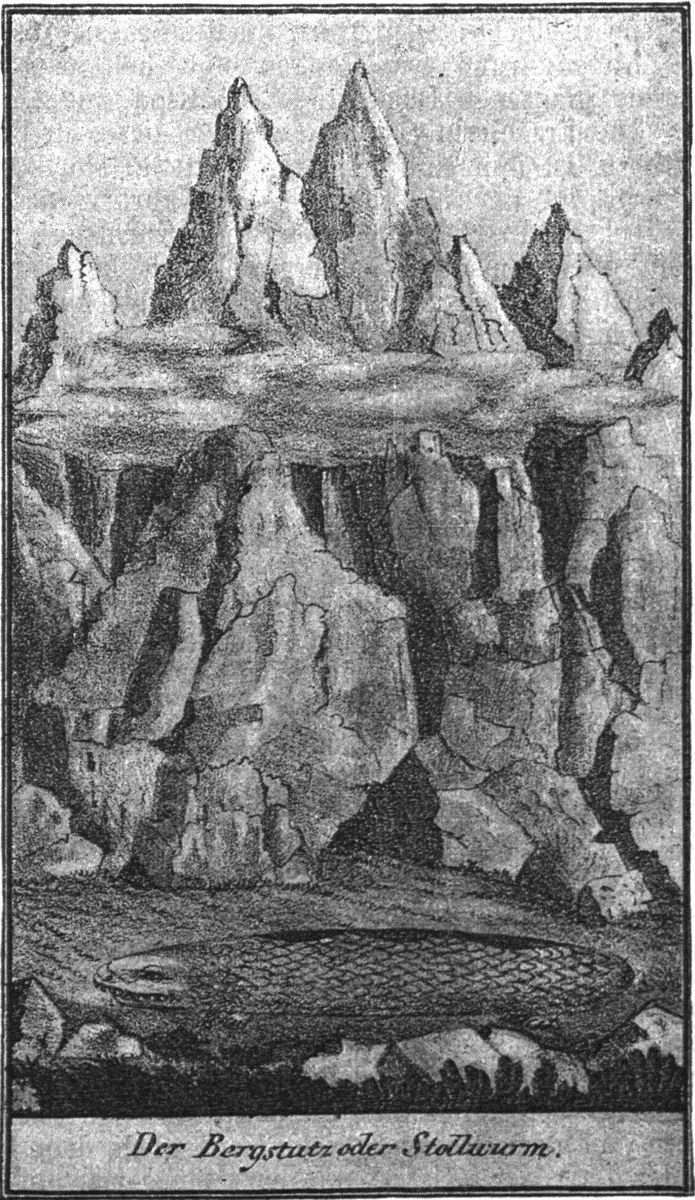
By 1887, when Karl Wilhelm von Dalla Torre published "Die Drachensage im Alpengebiet" in the yearbook of the German and Austrian Alpine Club, the animal had a dialect map and no zoology. Dalla Torre listed the names valley by valley: Stutzn in the Traun and Alm valleys, Büffel in the Ennstal, Bergstutz in Styria, Tatzl-, Daazl- or Praazlwurm in Bavaria, Springwurm around Reichenhall, Birgstutz'n in Salzburg, Berchtesgaden and the Zillertal, "schmecknder Wurm" (the smelly worm) in Austria, Stollwurm in western Tyrol, Passeier and Paznaun, Stollenwurm in Switzerland. He also reproduced, in facsimile on his page 217, the only illustration then in existence — an engraving from G. von Schultes's article "Etwas über den Bergstutz oder Stollwurm in den Alpen", printed in Weimar in the "Neues Taschenbuch für Natur-, Forst- und Jagdfreunde" for 1836. That engraving is the picture at the head of this file. Dalla Torre's own verdict on the older dragon plates was that they showed salamanders, and his verdict on the Tatzelwurm was that the giant beasts had vanished "from nature as from popular belief — but not without leaving another phantom behind".
The 1930s put the phantom in the press. Between 1928 and 1934 the South Tyrolean folklore journal "Der Schlern" ran collections by Dr Karl Meusburger and the engineer Hans Flucher, who sifted some eighty-five accounts, and in 1933 the retired school director Jakob Nicolussi concluded from sixty-five of them that "the Tatzelwurm of the Alps really lives, or at least lived a few years ago", and proposed for it the scientific name Heloderma europaeum, after the Gila monster.
Then came the photograph. In the spring of 1935 the Berliner Illustrirte Zeitung — a Berlin weekly of the Ullstein house selling over a million copies — printed across issues 16 and 17, in April, a long report by the journalist Hans Rudolf titled "Rätselhafte Begegnung im Schweizer Hochgebirge: Der Tatzelwurm", built around a picture sent in by a photographer named Balkin who had worked for the paper before. In his own letter, quoted in full by the paper, Balkin wrote that on a dull Saturday he had left the path between Meiringen and Innertkirchen, climbed a small alp, seen what he took for an oddly shaped tree trunk, photographed it from about ten metres, and watched it turn on him hissing and whistling before it fled to its hole. He gave measurements: about 80 cm long, some 25 cm across at the thickest point, brown with light and dark spots, scaled, forefeet visible, hind feet not.
The paper did not simply print it. It sent Rudolf and a zoologist called only "Dr M." to Bern by sleeping car, hired a party of men in Meiringen and searched the slope — twice, once under a metre of snow and once after the thaw. They found no animal, no burrow and no tracks. The editors then posted a reward of 1,000 marks for whoever delivered a Tatzelwurm, alive or dead, to a scientific institute. Nothing was ever delivered.
Timeline: the documented record of Tatzelwurm
- c. 1660 Andreas Roduner, secretary and ensign of the Altsax prefecture, climbs the Wangserberg in the county of Sargans with a companion and reports a 'mountain dragon' that rears to the height of a man, with four feet and 'the ears and face of a cat', a crest and a bristled back. The account was written down by Roduner's son and passed to Johann Jakob Wagner, who printed it in 1680; Scheuchzer reproduced it in 1723 with an engraved plate.
- 1723 Johann Jakob Scheuchzer publishes in Leiden the Alpine journey volume containing his catalogue of Swiss dragons, announced as 'arranged in the order of the cantons, as printed monuments, manuscripts and reports supply it', with territorial headings for Zurich, Bern, Lucerne, Unterwalden, Glarus, Appenzell, Sargans and the Grisons. It is the oldest methodical corpus of the cat-headed Alpine serpent. It never uses the words Tatzelwurm or Stollenwurm.
- 1779 A painted votive panel bearing this date is set on a stone column near Unken, on the path to the Schwarzbachklamm in the Salzburg lands. It shows a peasant lying on the ground after being attacked while picking berries, clutching his mouth and nose against the visible jet of breath from two Springwürmer above him; a small cross over his head means he is already dead. Franz von Kobell described it in 'Wildanger' (Stuttgart, 1859), from where Dalla Torre took it in 1887. No name for the man appears in either account.
- May 1811 A schoolmaster named Heinrich, from the Guttannen valley in canton Bern, reports meeting a Stollenwurm one May morning and staring at it for about as long as it takes to say the Lord's Prayer twice before terror sent him running. Samuel Studer collected the account and published it in 1814; Dalla Torre reprinted it in 1887, alongside the older story of Hans Kehrli of Trachselwald, who killed a small hairy one with a hazel switch.
- 1814 Samuel Studer's essay 'Ueber die Insekten dieser Gegend und etwas vom Stollenwurm' appears inside Franz Niklaus König's 'Reise in die Alpen' (Bern, pp. 127-139). It is the earliest printed treatment of the animal under the Swiss name, and it fixes the etymology from the mouths of the informants: a snake is a Wurm and a short thick foot is a Stollen.
- 1828 A farmer from canton Solothurn finds a dead animal of this kind in a dried-out marsh and sets it aside to bring to Professor Hugi; crows eat half of it. The skeleton reaches Solothurn, where nobody can make sense of it, and is forwarded to Heidelberg, 'without anything further being learned of its fate'. Friedrich von Tschudi records the episode; it is the only claimed physical specimen on record, and it is lost.
- 1836 G. von Schultes, a forestry official, publishes 'Etwas über den Bergstutz oder Stollwurm in den Alpen' in the Weimar 'Neues Taschenbuch für Natur-, Forst- und Jagdfreunde', with the first illustration of the animal ever printed - drawn, as Dalla Torre pointedly noted, without its author having seen one. Dalla Torre reproduced it in facsimile in 1887 on page 217; it is the engraving used on this page.
- 1887 Karl Wilhelm von Dalla Torre publishes 'Die Drachensage im Alpengebiet' in volume 18 of the yearbook of the German and Austrian Alpine Club. He maps the dialect names valley by valley, reads the old dragon plates as salamanders, dismisses the popular Tatzelwurm engravings of 1864 as 'exclusively artistic fantasy', and closes that the beasts have gone 'from nature as from popular belief - but not without leaving another phantom behind'.
- March 1933 Jakob Nicolussi, a retired school director, publishes in the South Tyrolean journal 'Der Schlern' his comparison of sixty-five reports and concludes that 'these sixty-five stories cannot possibly all have been taken out of thin air'. He reconstructs a single composite animal from them and proposes the scientific name Heloderma europaeum, on the analogy of the Gila monster. Meixner called the procedure 'of course completely unscientific'.
- April 1935 The Berliner Illustrirte Zeitung prints Balkin's photograph and Hans Rudolf's report across issues 16 and 17. The paper sends Rudolf and a zoologist to Meiringen, hires local men and searches the slope twice; nothing is found. It then offers 1,000 marks for a Tatzelwurm delivered alive or dead to a scientific institute.
- 18 and 23 April 1935 The Meiringen local paper 'Der Oberhasler' covers the affair in issues 32 and 33, notes that the Berlin weekly sells over a million copies, and says plainly what the valley is hoping for: that the new 'wonder of the world' might bring the Hasli 'even a fraction of the publicity success of the Loch Ness wonder'. The same issues print local Stollenwurm memories sent in by readers.
- 5 June 1935 Joseph Meixner, professor of zoology at Graz, publishes 'Der Streit um den Tatzelwurm' in the Neue Zürcher Zeitung. He dates the exposure to the winter of 1934/35, reports that neither the animal nor its burrow nor any track was found on either expedition, relays Steinböck's 1934 identification of most sightings as the common adder, and concludes that the picture 'makes one think of a late April Fool's joke'.
- 1948 Willy Ley's 'The Lungfish, the Dodo & the Unicorn' introduces the story to English readers as 'a Swiss photographer named Balkin' hiking near Meiringen. Heuvelmans later added 'the end of 1934'. Neither is right: Balkin was a Berlin press photographer for the Ullstein weekly, and the encounter and publication belong to 1935.
- Summer 2021 After the publication of the picture book 'Citronella und Tatzi feiern Geburtstag in der Aareschlucht' by Niels Dunkel and Susanne Schläppi-Dunkel, the Aare Gorge company installs a children's trail along the walk: five wooden Tatzelwürmer hidden in the gorge, each with a question. The creature that a Berlin weekly failed to catch in 1935 is now the gorge's mascot.
Is there a rational explanation for Tatzelwurm?
The rebuttal came fast and it has a name. On 5 June 1935, six weeks after the photograph, Joseph Meixner, professor of zoology at Graz, published "Der Streit um den Tatzelwurm" in the Neue Zürcher Zeitung. He dated the exposure to the winter of 1934/35, summarised the two failed expeditions in one line — "neither the Tatzelwurm was seen, nor its hole, nor any trace of it" — and concluded that the fragment on the plate "makes one think of a late April Fool's joke". He also reported that Professor C. Steinböck of Innsbruck had gone through the older and newer reports in "Der Schlern" in 1934 as a working zoologist and had found, in most of them and especially in the forty-five or so recorded above 1,000 m, the common adder (Vipera berus) — which, Meixner noted, is actually called Tatzelwurm or Bergstutz in parts of Salzburg and Upper Styria. The rest he assigned to grass snakes, the green lizard, the alpine and fire salamanders, weasels, martens, marmots and the otter, which also hisses and spits when cornered.
Half a century earlier Dalla Torre had already refused to be impressed by the pictures. In 1887 he flagged the widely copied Tatzelwurm engravings in the Leipziger Illustrirte Zeitung (1864, nos. 1093-1095) and in the illustrated edition of Scheffel's "Gaudeamus" as "exclusively artistic fantasy", and noted that the beast was familiar to the public mainly from Hermann Schmid's play, Max Haushofer's "Sintram", Ludwig Steub's travel sketches and Scheffel's verse.
The named animals are worth knowing, because they are odd enough on their own. The slow worm, Anguis fragilis, is a limbless lizard of the family Anguidae, and it gives birth to live young. Friedrich von Tschudi put it neatly in "Das Thierleben der Alpenwelt": the equally harmless Blindschleiche "forms the transition from the lizards to the snakes and appears up to the upper tree line" — which is exactly the altitude band where Tatzelwürmer are reported. The alpine salamander, Salamandra atra, is black, montane, lives well above 700 m and up to about 2,000 m, and is viviparous in a way few vertebrates are: at 650-1,000 m the pregnancy lasts about two years, at 1,400-1,700 m about three, and the female gives birth to two fully formed young, which have been feeding inside her on uterine tissue. Its skin secretes salamandarine alkaloids. A black, slow, thick-bodied, short-legged, toxic amphibian that appears on wet stony ground in high summer explains a great deal — and Dalla Torre had already read the old dragon plates as salamanders in 1887.
As for hard evidence, Meixner's line on the two expeditions of 1935 stands: no animal, no hole, no trace. Tschudi records an older specimen: in 1828 a farmer from Solothurn found a dead animal of this kind in a dried-out marsh and set it aside to take to Professor Hugi; crows ate half of it first; the skeleton went to Solothurn, where nobody could make sense of it, and then travelled on to Heidelberg, "without anything further being learned of its fate".
Finally, the version of this story that circulates in English — "in 1934 a Swiss photographer named Balkin" — is not what the German and Swiss sources say, and the drift can be dated. Willy Ley, in "The Lungfish, the Dodo & the Unicorn" (1948), wrote that "a Swiss photographer named Balkin asserted that he had accidentally taken a picture of a tatzelwurm" while hiking near Meiringen. Bernard Heuvelmans, in "On the Track of Unknown Animals", fixed the date: "at the end of 1934 a Swiss photographer called Balkin claimed to have photographed a Tatzelwurm by accident". Both details are wrong. Balkin was a Berlin press photographer working for the Berliner Illustrirte Zeitung; the paper's own text has him travelling from Berlin to Switzerland, a Bernese correspondent, E. Schenker, wrote to Der Bund in 1985 that he had looked after "the reporter Balkin" from 21 February to 2 March 1935, and the Aareschlucht company, which owns the gorge where it happened, dates the encounter to the spring of 1935. Heuvelmans himself credited the plate "Balkin-Ullstein", after the paper's publisher. The word "hoax" is safe; "1934" and "Swiss" are not.
Can you visit Tatzelwurm?
There is no Tatzelwurm to visit, and nobody sensible pretends otherwise. There are two places that have made a living out of it, and they are honest about which is which.
The Aare Gorge (Aareschlucht) at Meiringen, in the Bernese Oberland, is the site of the 1935 photograph: Balkin left the path on the ridge between Meiringen and Innertkirchen, just above the gorge, on his way past the "Du Pont". The gorge company has adopted the animal outright. Its own page tells the Balkin story — spring 1935, the innkeeper of the Hotel Bär in Meiringen identifying the description as "what we usually call the Stollenwurm" — and reproduces the photograph. Since the summer of 2021, when the picture book "Citronella und Tatzi feiern Geburtstag in der Aareschlucht" appeared, there has been a children's trail: five wooden Tatzelwürmer (father, mother and the three young, Titzi, Tetz and Tatzi) hidden along the walk, each with a question answered on a card picked up at the ticket desk. It is aimed at children of roughly four to ten.
Practical facts, as published by Aareschlucht AG for the 2026 season and correct at the time of this review: address Aareschluchtstrasse 3, CH-3860 Meiringen (46.72005 N, 8.20461 E). West entrance open 3 April to 1 November 2026; east entrance 9 May to 1 November. Hours 08.30-17.30, extended to 18.30 between 13 June and 20 September. Admission CHF 13 from age 16, CHF 8 for children 6-15, free under 6; a combined ticket with the Reichenbach Falls costs CHF 25 / CHF 16; season ticket CHF 26. No reservation is possible or required. The walk is 1.4 km on boardwalks and made paths; from the west entrance it is passable to the main attractions with a light wheelchair or a narrow pushchair, though access can be restricted when the gorge is busy. Dogs on a short lead are free. Restaurant at the west entrance, bistro at the east, free parking for cars and coaches, and a station on the Innertkirchen line for the return.
The second place is Bavarian and older in name. Below Oberaudorf, in the Inn valley, the Auerbach falls 95 m in two steps through the Gumpen gorge, and the hotel beside it is called the "Feuriger Tatzlwurm", at the address Tatzlwurm 1. The hotel states that the farmstead there was already known as "Zum Tatzlwurm" 750 years ago, and tells its own dragon story — a fire-breathing, six-legged, bat-winged monster that ate pilgrims and dairymaids. That is worth flagging: the hotel's dragon is a medieval Lindwurm, not the short-legged animal of the eyewitness reports, and the two should not be confused. The waterfall itself is public and free.
If you want the source material rather than the merchandising, all of it is online and free: Scheuchzer's 1723 volumes are on the Internet Archive, and so is the 1887 volume of the Alpine Club yearbook with Dalla Torre's essay and the 1836 engraving on page 217.
Sources consulted
- Johann Jakob Scheuchzer, «Ouresiphoítes Helveticus, sive Itinera per Helvetiae alpinas regiones - the Iter quintum volume, pp. 378-397: the catalogue of Swiss dragons 'juxta ordinem Pagorum directam', with the cat-headed, footless serpent of Johannes and Thomas Tinner at Frümsen and the four-footed, cat-faced mountain dragon of Andreas Roduner on the Wangserberg (c. 1660), both taken from Wagner's Historia naturalis Helvetiae (1680), plus Scheuchzer's own suggestion that these footed wingless dragons might be 'some species of subterranean lizard'. Full-text swept: 0 hits for Tatzelwurm and Stollenwurm, 198 for draco» — Petrus van der Aa, Leiden (scan of the Wellcome copy), 1723 book
- Karl Wilhelm von Dalla Torre, «Die Drachensage im Alpengebiet, in: Zeitschrift des Deutschen und Oesterreichischen Alpenvereins, vol. 18, pp. 208-226 - the dialect-name map of the animal valley by valley (p. 214), the Rochholz etymology 'Wurm means snake with us and a short thick foot is called a Stollen' (pp. 216-217), the facsimile of Schultes's 1836 engraving on p. 217 with its source given in footnote 32, the 1779 votive column at Unken after Kobell's Wildanger (p. 223), and the dismissal of the 1864 popular engravings as 'exclusively artistic fantasy' (footnote 33)» — Deutscher und Oesterreichischer Alpenverein, Munich, 1887 academic
- Friedrich von Tschudi, «Das Thierleben der Alpenwelt: Naturansichten und Thierzeichnungen aus dem Schweizerischen Gebirge - p. 162: the belief in Stollenwürmer in the Bernese Oberland and the Jura, the 1828 Solothurn specimen taken to Professor Hugi, half eaten by crows, sent on to Heidelberg and lost, and the note that the slow worm 'forms the transition from the lizards to the snakes and appears up to the upper tree line'» — J. J. Weber, Leipzig, 1865 book
- Hans Rudolf, «Rätselhafte Begegnung im Schweizer Hochgebirge: Der Tatzelwurm / Razzia auf den Tatzelwurm - Berliner Illustrirte Zeitung, April 1935, no. 16 pp. 551-558 and no. 17 pp. 601-604. Contains Balkin's own letter with the measurements, the editors' commission, the journey from Berlin, the two searches above Meiringen and the 1,000-mark reward. Read in the full German transcript published on markuskappeler.ch and preserved in the Wayback Machine» — Ullstein, Berlin (transcript, markuskappeler.ch, archived 2019), 1935 newspaper archive
- Joseph Meixner, professor of zoology, Graz, «Der Streit um den Tatzelwurm - Neue Zürcher Zeitung, 5 June 1935. The contemporary scientific rebuttal: the exposure dated to the winter of 1934/35, both expeditions returning without animal, burrow or track, Steinböck's 1934 reassignment of most sightings to the common adder, the note that the adder is locally called Tatzelwurm or Bergstutz in Salzburg and Upper Styria, and the verdict that the picture suggests 'a late April Fool's joke'. Read in the full German transcript on markuskappeler.ch, archived» — Neue Zürcher Zeitung (transcript, markuskappeler.ch, archived 2019), 1935 newspaper archive
- unsigned, with reader letters signed H.B. and Lux., «Der Oberhasler ('Wöchentlicher Gruss aus der Heimat an die Hasler in der Fremde'), no. 32 of 18 April 1935 and no. 33 of 23 April 1935 - the Meiringen local coverage of the affair, including the hope that the creature might bring the Hasli 'even a fraction of the publicity success of the Loch Ness wonder', and readers' own Stollenwurm memories from Innertkirchen and the Kirchet. Read in transcript on markuskappeler.ch, archived» — Der Oberhasler, Meiringen (transcript, markuskappeler.ch, archived 2019), 1935 newspaper archive
- Jacob Grimm and Wilhelm Grimm, «Deutsches Wörterbuch - entry 'tatze', vol. XI,I,I col. 160: a feminine noun, Middle High German tatze, 'first the pads of the bear, then also the paws and claws of other beasts of prey'. Entry 'wurm', vol. XIV,II col. 2226: 'reptile; snake, dragon', cognate with Gothic waurms 'snake', Old Norse ormr 'snake, dragon', Old English wyrm 'reptile, snake, dragon, worm' and Latin vermis; the dragon sense was pushed out of the standard language by Schlange and Drache in Early New High German but 'lives on in the newer Upper German dialects, as well as in compounds and in names'» — S. Hirzel, Leipzig (consulted in the DWDS digital edition), 1935 book
- Willy Ley, «The Lungfish, the Dodo & the Unicorn: An Excursion into Romantic Zoology, pp. 131-135 - the passage that put the story into English: 'A Swiss photographer named Balkin asserted that he had accidentally taken a picture of a tatzelwurm. He was taking a hike near Meiringen in the Swiss Alps...'. Ley also records the Austrian ministry's explanation of Tatzelwurm sightings as stray otters. Consulted through the Internet Archive full-text index (the volume is lending-restricted)» — Viking Press, New York, 1948 book
- Bernard Heuvelmans, «On the Track of Unknown Animals - the source of the date: 'at the end of 1934 a Swiss photographer called Balkin claimed to have photographed a Tatzelwurm by accident'. The plate list credits the photograph 'Balkin-Ullstein' (facing p. 40) and names the two drawings reproduced: 'Naive drawing of the Tatzelwurm, 1836' and 'A more plausible picture of the Tatzelwurm, 1841', the latter from the Swiss almanac Alpenrosen. Consulted through the Internet Archive full-text index (lending-restricted)» — Rupert Hart-Davis, London, 1958 book
- Aareschlucht AG, Meiringen, «Aareschlucht: Tatzelwurm; Informationen (Preise, Öffnungszeiten, Themenweg Tatzi, Rollstuhl & Kinderwagen) - the gorge company's own account of the spring 1935 Balkin episode and the Hotel Bär innkeeper's reply, plus the 2026 season prices, opening dates, accessibility and the children's trail created after the 2021 picture book» — aareschlucht.ch (official site), 2026 web
- Georges-Daniel Guex and Peter S. Chen, «Epitheliophagy: Intrauterine cell nourishment in the viviparous alpine salamander, Salamandra atra (Laur.) - Experientia 42(11-12), pp. 1205-1218, DOI 10.1007/bf01946392: the gestation of two years at 650-1,000 m and about three years at 1,400-1,700 m, and the two fully formed young nourished on uterine tissue» — Experientia (Birkhäuser, Basel), 1986 academic
- Peter Uetz et al. (eds.), «Anguis fragilis Linnaeus, 1758 - species account: higher taxa Anguidae (Anguinae), Anguimorpha, Sauria, Squamata (lizards); limb morphology limbless; reproduction ovoviviparous; distribution including Austria, Switzerland, Germany and Liechtenstein» — The Reptile Database, Reptarium, 2026 web
- Familie Kiesl, Hotel Feuriger Tatzlwurm, «Namensgebung & die Tatzlwurm-Sage - the hotel's own account of the name: the address Tatzlwurm 1 below Oberaudorf, the Auerbach falling 95 m in two steps through the Gumpen gorge, the claim that the farmstead was called 'Zum Tatzlwurm' 750 years ago, and the house legend of a fire-breathing, six-legged, bat-winged dragon that ate pilgrims - a medieval Lindwurm, not the short-legged animal of the eyewitness reports» — tatzlwurm.de (official site), Oberaudorf, 2026 web
Reviewed by V. Serrano on 2026-08-11 · How we verify our content
📎 Source: Enigma Atlas
💬 Field testimonies (0)
No testimonies yet. Add the first.
Add your testimony
🔒 Log in to add a testimony