🦶 CRYPTID SIGHTING · EXP. Nº0555
ACTIVE
Lagarfljót Worm
Lagarfljót is a long glacial river in East Iceland that widens into the lake Lögurinn beside Egilsstaðir, and something in it has been reported for seven hundred years.
Where and when was Lagarfljót Worm sighted?
- Location
- Egilsstaðir, East Iceland, Iceland
- Date sighted
- Unknown
- Coordinates
- 65.168, -14.634
- Last updated
LOCATION
What is Lagarfljót Worm?
The oldest record is real and dated: the Skálholt annal for 1345, printed by Gustav Storm in 1888, says a strange thing appeared there which men knew to be alive, at times like great islands and at times throwing up coils with channels of water between them, many hundreds of fathoms long, with neither head nor tail ever seen — and it names no worm at all. In 1638 the bishop of Skálholt still had no Icelandic word for it and borrowed a Norwegian one. The gold ring, the heather-worm and the two Finns who bound it come from schoolboys of Múlasýsla in 1845, printed by Jón Árnason in 1862. In 2012 a farmer filmed something writhing in the ice below his kitchen window; a truth commission of thirteen voted seven to four that it was the worm, and an analyst in Finland had already shown the shape never moved.
What is the history of Lagarfljót Worm?
The oldest document is real, it is dated, and it does not say what it is usually quoted as saying.
Gustav Storm's Islandske Annaler indtil 1578 (Christiania, 1888) prints nine Icelandic annals in one volume. Only one of them has anything about Lagarfljót, and it has it once. Under the running head "V. Skálholts-Annaler (D) 1344-1345", on page 211, between the sailing of Bishop Ormr and a landslide in Gauldalr in Norway, stands this:
"Syndiz einn undarligr lutr austr j Lagar flioti ok Fliotzdals hæradi, ok vita menn at kvikt var; syndiz stundum sem eyiar storar, enn stundum skytr upp lykkium ok sund i milli, ok margra hundrada fadma langt; engin veit digrleika a því, ok hvarki hefir sezt a því hofud ne spordr, ok því vita menn eigi hvat undra þat var."
"A strange thing appeared east in Lagarfljót and Fljótsdalshérað, and men know that it was alive. At times it looked like great islands, and at times it shoots up coils with channels of water between them, and many hundreds of fathoms long. Nobody knows its girth, and neither head nor tail has been seen on it, and so men do not know what marvel it was."
There is no worm in it. There is no serpent, no ormr, no name of any kind: the entry is about "a strange thing", and its last clause is a refusal to identify. That the Skálholt annal is the only one of the nine that carries the notice can be checked without trusting an optical scan, because Storm indexed his own volume. In the Navneregister, in its alphabetical place between "Lafransbollinn, Skib" and "Langanes", the entry reads in full: "Lagarfljót, i Fljótsdalr, mellem Norðmúla- og Suðrmúlasýslur, Ø. 1345 V." One year, one annal, no cross-reference. A full-text search of the same 763-page volume returns the token "Lagar" exactly once, against 54 hits for "byskupi" and 99 for "ormr", which in these annals is almost always a man's name.
Three centuries later the thing still had no name. Gísli Oddsson, bishop of Skálholt, wrote his De mirabilibus Islandiae in 1638 — he dates the manuscript himself in chapter V. He opens his chapter on portents with Lagarfljót and gets stuck on the vocabulary at once: it is "angvis-ne an serpens fluviatilis", a river snake or perhaps a serpent, of immense size, and he calls it strandvorm, "a name borrowed from the Norwegian tongue, though here quite inadequate, because a proper one is lacking". A bishop whose first language was Icelandic, writing in 1638, had to import a Norwegian word. Whatever Icelanders called the thing then, it was not Lagarfljótsormur.
Gísli also supplies, 224 years before the folktale collectors, three things the folktale would later be credited with. First the omen: the sight "is generally believed to portend and presage either a dearth of grain, or an extraordinary plague, or the death of magnates, or something else". Second the anatomy, or rather its absence: "cujus caput et cauda nunqvam visa", whose head and tail have never been seen, which is the annal's clause word for word. Third the binding, which he had heard and did not believe: "there is a rumour that some bishop or other petty saint of an exorcist bound it there, which I mention in passing as trifles and as a fable". And he is careful that the Lagarfljót has more than one occupant: one "in the form of an unwonted seal of monstrous size", another presenting "the figure of a very great skate of immense quantity". His year-by-year notes register sightings in December 1600 with three coils above the water, in 1606 on two successive days, one by a man named Finni Gíslason, and in 1624, when "the serpent appeared in the Lagarfljót of the eastern men, and indeed to many, which is commonly held for a portent".
The best single document is a letter, and it is not famous. Jón Árnason printed it in 1862 under the heading "Skrýmslin í Lagarfljóti", sourced to a letter of Hans Wíum, sýslumaður of Múlasýsla, in 1750. It is a magistrate's report, with places and ranks. Pétur, deputy sheriff for the northern part of the county, and two others saw something from Ketilsstaðir á Völlum and could make out no shape. Two men on the same day saw, off Arneiðarstaðir, a creature the size of a large six-oared boat travelling fast up the river, and the whole household at Hafursgerði saw it too. A third saw something like a seal near the shore whose belly looked "like a skate when it is drawn out of the sea". Then, while the three were telling their story that evening at Arneiðarstaðir, all of them together saw one below the farm, thirty to forty fathoms long with a high peak out of its back. "All of these were truthful and careful men," Wíum adds.
Two details of that letter matter more than its length. The whole household at Hrafngerði watched "three humps up out of the river, for nearly a whole day, and there was water between them all for many hundreds of fathoms" — the annal's image of 1345, reported as a fresh observation four centuries later. And in the spring and summer of 1750, Wíum says, the monsters were seen "in the rivers up from the fljót, three off Hrafnkelsstaðir". Hrafnkelsstaðir in Fljótsdalur is the farm from whose kitchen window Hjörtur E. Kjerúlf filmed in February 2012, and the rivers up from the fljót are where he filmed. The 2012 video did not put a monster somewhere new; it put one back exactly where a sheriff had put three in 1750.
Wíum's account closes with a sighting of 1819 that reads like a field note. It was seen first at the ice bridge, in the open water by the shore off Hafursá, two or three teigshæðir (field-strip lengths) from the shore, grey, and shaped "as if a horse stood on its head with its rump up"; no legs and no limbs were seen. It appeared on a Saturday, drifted very slowly against the current and a light wind up level with Hallormsstaður, and vanished the following Sunday. The witnesses are named: the Reverend Gunnlaugur at Hallormsstaður and Hinrik at Hafursá, and many more. One of them wanted to shoot at it and the others would not let him. And the record adds, without seeing what it is giving away: "while this went on, the ice was drifting out down the river."
The gold-ring story, the one every guidebook tells, is younger than all of that. Jón Árnason prints it at I, 638-641 as "Ormurinn í Lagarfljóti", and his source line is exact: "Eptir sögn skólapilta úr Múlasýslu 1845" — from the account of schoolboys from Múlasýsla, 1845. A woman by the Lagarfljót gives her grown daughter a gold ring; the girl asks how she can get most profit from it; the mother says, put it under a heather-worm. Gold and worm go into the girl's linen box; days later the box is splitting apart, and she throws box, worm and gold together into the river. Two Finns are fetched to kill it and recover the gold. They dive, come up quickly, and report that it cannot be done, because a second worm lies under the gold, far worse than the first. So they bind it with two bonds, one behind the shoulders and one at the tail. It can harm nobody now — "but it happens that he puts up a hump out of his back, and that is always thought to portend great tidings when it is seen, for instance hard years or a failure of the grass."
That is the omen clause, in 1862, on a single hump raised once. A promise about two humps and the coming winter is not in that text, and it is not in any of the older ones either.
The name itself has a documented twentieth-century career that has nothing to do with monsters. In 1905 a motor launch built of oak, thirty-one feet long, was put on the Lögur to carry passengers, and it was called Lagarfljótsormurinn; the children's magazine Unga Ísland described her in 1907. In 1997 the town council of Egilsstaðir ran a competition for pictures of the worm — drawings sent in by residents were still being printed in Múlaþing in 1998 — and promised half a million krónur to anyone who could get it on film. Nobody did, and the offer was left standing. It was collected fifteen years later.
Timeline: the documented record of Lagarfljót Worm
- 1345 The only annal entry. Skálholtsannáll, printed by Gustav Storm in 1888 at page 211, records that "a strange thing appeared east in Lagarfljót and Fljótsdalshérað, and men know that it was alive; at times it looked like great islands, and at times it shoots up coils with channels between them, and many hundreds of fathoms long; nobody knows its girth, and neither head nor tail has been seen on it, and so men do not know what marvel it was." It contains no worm, no serpent and no name. Storm's own index confirms the notice stands in that annal alone.
- December 1600 Gísli Oddsson's annal farrago notes that "that huge serpent was seen in the river Lagarfljót, with three coils standing above the water". Further entries follow for 1606 (two days running, three coils), for a sighting by a man named Finni Gíslason, and for 1624: "the serpent appeared in the Lagarfljót of the eastern men, and indeed to many, which is commonly held for a portent".
- 1638 Gísli Oddsson, bishop of Skálholt, writes chapter VI of De mirabilibus Islandiae. He has no Icelandic word for the creature and borrows the Norwegian strandvorm, "though here quite inadequate, because a proper one is lacking"; he records the omens (dearth of grain, plague, the death of magnates), notes that its head and tail have never been seen, dismisses the story that a bishop bound it as "trifles and a fable", and describes two further beings in the same water, one shaped like a monstrous seal and one like a huge skate.
- 1749-1750 (letter of 1750) Hans Wíum, sýslumaður of Múlasýsla, reports sightings by named people of rank: the deputy sheriff Pétur at Ketilsstaðir á Völlum; a creature the size of a large six-oared boat off Arneiðarstaðir; three humps watched for nearly a day by the household at Hrafngerði, "and there was water between them all for many hundreds of fathoms"; and, in the spring and summer of 1750, monsters "in the rivers up from the fljót, three off Hrafnkelsstaðir" — the same farm and the same waters as the 2012 video.
- 1772 Eggert Ólafsson, in the travel book he wrote with Bjarni Pálsson, suggests that what people call a worm are columns of vapour. This is the earliest natural explanation on record, and it is not zoological. (Taken here from Finnur N. Karlsson 1998; the Reise itself has not been read.)
- 1819 A grey, shapeless object with neither legs nor limbs is watched from Saturday to the following Sunday moving very slowly upstream from Hafursá to Hallormsstaður. Witnesses named: the Reverend Gunnlaugur at Hallormsstaður and Hinrik at Hafursá. The same record adds that "while this went on, the ice was drifting out down the river".
- 1862 (collected 1845) Jón Árnason prints "Ormurinn í Lagarfljóti" at I, 638-641, sourced "from the account of schoolboys from Múlasýsla, 1845": the gold ring laid under a heather-worm, the linen box that splits, the two Finns who cannot kill it because a second worm lies under the gold, and the two bonds. The omen clause is a single hump: it "is always thought to portend great tidings when it is seen, for instance hard years or a failure of the grass". The same page records the local sceptics, who called it humbug and cited a priest who had rowed straight across the spot to prove there was nothing there.
- 1905 A thirty-one-foot oak motor launch begins scheduled runs on the Lögur and is named Lagarfljótsormurinn. For much of the twentieth century that boat is what the word refers to in the Icelandic press.
- February 1967 Jón Jónsson files an eleven-page report, "Skýrsla um gas í Lagarfljóti og víðar", with the geothermal department of the Director of Electricity: the first technical investigation of the gas that seeps up through the bed.
- 1982 Helgi Hallgrímsson publishes "Undrin í Lagarfljóti. Er Lagarfljótsormurinn gufa?" — is the Lagarfljót worm vapour? — in Týli 12(1), 13-26, with a map on which the sighting places and the gas seeps are marked together. The naturalist most closely identified with the Lagarfljót asks whether the worm is a gas, not what species it is.
- 1987 Halldór Ármannsson and Sigmundur Einarsson deliver "Gas í Lagarfljóti" as Orkustofnun report OS-87035/JHD-09, twenty-five pages. The following July, Helgi Hallgrímsson writes in Austri that the gas "has been known since the fourteenth century, or as long as the Lagarfljótsormur, which seems inseparably bound up with it".
- 1997 The town council of Egilsstaðir runs a competition for pictures of the worm and offers 500,000 krónur to anyone who can get it on film. Nobody claims it, and the council leaves the offer standing for the future.
- February 2012 Hjörtur E. Kjerúlf films a long undulating shape in the ice-filled river below his kitchen window at Hrafnkelsstaðir in Fljótsdalur — the Jökulsá í Fljótsdal, which feeds the Lögur, not the lake itself — after it had stayed put through a cup of coffee. He takes the tape to the RÚV office in Egilsstaðir; the national news broadcasts it; someone else posts it on YouTube. Kjerúlf never calls it the worm: "This is absolutely not a hoax by me, that is ridiculous. This is no joke."
- 14 February 2012 Benjamin Radford publishes the analysis of Miisa McKeown, in Finland, who compared the position of the object's head against fixed points on the bank across the clip and found it stationary. With Kjerúlf's own timeline, Radford concludes the behaviour is "completely consistent with an ice-caked fishing net or piece of cloth caught on an underwater branch or rock — and completely inconsistent with a living animal".
- 17 August 2012 The municipality of Fljótsdalshérað appoints a thirteen-member sannleiksnefnd, a truth commission, to rule on Kjerúlf's video and on a photograph submitted by Sigurður Aðalsteinsson of Vaðbrekka. Mayor Björn Ingimarsson insists the matter is being taken seriously, then adds, laughing, that "the truth commission will most likely be in session for the rest of the electoral term". The video has 4.5 million views.
- 23 August 2014 The commission drives out, stops below Hafursá á Völlum to look over the water, questions Kjerúlf at Hrafnkelsstaðir and sits at Iðavellir. Its minute states that in the river there is "a creature or being that the methods of science have not managed to find". It rejects Sigurður's photograph eleven to one with one blank, and accepts Kjerúlf's video seven to four with two blanks. "The worm exists!" says the chairman, Stefán Bogi Sveinsson, who had already said he had "lost sight long ago of whether appointing this commission is a joke or serious". Kjerúlf is paid the 500,000 krónur and a further 50,000 by the local tourism association.
- October 2017 The rescue team Ísólfur tows the ferry Lagarfljótsormurinn — built in Russia in 1992, brought from Sweden in 1999, ashore in the ferry harbour for about a decade — away to a spot below the farm Setberg í Fellum. A plan to turn her into a 110-seat restaurant had been refused a licence. Nothing now sails on the Lögur under the worm's name.
- 4 October 2020 Fljótsdalshérað, the municipality that appointed the commission and paid the prize, ceases to exist: it merges with Seyðisfjörður, Djúpivogur and Borgarfjarðarhreppur to form Múlaþing. Fljótsdalshreppur, which contains Hrafnkelsstaðir, stays out and remains a separate municipality of about ninety people.
Is there a rational explanation for Lagarfljót Worm?
The natural explanation of the Lagarfljót worm is Icelandic, it is old, and it has never been that the worm is an unknown animal.
Finnur N. Karlsson set out its descent in Múlaþing 25 (1998), in an article whose title is a question no cryptozoologist asks: "Uppruni ormsins í Lagarfljóti", the origin of the worm in Lagarfljót. He opens with it: "The Lagarfljót worm has occupied people's minds for centuries, belief in it long general and its fame great, at home and abroad. But when did the idea arise that Lagarfljót harbours a worm?" On page 37 he gives the chain: "Eggert Ólafsson guessed, 220 years ago, in his and Bjarni Pálsson's travel book, that what people called a worm were columns of vapour; Ólafur Davíðsson, however, was the first to connect the worm with gas, in an article he wrote around the turn of the last century. Helgi Hallgrímsson has since given further support to this theory and set it against the descriptions of eyewitnesses." (I have read Finnur's article in extracts, through the full-text search of timarit.is, not in the printed offprint; Eggert Ólafsson's Reise of 1772 I have not read at all, and I take his opinion here from Finnur.)
So there are two hundred and fifty years of Icelandic naturalists asking what physical process makes the humps, and none of them asking what species the humps belong to. The technical file is long. Jón Jónsson filed an eleven-page report on the gas in Lagarfljót with the geothermal department of the Director of Electricity in February 1967. Helgi Hallgrímsson published "Undrin í Lagarfljóti. Er Lagarfljótsormurinn gufa?" — the wonders in Lagarfljót: is the Lagarfljót worm vapour? — in Týli 12(1), 1982, pages 13-26, and followed it with "Bein Lagarfljótsormsins" in the Austri Christmas issue of 1987 and "Nýfundin heimild um Lagarfljótsorminn" in Glettingur 1(1) in 1991. Leó Kristjánsson published chemical analyses of the gas in Týli 13(1) in 1983. Halldór Ármannsson and Sigmundur Einarsson produced "Gas í Lagarfljóti" as Orkustofnun report OS-87035/JHD-09, twenty-five pages, in 1987. In 1994-95 Náttúrufræðingurinn reprinted Helgi's 1982 map of the water, with the places where the worm has been seen and the places where gas seepage has been found marked on the same sheet, which is as compact a statement of the hypothesis as anyone has made.
Helgi put the point himself in a newspaper in 1988: "It may be said that the gas in Lagarfljót has been known since the fourteenth century, or as long as the Lagarfljótsormur, which seems inseparably bound up with it. The holes in the ice off Hreiðarsstaðir, the Nautavakir, were known when Fljótsdæla was written in the fifteenth to sixteenth century, and it was precisely those holes that led to the gas being recognised for what it is." (Helgi later published a monograph on the Lagarfljót with Skrudda, in 2005, with a long chapter on the worm; I have not been able to read it, and nothing here rests on it.)
The primary records supply a second explanation on their own, and it is drifting ice. The 1819 sighting off Hafursá — grey, shapeless, neither legs nor limbs, moving very slowly upstream over two days — is recorded together with the sentence "while this went on, the ice was drifting out down the river". Nobody there needed to be told what ice looks like in that water.
Which brings the argument to February 2012 in one step. Hjörtur E. Kjerúlf saw something moving in the river from his kitchen window at Hrafnkelsstaðir, went on drinking his coffee, found it still there when he had finished, and went out with a camera. He took the footage to the RÚV office in Egilsstaðir; the national news ran it; somebody else put it on YouTube, where it had four and a half million views by that August. Kjerúlf never claimed it was the worm, and said so at the time: "This is absolutely not a hoax by me, that is ridiculous. This is no joke."
The analysis that undid it has a name on it. Miisa McKeown, in Finland, took screen captures at different points in the clip and compared the position of the object's head against fixed points on the bank. She told Discovery News why she looked: "Being at least passingly familiar with ice and how frozen objects behave in water (I live in Finland), I couldn't help but be intrigued by this. The movement was the most fascinating aspect, but when I realized how quickly the water was flowing I figured that could very well cause that effect on a flexible object trapped there." The object is not moving. It appears to advance upstream and does not. Benjamin Radford, who published her result on 14 February 2012, added the timing that clinches it: the thing had already stayed put through a cup of coffee and through the walk back for a camera. "This behavior is completely consistent with an ice-caked fishing net or piece of cloth caught on an underwater branch or rock — and completely inconsistent with a living animal."
The official verdict went the other way, and the officials said so with their eyes open. On 17 August 2012 the municipality of Fljótsdalshérað appointed a thirteen-member sannleiksnefnd, a truth commission, to decide whether Kjerúlf — and Sigurður Aðalsteinsson of Vaðbrekka, who had sent in a photograph — had earned the prize Egilsstaðir offered in 1997. The mayor, Björn Ingimarsson, told Vísir the matter was being taken seriously and then added, laughing, that "the truth commission will most likely be in session for the rest of the electoral term". The chairman, Stefán Bogi Sveinsson, said on the day it finally sat: "I lost sight long ago of whether appointing this commission is a joke or serious, but we were given the job of taking a position and finishing it." There were thirteen members because it was not thought right that they should be fewer than the Jólasveinar, the thirteen Icelandic Yule Lads.
On 23 August 2014 the commission drove out, stopped below Hafursá á Völlum to look over the water — the 1819 spot — went on to Hrafnkelsstaðir to question Kjerúlf, and sat in the community hall at Iðavellir. Its minute to the council, after reviewing "a number of accounts by reliable witnesses", was that there is in the river "a creature or being that the methods of science have not managed to find", and it recommended further research. It then voted twice. Sigurður's photograph: eleven against, one for, one blank. Kjerúlf's video: four against, two blank, seven for. "The worm exists!" said the chairman, reading it out. Kjerúlf collected the 500,000 krónur, plus 50,000 from the local tourism association for having marketed the district, and said the money was a trifle next to the visit. Seven votes out of thirteen is what the finding actually was, and it is worth writing down beside the headlines it produced.
Can you visit Lagarfljót Worm?
Egilsstaðir stands at the north end of the Lögur, the lake-like reach of the Lagarfljót, beside the bridge that carries the road over the river. The places named in this file lie along the lake and up the valley: Hafursá and Ketilsstaðir á Völlum, where the witnesses of 1750 and 1819 lived; the Nautavakir off Hreiðarsstaðir, the holes in the ice around which the natural explanation of the worm was built; and Hrafnkelsstaðir in Fljótsdalur, the farm where in 2012 Hjörtur Kjerúlf saw a shape in the river from his kitchen window and then filmed it from the bank. Austurfrétt reported that on 23 August 2014 the truth commission itself stopped below Hafursá á Völlum to look out over the water, questioned Kjerúlf at Hrafnkelsstaðir and held its formal meeting in the community hall at Iðavellir.
The ferry Lagarfljótsormurinn, built in Russia in 1992 and brought to the district from Sweden in 1999, sailed between Atlavík and Egilsstaðir in the years that followed. Austurfrétt reported on 18 October 2017 that she had stood ashore for the previous decade in the ferry harbour built at the east end of the Lagarfljót bridge. A plan to turn her into a restaurant seating 110 had been refused permission, and the rescue team Ísólfur towed her that month to a new site below the farm Setberg í Fellum, where her owner, Hlynur Bragason, grew up.
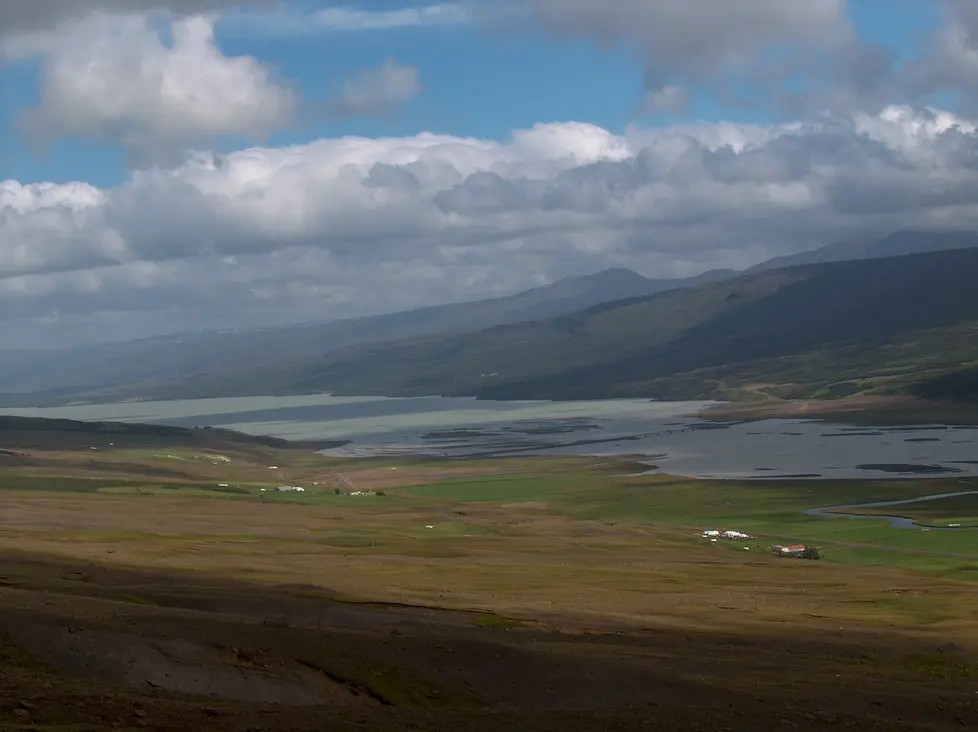
The water has changed since the Kárahnjúkar hydro scheme began operating in 2007. The sustainability monitoring programme of Alcoa Fjarðaál and Landsvirkjun states on its page about the fish of the Jökulsá á Dal and the Lagarfljót, last updated on 25 July 2023, that water from the Jökulsá á Dal has since then been led from the Hálslón reservoir to the Fljótsdalur power station and on into the Lagarfljót. The same page attributes large changes in the living conditions of the river's aquatic life to that diversion of more turbid and colder water. It reports lower catches in standardised test netting since the plant opened, most markedly for Arctic char, and a fall in the growth rate of char and brown trout. The photograph on this file was taken in August 2004, before the diversion, according to its record on Wikimedia Commons.
Minjasafn Austurlands, the East Iceland Heritage Museum, is at Laufskógar 1, 700 Egilsstaðir, telephone 471 1412. Its website, read on 24 September 2026, opens the museum from 10:00 to 17:00 on weekdays and from 11:00 to 17:00 on Saturdays between 1 June and 31 August, and from 11:00 to 16:00 from Tuesday to Friday between 1 September and 31 May. Admission is 1,800 krónur from the age of 18 and free at 17 and under. Pensioners, disabled visitors and students pay 1,200 krónur, as does each member of a group of ten or more; the audio guide costs 400. The two permanent exhibitions listed on the site deal with the self-sufficient farm household and with the reindeer of East Iceland.
Ormsteiti, the harvest and culture festival that takes its name from the worm, has been held every year in some form since 1993, according to the municipality of Múlaþing. On 20 August 2026 Múlaþing announced that the year's festival was taking place that weekend in Egilsstaðir and Fellabær, opening that day with the Vök Baths run; the 2023 edition had run from 15 to 24 September. Fljótsdalshérað, the municipality that appointed the truth commission and paid the prize, merged in October 2020 with Seyðisfjörður, Djúpivogur and Borgarfjarðarhreppur to form Múlaþing. Fljótsdalshreppur, the up-valley municipality in which Hrafnkelsstaðir lies, remained a separate municipality.
Sources consulted
- Gustav Storm (ed.), «Islandske Annaler indtil 1578 — «V. Skálholts-Annaler (D) 1344-1345», p. 211, y Navneregister s.v. «Lagarfljót», p. 587» — Det Norske historiske Kildeskriftfond, Christiania (Grøndahl & søns bogtrykkeri), 1888 book
- Gísli Oddsson, obispo de Skálholt; ed. Halldór Hermannsson, «Annalium in Islandia farrago y De mirabilibus Islandiae (Capitulum VI, pp. 39-41; entradas de 1600, 1606, 1611 y 1624)» — Islandica X, Cornell University Library, 1917 book
- Jón Árnason, «Íslenzkar þjóðsögur og æfintýri, tomo I: «Ormurinn í Lagarfljóti» (colegiales de Múlasýsla, 1845), «Selurinn og skatan í Lagarfljóti» y «Skrýmslin í Lagarfljóti» (carta del sýslumaður Hans Wíum, 1750, con el avistamiento de 1819), pp. 638-641» — J. C. Hinrichs, Leipzig, 1862 book
- Finnur N. Karlsson, «Uppruni ormsins í Lagarfljóti» — Múlaþing: byggðasögurit Austurlands 25, pp. 33-42 (leído en extractos por la búsqueda a texto completo de timarit.is), 1998 academic
- Hið íslenska náttúrufræðifélag, «Náttúrufræðingurinn 64(4): el mapa de Helgi Hallgrímsson (1982) del Lagarfljót con los avistamientos del gusano y las emanaciones de gas (p. 278) y la bibliografía islandesa del gas (p. 280)» — Náttúrufræðingurinn, vol. 64, n.º 4 (1994-1995) (leído en extractos por timarit.is), 1995 academic
- Helgi Hallgrímsson, «Af náttúru og minjum á Austurlandi III: Gasið í Lagarfljóti» — Austri, 14 de julio de 1988, p. 4 (leído en extracto por timarit.is), 1988 newspaper archive
- Benjamin Radford, «Icelandic River Monster Mystery Solved (el análisis fotograma a fotograma de Miisa McKeown y el relato del propio Kjerúlf)» — Discovery News / LiveScience, 14 de febrero de 2012, 2012 newspaper archive
- Vísir, «Lagarfljótsormurinn fyrir sannleiksnefnd (nombramiento de la comisión; el premio de Egilsstaðir de 1997; entrevistas a Hjörtur Kjerúlf y al alcalde Björn Ingimarsson)» — Vísir.is, 17 de agosto de 2012, 2012 newspaper archive
- Austurfrétt, «Hjörtur fær verðlaunin greidd: Ánægja að meirihluti nefndarinnar hafði rétt fyrir sér! (la visita de campo, el acta y las dos votaciones)» — Austurfrétt, 23 de agosto de 2014, 2014 newspaper archive
- Austurfrétt, «Lagarfljótsormurinn lætur úr höfn (la motonave que lleva el nombre del gusano es remolcada fuera del puertecillo)» — Austurfrétt, 18 de octubre de 2017, 2017 newspaper archive
- Iceland Review, «Truth Commission: Lake Monster Does Exist» — Iceland Review, 25 de agosto de 2014, 2014 newspaper archive
- Wikimedia Commons, «File:Lagarfljot.jpg — metadatos de subida (usuario Henna, 10 de mayo de 2005; fotografía tomada en agosto de 2004; CC BY-SA 1.0; categorías Lagarfljót / Fljótsdalur / Bridges over Lagarfljót)» — commons.wikimedia.org, 2005 web
- Minjasafn Austurlands, «Minjasafn Austurlands — dirección, horarios y precios (consultado en agosto de 2026)» — minjasafn.is, 2026 web
- Sjálfbærniverkefni Alcoa Fjarðaáls og Landsvirkjunar, «2.5.4 Fiskar í Jökulsá á Dal og Lagarfljóti — el trasvase de agua más turbia y fría del Jökulsá á Dal al Lagarfljót desde 2007 y sus efectos en salvelino y trucha (actualizado el 25 de julio de 2023)» — sjalfbaerni.is, 2023 report
- Múlaþing, «Ormsteiti haldið um helgina — la edición de 2026, celebrada desde el 20 de agosto en Egilsstaðir y Fellabær; la fiesta se celebra desde 1993» — mulathing.is, 20 de agosto de 2026, 2026 web
Reviewed by V. Serrano on 2026-08-14 · How we verify our content
📎 Source: Enigma Atlas
💬 Field testimonies (0)
No testimonies yet. Add the first.
Add your testimony
🔒 Log in to add a testimony