👻 HAUNTED PLACE · EXP. Nº9474
ACTIVE
Sprengisandur
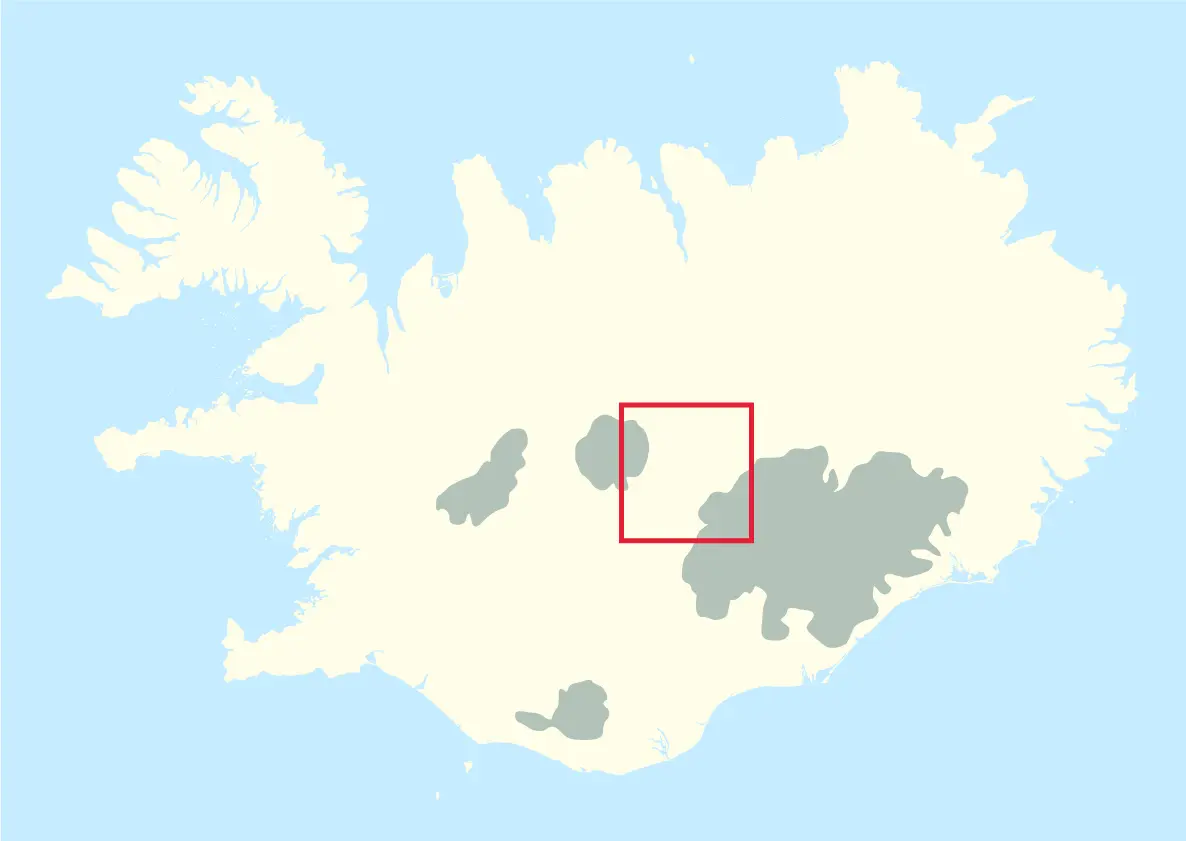
Sprengisandur is the gap between two Icelandic ice caps, Hofsjökull and Vatnajökull: a floor of black volcanic sand and gravel where almost nothing grows and nobody lives.
Where is Sprengisandur?
- Location
- Central Highlands, Iceland
- Type
- Desert / sand plain
- Coordinates
- 64.867, -18.117
- Last updated
LOCATION
Why is Sprengisandur said to be haunted?
The name is an instruction rather than a description — sandur, the ash desert of the interior, plus sprengja, to burst a horse by riding it too hard — because the only way across was fast, before the animals gave out. The medieval Icelanders who used the route left no ghost stories about it, only arithmetic: in chapter 8 of Hrafnkels saga a travelling party takes the Sand and reaches the Alþingi before a rival who went the long inhabited way. The spirits arrived later, and in print. The crossing's supernatural reputation is carried above all by one poem, Grímur Thomsen's Á Sprengisandi, whose rider reports that many an unclean spirit is abroad here; Skírnir was already quoting it as a known poem in 1889, and the melody that made it famous was first sung in Reykjavík in September 1913. The ghost stories told today attach to a mountain hut built in 1967, and as early as 1865 an Icelandic newspaper was arguing against the belief in highland outlaws.
What is the history of Sprengisandur?
Sprengisandur is the gap between two ice caps. Hofsjökull closes it on the west, Vatnajökull on the south-east, and between them lies a floor of black volcanic sand and gravel, lifted to roughly 700-800 metres, with almost nothing growing on it. The name is a warning rather than a description: it joins sandur, the Icelandic word for the ash deserts of the interior, to the verb sprengja, to burst a horse by riding it too hard. Riders crossed it fast because there was nothing on it to feed the horses.
The medieval Icelanders who used the route left no ghost stories about it — they left logistics. In chapter 8 of Hrafnkels saga Freysgoða, Sámur takes his gathered men north to the bridges, over Möðrudalsheiði, to Herðubreiðstunga, above Bláfjöll, into Króksdalur "og svo suður á Sand", south onto the Sand, coming down at Sandafell and on to Þingvellir — and he is there before Hrafnkell, who had ridden the long inhabited way round the coast, seventeen day-stages from Fljótsdalur by the saga's own count. The saga never uses the name Sprengisandur. It calls the crossing simply the Sand, and what it records is distance and time.
The best account of what that arithmetic cost is an unsigned route description printed in 1848 in the eighth volume of Ný félagsrit, "Lýsíng á Sprengisandi", fourteen pages of it. It advises the traveller to go up the west side of the Þjórsá from Skriðufell, the highest farm in Gnúpverjahreppur, to take advice there on the first bearing, and above all to travel with few horses and little baggage. It is blunt about the road: the Sprengisandur way is broken and in many places very bad going, neither much travelled nor mended anywhere — what it is, it is by nature. A pack train needs a full twenty-four-hour stage to get across the sand itself, and the man driving it will be five or six days between inhabited farms. The last line of the article advises nobody to take the Arnarfell variant at all.
The interior did hold people: outlaws. On the western flank of the route lies Eyvindarver, also called Eyvindarkofaver, named for the outlaw Fjalla-Eyvindur and his wife Halla. On 1 February 1861 the newspaper Íslendingur printed what a named witness had told it: Stefán Stefánsson, district officer at Sviðholt, had crossed Sprengisandur some twenty years before and come to Eyvindarver, where he found a structure walled outside with turf and divided inside into what looked like four chambers, each about a fathom long, with passages between them, doorways to all of them, walls shoulder-high at the highest point, and shelves of small flat stones set into the inner walls. Forty years later Eimreiðin (1903) was still describing riders camping on the southern part of the mires beside the ruins of Eyvindarkofi, and Skinfaxi (1913) placed the low ruins of the outlaws' dwelling in the middle of the marsh, "named after Fjalla-Eyvindur and Halla, who lived there for many years" — adding that it is hard to reach, the ground being so unbound.
After about 1930 the horse traffic thinned and the route was overtaken by better roads elsewhere. It came back as a motoring feat: in late August 1933 an old and unlovely Ford carrying four men arrived in the north, plainly not by the main road, and Íslendingur ran the story on 24 August under the headline "Í bíl yfir Sprengisand" — by car over Sprengisandur. Three days later the driver, Sigurður Jónsson from Laug, told Morgunblaðið that the going from the Tungnaá north over the sand was excellent, many times better than the Holtavörðuheiði road, and that he would have driven back south the same way if he had been able to get petrol at Mýri in Bárðardalur. The first hut at Nýidalur, in the middle of the crossing, went up in 1967.
Timeline: the documented record of Sprengisandur
- 13th century Chapter 8 of Hrafnkels saga Freysgoða has Sámur's party ride north to the bridges, over Möðrudalsheiði and Herðubreiðstunga, above Bláfjöll, into Króksdalur and then "suður á Sand" — south onto the Sand — coming down at Sandafell and reaching Þingvellir before Hrafnkell, who had gone the long inhabited way, seventeen day-stages from Fljótsdalur. The saga calls the crossing only the Sand and mentions nothing supernatural about it.
- 1848 The eighth volume of Ný félagsrit prints "Lýsíng á Sprengisandi", an unsigned fourteen-page route description: travel with few horses and little baggage, take your first bearing at Skriðufell, expect a full twenty-four-hour stage across the sand and five or six days between inhabited farms, and do not take the Arnarfell variant at all.
- 1 February 1861 Íslendingur prints the account of Stefán Stefánsson, district officer at Sviðholt, who had crossed Sprengisandur some twenty years earlier and found at Eyvindarver a turf-walled ruin divided into four chambers about a fathom long each, with passages, doorways, shoulder-high walls and shelves of small flat stones set into the inner faces.
- 8 March 1865 Norðanfari carries an article against the outlaw belief — attributed in 1885 by Andvari to Sigurður Gunnarsson — whose author states that he has been almost all the way round the mountain and there are nowhere outlaw stations, that they cannot be in Vonarskarð, and that he rode that pass with the surveyor Björn Gunnlaugsson in bright weather and the two of them saw the whole of it.
- 1889 Skírnir quotes "Ríðum, ríðum, rekum yfir sandinn" as a known poem of Grímur Thomsen's.
- 1907 Barnabók Unga Íslands III prints "A Sprengisandi" as sheet music signed "Gr. Th." — set to a Finnish folk melody, six years before the setting that made it famous.
- 3 September 1913 Ísafold reports that Eggert Stefansson has sung an Icelandic song "never heard here before", by his brother Sigvaldi the doctor — Sigvaldi Kaldalóns — to Grímur Thomsen's verses about Sprengisandur, and had to sing it a second time.
- 24 August 1933 Íslendingur reports the first motor crossing under the headline "By car over Sprengisandur": an old, unlovely Ford with four men aboard. Three days later the driver, Sigurður Jónsson from Laug, told Morgunblaðið the going was better than the Holtavörðuheiði road and that he would have driven back the same way had there been petrol at Mýri.
- 10 March 1964 Vísir observes that "the mountain huts seem to be the last refuge of ghosts in Iceland" — and in the same article the highland driver Guðmundur Jónasson assures the paper that one particular hut has no ghost in it.
- 1967 The first hut is built at Nýidalur, on the road over the central highlands at Sprengisandur, by the Iceland Touring Association.
- 7 March 1976 Tíminn asks Gísli Albertsson, who had worked two summers at the two huts by Nýidalur, whether the place is haunted. His answer: "I have not noticed it."
- 8 April 1984 Snowmobilers are caught out on the highland. Ingvar Ketilsson of Halldórsstaðir II in Bárðardalur falls with his machine an estimated forty metres into Þvergil on Sprengisandur late on the Sunday evening; Sveinn Rúnar Arason of Húsavík falls into the same gully and a third man loses his machine after them. Dagur interviewed Ingvar in hospital in Húsavík on the Wednesday.
- 6 September 1990 Pressan runs "Slæðingur á Sprengisandi": a visitor named Margit, who tested places for hauntings with knitting needles, said she had sensed a wandering soul or revenant in one of the bunks of the Nýidalur hut and had cleared the building of it.
- 11 November 2024 A Wikipedia editor makes one edit to the English article, summarised as "add citations", attaches four references and appends "Category: Reportedly haunted locations in Europe" below a stray interwiki link at the foot of the page. In the twenty years and eighty-six revisions before that edit the article had never carried such a category.
Is there a rational explanation for Sprengisandur?
The haunting of Sprengisandur has an author, a text and a date. It is carried, above everything else, by one poem: "Á Sprengisandi", by Grímur Thomsen (1820-1896), whose rider says of the crossing that "hér á reiki er margur óhreinn andinn" — many an unclean spirit is abroad here — and, in another stanza, that the elf-queen is bridling her mount and it is not good to get in her way. Skírnir for 1889, page 82, already quotes the first line as a known poem of Thomsen's; Haukur prints a full stanza in 1898. In 1907 Barnabók Unga Íslands III printed it as sheet music signed "Gr. Th.", set to a Finnish folk melody. The setting sung today is younger: on 3 September 1913 Ísafold reported that Eggert Stefánsson had sung one Icelandic song "never heard here before", by his brother Sigvaldi the doctor — Sigvaldi Kaldalóns — to Grímur's verses, and had to sing it again. The reputation of the place travelled, in other words, as a song.
In the Icelandic press the huldufólk, the hidden people, are not placed on Sprengisandur. A full-text search of timarit.is, the Icelandic newspaper and periodical archive, made in August 2026 for both terms together returned three hits, and none of the three puts hidden people on Sprengisandur: a 1940 essay listing outlaws, hidden people, ghosts and trolls as the fears of the ancestors in general, a 2004 art review, and a 2015 note on a folk song. The same archive, on the same day, gives 37 for Sprengisandur plus outlaws, 17 for Sprengisandur plus ghosts and 5 for Sprengisandur plus ghost; the query was repeated and returned three again. The classification of the canonical collection points the same way: in Jón Árnason's Íslenzkar þjóðsögur og æfintýri (Leipzig, 1862-64) the outlaw stories form a class of their own, the seventh, while the elf and hidden-people stories are titled after farms, fjords and inhabited valleys. In that collection the interior belongs to the outlaws, and the hidden people live beside farms.
Iceland produced its own sceptic early. On 8 March 1865 Norðanfari carried an article — attributed twenty years later, in Andvari for 1885, to Sigurður Gunnarsson — arguing that belief in outlaws made men far too quick to take any stranger met in the wilderness for an outlaw-thief. Its author states flatly that he has been almost all the way round the mountain and that there are nowhere any outlaw stations there; that they cannot be in Vonarskarð, which is not a mile and a half across; and that he rode through that pass with Björn Gunnlaugsson, the surveyor of Iceland, in bright clear weather, and the two of them could see the whole of it. In the same piece the "Fjallaskjóni", the mountain horse whose tracks were pointed out on Sprengisandur, is explained as a farm mare that had run off and wintered on the good grazing of the interior.
The modern ghost of Sprengisandur is not on the sand at all: it is in the huts, and the huts are younger than the ghost stories about them. On 10 March 1964 Vísir observed that "the mountain huts seem to be the last refuge of ghosts in Iceland" — and in the same article the highland driver Guðmundur Jónasson assured the paper that a particular one of them had no ghost in it. On 7 March 1976 Tíminn asked Gísli Albertsson, who had spent two summers working at the two huts by Nýidalur, whether it was haunted there; his answer was that he had not noticed it. A first-hand report appears in Pressan of 6 September 1990, under the headline "Slæðingur á Sprengisandi": a visitor named Margit, who used knitting needles to test places for hauntings, said she had become aware of a wandering soul or revenant in one of the bunks in the Nýidalur hut and had cleared the building of it. The building she cleared was put up in 1967.
What the record does document is ordinary and lethal: fog, rivers and exposure. Snowmobilers were caught out on the highland in April 1984, and one of them, Ingvar Ketilsson of Halldórsstaðir II in Bárðardalur, fell with his machine an estimated forty metres into the gully of Þvergil on Sprengisandur late on the Sunday evening; Dagur interviewed him from the hospital in Húsavík. A philological note in Mímir in 1964 even reads the elf-queen's mount out of the supernatural: gandur, it argues, most often meant a magic staff ridden through the air, but also a wolf, and Shetlandic has gander for a howling wind.
The haunted label in English has a traceable origin. The English Wikipedia article on Sprengisandur mentioned ghosts from its first version, of 22 May 2004 ("Stories about bad ghosts and criminals were told"), and the sentence on ghosts it carries now comes from a rewrite of 15 October 2011; neither cited a source. For twenty years the article was not filed as a haunted place. On 11 November 2024 an editor made a single edit summarised as "add citations", attached four references, and appended "Category: Reportedly haunted locations in Europe" at the very bottom of the page, below a stray interwiki link. Catalogues of haunted places compiled from that Wikipedia category, this one among them, took Sprengisandur from there.
Can you visit Sprengisandur?
The mountain road F26, Sprengisandsleið, runs across Sprengisandur, and the Icelandic Road Administration, Vegagerðin, publishes road conditions, highland roads included, on its traffic site umferdin.is. The pin of this file, at 64.8667 N 18.1167 W, is a general point for the plateau.
The huts of Nýidalur stand about 15 km south of the pin. According to its page on the website of Ferðafélag Íslands, the Iceland Touring Association, read on 24 September 2026, the association runs two huts at the mouth of the valley of Nýidalur, 830 m above sea level at N 64°44.130, W 18°04.350, which house a total of 54 people; the first hut there was built in 1967. The huts are built alike: the ground floor holds a kitchen, a large dormitory with bunk beds and a warden's room, and the sleeping lofts upstairs have mattresses. Toilets and showers are in a separate house nearby, with a winter latrine behind it, and the campsite is close to the toilet building; a hut warden is present in summer. The page listed a bed at 15,000 ISK, booked through the association's website, and gives the hut telephone as 860 3334.
The same page states that in summer it is possible to drive 4x4 jeeps to Nýidalur along F26. The huts open when the Road Administration opens the road, which in turn depends on snow and on the general condition of the road; on average, the association says, they are open from early July to early September. In winter they are closed and locked, although they can be rented by sending a hut enquiry to the association's office. The page adds that "winter travel in Iceland is serious business and should only be undertaken by highly skilled hikers, accustomed to extreme conditions and carrying 5 season equipment".
For the surroundings, the association notes that the Tungnafell glacier can be climbed from the valley of Nýidalur, which also gives access to the Vonarskarð pass across the Mjóháls ridge, and it lists Laugafell as the next hut.
Sources consulted
- Anónimo (siglo XIII), «Hrafnkels saga Freysgoða, 8. kafli» — Icelandic Saga Database, 1300 book
- sin firma, «Lýsíng á Sprengisandi» — Ný félagsrit, 8. árgangur, pp. 53-66, 1848 book
- Íslendingur, «Eyvindarver: las ruinas descritas por Stefán Stefánsson de Sviðholt» — Íslendingur, 1 de febrero de 1861, p. 163, 1861 newspaper archive
- Sigurður Gunnarsson, «Artículo sobre los útileguþjófar (ladrones forajidos)» — Norðanfari, 8 de marzo de 1865, p. 12, 1865 newspaper archive
- Andvari, «Nota que atribuye a Sigurður Gunnarsson el artículo de Norðanfari de 1865» — Andvari, 11. árgangur, p. 31, 1885 academic
- Skírnir, «Mención de «Ríðum, ríðum, rekum yfir sandinn» como poema conocido de Grímur Thomsen» — Skírnir, 63. árgangur, p. 82, 1889 academic
- Haukur, «Estrofa de «Á Sprengisandi» citada en un relato» — Haukur, 2. árgangur, 3.-4. tölublað, p. 15, 1898 newspaper archive
- Eimreiðin, «Descripción de Eyvindarver / Eyvindarkofaver en una guía de ruta» — Eimreiðin, 9. árgangur, 2. tölublað, p. 132, 1903 newspaper archive
- Barnabók Unga Íslands III, ««Á Sprengisandi», partitura firmada «Gr. Th.» sobre tonada popular finlandesa» — Barnabók Unga Íslands, 3. árgangur, p. 15, 1907 book
- Skinfaxi, «Eyvindarver, «llamado así por Fjalla-Eyvindur y Halla, que vivieron allí muchos años»» — Skinfaxi, 4. árgangur, 3. tölublað, p. 21, 1913 newspaper archive
- Ísafold, «Reseña del recital de Eggert Stefánsson: una canción islandesa «nunca oída aquí antes», de Sigvaldi Kaldalóns, sobre los versos de Grímur» — Ísafold, 3 de septiembre de 1913, p. 277, 1913 newspaper archive
- Íslendingur, ««Í bíl yfir Sprengisand» (En coche por Sprengisandur)» — Íslendingur, 24 de agosto de 1933, p. 3, 1933 newspaper archive
- Morgunblaðið, «Declaraciones del conductor Sigurður Jónsson frá Laug tras cruzar el arenal» — Morgunblaðið, 27 de agosto de 1933, p. 4, 1933 newspaper archive
- Vísir, ««Sæluhúsin virðast vera síðasta athvarf drauga á Íslandi» (Los refugios parecen el último asilo de los fantasmas en Islandia)» — Vísir, 10 de marzo de 1964, p. 9, 1964 newspaper archive
- Mímir, «Nota filológica sobre «gandur» en el verso «álfadrottning er að beizla gandinn»» — Mímir, 3. árgangur, nr. 4, p. 52, 1964 academic
- Tíminn, «Entrevista a Gísli Albertsson, dos veranos en los refugios de Nýidalur» — Tíminn, 7 de marzo de 1976, p. 16, 1976 interview
- Dagur, «Entrevista a Ingvar Ketilsson en el hospital de Húsavík tras caer en Þvergil» — Dagur, 11 de abril de 1984, p. 1, 1984 newspaper archive
- Pressan, ««Slæðingur á Sprengisandi»» — Pressan, 6 de septiembre de 1990, p. 14, 1990 newspaper archive
- Jón Árnason, «Íslenzkar þjóðsögur og æfintýri: índice de los once flokkar (la séptima clase es Útilegumannasögur)» — Leipzig, 1862-1864 (edición digital de Wikisource en islandés), 1862 book
- Ferðafélag Íslands, «Hut: Nýidalur (dos refugios, 54 plazas, 830 m, temporada según abra la F26)» — fi.is, consultado el 20 de agosto de 2026, 2026 web
- Wikipedia en inglés (usuario Nayyn), «Edición que añade la categoría «Reportedly haunted locations in Europe» al artículo Sprengisandur» — Historial de revisiones, revisión 1256748379 de 11 de noviembre de 2024, 2024 archive
- Vegagerðin (Icelandic Road and Coastal Administration), «Traffic Info: road conditions, including the highland roads» — umferdin.is, 2026 web
Reviewed by V. Serrano on 2026-08-20 · How we verify our content
💬 Field testimonies (0)
No testimonies yet. Add the first.
Add your testimony
🔒 Log in to add a testimony