🦶 CRYPTID SIGHTING · EXP. Nº6501
ACTIVE
Lariosaurus
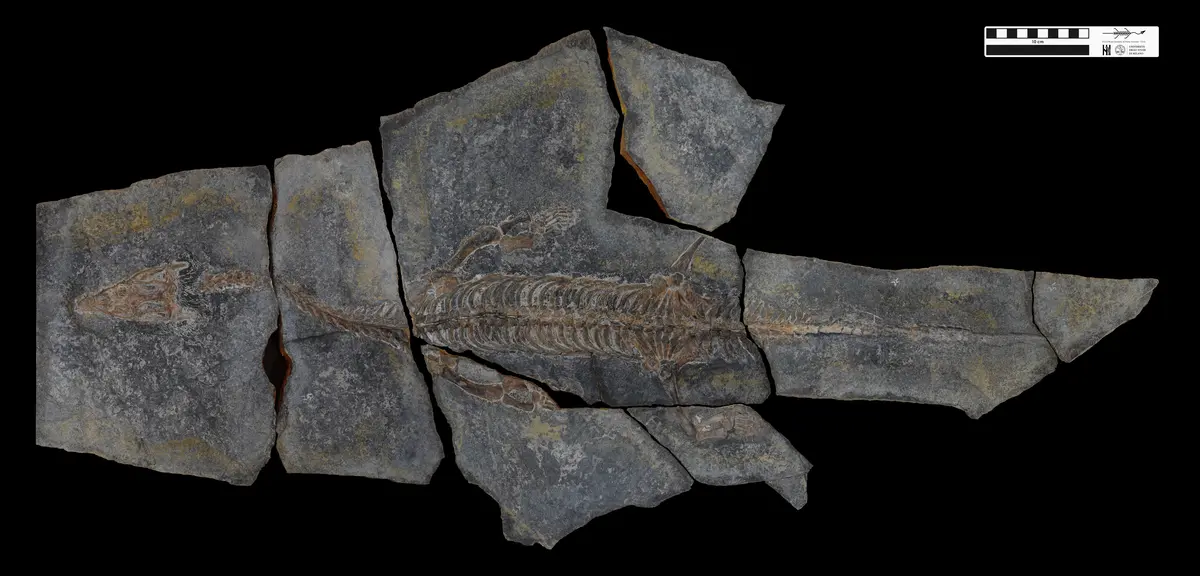
Lariosaurus is a real animal, and that is the strange part. It is a small Middle Triassic marine reptile, a nothosaur of about 60 cm to 1.3 m, whose first skeleton came out of the black limestone above Varenna, in the commune of Perledo on Lake Como, and which the geologist Giulio Curioni named in 1847 after Larius, the Roman name of the lake.
Where and when was Lariosaurus sighted?
- Location
- Lago de Como, Italy
- Date sighted
- Unknown
- Coordinates
- 46.017, 9.283
- Last updated
LOCATION
What is Lariosaurus?
The monster is a much later and much shorter story. In November 1946 the Corriere comasco reported an enormous animal at Pian di Spagna, at the northern end of the lake; the librarian Giorgio Castiglioni, who worked through the local press case by case, considers the report an invention of the paper, which killed the creature off a week later by declaring it a sturgeon caught by two boys. Further reports followed in 1954, in 1957 and in 2003, and the fossil's name was attached to all of them. The transfer is documented and the fossil does not support the monster: this is a lake monster that demonstrably borrowed its name from a museum label, rather than a folklore later dignified by a fossil.
What is the history of Lariosaurus?
The Lariosaurus file has to begin with something no other entry in this catalogue can claim: the animal is real, it has a type specimen, and its name was published in a scientific journal. What is invented is the monster that later borrowed the name — and the borrowing itself is documented well enough to be told as history.
The rock came first. Above Varenna, on the eastern shore of Lake Como, in the commune of Perledo, quarrymen worked a black bituminous limestone sold as the marmo nero di Varenna. Giancarlo Colombo, who spent years studying the animal and reconstructed its skull for his own book, described the setting to an audience in Como in 2006: five or six quarries working the year round, men splitting the stone by hand with sledge and chisel, and inside it the flattened skeletons of a Triassic sea. The limestone had formed in an oxygen-poor trough between two carbonate platforms — the platforms that became the Grigne massif — where a dead animal sank, was not eaten, and was buried by mud.
The first skeleton is conventionally dated to about 1830; Colombo says "intorno al 1830", around 1830, and that is as precise as the sources get. The first hard date is 1839, when Giuseppe Balsamo Crivelli published it in Milan in Il Politecnico. The title of that paper is worth reading in full, because it names a man our own earlier text had dropped: "Descrizione d'un nuovo rettile fossile, della famiglia dei Paleosauri, e di due pesci fossili, trovati nel calcareo nero, sopra Varenna sul lago di Como, dal nobile sig. Lodovico Trotti" — the reptile and two fossil fishes found in the black limestone above Varenna by the nobleman Lodovico Trotti. Balsamo Crivelli described the skeleton and figured it, filed it under the "famiglia dei Paleosauri", and then did something unusual: he declined to give it a name until it was settled that nothing like it had been described before.
It was settled eight years later. In 1847 Giulio Curioni (Milan, 1796–1878), a geologist who would later write the standard survey of Lombard applied geology, published "Cenni sopra un nuovo saurio fossile dei monti di Perledo sul Lario e sul terreno che lo racchiude" in the journal of the Istituto Lombardo, and on page 166 the genus Lariosaurus appears. The genus name means the reptile of the Lario — Larius being the Roman name of Lake Como. The species name does not refer to the lake at all: balsami honours Balsamo Crivelli, the man who had described the specimen and refused to name it. Our previous description said the species had been named "after the lake's Latin title". Half of that is right and the half that is wrong deletes a person.
Curioni also got something wrong in the same paper. He described a second, smaller skeleton from the same quarries as a separate animal, Macromirosaurus plinii. It was a juvenile of his own species. By 1863 he had swung to the opposite extreme and claimed that every fossil saurian from Perledo belonged to a single taxon; Bernhard Peyer's revision of 1933–34 showed that was wrong too, and settled the smaller specimen as a variety of Lariosaurus balsami.
The animal itself is a nothosaur — a Middle Triassic marine reptile of the Sauropterygia, from roughly 247 to 235 million years ago, when this was warm shallow sea some twenty degrees north of the equator. Adults ran from about 60 cm to 1.3 m, which makes Lariosaurus one of the smallest nothosaurs known. Its interest to palaeontology is that it was caught mid-change: the forelimb had already become a paddle, while the hind foot still had five toes, probably webbed. Perledo gave its name to other things pulled out of the same stone, including the fossil fish genus Perleidus and the family Perleididae.
Then the war. Most of the historical Perledo material was held at the Museo Civico di Storia Naturale in Milan, and in 1943 the museum was gutted by Allied bombing; the fire that followed burned for three days. The holotype of Lariosaurus balsami — the large partial skeleton Balsamo Crivelli had described and Curioni had named — was destroyed. A plaster cast of it survives in Milan. In 1987 Emil Kuhn-Schnyder designated a neotype: a complete specimen from Perledo, catalogued BSP AS I 802, in the Bayerische Staatssammlung in Munich, where it had ended up in the years when buying fossils was unrestricted. Olivier Rieppel's 1998 revision, which is the modern reference for the genus, adds a quiet warning about all this nineteenth-century material: its precise age cannot be established today, because nobody recorded the stratigraphy or the exact spot in the quarry.
The monster arrives a hundred years after the fossil, and it arrives in a newspaper. In November 1946 the Corriere comasco reported that an enormous animal had appeared at Pian di Spagna, near Colico at the northern end of the lake, and had frightened a party of hunters. The story travelled: the local daily La Provincia picked it up, added a second sighting of its own and a third from years earlier, and papers across Italy repeated it, the Corriere della Sera among them. A week later the Corriere comasco closed the account by announcing that the creature had been a sturgeon caught by two boys. Both halves were invented. From then on the fossil's name was attached to anything odd seen in the water, and it stuck: a Van de Sfroos song called El mustru on the 2001 album ...e semm partii, a local anglers' association that calls itself the Amici del Lariosaurus balsami, and, in March 2006, a public conference in Como at which a palaeontologist, a librarian and a cryptozoologist sat down together to separate the animal from the story.
Timeline: the documented record of Lariosaurus
- c. 1830 A large fossil skeleton comes out of the black bituminous limestone above Varenna, in the commune of Perledo on Lake Como. The date is conventional: Giancarlo Colombo says only "intorno al 1830", around 1830, and no primary record of the find has been traced.
- 1839 Giuseppe Balsamo Crivelli describes and figures the skeleton in Il Politecnico of Milan, filing it under the "famiglia dei Paleosauri". The title of the paper credits the find to the nobleman Lodovico Trotti. Balsamo Crivelli deliberately gives the animal no name, pending confirmation that nothing like it had been described before.
- 1847 Giulio Curioni publishes "Cenni sopra un nuovo saurio fossile dei monti di Perledo sul Lario" in the journal of the Istituto Lombardo and, on page 166, names the genus Lariosaurus — reptile of the Lario. The species name balsami honours Balsamo Crivelli, not the lake. In the same paper he describes a smaller skeleton as Macromirosaurus plinii; it is a juvenile of his own species.
- 1933–34 Bernhard Peyer's revision of the Perledo reptiles disproves Curioni's 1863 claim that every fossil saurian from the quarries belonged to a single taxon, and ends the Macromirosaurus dispute by recognising the specimen as Lariosaurus balsami var. plinii.
- 1943 The Museo Civico di Storia Naturale in Milan is gutted by Allied bombing and the resulting fire burns for three days. The holotype of Lariosaurus balsami, held there, is destroyed; only a plaster cast survives. Most of the historical Perledo fossil material is lost with it.
- November 1946 The Corriere comasco reports an enormous animal at Pian di Spagna, near Colico, frightening a party of hunters. La Provincia adds a sighting of its own and a third from years earlier; the Corriere della Sera repeats the story. A week later the Corriere comasco declares the creature a sturgeon caught by two boys. Giorgio Castiglioni concludes that both the monster and the sturgeon were inventions of the paper. This is the earliest datable appearance of the lake-monster story.
- 1954 An animal 80–90 cm long is reported at Argegno. Castiglioni traces the witness through his name in the press and interviews him: rounded snout, broad hindquarters "like a pig's", and legs "like a duck's". Castiglioni identifies an otter, a species still present on the Lario at the time, and checks the distance question with Claudio Prigioni of the University of Pavia.
- August–September 1957 The Como daily L'Ordine prints a monster between Dongo and Musso in August — a story that finds no takers — and in September reports that two men in a bathysphere saw the front part of a strange animal with a crocodile-like head, total length estimated at 60 cm to 1.2 m. Castiglioni suggests a large pike for the September case and reads the August one as invention.
- 1965 Somebody throws an inflatable rubber monster into Lake Como. The Corriere della Sera runs the hoax with a photograph.
- 1987 With the holotype destroyed, Emil Kuhn-Schnyder designates a neotype for Lariosaurus balsami: a complete specimen from Perledo, BSP AS I 802, held in the Bayerische Staatssammlung in Munich.
- 1998 Olivier Rieppel publishes the modern revision of the genus in Fieldiana, and warns that the precise age of the historical Perledo collections can no longer be established, because the stratigraphic and locality data were never recorded.
- 2003 An internet forum post describes an eel 10–12 metres long seen from Monte Barro in the water off Lecco. Castiglioni considers a tight shoal of fish or surface reflections the more credible reading.
- 3 March 2006 The conference "Incontro con il lariosauro" is held in Como: Giancarlo Colombo on the Triassic animal, Giorgio Castiglioni on the alleged monster, and the veterinarian and cryptozoologist Maurizio Mosca — author of Mostri dei laghi (Mursia, 2000) — on lake monsters worldwide. The three papers are the fullest published treatment of the case.
Is there a rational explanation for Lariosaurus?
There is no need to speak vaguely about "sceptics" here, because one man went through the Lariano cases one at a time and published what he found. Giorgio Castiglioni, a librarian at Parè and Moltrasio, wrote three articles on the Lake Como "monsters" for the Studi della biblioteca comunale di Cavallasca and a further piece in the review Canturium in April 2005, and set out his conclusions at the Como conference of 3 March 2006. They are unusually specific.
The November 1946 report he treats as an outright invention of the Corriere comasco. His reasoning is not merely that the article is implausible — although he says a reader can have few doubts on that score — but that the same paper wound the story up a week later with an equally invented sturgeon, and that shortly afterwards, in the same slot at the foot of the front page where the monster and the sturgeon had run, it published the apparition of a ghost complete with photograph. That position on the page, he observes drily, was not an index of the reliability of the news.
The August 1957 monster between Dongo and Musso, printed by the Como daily L'Ordine, he reads the same way; that one found no takers and died where it lay. The September 1957 case is the one he takes half-seriously: L'Ordine reported that two men in a bathysphere had seen the front part of a strange animal and put its total length at between 60 cm and 1.2 m. The description is vague, but the crocodile-like head is consistent, he suggests, with a large pike — if the report is reliable and was written down correctly.
The 1954 sighting at Argegno is the one that shows what real work looks like. The newspapers gave only a few lines, but one of those lines carried the witness's name, so Castiglioni tracked him down and asked him. The animal was 80 to 90 cm long. It was certainly not a fish: the snout was rounded rather than pointed, and the rear end was broad — "like a pig's", the witness said — instead of tapering. And it had legs, which he compared to a duck's. A mammal with webbed feet, in other words. Castiglioni's identification is an otter, and otters were still present in the Lario area in 1954, including at Pian di Spagna. He even checked the obvious objection, asking Claudio Prigioni of the University of Pavia, then studying otter movements in the Pollino National Park, whether an otter could plausibly cover the distance from Pian di Spagna to Argegno; the answer was that such journeys are recorded, if not everyday. A rare excursion would also explain why nobody recognised the animal.
The rest is thinner still. The giant eel reported in 2003 off Lecco, seen from the top of Monte Barro and estimated at 10 to 12 metres, is more economically explained by a tight shoal of fish or reflections on the surface. And in 1965 somebody simply threw an inflatable rubber monster into the lake; the Corriere della Sera ran it with a photograph.
Two further points are worth making plainly. First, the cases do not corroborate one another: as Castiglioni notes, the Argegno animal and the September 1957 animal are described so differently that, taken together, they would argue for two unknown species rather than one. Second, the fossil supports nothing. Lariosaurus is known only from Triassic marine deposits laid down when this was open sea; a nothosaur of at most 1.3 m has no bearing on what may or may not swim in a lake today, and the transfer of the name is the whole of the connection. Colombo said as much at the same conference, translating the genus as the reptile found near Lake Como and adding: "Forse l'equivoco sul mostro del lago può essere venuto fuori di qui" — perhaps the misunderstanding about the lake monster came out of this.
One negative result, with its control, since it is the claim our previous text rested on. That text said nineteenth-century villagers had woven the fossil finds into lake-monster folklore. Searching the Internet Archive full-text corpus in August 2026, "lariosauro" returns four hits in total, and not one of them is a monster: a volume of the Transactions of the Zoological Society of London quoting Curioni in Italian, a 1987 sailing yearbook listing a boat of that name, and Devoto's Italian dictionary defining it as a genus of nothosaurid reptiles. The phrase "mostro del lago di Como" returns nothing at all. The controls in the same corpus and the same search: "lago di Como" returns about 6,159 hits, "Perledo" about 446, "Lariosaurus" about 278, "mostro di Loch Ness" about 55, and Tarantasio — the genuinely medieval dragon of the Lombard Lago Gerundo — about 56. A corpus that holds fifty-six Italian references to a mediaeval lake dragon holds none to a nineteenth-century Como one. The folklore we described did not exist; what existed was a newspaper, and it can be dated to November 1946.
Can you visit Lariosaurus?
The quarries above Varenna that produced the first skeletons are closed, and Perledo has no visitable dig, so what can be seen is the animal in three collections.
The nearest is the Museo di Storia Naturale of Lecco, in Palazzo Belgiojoso at Corso Giacomo Matteotti 32, whose palaeontology room is built around the lariosauro finds of the Lecco district. Admission to the Palazzo Belgiojoso museums is free and the planetarium in the same building is ticketed apart. The museum opens Tuesday to Friday from 10:00 to 14:00 and Saturday to Sunday from 10:00 to 18:00, and closes on Mondays; the ticket office answers on +39 0341 481248 and at [email protected]. Those hours were read from the municipal museum service page on 10 September 2026.
The specimen that formally carries the name Lariosaurus balsami is in Munich. Rieppel gave it in 1998 as BSP AS I 802 in the Bayerische Staatssammlung für Paläontologie und Geologie, and recorded that it was then mounted for permanent exhibition, which is why he had trouble examining it. The plaster cast of the destroyed holotype is in Milan, at the Museo Civico di Storia Naturale and without a catalogue number, and a further specimen is held by the geological service in Rome; neither is guaranteed to be on show.
Perledo has the Varenna-Esino-Perledo station of the Lecco–Tirano railway, and ferries cross from Varenna to Menaggio and Bellagio. Palaeontological material is cultural property in Italy: article 10, paragraph 4, letter a) of Legislative Decree 42 of 22 January 2004 lists "le cose che interessano la paleontologia" among the protected items, so a vertebrate fossil picked up in Lombardy belongs to the state.
Sources consulted
- Olivier Rieppel, «The status of the sauropterygian reptile genera Ceresiosaurus, Lariosaurus, and Silvestrosaurus from the Middle Triassic of Europe» — Fieldiana: Geology, new series, no. 38 — Field Museum of Natural History, 1998 academic
- Giorgio Castiglioni, «Il lariosauro tra fantasia e zoologia» — Conferenza «Incontro con il lariosauro», Como, 3 marzo 2006 — Bibliotopia, 2006 report
- Giancarlo Colombo, «Il lariosauro del Triassico» — Conferenza «Incontro con il lariosauro», Como, 3 marzo 2006 — Bibliotopia, 2006 report
- Maurizio Mosca, «I cugini del lariosauro: mostri lacustri nel mondo» — Conferenza «Incontro con il lariosauro», Como, 3 marzo 2006 — Bibliotopia, 2006 report
- Giulio Curioni, «Cenni sopra un nuovo saurio fossile dei monti di Perledo sul Lario e sul terreno che lo racchiude» — Giornale dell'I. R. Istituto Lombardo di Scienze, Lettere ed Arti, vol. 16, pp. 159-170 — descripción original del género (citada y usada por Rieppel 1998), 1847 academic
- Giuseppe Balsamo-Crivelli, «Descrizione d'un nuovo rettile fossile, della famiglia dei Paleosauri, e di due pesci fossili, trovati nel calcareo nero, sopra Varenna sul lago di Como, dal nobile sig. Lodovico Trotti» — Il Politecnico (Milano), vol. 5, pp. 421-431 — primera descripción del ejemplar, sin nombre (citada y usada por Rieppel 1998), 1839 academic
- SiMUL — Sistema Museale Urbano Lecchese, Comune di Lecco, «Palazzo Belgiojoso — Museo di Storia Naturale, e Visita e biglietteria» — simulecco.it, 2026 web
- Repubblica Italiana, «Codice dei beni culturali e del paesaggio, art. 10, comma 4, lettera a)» — Decreto legislativo 22 gennaio 2004, n. 42 — Normattiva, 2004 report
Reviewed by V. Serrano on 2026-08-11 · How we verify our content
📎 Source: Enigma Atlas
💬 Field testimonies (0)
No testimonies yet. Add the first.
Add your testimony
🔒 Log in to add a testimony