👻 HAUNTED PLACE · EXP. Nº9475
ACTIVE
Poveglia
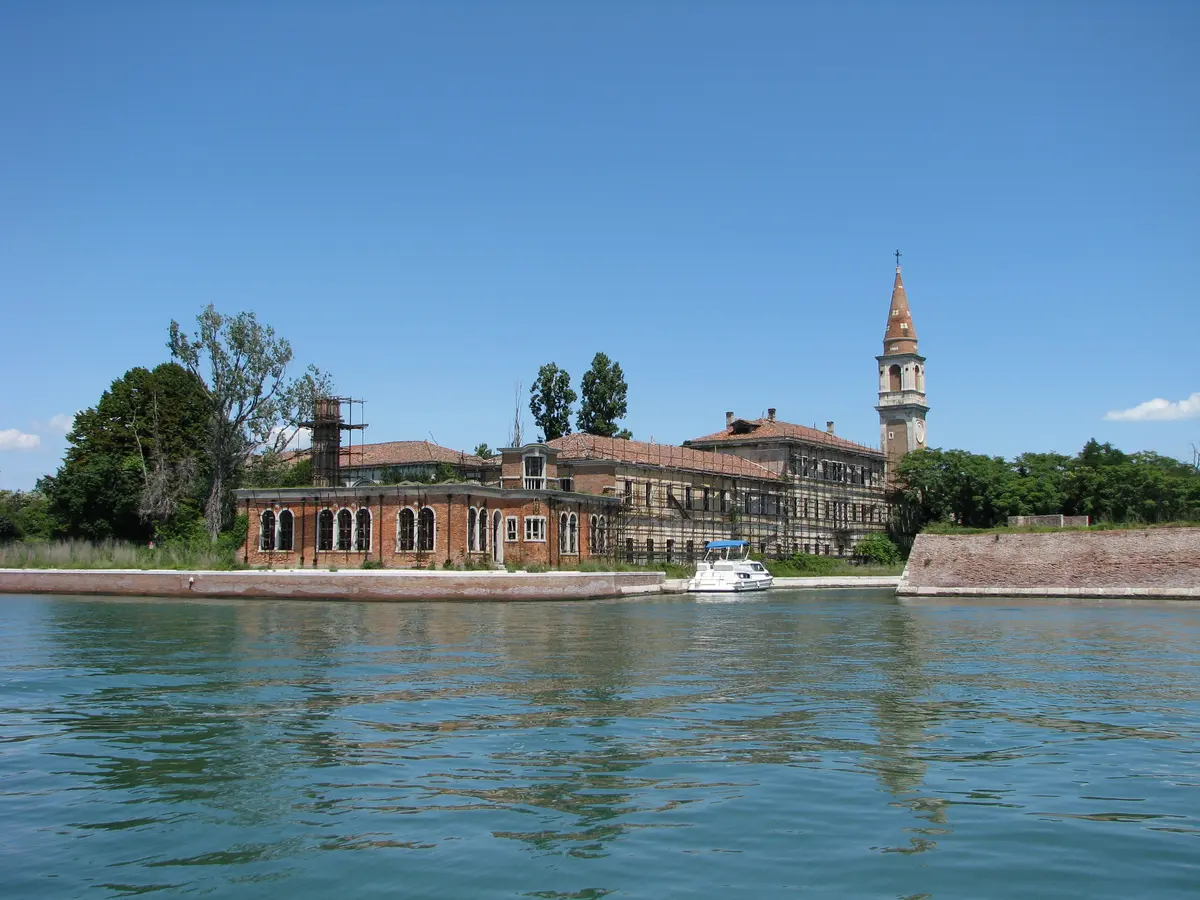
Lying in the Venetian Lagoon between Venice and Lido, the small island of Poveglia has been called "the most haunted island in the world," a reputation built over centuries of grim use.
Where is Poveglia?
- Location
- Veneto, Italy
- Type
- Island
- Coordinates
- 45.382, 12.331
- Last updated
LOCATION
Why is Poveglia said to be haunted?
First recorded in 421, the island was abandoned by its farming population in 1379 amid warfare, and beginning in 1776 it served for more than a century as a quarantine station where plague victims were isolated, and, according to local tradition, where the dead and dying were burned on mass pyres, leaving ash said to still make up nearly half the island's soil. From the early 20th century until its closure in 1968, Poveglia housed a psychiatric hospital, and persistent, though unverified, stories claim a doctor there performed crude experimental treatments on patients before either being driven mad himself or thrown from the hospital's bell tower. Decades of abandonment since have only deepened the island's sinister reputation, and Italian authorities restrict access, doing little to discourage the ghost stories that surround it.
What is the history of Poveglia?
Poveglia is a seven-hectare island in the southern Venetian lagoon, off the south-west end of the Lido, and its reputation rests on two periods of institutional use.
Against recurring plague, the Republic of Venice kept isolation stations on lagoon islands, the lazzaretti, where ships, crews and cargo were held before entering the city; the oldest were Lazzaretto Vecchio and Lazzaretto Nuovo. Poveglia joined the system late: in the last quarter of the eighteenth century it passed to the Venetian health magistracy — in 1776 according to Walks of Italy, in 1777 according to the Venetian historian Davide Busato, in 1782 according to Poveglia per tutti — and Busato records that ships whose draught kept them out of the Lido port were routed through the Poveglia channel, with the island's large building, the Teson, used to store their gear.
Plague reached the island twice, first in 1793, when it was hastily fitted out as a lazaretto, nicknamed the "nuovissimo", to isolate the crew of a Hydriot tartane carrying the disease; twelve people died, four sailors and eight porters. In 1799 by Busato's account — 1798 in others — a Spanish brig with plague aboard was brought to Poveglia and eight of its crew died there. Busato calls it the last time the island's cemetery served the disease.
In the twentieth century the island's buildings became a hospital for the elderly — a geriatric sanatorium in Poveglia per tutti's description, a convalescent and rest home in Busato's — which closed in 1968; the association's own history dates the abandonment to 1969, and the buildings have been decaying ever since.
In March 2014 the Italian state property agency announced that it would auction the island on a 99-year lease, and on 2 April a citizens' association called Poveglia per tutti was founded to bid for it under the motto "99 euros for 99 years". More than 4,500 people donated and raised €460,000 in forty days, for a plan to make the island a freely accessible public park run on a non-profit basis; the agency judged the highest bid, €513,000 from the holding company Umana, incongruous. After a decade of legal battles — including two rulings in the association's favour by the Regional Administrative Court of Veneto, the second in November 2024 — the association was awarded a six-year concession of the northern island on 1 August 2025.
Timeline: the documented record of Poveglia
- 1776 Poveglia comes under the jurisdiction of the Venetian Public Health Office, initially as a form of customs control. Other accounts date the transfer to 1777 or 1782.
- 1793 and 1798 The last two plague ships are isolated at Poveglia: a Hydriot tartane in 1793, with twelve dead, and a Spanish brig in 1798 (1799 in Davide Busato's account), with eight — twenty documented deaths, the basis for a legend that claims 160,000.
- 1968 The hospital for the elderly on the island — "actually a geriatric sanatorium", in Poveglia per tutti's words — closes, and the buildings begin to decay.
- 2014 Facing the island's sale to private developers, the citizens' association Poveglia per tutti is formed. More than 4,500 people raise €460,000 to turn it into a freely accessible public park.
- November 2024 The Regional Administrative Court of Veneto rules in the association's favour for the second time, finding that the state property agency had not justified its refusals.
- 1 August 2025 The association takes over the concession of the northern island, the part without buildings. Access is by their own events; the existing pontoon still fails safety standards.
Is there a rational explanation for Poveglia?
The Poveglia legend is built on numbers, and the Venetian record answers them with smaller ones.
The headline claim is that the island is the burial ground of up to 160,000 plague victims, and that the soil is half human ash. The Venetian historian Davide Busato, who has published the health magistracy's manuscript report on the 1793 case, counts two plague episodes on the island: in 1793, when the crew of an infected Hydriot tartane was isolated there and twelve people died, four sailors and eight porters; and in 1799 — 1798 in other accounts — when a Spanish brig brought an outbreak that killed eight of its crew. That makes twenty documented plague deaths. The lagoon's mass plague burials have been found and excavated at Lazzaretto Vecchio, a different island, where archaeologists have recovered remains on a large scale. Poveglia per tutti, the association that now holds part of the island, puts it plainly on its own site: Poveglia "was used as a quarantine station for ships, but it is not a mass grave for plague victims." The "fifty per cent human ash" figure travels with no study attached; Walks of Italy, which repeats it, answers it with another unsourced figure of "about 100,000 victims" in plague pits.
The asylum layer follows the same pattern. The twentieth-century hospital was, in the association's words, "actually a geriatric sanatorium"; Busato calls it a convalescent and rest home for the elderly, abandoned in 1968. The tale of a sadistic doctor who threw himself from the bell tower has nothing documentary behind it: Busato writes that no newspaper reports a doctor's suicide or any death on the island, and Walks of Italy traces the story to American television.
The closed gate is offered as the last proof, on the reasoning that the authorities must be hiding something. According to Poveglia per tutti's FAQ, consulted on 25 September 2026, landing is prohibited on the built-up island, managed by the State Property Agency; Walks of Italy describes its buildings as rubble, with most stairs and ceilings collapsed. The northern island, which has no buildings, has been under concession to the association since 1 August 2025, and it is reached by a temporary pontoon that the association says does not meet safety standards.
The largest documented crowd in Poveglia's history is a modern one: more than 4,500 donors who raised €460,000 in forty days in 2014 to bid for the island and keep it public.
Can you visit Poveglia?
The island lies in the Venice lagoon south of Malamocco, on the Canale Orfano, the channel that links the Malamocco harbour mouth with the city. Italian Wikipedia gives its position as 45°22′54″N 12°19′54″E and its surface as 0.072788 km², about 7.25 hectares. A canal cuts the island in two: the hospital buildings that carry its reputation stand on the southern half, while the northern half is bare ground.
Poveglia is state property, administered by the Agenzia del Demanio. The agency announced on 2 July 2025 a six-year concession over the northern island to the citizens' association Poveglia per tutti, which took effect on 1 August 2025 and runs to 2031. For the rest of the island the agency's stated intention is to bring in public and private partners, under the programme that lists Poveglia among some 400 state properties offered for valorisation.
The association's own FAQ, consulted on 9 September 2026, sets out the access rules. On the built-up island: «Attualmente lo sbarco e l'accesso sono vietati sull'isola edificata gestita dall'Agenzia del Demanio». The northern island is reached «tramite un pontile temporaneo preesistente che non rispetta gli standard di sicurezza», a pontoon the association intends to replace. It runs boats to the island for its own events, which are published on its calendar; at any other time landing depends on a private or a hired boat. The same page describes the place as «un'isola selvaggia e verde — non ci sono bar, punti ristoro, servizi, acqua o elettricità». Fires are prohibited on the island, and whatever a visitor brings in has to leave with them.
The lagoon's excavated plague burials lie on Lazzaretto Vecchio, a separate island off the Lido.
Sources consulted
- Walks of Italy, «Poveglia Island: all about Venice's haunted island — la jurisdicción sanitaria de 1776, los dos barcos apestados de 1793 y el estado de los edificios; repite además el rumor de «unas 100.000 víctimas» en fosas de peste» — Walks of Italy, 2023 web
- Associazione Poveglia per tutti, «Storia — la campaña ciudadana por la isla» — Documentación de la asociación, 2025 report
- Associazione Poveglia per tutti, «Domande frequenti — condiciones reales de acceso a la isla» — Información oficial, 2025 archive
- Atlas Obscura, «Lazzaretto Vecchio — la isla donde sí se excavaron los enterramientos de peste» — Atlas Obscura, 2020 web
- Davide Busato, «La vera storia dell'isola maledetta di Poveglia — the health magistracy from 1777, the 1793 tartane (twelve dead) and the 1799 Spanish brig (eight dead), closure in 1968, and no newspaper report of a doctor's suicide» — veneziacriminale.wordpress.com (Busato's blog on Venetian crime history), 2013 web
- Davide Busato, «Non disturbare! I morti, per contagio in vita, riposano. Poveglia 1793 — partial transcription of the health magistracy's manuscript report on the infected Hydriot tartane of June 1793» — veneziacriminale.wordpress.com, 2015 web
Reviewed by V. Serrano on 2026-07-28 · How we verify our content
💬 Field testimonies (0)
No testimonies yet. Add the first.
Add your testimony
🔒 Log in to add a testimony