👻 HAUNTED PLACE · EXP. Nº9475
ACTIVE
Catacombe dei Cappuccini
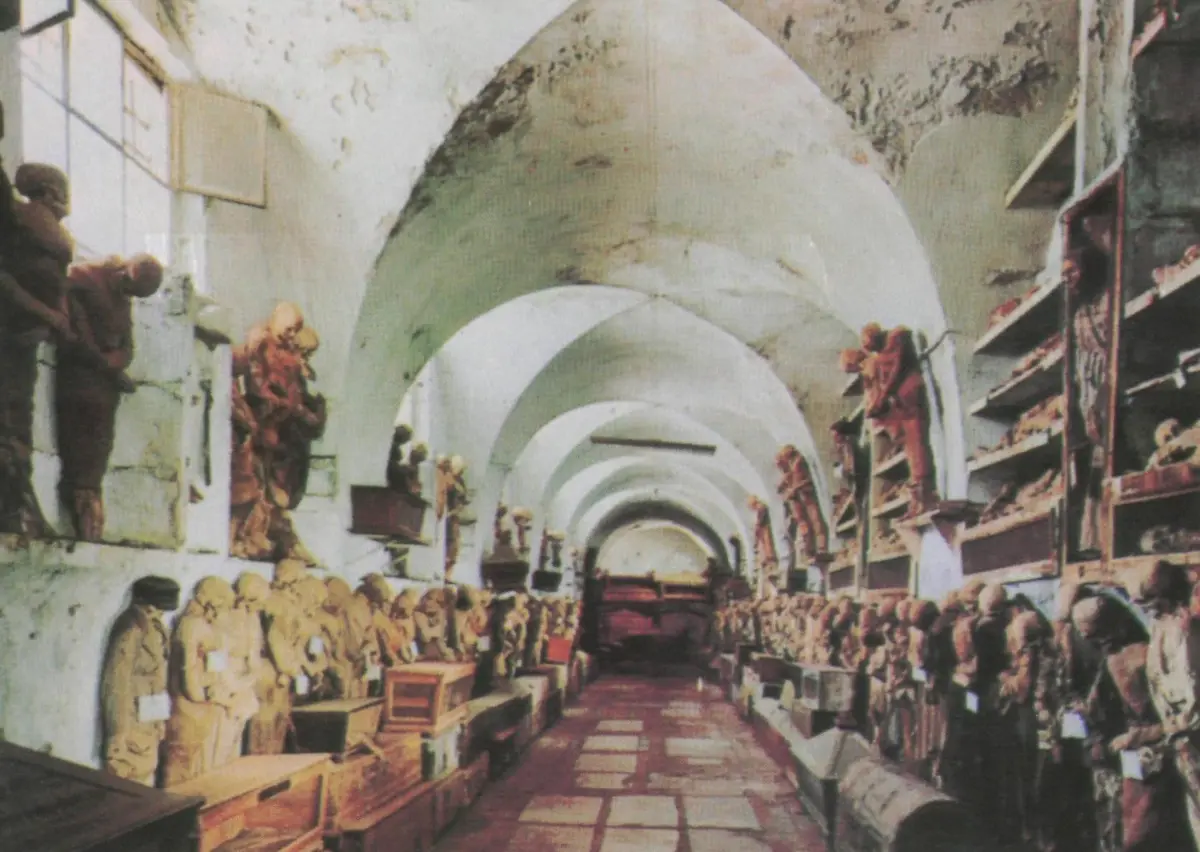
Beneath the Capuchin monastery in Palermo, Sicily, the Capuchin Catacombs display more than twelve hundred mummified bodies — the "eight thousand" figure that circulates online confuses those buried over the centuries with those on display today.
Where is Catacombe dei Cappuccini?
- Location
- Sicily, Italy
- Type
- Cemetery
- Coordinates
- 38.112, 13.341
- Last updated
LOCATION
Why is Catacombe dei Cappuccini said to be haunted?
The tradition did not begin from a wish to preserve anyone: emptying the old pit in 1599, the friars found forty-five incorrupt bodies, and the first body deposited in the new cemetery was Brother Silvestro da Gubbio. Wealthy Palermitans followed, paying to be there. Most are natural mummifications — desiccation, vinegar, straw packing — not embalmings. The cemetery closed in 1880 and admitted only two further bodies by exception; the last is Rosalia Lombardo, who died on 6 December 1920 before her second birthday and whose astonishing preservation earned her the name "Sleeping Beauty". A formula by the embalmer Alfredo Salafia is credited for it, but the matter is still disputed in peer-reviewed journals: no writing by Salafia says he embalmed her, and no sample has ever been taken that would confirm it.
What is the history of Catacombe dei Cappuccini?
The Capuchin Catacombs of Palermo are not a haunted house. They are a cemetery that never closed its doors to the public, and the single most useful thing to know before going down the stairs is that almost everyone standing in those corridors is somebody's relative, placed there on purpose, by name, with the family's consent and at the family's expense.
The friars arrived at the church of Santa Maria della Pace in 1534 and buried their dead in a common pit that opened like a cistern beneath the altar of Sant'Anna, lowering the bodies wrapped in a sheet. By 1597 the pit was full, and they began digging a larger cemetery behind the high altar, in the soft tuff under the convent. Two years later it was ready. When they moved the remains of their brothers from the old pit to the new one, they found that forty-five bodies had not decayed. The friars read this as a sign of divine favour and, instead of reburying them, stood them upright in niches along the walls of the first corridor. The scientific literature treats that exhumation as the founding event of the whole tradition. The catacombs' own visitor material adds a detail worth having: the first body deliberately laid in the new cemetery was that of Fra Silvestro da Gubbio, still on display with a placard recording the date, 16 October 1599.
What happened next was not embalming. It was drying, industrialised. A body was carried to a colatoio, a draining room, laid out on terracotta piping so the fluids ran off, and the room was sealed for roughly a year. The corpse came out desiccated, was taken into the open air, washed with vinegar, dressed in its best clothes, and — in many cases — packed with straw and tow to hold its shape. Skin turned the colour and texture of leather. In epidemic years the friars added baths of lime, and the catacombs' own guide credits an arsenic bath for the startling red-faced mummy of Antonio Prestigiacomo. Only a minority of bodies were treated anthropogenically, with evisceration or chemical injection.
The private cemetery of an order of friars became something else entirely once the friars began accepting laymen. From 1783 anyone who could pay for the treatment could be admitted, and the place turned into a directory of Palermo society sorted by category: a corridor for the Capuchins in their habits, one for priests in their vestments, one for professionals — doctors, lawyers, painters, officers — one for men, one for women in their embroidered dresses and lace caps, a chapel for virgins, a chapel for children, and a corridor grouping whole families. The point was not display. It was access. Under the nineteenth-century cult of the anime del purgatorio, preserving the dead kept their social identity alive and turned them into protective entities; relatives came down to visit them, to talk to them, to ask for health and luck.
The scale of that habit is easy to underestimate. Death registers held in the library of the Capuchin convent, examined by the Capuchin Catacombs Children Project, record roughly 9,300 non-adults buried in the catacombs between 1819 and 1856 alone — a figure inflated by the cholera epidemics that killed over 24,000 people in Palermo between 1826 and 1849. Of that vast number, the researchers calculate that around 1.7 per cent of that slice of Palermo's young dead is what remains in the crypt today. Children were revered as angioletti, little angels, mediators between the living and the afterlife; but the study found that what decided whether a child was mummified was not age, health or piety. It was the family's money.
Outsiders found the whole thing unbearable. Guy de Maupassant described the visit in La Vie errante (1890): a photograph of the place on sale in the street, and a Palermitan telling him, when he asked what it was, not to go and see that horror, that it was a savage thing which would fortunately soon disappear. He went. He recorded the placards hung round the necks with names and dates — 1880, 1881, 1882 — the glass coffins of the children with a photograph of the living child hung beside the corpse, the poor bundled in black cloth under an air vent, the priests in gold vestments with their birettas slipping over their noses, which he called the carnival of death. He also recorded the two things a modern guidebook leaves out: that families paid an annual fee to keep a relative on the wall, and that if they stopped paying the body was simply buried in the ordinary way; and that heads occasionally dropped to the floor because mice had gnawed through the neck.
The cemetery closed in 1880. Two bodies were admitted afterwards by exception: Giovanni Paterniti, deputy and vice-consul of the United States, who died on 1 May 1911, and, in December 1920, a child not quite two years old named Rosalia Lombardo.
Timeline: the documented record of Catacombe dei Cappuccini
- 1534 The Capuchin friars settle in Palermo at the church of Santa Maria della Pace and bury their dead in a common pit opening like a cistern beneath the altar of Sant'Anna, according to the catacombs' own visitor site.
- 1597 The pit is full and the friars begin excavating a larger cemetery in the tuff behind the high altar. Two years later it is ready.
- 1599 Moving their brothers' remains to the new cemetery, the friars find forty-five bodies naturally mummified and read it as a sign from God, standing them in niches instead of reburying them. The first bodies are placed in the catacombs this year; the visitor site names Fra Silvestro da Gubbio, dated 16 October 1599.
- 1783 The friars open the cemetery to anyone who can pay for the treatment, and the private crypt of an order becomes a directory of Palermo society sorted into corridors by sex, profession and status. Non-adults are placed there from 1787.
- 1826-1849 Cholera epidemics kill over 24,000 people in Palermo. The convent's death registers for 1819-1856 record roughly 9,300 non-adult burials in the catacombs; researchers calculate that only about 1.7 per cent of that group is represented in the crypt today.
- 1880 The cemetery closes to new burials. Around this date Guy de Maupassant visits and describes the place in La Vie errante (1890), recording the name-and-date placards hung from the necks, the annual fee families paid to keep a relative on display, the glass coffins of the children with photographs of the living child beside them, and heads dropping to the floor because mice had gnawed through the neck.
- 1911 Giovanni Paterniti, deputy and vice-consul of the United States, dies on 1 May and is admitted to the closed cemetery by exception, embalmed by Alfredo Salafia. On 16 November of the same year Salafia's company files the trademark of the Perfection Fluid in New York, without disclosing the formula.
- 6 December 1920 Rosalia Lombardo dies in Palermo shortly before her second birthday and becomes one of the last people admitted to the catacombs. The cause is variously reported as bronchopneumonia, pneumonia, influenza or diphtheria; no molecular test has ever been performed.
- c. 1927-1933 Alfredo Salafia writes, and leaves unpublished, the Palermo manuscript Nuovo metodo speciale per la conservazione del cadavere umano intero allo stato permanentemente fresco. He dies in 1933.
- February 2007 Di Cristina, Gaziano and Magrì describe the existence and content of Salafia's handwritten memoir in the book La Dimora delle Anime — two years before the rediscovery was announced, a priority the critical team later insists on. The Sicily Mummy Project also begins in 2007.
- 2009 Piombino-Mascali, Aufderheide, Johnson-Williams and Zink publish 'The Salafia method rediscovered' in Virchows Archiv, citing the unpublished Palermo manuscript. The published formula is glycerin, formalin saturated with zinc sulphate and chloride, and an alcohol solution saturated with salicylic acid.
- 2013 Two studies land in the same year. A whole-body CT of Rosalia, performed in December 2010 inside her sealed glass-topped coffin with only her head visible above a sheet, finds her internal organs remarkably preserved. And a microbiological survey of the catacombs records fungal spore counts above 2,000 spores per cubic metre in some areas, classified as a potential health risk to visitors.
- 2019 A patented passive controlled-atmosphere display case, developed with Italy's national metrology institute, is built for Rosalia Lombardo. Photographs published by a critical research team show the first signs of oxidation on her face as early as February 2008.
- 2021-2023 The Capuchin Catacombs Children Project X-rays 43 non-adult mummies in situ, while a second research team publishes a series of papers disputing the attribution of Rosalia's embalming to Salafia and correcting a gallons-to-litres conversion error running through the English-language literature. Piombino-Mascali and Zink reply in 2023 defending the attribution and warning that further sampling would irreversibly damage the mummy.
- 2024 The 'angioletti' study is published in Frontiers in Medicine: at least 1,284 mummified and skeletonised bodies remain on display, 163 of them non-adults, and what decided whether a child was mummified was the family's wealth and standing, not age or health.
Is there a rational explanation for Catacombe dei Cappuccini?
There is very little to debunk here in the usual sense — nobody in the scientific literature claims the catacombs are haunted, and the friars have never sold them that way. What there is instead is a set of numbers and a famous story that almost every popular account, including our own earlier summary of this place, gets wrong.
The body count is inflated by a factor of six. The figure repeated everywhere, and previously repeated by us, is about 8,000. No source we could read supports it. The Capuchin Catacombs Children Project, which had exclusive access to the collection, states that at least 1,284 mummified and skeletonised bodies remain on display, of which 163 are non-adults. The 2013 microbiological survey of the site puts it at 'over eighteen hundred' bodies displayed along the corridors or stored in coffins. National Geographic's 2013 report on the Sicily Mummy Project says Rosalia Lombardo 'lies with 1,251 others'; A. A. Gill, writing for the same magazine in 2009, said 'approximately 2,000'. The real range is roughly 1,250 to 2,000 depending on whether you count coffined remains. Where the tens of thousands come from is not mysterious: the death registers for 1819 to 1856 alone list some 9,300 non-adult burials. Thousands were buried there. Around a thousand and a half are still standing there. Those are different sentences.
Most of these are not embalmed mummies. They are spontaneously desiccated bodies: dried in a sealed room, washed in vinegar, dressed. Chemical embalming at Palermo is the exception, not the rule.
And the most famous case is not a solved mystery. This is the part worth reading slowly, because it is an active dispute in peer-reviewed journals and both sides are published scientists.
The familiar version runs: Rosalia Lombardo was embalmed in 1920 by Alfredo Salafia, who died in 1933 taking his formula with him, until the anthropologist Dario Piombino-Mascali tracked down his heirs and found the recipe in a handwritten memoir. That memoir is real. It is cited in the 2009 note announcing the rediscovery, in Virchows Archiv, as Nuovo metodo speciale per la conservazione del cadavere umano intero allo stato permanentemente fresco, an unpublished manuscript written in Palermo around 1927-1933, and the formula published from it is glycerin, formalin saturated with zinc sulphate and zinc chloride, and an alcohol solution saturated with salicylic acid.
Since 2021 a second team — Raffaella Bianucci, Francesco Galassi, Andreas Nerlich, Luca Sineo and colleagues, working as the Human Embalming Project — has published a series of papers challenging almost every link in that chain. Their objections, from the 2022 paper in the Italian Journal of Anatomy and Embryology, are specific and checkable: the memoir's existence and contents had already been described in February 2007, two years before the announcement, in the book La Dimora delle Anime by Di Cristina, Gaziano and Magrì; only extracts of it have ever been published; no independent full-length review of the manuscript exists; no written statement by Salafia saying he embalmed Rosalia has ever been produced; no biopsy, swab or toxicological sample has ever been taken from her body, dress or coffin, so there is no chemical evidence that the Perfection Fluid was what preserved her; and no experimental reproduction of the fluid has yet succeeded. They also point out that a Polish Egyptologist, Andrzej Niwiński, had described a liquid-wax injection in Rosalia's embalming in a paper published in 1981, thirty years earlier, after reading it on a leaflet from the catacombs themselves.
In a 2023 follow-up the same team demonstrated a plain arithmetical error running through the English-language literature on Salafia: the figure of 15 US gallons — 57 litres — injected into a single corpse. Read the Italian excerpt of the memoir carefully, they argue, and Salafia specifies at least seven litres, that is 1.85 gallons. Fifty-seven litres pumped into a 59-kilo body with no blood drainage would have bloated it and wrecked the vascular system.
Piombino-Mascali and Albert Zink replied in Anthropologischer Anzeiger the same year, arguing that the attribution to Salafia rests on a book, two unpublished documents, familial memory and the tradition of the Capuchin Brotherhood, plus indirect evidence consistent with the memoir — and that the additional sampling their critics want would irreversibly damage the mummy's long-term conservation. That is where it stands. The honest summary is not 'the mystery was solved in 2009'. It is: a formula was recovered and published, it is very probably the one used, and it has never been chemically confirmed on Rosalia herself.
Her cause of death is equally soft. The 2013 CT paper says she 'reportedly died of bronchopneumonia'; the press repeats pneumonia; her own relatives, according to the critical team, spoke of influenza or diphtheria. No molecular test has been done. She was also not quite two: she died on 6 December 1920, shortly before her second birthday.
On the video where she opens her eyes. We could not find that explanation in any source we were able to read, so we will not attribute it to anyone. What we can document is this. A. A. Gill, looking at her for National Geographic in 2009, wrote that 'her eyes are closed, the eyelashes perfectly preserved'. The 2013 CT study was performed with her inside her sealed original glass-topped coffin, with only her head visible above a sheet, and reports no movement of any kind. Since 2019 she has been inside a patented passive controlled-atmosphere display case built specifically for her. A child under two panes of glass, photographed from different angles in changing light by millions of phones, will produce frames that differ. The child does not.
What is genuinely changing is the decay. The critical team published photographs showing the first signs of oxidation on Rosalia's face by February 2008, and argue the process has continued rapidly despite the new case. The body of Salafia's own brother, Ernesto Salafia Maggio, embalmed by him in 1914 and kept in the same crypt, lost the glass top of its coffin at some point before 2008; it was never replaced, water and insects got in, and the lower body has half skeletonised. And the 'oppressive stillness' visitors report in the deeper corridors has a measurable component: the 2013 survey found fungal spore counts exceeding 2,000 spores per cubic metre in some areas, a level its authors classify as a potential health risk to visitors, along with halophilic bacteria colonising the walls and heavy mould on the mummies themselves. Maupassant, in 1890, blamed the mice. He was not wrong either.
Can you visit Catacombe dei Cappuccini?
The catacombs are at Piazza Cappuccini 1, 90129 Palermo, under the Capuchin convent attached to the church of Santa Maria della Pace. The telephone number is +39 091 652 7389 and the square doubles as a car park. Buses 109 and 318 run from Palermo Centrale to Piazza Indipendenza; from there it is bus 327 or a walk of fifteen minutes up via Cappuccini, turning right at the first junction into via Pindemonte. The nearest metro stop is Palazzo Reale-Orleans, on the far side of Piazza Indipendenza.
The site that the Palermo city tourism portal names as the official one, catacombefraticappuccini.com, gave the opening on 10 September 2026 as Monday to Sunday, 9:00 to 17:30 with last entry at 17:10, and described that as continuous summer hours. On the same site admission is 5 euros full and 3 euros reduced. Payment is taken only at the ticket office and online sales are described there as unauthorised; groups book through the same telephone number or through [email protected]. The older site catacombepalermo.it, which is the one cited in this file, still gave a split day on 10 September 2026: Monday to Sunday, 09:00 to 12:30 with last entry at 12:10 and 15:00 to 17:30 with last entry at 17:10, at the same two prices. The city portal gave "Tutti i giorni 9:00 – 17:30" and 5 euros on the same date.
Photography and filming are forbidden, and so is touching anything. The site gives two reasons: conservation of the mummies and compliance with bioethical requirements. The team that studies these remains published its ethical framework in the American Journal of Biological Anthropology [9]: Italian law treats the mummies as res extra commercium, things outside commerce; the child mummies in the recent X-ray project were anonymised behind code numbers so that individual children could not be identified in published images; and the authors argue for narratives "anchored in authenticity" against sensationalism. Rosalia Lombardo is the deliberate exception to that anonymity. Her name is already public, and the attention she draws paid for her climate-controlled case [10].
Rosalia lies at the end of the first corridor, in the chapel of Santa Rosalia, between two other children's coffins. Her head and hair are visible; the rest is under a sheet, and has been throughout the scientific work on her.
The crypt is sealed underground and has a documented indoor air problem. The 2013 microbiological survey found fungal spore concentrations above 2,000 spores per cubic metre in some areas, a level its authors say must be classified as a potential health risk to visitors, and it recorded that the Italian standards for controlling indoor climate in heritage spaces had not been applied there [2]. The figure matters for anyone with asthma or a serious mould allergy; it matters too in immunosuppression and in pregnancy. It is cool and damp down there in every season.
This is consecrated ground attached to a working religious house. For a long time the people on the walls had families who came down to talk to them, and every one of them either chose the place or had it chosen by someone who could pay for it.
Sources consulted
- Kirsty Squires, Mark Viner, Wendy Hoban, Robert Loynes, Katherine van Schaik, Dario Piombino-Mascali, «The 'angioletti' of Palermo: the health and development of mummified non-adults in late modern Palermo, Sicily (1787-1880 CE)» — Frontiers in Medicine 11: 1443291, 2024 academic
- Guadalupe Piñar, Dario Piombino-Mascali, Frank Maixner, Albert R. Zink, Katja Sterflinger, «Microbial survey of the mummies from the Capuchin Catacombs of Palermo, Italy: biodeterioration risk and contamination of the indoor air» — FEMS Microbiology Ecology 86(2): 341-356, 2013 academic
- Guy de Maupassant, «La Vie errante, chapter 'La Sicile', pp. 66-73 (Paris: Paul Ollendorff; edition consulted 1899)» — Paul Ollendorff, Paris, 1890 book
- Dario Piombino-Mascali, Arthur C. Aufderheide, Melissa Johnson-Williams, Albert R. Zink, «The Salafia method rediscovered (citing Salafia's unpublished Palermo manuscript 'Nuovo metodo speciale per la conservazione del cadavere umano intero allo stato permanentemente fresco', c. 1927-1933)» — Virchows Archiv 454(3): 355-357, 2009 academic
- Stephanie Panzer, Heather Gill-Frerking, Wilfried Rosendahl, Albert R. Zink, Dario Piombino-Mascali, «Multidetector CT investigation of the mummy of Rosalia Lombardo (1918-1920)» — Annals of Anatomy 195(5): 401-408, 2013 academic
- Raffaella Bianucci, Francesco M. Galassi, Tiziana Lanza, Grazia Mattutino, Andreas G. Nerlich, «What lies behind the embalmed body of Rosalia Lombardo (1918-1920)?» — Italian Journal of Anatomy and Embryology 126(1): 5-13, 2022 academic
- Raffaella Bianucci, Simon T. Donell, Francesco M. Galassi, Tiziana Lanza, Grazia Mattutino, Andreas G. Nerlich, Luca Sineo, «The Salafia embalming formula: do it well or don't do it at all» — Italian Journal of Anatomy and Embryology 127(1): 7-11, 2023 academic
- Dario Piombino-Mascali, Albert R. Zink, «Alfredo Salafia's handwritten memoir and the embalming of Rosalia Lombardo: a commentary» — Anthropologischer Anzeiger 80(1): 113-118, 2023 academic
- Dario Piombino-Mascali, Kirsty Squires, Albert R. Zink, «Ethical challenges in the bioanthropological and biomedical investigation of Sicilian mummies - past experience and future pathways» — American Journal of Biological Anthropology 186(1): e24946, 2025 academic
- Marco Samadelli, Albert R. Zink, Graziella Roselli, Serena Gabrielli, Shahin Tabandeh, Vito Fernicola, «Development of passive controlled atmosphere display cases for the conservation of cultural assets (the case built for the mummy of Rosalia Lombardo, Palermo)» — Journal of Cultural Heritage, 2019 academic
- A. A. Gill, «Where the Dead Don't Sleep (National Geographic magazine, February 2009 issue)» — National Geographic, 2009 web
- Jeremy Berlin, «Sicilian Mummies Bring Centuries to Life (30 January 2013)» — National Geographic, 2013 web
- Nicoletta Lanese, «Child mummies in Sicily's Capuchin Catacombs to be X-rayed (5 January 2022)» — Live Science, 2022 web
- Yuliya Talmazan, «Sicily's child mummies are a mystery. Scientists want to learn their stories. (5 January 2022)» — NBC News, 2022 web
- Catacombe dei Cappuccini di Palermo, «Catacombe dei Cappuccini di Palermo - visitor site: origins, history, mummification techniques, corridors, opening hours, admission, rules and access (consulted July 2026)» — catacombepalermo.it / palermocatacombs.com, 2026 web
Reviewed by V. Serrano on 2026-07-31 · How we verify our content
💬 Field testimonies (0)
No testimonies yet. Add the first.
Add your testimony
🔒 Log in to add a testimony